
Lede
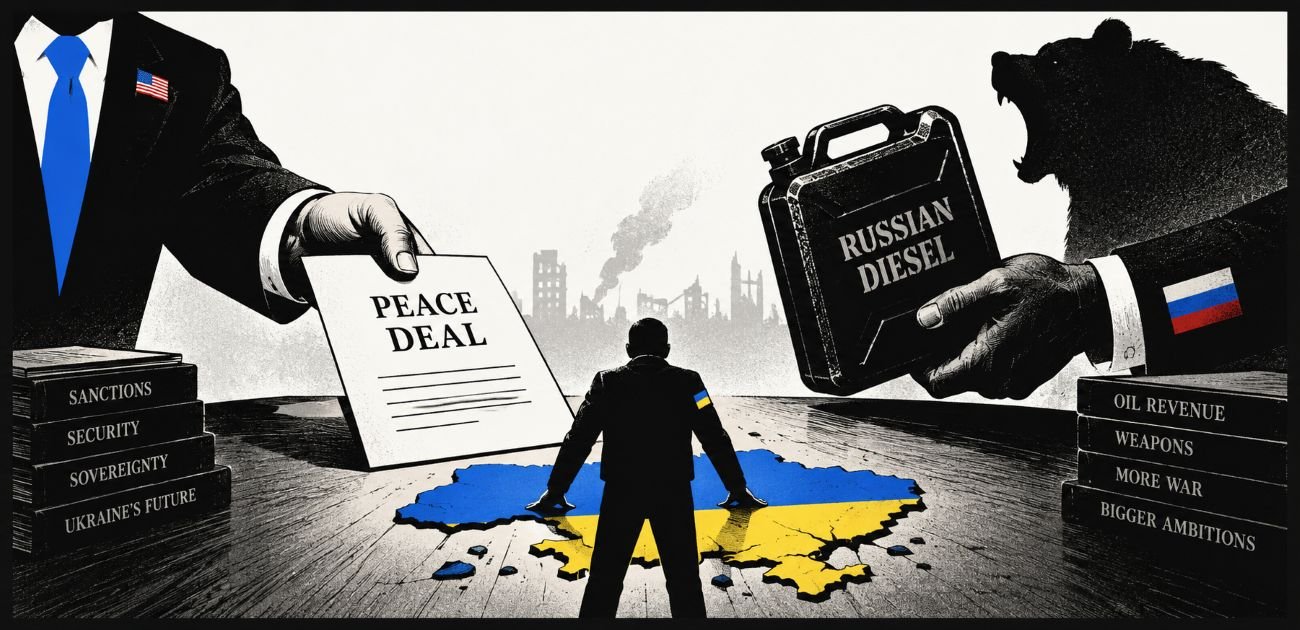
Russia invades Ukraine, Ukraine refuses to surrender, and Trump once again decides that the country defending itself is the obstacle to peace.
Hermit Off Script
Ukraine again. Trump again. And somehow the country being invaded is still the one expected to apologise for refusing to disappear. I watch Trump’s latest manoeuvres around Putin and see the same admiration for men who treat laws, borders and weaker neighbours as inconveniences. His diesel deal with Russia, followed by demands for Ukraine to change its president, looks less like impartial mediation and more like helping the bully sell the stolen furniture. That is my judgement, not proof of secret collusion. Trump has money, office and an appetite for acting like a king; American voters, Congress and the courts are supposed to stop any president confusing a republic with his private estate. Without those restraints, I dread where that appetite could lead. Then I watched Piers Morgan interview Zelenskyy on 14 October 2026, followed by a Trump supporter calling him “delusional” for persisting. Delusional? Putin’s forces seized Crimea in 2014 against limited armed resistance, then attacked across Ukraine in 2022 and failed to take Kyiv. The quick conquest did not happen. I sometimes wonder whether Putin, had he foreseen years of Ukrainian resistance, would have attempted a bigger grab back in 2014. That’s speculation, but his failed expectation of an easy victory is hard to ignore. Apparently the sensible response to invasion is to thank the invader, because without America Russia must inevitably win. US support matters enormously, but Ukrainians are not imaginary soldiers and Europe is not an empty warehouse. In a human sense Ukraine cannot win back the lives already lost or erase the suffering. Yet that makes defending what remains more necessary, not less. Russian propaganda sells surrender as realism, then waves nuclear threats when polite lies fail. What happened to the assurances made when Ukraine gave up nuclear weapons? What happened to the agreements supposed to protect its territory? They did not make invasion impossible. I fear that if Kyiv had fallen, Moscow might have gained forces, equipment and confidence to threaten more of Europe; whether a bigger war would actually have followed is impossible to know. And I wonder whether Washington would have done anything meaningful to stop it. I remember what surrender to aggressive powers would have meant in the Second World War. That history does not make every war identical, but it should cure the habit of calling defence a mental illness.
My harder question is why Ukraine and Europe have not reduced their dependence on American-controlled military communications faster. And now Elon Musk has made things rather interesting. On 14 October 2026, he said Starshield systems were owned and controlled by the US government, with restrictions decided by the military and ultimately POTUS. So when I say Trump has the switch, apparently I’m not imagining things. According to Musk, the chain of authority leads straight to the American President. Does that prove Trump personally ordered the latest restrictions? No. But when Ukraine’s drone operations suddenly face serious communications restrictions while Trump is pressuring Zelenskyy over attacks on Russian oil facilities, I think asking who made that decision is perfectly reasonable. Ukraine has backup communication systems, but they cannot yet replace everything. Why is one external switch allowed to endanger the people under fire? And why should the survival of a country fighting an invasion depend on decisions made thousands of miles away by a government whose commitment changes with its president’s mood? Europe should have been working much harder to eliminate that dependency.
Meanwhile, Russian aircraft have violated NATO airspace, and drones have struck ships near Bulgaria, even as responsibility for those maritime attacks remains under investigation. So what exactly is the peace plan beyond hoping the next warning is only a warning? Two bullies can call surrender peace. A country fighting to remain a country has another word for it: survival.
P.S. Here’s another uncomfortable thought. With the American midterm elections approaching, I can’t help wondering whether Trump’s sudden enthusiasm for accommodating Putin has something to do with more than oil, refineries and diplomatic theatre. Ukraine has also been hitting Russian data centres, disrupting digital infrastructure. And Russia’s history of using social media manipulation, bots and disinformation to influence American politics is hardly imaginary. Now, some people are suggesting that these attacks have also disrupted Russian political bot networks. That particular claim remains unproven, and I certainly have no evidence that Trump is colluding with Putin or that these attacks are influencing his decisions. But here’s what makes me curious: Reuters has now reported discussions between Washington and Moscow about joint data centre projects. So perhaps the more interesting question is whether Ukraine’s attacks on Russia’s digital infrastructure are becoming politically inconvenient for people far beyond Moscow. Maybe it’s coincidence. Maybe it’s economics. Or maybe there’s something worth investigating beneath all that sudden concern for peace. I’d rather ask an uncomfortable question than pretend an uncomfortable coincidence doesn’t exist.
Piers Morgan sits down for an exclusive, in-person interview with President Volodymyr Zelensky in his London studios.
What does not make sense
- The victim becomes the problem. Trump demanded that Zelenskyy be replaced on 10 October 2026 while Russian attacks continued killing Ukrainian civilians. The man resisting the invasion gets a lecture about leadership. The man conducting it gets a diesel agreement.
- A peace deal that rewards the aggressor. Sanctions are supposed to reduce Russia’s ability to finance its military. A new agreement allowing Russian diesel exports risks providing more revenue to the same war economy. Apparently economic principles have an exception for expensive American fuel.
- Resistance becomes delusion. In the discussion following Piers Morgan’s interview, commentator Jim Hanson called Zelenskyy “delusional”. What counts as realism here? Accepting that a powerful neighbour is entitled to your territory because resisting him is inconvenient?
- History starts whenever the argument requires. The war did not begin with Zelenskyy’s refusal to accept Trump’s latest demands. Russia invaded Crimea in 2014 and launched its full-scale invasion in February 2022. That sequence matters, particularly when someone tries to sell a 24-hour peace plan as though the obstacle were Ukrainian stubbornness.
- Broken promises become another invitation to negotiate. The 1994 Budapest Memorandum included assurances concerning Ukraine’s sovereignty and borders. It was not a NATO-style military defence guarantee, but Russia still broke its commitments. The country that disregarded the agreement is again expected to honour a new one.
- The switch has an address. Elon Musk says Starshield restrictions are controlled by the US military, with ultimate authority resting with the President. Yet nobody has publicly established who authorised the specific restrictions affecting Ukraine. Apparently identifying who owns the switch is easier than finding out who used it. Meanwhile, Ukrainian soldiers must deal with the consequences.
- Dictators become entertainment for comfortable democracies. Strongman politics makes excellent television until the men with nuclear weapons decide to demonstrate their strength outside the studio.
- Nuclear threats are treated as reasonable arguments. Moscow invokes nuclear escalation when it wants to discourage Western intervention. If threatening catastrophe automatically wins concessions, the next authoritarian government learns exactly which weapons to acquire.
- Peace is confused with helplessness. Ukraine does not need to become undefeatable before negotiations can work. It needs a settlement that can be enforced, military means to deter another invasion, and security commitments that survive the next political mood swing.
Sense check / The numbers
- 1994, 2014 and 2022: Three dates that destroy the false starting point. Russia signed the Budapest Memorandum in 1994, committed itself to respect Ukraine’s sovereignty and borders, seized Crimea in 2014, and began a full-scale invasion on 24 February 2022. The UK Government has explicitly identified Russia as the aggressor. These dates establish responsibility for the invasion; they do not settle every question about how the war should end. [UK FCDO; UK Parliament]
- More than 300,000 tonnes of Russian diesel. On 9 October 2026, Trump announced an agreement under which Russia would immediately supply more than 300,000 tonnes of diesel, with further shipments proposed. On 10 October, he blamed Zelenskyy for American diesel prices and suggested Ukraine needed a different president. The agreement was announced; whether all the proposed deliveries materialise is a separate question. [AP; Reuters]
- 372 civilians killed and 2,349 injured in one month. UN monitors verified these casualties in Ukraine during August 2026. They recorded 2,222 civilian deaths and 13,058 injuries across the first eight months of the year. Those are verified minimums, not the complete human cost. Fighting back has been expensive. Submission, however, carries risks of its own. [OHCHR]
- 160 km/h and one very powerful chain of command. On 14 October 2026, Ukrainian officials reported that satellite connectivity restrictions had disrupted drone missions. Service was partially restored, but the 160 km/h speed ceiling remained a problem for some operations. Elon Musk stated that Starshield systems are controlled by the US government, with restrictions decided by the military and ultimately POTUS. That identifies the stated chain of authority, not who ordered the specific interruption. The distinction matters, particularly because commercial Starlink is controlled separately by SpaceX. [Reuters; AFP; Axios]
- Three Russian aircraft, more than 10 minutes inside NATO airspace. NATO reported that three armed Russian MiG-31 aircraft violated Estonian airspace on 19 September 2025. More recently, a drone attack on 13 October 2026 sank a commercial vessel off Bulgaria, leaving 11 sailors missing. Responsibility for that maritime attack has not been conclusively established, and the ship was not a NATO warship. These incidents illustrate serious regional security risks without proving that a direct Russia-NATO war is inevitable. [NATO; Reuters]
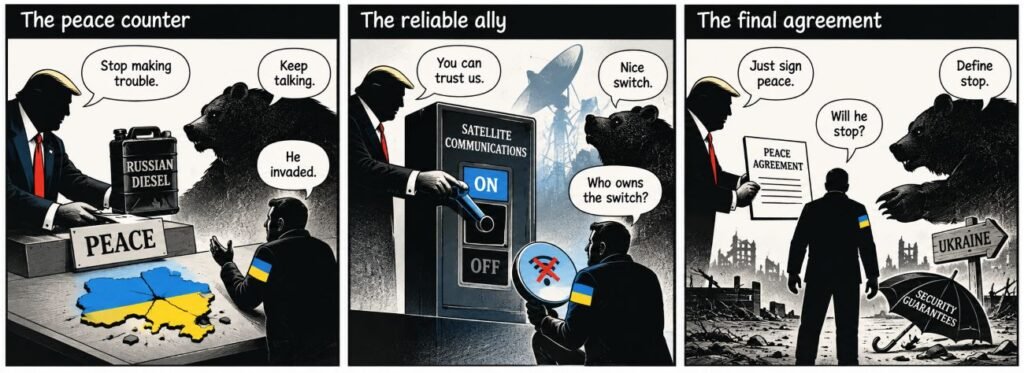
The sketch
Scene 1: The peace counter
A powerful suited silhouette stands behind a desk marked PEACE, offering a fuel canister to a large bear. A smaller figure holds a damaged map of Ukraine.
Dialogue:
Dealmaker: “Stop making trouble.”
Defender: “He invaded.”
Bear: “Keep talking.”
Scene 2: The reliable ally
The same suited figure stands beside an enormous communications switch. The smaller defender holds a disconnected satellite terminal while the bear watches from behind.
Dialogue:
Dealmaker: “You can trust us.”
Defender: “Who owns the switch?”
Bear: “Nice switch.”
Scene 3: The final agreement
The smaller defender stands between an enormous bear reaching across a border and a suited figure holding a peace document. A broken umbrella lies on the floor.
Dialogue:
Dealmaker: “Just sign peace.”
Defender: “Will he stop?”
Bear: “Define stop.”
What to watch, not the show
- American political incentives. Trump wants lower diesel prices and a foreign-policy agreement he can present as a success. Watch whether that ambition produces actual Russian concessions or simply pressures Ukraine.
- Russian oil revenue. Track the announced diesel shipments, sanctions exemptions and financial benefits to Moscow. A deal that strengthens the Russian state’s capacity to continue fighting deserves more scrutiny than a press conference about peace.
- Who controls Ukraine’s communications? Establish who authorised the October restrictions, whether military Starshield and commercial Starlink were affected by separate decisions, and what contractual safeguards Ukraine possesses. Accelerate genuinely independent European alternatives. A critical military communications system should not depend on political goodwill or an unexplained change in service conditions.
- US intelligence sharing. Distinguish threats, reported gaps in early warning and confirmed interruptions. A missed warning does not automatically prove that all intelligence-sharing agreements have ended.
- European defence independence. Europe needs one voice on defence, but it also needs dependable equipment, joint procurement, satellite capability, air defence and decisions made quickly enough to matter.
- Russian pressure on NATO. Airspace violations, sabotage allegations and attacks near NATO territory must be investigated carefully. Particular attention belongs to whether incidents are attributable to Russia, whether they are deliberate, and whether NATO responses deter repetition.
- Nuclear coercion. Russia’s September 2026 warning over Kaliningrad demonstrates how nuclear threats can be used to raise the perceived cost of European resistance. Watch the threats alongside actual military movements, rather than treating rhetoric as either harmless or proof of imminent nuclear war.
- Credible peace guarantees. Any negotiated settlement needs clear enforcement, monitoring, deterrence and consequences for renewed aggression. Another signature without the ability to respond to violations offers little reassurance.
The Hermit take
A peace agreement that depends on the invader’s goodwill is a dangerous gamble.
Calling resistance delusional is how surrender gets a press pass.
Keep or toss
Toss
Keep negotiations that can genuinely stop the killing, protect civilians and provide enforceable security guarantees.
Toss the demand that Ukraine accept permanent vulnerability while Russia receives economic rewards and another opportunity to prepare.
Sources
- Piers Morgan Uncensored, Zelenskyy interview and subsequent discussion, 14 October 2026: https://youtu.be/2KrGqdxy_Ag
- Reuters, Zelenskyy discusses Trump and American support, 14 October 2026: https://www.reuters.com/world/us/ukraines-zelenskiy-says-it-is-painful-trump-choose-different-side-2026-10-14/
- Associated Press, Trump’s criticism of Zelenskyy and Russian diesel agreement: https://apnews.com/article/russia-ukraine-war-trump-putin-diesel-228ccf74b2848c1ff0ac23f038b37512
- UK Foreign Office, the facts of Russia’s war against Ukraine, 1 October 2026: https://www.gov.uk/government/speeches/the-facts-of-russias-war-against-ukraine-uk-statement-to-the-osce
- UK Government, Budapest Memorandum commitments: https://www.gov.uk/government/news/joint-statement-by-foreign-ministers-of-uk-us-and-ukraine-on-budapest-memorandum
- UN Human Rights Monitoring Mission, civilian casualties during 2026: https://ukraine.ohchr.org/en/reports/protection-of-civilians
- Reuters, Starshield restrictions affecting Ukrainian military operations: https://www.reuters.com/world/europe/spacex-limits-starlink-operations-ukraine-disrupting-military-missions-2026-10-14/
- Reuters, European satellite and early-warning alternatives: https://www.internazionale.it/ultime-notizie-reuters/2026/10/14/as-ukraine-struggles-with-starlink-and-us-satellite-data-europe-has-no-quick-fix
- Interfax-Ukraine, military backup communications in use: https://en.interfax.com.ua/news/general/1220062-amp.html
- NATO, official statement on Russian airspace violations: https://www.nato.int/en/about-us/official-texts-and-resources/official-texts/2025/09/23/statement-by-the-north-atlantic-council-on-recent-airspace-violations-by-russia
- Reuters, drone attack on commercial shipping near Bulgaria: https://www.reuters.com/world/europe/drone-sinks-ship-off-bulgaria-coast-prime-minister-says-2026-10-13/
- Reuters, Russian nuclear warning over Kaliningrad: https://www.reuters.com/business/aerospace-defense/russia-issues-nuclear-warning-nato-tensions-rise-baltic-2026-09-30/
- AFP, Musk’s statement on Starshield authority, 15 October 2026: https://www.afp.com/en/musk-suggests-us-govt-behind-any-slowdown-ukraines-starshield-system
- Axios, Ukraine’s Starlink restrictions and disputed responsibility, 14 October 2026: https://www.axios.com/2026/10/14/ukraine-starlink-zelensky-spacex-musk-trump
- Reuters, US-Russia data centre discussions: https://www.reuters.com/world/dmitriev-says-russian-wealth-fund-will-work-with-us-payment-diesel-deal-2026-10-16/
- Microsoft, Russian election influence operations: https://www.microsoft.com/en-ie/security/security-insider/threat-landscape/russia-linked-operators-engaged-in-expansive-efforts-to-influence-us-voters
- The Guardian, evidence surrounding the Russian bot claims: https://www.theguardian.com/world/2026/oct/13/ukrainian-strikes-russian-datacentres-online-disinformation-bots
- Lawfare, assessment of the data centre theory: https://www.lawfaremedia.org/article/the-russian-bots-went-silent.-or-did-they
Disclaimer: This article is political satire and commentary based on publicly reported information. The author’s interpretations, historical comparisons and hypothetical outcomes are opinion, not established evidence of personal motives, secret agreements or future events.
Leave a Reply