Lede
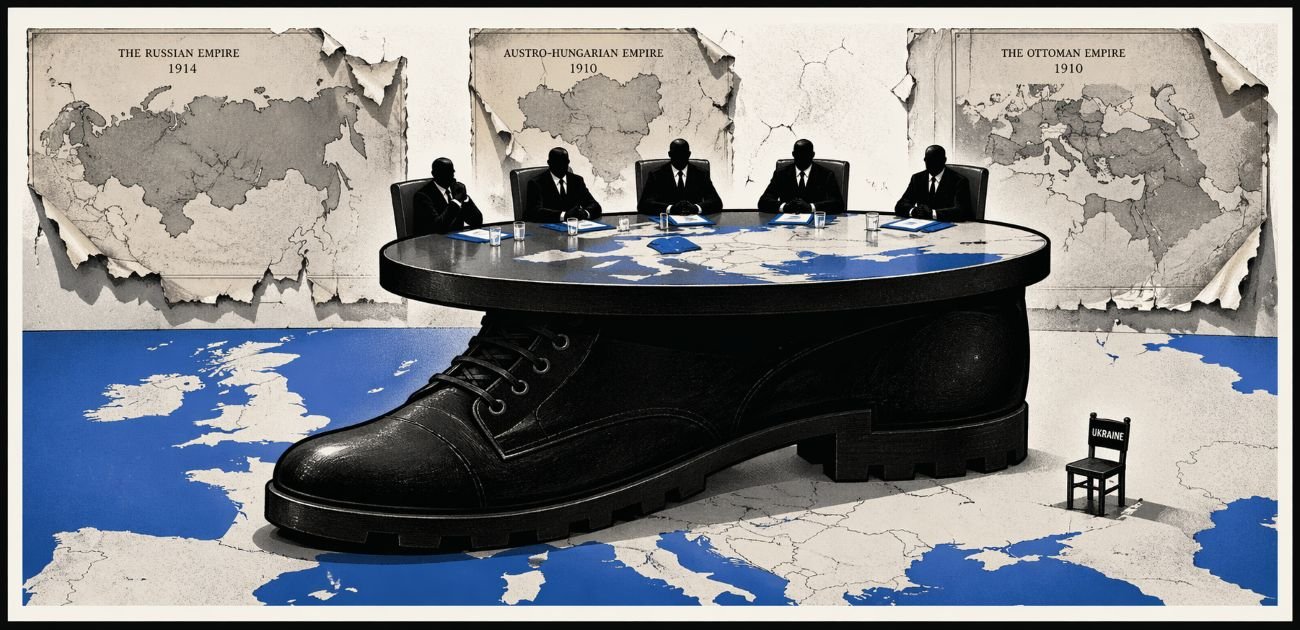
The problem is not diplomacy; the problem is when diplomacy becomes a polite word for asking Ukraine to negotiate with the boot still on its throat.
Hermit Off Script
This whole address is about Europe needing its own foreign policy, and on that point, fine, I agree. Europe should stop behaving like a well-dressed assistant waiting outside Washington’s office for the next foreign policy memo. It needs its own spine, its own defence structure, its own technology, its own diplomacy, and enough seriousness not to confuse NATO invoices with destiny. But the moment this argument turns into “talk nicely to Moscow because I have known Russian politicians for more than 30 years”, the alarm bells start ringing like a church tower during an earthquake. Knowing Russian leaders for decades is not a certificate of peace. It is not a guarantee of good faith. It may only mean you have watched the same imperial appetite put on different suits while Ukraine, Georgia, Moldova, Chechnya, and half of Eastern Europe kept checking the locks. Calling strongmen “good people to talk to” after those same political currents helped bring war, destruction, occupation, and fear back into Europe is not diplomacy. It is nostalgia wearing a university badge. Yes, moderation and talks should always be at the forefront before war. Of course. Only a fool worships conflict. But sometimes the country asking to be understood is the same country that started the fire, blamed the smoke, and then demanded respect for its security concerns while standing in someone else’s living room. You cannot negotiate normally with war lovers when their real demand is your silence, your submission, or your disappearance as a nation. It is either their way or no way. That is not peace. That is authoritarianism speaking softly so the microphone does not catch the threat. And Europe must be honest here. All countries should have done more earlier to weaken Russia’s ability to sustain this war, because if the excuse was not NATO, it would have been Europe. If it was not Europe, it would have been language. If it was not language, it would have been history, missiles, borders, culture, or some ghost from an empire with indigestion. Tyrants never run out of reasons. They only run out of resistance. The Finlandisation argument sounds clever until history itself coughs into the room. Finland was happy and successful, yes, but Finland joined NATO after Russia’s full-scale invasion of Ukraine because happiness is not a defence policy when the neighbour starts collecting countries like old coins. Neutrality can work when both sides respect borders. It becomes a prayer mat in a tank factory when one side believes former territories are still part of its existential future as a world power. That is why Russia under this fossilised authoritarian leadership cannot be treated like a normal neighbour having a bad diplomatic season. If Russia had democratic institutions strong enough to restrain power, then yes, real talks and peace would be far more possible. The United States has its own dangerous illness now, with wannabe strongmen banging on the walls of democracy and billionaires valuing freedom mainly when it protects their own money. But institutions still matter. Courts matter. Elections matter. Pressure matters. Russia’s system is not in that same place. It is built around the strongman, and politics there has become an arm for power, not a tool for peace. And these old leaders, these men who should have been pensioned off before their memories became foreign policy, keep dragging young people into old imperial fantasies. I would honestly argue that any politician older than 60 should be forced to pass a reality test before touching war, because age does not automatically bring wisdom. Sometimes it brings maps from 1972, a dry soul, and the confidence to call other people’s graves “geopolitical compromise”. The army retires people earlier because a life under orders takes its price. Politics should learn the same lesson before the joyless old guard keeps gambling with the future. So yes, talk to Moscow. Talk to anyone if it can stop death. But talk with leverage, not incense. Talk with Ukraine’s freedom at the centre, not as loose change on the negotiation table. Do not tell a victim to amputate territory so Europe can sleep better. Do not call surrender “realism” because it sounds cleaner in a conference room. And do not pretend empire becomes peaceful just because someone has had its phone number for 30 years. What would happen if the UK woke up tomorrow and decided all former territories should return to the fold? The world would call it madness before the kettle boiled. When Russia does it, some call it security concerns. That is the trick. Empire walks in wearing a diplomatic tie, and everyone is asked to admire the knot.
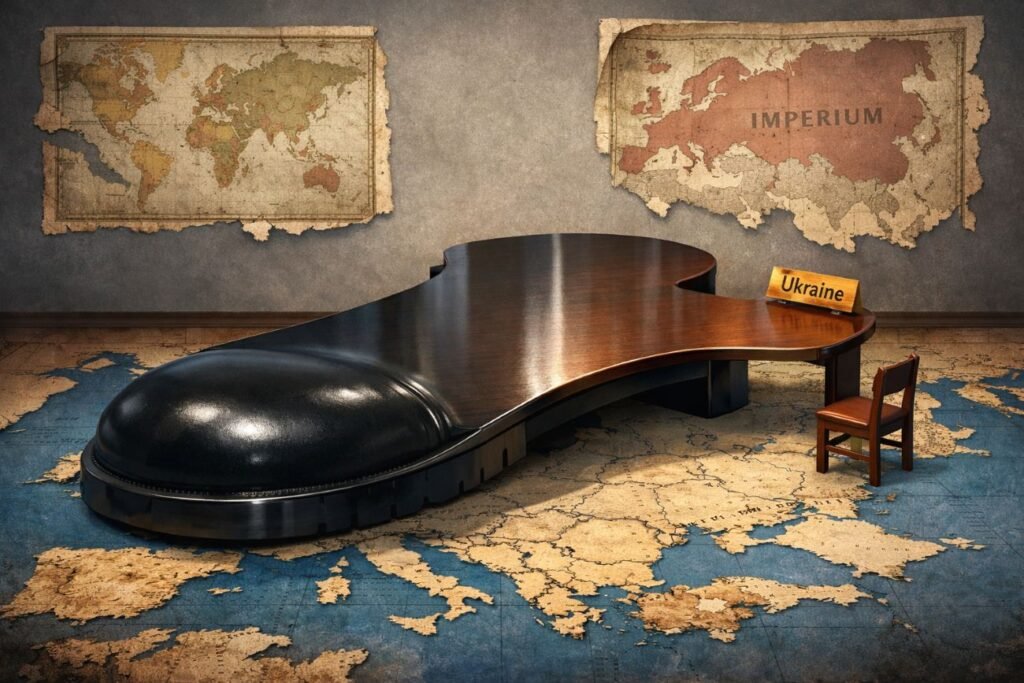
The contrast is brutal: Ukraine is asking to live; empire is asking to be understood.
LIVE | China-US War Over Hormuz? Jeffrey Sachs UNCOVERS Trump’s ‘SECRET’ Iran Plan
What does not make sense
- Saying Europe needs independence from Washington makes sense. Turning that into softness towards Moscow does not.
- If one country invades another, the peace table cannot start by asking the victim what it is willing to amputate.
- “Understanding Russia’s concerns” cannot become a magic spell that makes Ukraine’s concerns disappear.
- Finlandisation is a poor model after Finland itself joined NATO in 2023.
- A European foreign policy that ignores Russia’s pattern of military intervention is not mature. It is wearing grown-up shoes with jelly for bones.
- If former imperial territory becomes a valid excuse, every old empire gets a map, a fever, and a disaster budget.
Sense check / The numbers
- Sachs says in the transcript that he watched events in Eastern Europe, Russia and Ukraine closely for 36 years, and that he had been in touch with Russian leaders for more than 30 years. [Jeffrey Sachs transcript]
- Sachs argues that Europe should negotiate directly with Russia and not hand over its foreign policy to the United States, Ukraine, or Israel. [Jeffrey Sachs transcript]
- Sachs says he would not oppose Europe spending 2 to 3 per cent of GDP on a unified European security structure invested in Europe and European technology. [Jeffrey Sachs transcript]
- On 2 March 2022, the UN General Assembly voted 141 to 5 for a resolution rejecting Russia’s invasion of Ukraine and demanding Russian withdrawal. [EEAS / UN]
- In March 2026, OHCHR recorded at least 211 civilians killed and 1,206 injured in Ukraine, a 49 per cent increase compared with February 2026. [OHCHR]
- The World Bank’s 2026 assessment estimated Ukraine’s recovery and reconstruction needs at nearly $588 billion over 10 years, with direct damage above $195 billion. [World Bank]
- Finland became NATO’s 31st member on 4 April 2023, after its position changed following Russia’s full-scale invasion of Ukraine. [NATO]
- The ICC issued arrest warrants on 17 March 2023 for Vladimir Putin and Maria Lvova-Belova over alleged unlawful deportation and transfer of Ukrainian children. [ICC]
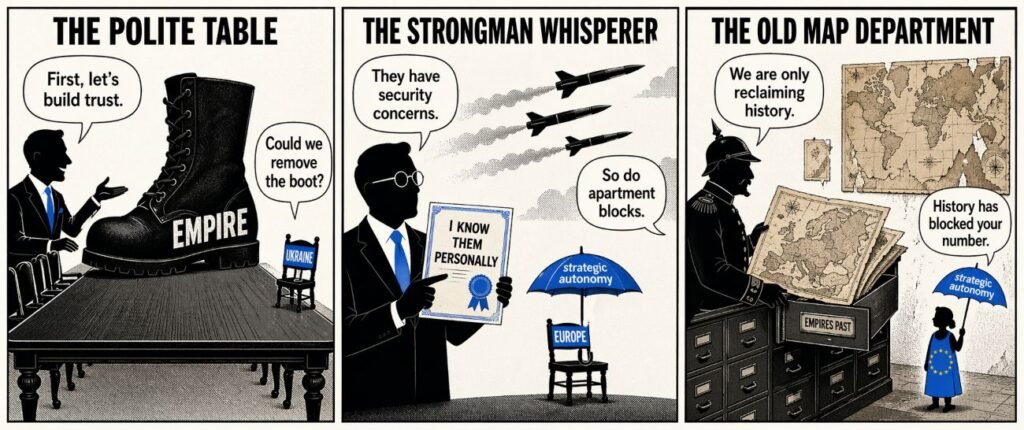
The sketch
Scene 1: “The Polite Table”
Panel description + dialogue: A long negotiation table sits between a small Ukrainian chair and a huge boot marked “Empire”. A diplomat smiles while the boot remains on the table.
Diplomat: “First, let’s build trust.”
Ukraine: “Could we remove the boot?”
Scene 2: “The Strongman Whisperer”
Panel description + dialogue: A suited expert holds a certificate reading “I Know Them Personally” while missiles pass silently in the background.
Expert: “They have security concerns.”
Missile: “So do apartment blocks.”
Scene 3: “The Old Map Department”
Panel description + dialogue: An imperial clerk pulls dusty maps from a cabinet while Europe holds a tiny umbrella labelled “strategic autonomy”.
Clerk: “We are only reclaiming history.”
Europe: “History has blocked your number.”
What to watch, not the show
- The way “peace” can become pressure on the victim rather than restraint on the aggressor.
- The temptation to blame Washington for everything and quietly erase Moscow’s agency.
- Europe’s real weakness: dependence on America for security, dependence on cheap moral shortcuts for analysis.
- The propaganda habit of making invasion sound defensive and resistance sound provocative.
- The risk that territorial concessions become not an ending, but a training manual for the next war.
- The danger of elderly geopolitics: old men with old maps telling young people to die politely.
The Hermit take
Talk to Russia, yes. Trust the boot because it speaks softly, no.
Europe needs a spine, not a scented candle for empire.
Keep or toss
Keep / Toss.
Keep the demand for European strategic autonomy and serious diplomacy.
Toss the fantasy that Russia’s authoritarian hunger can be solved by treating Ukraine’s territory like loose change on the negotiation table.
Sources
- Jeffrey Sachs transcript, Speech at the EU Parliament: https://www.jeffsachs.org/recorded-lectures/shw6yhjhpnbf8dpfnazyjywjwdjy5l
- EEAS on UN General Assembly vote, 2 March 2022: https://www.eeas.europa.eu/eeas/un-general-assembly-demands-russian-federation-withdraw-all-military-forces-territory-ukraine_und
- OHCHR Ukraine civilian casualties, March 2026: https://ukraine.ohchr.org/en/Protection-of-Civilians-in-Armed-Conflict-March-2026
- World Bank Ukraine recovery and reconstruction assessment, 2026: https://www.worldbank.org/en/news/press-release/2026/02/23/updated-ukraine-recovery-and-reconstruction-needs-assessment-released
- World Bank URTF brief note, April 2026: https://thedocs.worldbank.org/en/doc/6fe4ad9aa74b9ed9c0527523b4fc5b55-0080072026/original/URTF-Brief-Note-April-2026.pdf
- NATO relations with Finland: https://www.nato.int/en/what-we-do/partnerships-and-cooperation/relations-with-finland
- ICC arrest warrants for Vladimir Putin and Maria Lvova-Belova: https://www.icc-cpi.int/news/situation-ukraine-icc-judges-issue-arrest-warrants-against-vladimir-vladimirovich-putin-and
- CFR Global Conflict Tracker, War in Ukraine: https://www.cfr.org/global-conflict-tracker/conflict/conflict-ukraine
- RAND report on Russia’s military interventions: https://www.rand.org/pubs/research_reports/RRA444-3.html