Lede
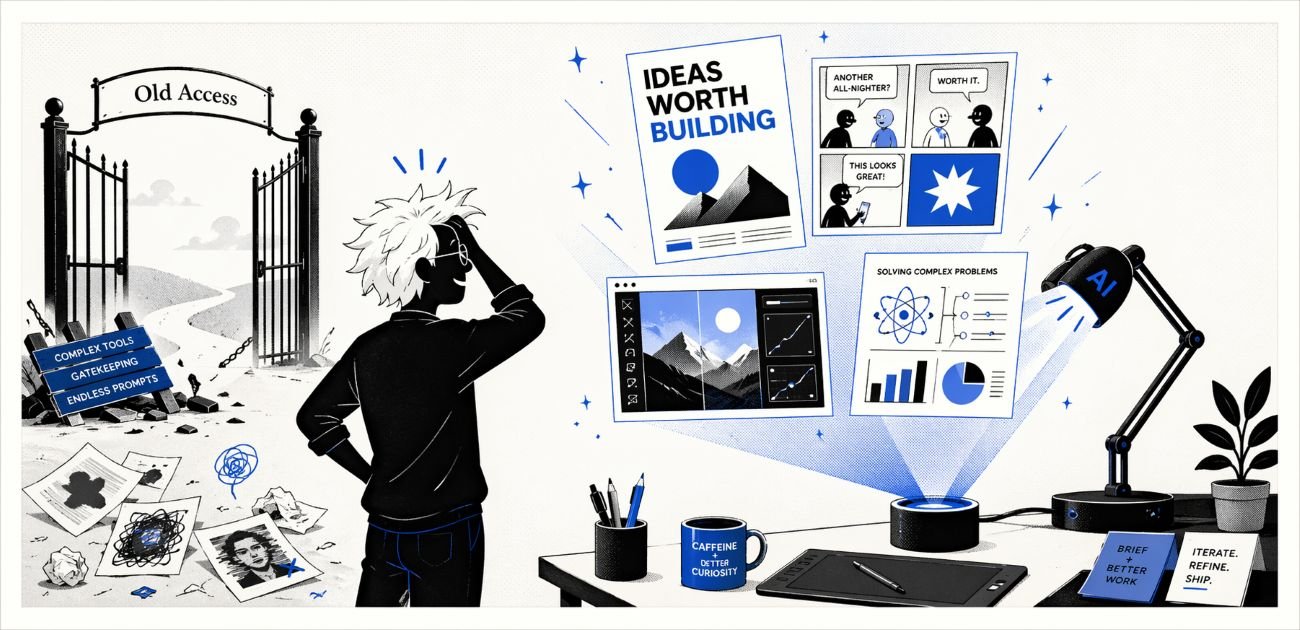
AI image generation has finally stopped behaving like a drunk intern with crayons and started looking like a junior designer who read the brief.
Hermit Off Script
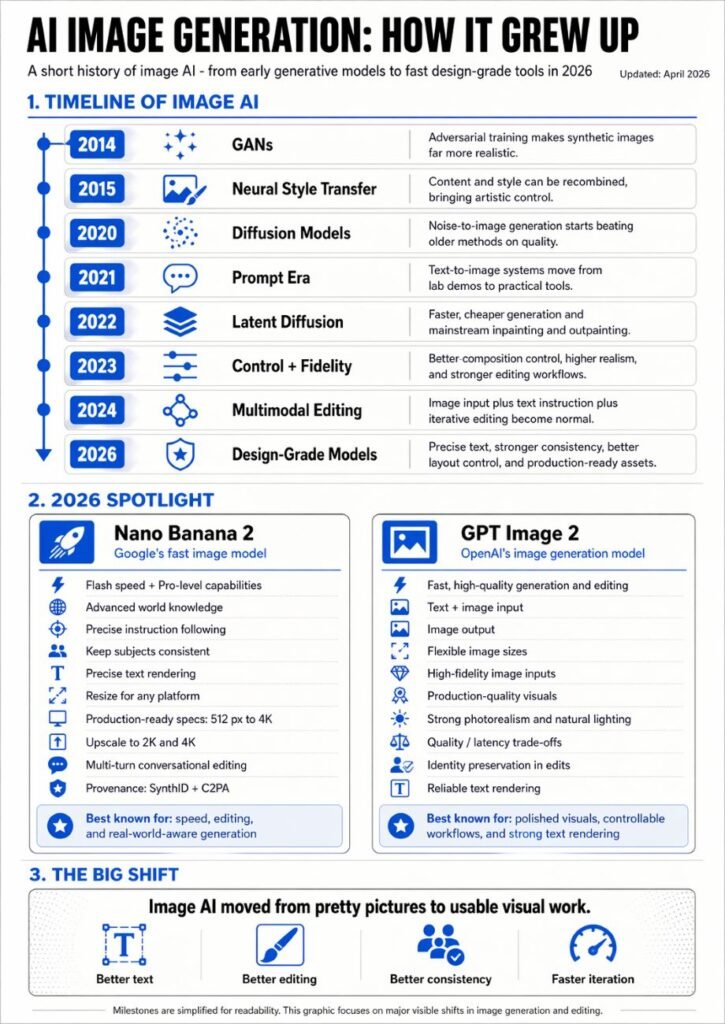
AI image generation is impressive now, and I say that after months of white hair, stretched nerves, cursed prompts, broken hands, haunted faces, and designs that looked as if a printer had suffered a theological breakdown. For the first time, it feels less like begging a machine to behave and more like working with something that understands composition, editing, hierarchy, text, mood, and the painful little details that separate design from digital soup. Not the best designer in the world, no. Calm down, Silicon Valley, put the tambourine away. But knowledgeable. Useful. Capable enough to make you stop for a second and think: without a design team, without a studio budget, without hiring three freelancers and one man named “Brand Vision Dave”, I can actually make something that looks intentional. That is the change. ChatGPT Images 2.0, GPT image generation, whatever name the machine wardrobe is wearing this week, has moved from novelty into instrument. Before that, Nano Banana 2 had speed and promise, but not always the artistic design weight. It could do tricks. This new step feels closer to direction, not just generation. It reasons through the visual problem instead of vomiting pixels into a nice frame and calling it destiny. Still, this is not the moment for everyone to hold hands with AI and sing Kumbayah under a synthetic moon. Slop is still slop. Lazy AI content remains the internet’s new plastic bag, floating everywhere, used once and regretted forever. The point is not “AI replaces humans”. The point is that humans using AI well can now create better, sharper, more meaningful work with tools that were impossible to access before. Science already shows the same pattern. AI is not replacing discovery like a smug magician; it is widening the laboratory table. It helps test, calculate, compare, simulate, and compress years of work into new possible directions. If AI and humans eventually compete not only by remixing the old, but by opening new frontiers of creation, then yes, a new race has begun. Intelligence born from the grandfathers and grandmothers who built the first machine minds. Not a god. Not a toy. A torch with terms and conditions.
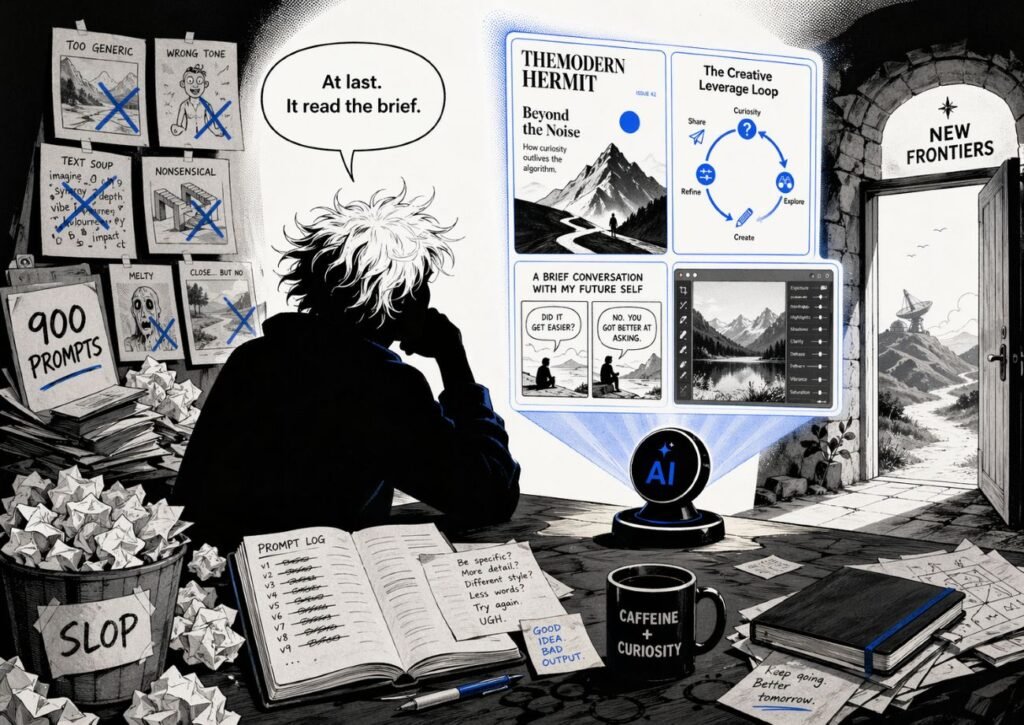
After 900 prompts, AI finally stopped making slop and started acting like a junior designer who actually read the brief.
What does not make sense
- People mocked AI images for years, then panicked the moment the images stopped looking like melted postcards.
- The same crowd that said “AI has no creativity” now complains that it is becoming too creative. Pick a chair and sit down.
- Bad AI content is blamed on AI, while bad human content is called “personal style”. That is generous. Too generous.
- Everyone wants cheap design until cheap design arrives with reasoning, editing, typography, and no invoice for coffee meetings.
- The fear is not that AI cannot create. The fear is that ordinary people can now create without asking permission from the gatekeepers.
- People confuse “AI made this” with “no human thought was involved”, as if a camera makes photography without the photographer.
Sense check / The numbers
- OpenAI introduced ChatGPT Images 2.0 in April 2026, showing examples across realistic photography, typography, manga, posters, infographics, comics, product layouts, and multilingual visual text. [OpenAI]
- OpenAI’s developer guide describes gpt-image-2 as its most capable image model for production workflows and lists 4 key strengths: photorealism, quality and latency control, identity preservation, and reliable text rendering. [OpenAI Developers]
- Google AI documentation lists 3 Nano Banana image models: Nano Banana, Nano Banana 2, and Nano Banana Pro, with Nano Banana 2 positioned for high-efficiency visual creation and developer use. [Google AI Developers]
- Google DeepMind says AlphaFold has predicted over 200 million protein structures, with over 3 million users across more than 190 countries. [Google DeepMind]
- The 2024 Nobel Prize in Chemistry recognised computational protein design and AI protein structure prediction, including AlphaFold2’s role in predicting virtually all 200 million proteins then identified by researchers. [Nobel Prize]
The sketch
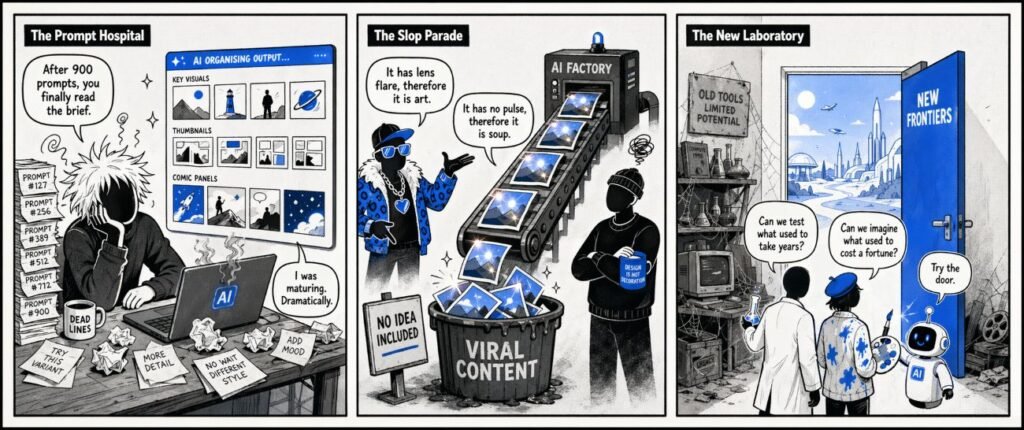
Scene 1: “The Prompt Hospital”
Panel description + dialogue: A creator with white hair sits beside a smoking laptop while an AI screen calmly arranges posters, thumbnails, and comic panels into neat rows.
Creator: “After 900 prompts, you finally read the brief.”
AI: “I was maturing. Dramatically.”
Scene 2: “The Slop Parade”
Panel description + dialogue: A conveyor belt drops identical glossy images into a bin marked “viral content”, while a small sign says “No idea included”.
Influencer: “It has lens flare, therefore it is art.”
Designer: “It has no pulse, therefore it is soup.”
Scene 3: “The New Laboratory”
Panel description + dialogue: A scientist, an artist, and a small AI assistant stand before a door marked “New Frontiers”. Behind them, old tools gather dust.
Scientist: “Can we test what used to take years?”
Artist: “Can we imagine what used to cost a fortune?”
AI: “Try the door.”
What to watch, not the show
- The money shift from expensive design access to cheap iterative creation.
- The quality gap between lazy AI output and human-directed AI workflow.
- The copyright and training disputes hiding behind every shiny image launch.
- The rise of visual literacy as a survival skill, not a luxury.
- The danger of content floods where everything looks polished and nothing says anything.
- The scientific gain when AI helps compress research time, model complexity, and experimental options.
- The new creative class: people with taste, patience, prompts, judgement, and no committee.
The Hermit take
AI did not kill creativity. It killed the excuse that only people with a studio budget may try.
The machine can make the image. The human still has to mean something.
Keep or toss
Keep.
Keep AI as a creative assistant, research engine, design sparring partner, and laboratory torch.
Toss the lazy slop, the magic-god nonsense, and the panic merchants selling fear because their old gate has lost its lock.
Sources
- OpenAI – Introducing ChatGPT Images 2.0: https://openai.com/index/introducing-chatgpt-images-2-0/
- OpenAI Developers – GPT Image Generation Models Prompting Guide: https://developers.openai.com/cookbook/examples/multimodal/image-gen-models-prompting-guide
- Google AI Developers – Nano Banana image generation documentation: https://ai.google.dev/gemini-api/docs/image-generation
- Google Blog – Nano Banana 2: Google’s latest AI image generation model: https://blog.google/innovation-and-ai/technology/ai/nano-banana-2/
- Google DeepMind – AlphaFold: https://deepmind.google/science/alphafold/
- Nobel Prize – Chemistry 2024 press release: https://www.nobelprize.org/prizes/chemistry/2024/press-release/
- Royal Society – Science in the age of AI: https://royalsociety.org/news-resources/projects/science-in-the-age-of-ai/