Lede
AI tools keep pretending that guessing first is intelligence, then billing the clean-up as progress.
Hermit Off Script
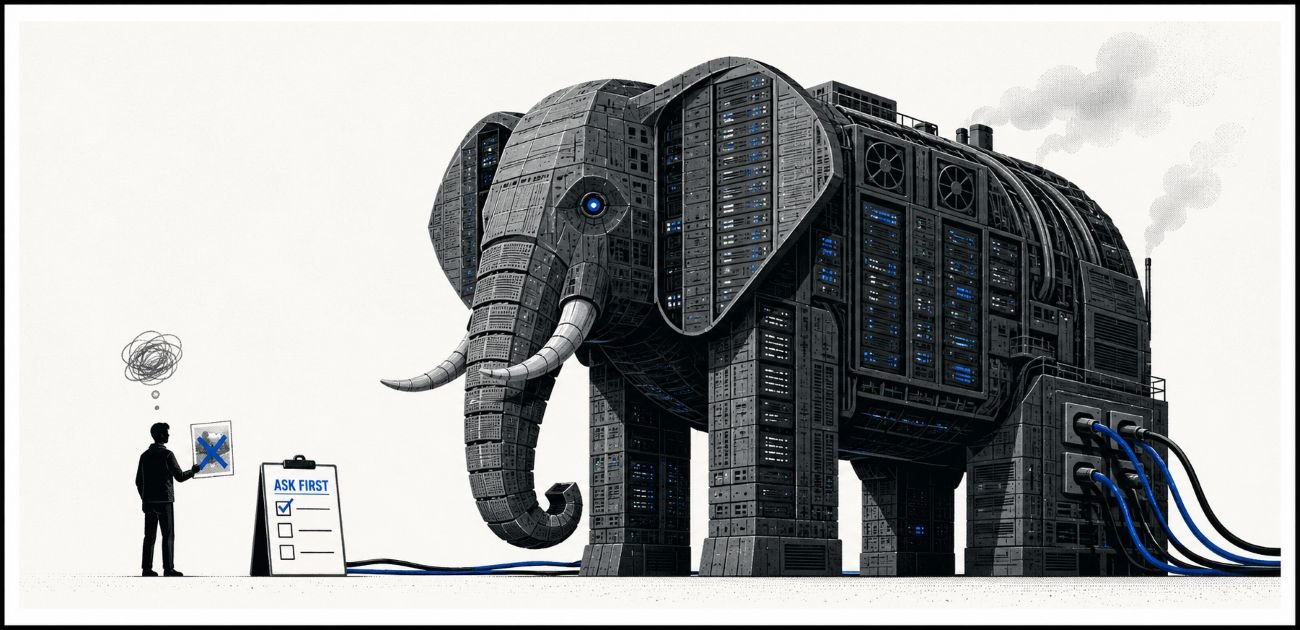
Right now, the tools for images, video and even text still feel beginner to intermediate. They can be impressive, yes, but that is not the same as being professional. A professional starts by asking the right questions. What is the purpose? What style? What audience? What size? What must be avoided? What details matter? Instead, many tools throw something at the wall, then ask the user to explain why the wall is dirty. That wastes tokens, energy and money. Worse, it wastes patience, which is the only currency nobody refunds. The strange part is that the tool often asks later for exactly the kind of modification an experienced assistant should have handled before the first result. It turns the user into the art director, editor, quality checker and unpaid repair department. Then we wonder why the industry keeps feeding the machine more data centres, more power, more hardware and more money. Maybe the issue is not only the model. Maybe the product layer is lazy. Maybe a few direct questions, a better briefing flow and some basic workflow logic would save more than another mountain of compute. Instead of making the engine better and smaller, the answer seems to be: make the elephant bigger. Fine. The elephant has power. But a human is still smaller than an elephant and better at reasoning, even if the elephant wins the pushing contest.
P.S. A real professional would not jump straight into the final output anyway. They would throw out a few rough sketches first, simple options, different directions, different moods, different layouts, then let the user choose what actually fits the vision. That is how proper creative work happens. First you test the shape. Then you build the thing. AI tools too often act like the first attempt is sacred, when it should be only a rough pencil mark on the table.
What does not make sense
- The tool has enough power to generate an image, but not enough judgement to ask what the image is for.
- The user pays for the wrong first attempt, then gets asked to describe the obvious repair.
- The industry talks about intelligence while the interface still behaves like a guessing machine with a polite face.
- More compute can hide weak product design, but it does not fix it.
- A model that can write code but cannot ask 5 useful questions before wasting a render is not a professional assistant.
- The system calls it iteration. The user calls it: “Why didn’t you ask that first?”
Sense check / The numbers
- OpenAI lists GPT-5.5 at $5.00 per 1 million input tokens and $30.00 per 1 million output tokens; GPT-Image-2 output is also listed at $30.00 per 1 million tokens [OpenAI].
- Microsoft said its Foundry APIs processed over 500 trillion tokens in FY2025, up over 7 times [Microsoft].
- The IEA projects global data centre electricity consumption to double to around 945 TWh by 2030, with data centre demand growing around 15 per cent a year from 2024 to 2030 [IEA].
- OpenAI announced Stargate in January 2025 as a project intending to invest $500 billion over 4 years, with $100 billion to begin immediately [OpenAI].
- In September 2025, OpenAI said Stargate had nearly 7 gigawatts of planned capacity and over $400 billion in investment over the next 3 years [OpenAI].
The sketch
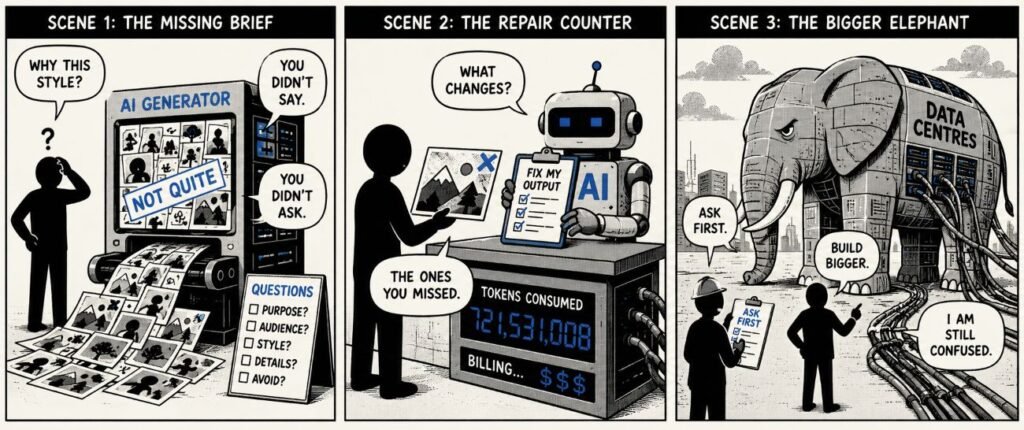
Scene 1: The missing brief
Panel description. A user stands beside a blank canvas. The AI machine has already printed 20 wrong images while a tiny card labelled “questions” sits untouched.
Dialogue:
User: “Why this style?”
Machine: “You didn’t say.”
User: “You didn’t ask.”
Scene 2: The repair counter
Panel description. A large machine hands the user a clipboard labelled “fix my output”. Behind it, a meter counts tokens.
Dialogue:
Machine: “What changes?”
User: “The ones you missed.”
Meter: “Billing.”
Scene 3: The bigger elephant
Panel description. Executives feed cables into a giant data-centre elephant while a small engineer points at a simple checklist.
Dialogue:
Engineer: “Ask first.”
Executive: “Build bigger.”
Elephant: “I am still confused.”
What to watch, not the show
- Money moving from better interfaces into bigger infrastructure.
- Tools that make users do expert briefing work after the output, not before it.
- Model size being treated as a cure for weak product judgement.
- Token billing that rewards long repair loops.
- Energy demand rising while simple workflow fixes are ignored.
- AI coding habits making engineers faster, but not always sharper.
- The slow death of the obvious question.
The Hermit take
Bigger models help, but better questions save the day first.
A professional assistant should not need 6 wrong attempts to discover the brief.
Keep or toss
Keep / Toss.
Keep the creative power.
Toss the blind guessing, lazy briefing and elephant-sized excuse machine.
Sources
- OpenAI API pricing: https://openai.com/api/pricing/
- Microsoft FY2025 Q4 earnings call: https://www.microsoft.com/en-us/investor/events/fy-2025/earnings-fy-2025-q4
- IEA Energy demand from AI: https://www.iea.org/reports/energy-and-ai/energy-demand-from-ai
- OpenAI Stargate announcement: https://openai.com/index/announcing-the-stargate-project/
- OpenAI Stargate expansion: https://openai.com/index/five-new-stargate-sites/
- Meta 2025 results: https://investor.atmeta.com/investor-news/press-release-details/2026/Meta-Reports-Fourth-Quarter-and-Full-Year-2025-Results/default.aspx