
Lede
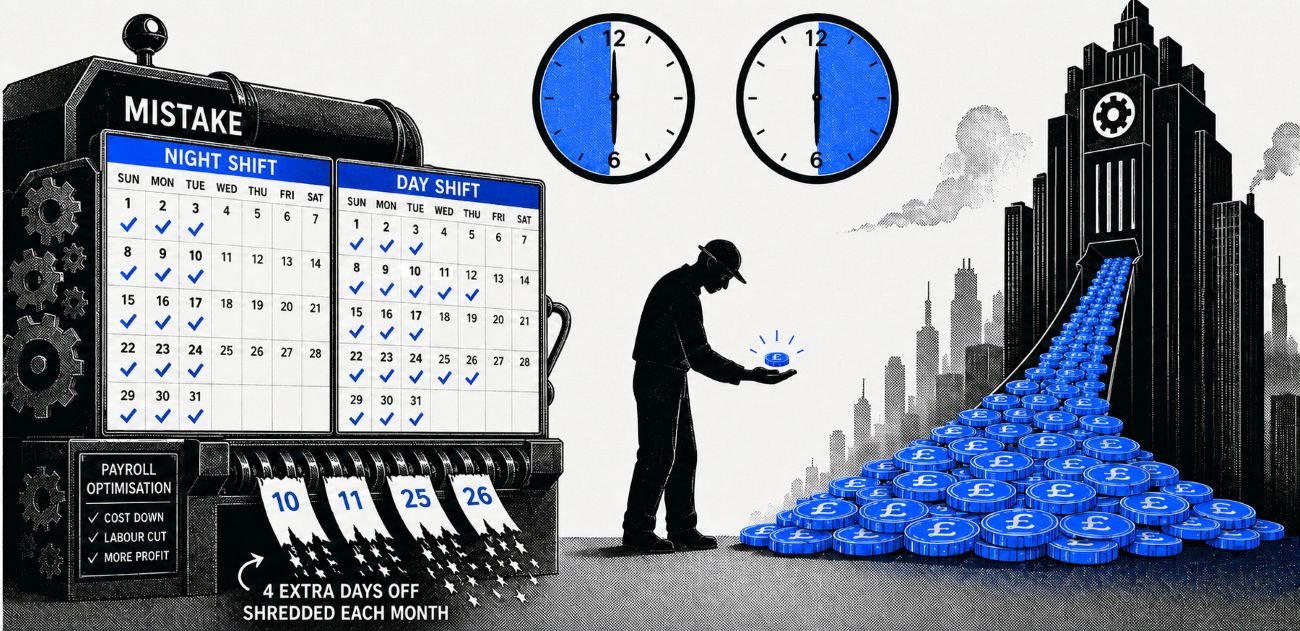
Some companies call it a mistake when the worker loses money, rest and health, but somehow the spreadsheet always remembers profit.
Words used
- PAYE: The UK system used by HMRC to collect Income Tax and National Insurance from employment.
- Night work premium: Extra pay for working nights, often offered because night work is harder on sleep, family life and health.
- Rest days: Days away from work, which are not a luxury item found near the biscuits.
Hermit Off Script
I want to talk about how some companies fool the state and the employees with their so-called mistakes, as if misunderstanding payroll is a natural disaster and not an accounting decision with a tie. Every penny that does not go into the employee’s pocket is also not counted properly for tax, National Insurance or pension where it applies. Funny how the mistake never seems to buy the worker a holiday home. Take one simple example. Night shift is 12 hours long and day shift is 12 hours long. Every week, the night shift has 3 full days off. The day shift has 3 full days off one week and 5 full days off the next week. So across a month, the difference between the shifts can become around 4 full days off. Same hours, but not the same life. This is not ancient mathematics found on a lost tablet. It is counting days. The 1 pound difference between day shift and night shift does not cover even the moral cost, never mind the missing rest. Night work also carries health risks, but the company can afford to act confused because confusion is cheaper than fairness. What I wonder is how the controls from government are fooled as well, because if this sort of thing runs for years, it is not only workers losing money. The state loses too. Then we hear the same wealthy class crying that they pay more taxes than everybody else, while the system lets tiny cuts happen to ordinary people until the cut becomes a tunnel. In a fair society, wealth and burden would not sit like a pyramid with the 1 per cent sipping champagne on the roof and everyone else carrying the bricks.
Maybe the promised age of abundance will arrive one day, as an idea and not a fact. But I have noticed the promise usually comes from the same billionaires who first want to fill their pockets, take over services with robots and AGI, and then announce that money will no longer matter – after they have collected all of it.
What does not make sense
- A company can calculate production targets to the decimal, but apparently needs divine intervention to count rest days.
- Night work gets a tiny premium, while the worker pays with sleep, family time and long-term health risk.
- If wages are underpaid or misclassified, the worker loses first, but the tax system may also lose quietly.
- Calling payroll unfairness a “mistake” is convenient when the mistake has the survival instinct of a cockroach.
- Billionaires promise abundance after ownership has already been moved behind a very expensive gate.
Sense check / The numbers
- GOV.UK says night workers must not work more than an average of 8 hours in a 24-hour period, usually calculated over 17 weeks, with longer reference periods possible up to 52 weeks by agreement. [GOV.UK]
- Employers must offer night workers 1 free health assessment before they become night workers, and regular assessments during employment. [GOV.UK]
- PAYE is HMRC’s system for collecting Income Tax and National Insurance from employment, so payroll mistakes are not only private workplace clutter. [GOV.UK]
- In October 2025, the UK government said nearly 500 employers had been fined over 10 million pounds for failing to pay the National Minimum Wage, with 6 million pounds repaid to workers. [GOV.UK]
- Oxfam said billionaire wealth rose by over 16 per cent in 2025 to $18.3 trillion, its highest recorded level. That is the kind of “abundance” that somehow keeps choosing the same address. [Oxfam]
The sketch
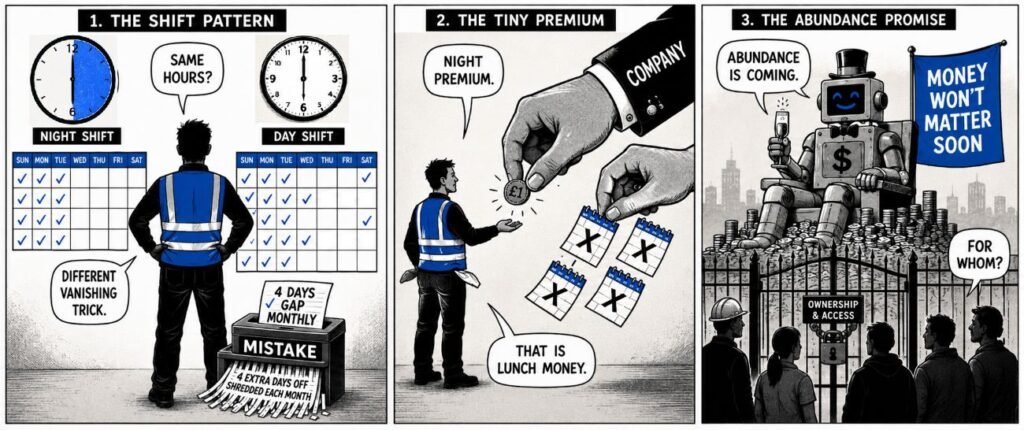
Scene 1: The shift pattern
Panel description. A worker stands between 2 clocks, both showing 12 hours. One calendar has missing rest days falling into a shredder labelled “mistake”.
Dialogue:
Worker: “Same hours?”
Payroll: “Different vanishing trick.”
Scene 2: The tiny premium
Panel description. A giant company hand offers a worker 1 coin while taking 4 calendar pages from their pocket.
Dialogue:
Company: “Night premium.”
Worker: “That is lunch money.”
Scene 3: The abundance promise
Panel description. A billionaire robot sits on a mountain of coins beside a banner reading “money won’t matter soon”. Workers watch from outside a locked gate.
Dialogue:
Robot: “Abundance is coming.”
Worker: “For whom?”
What to watch, not the show
- Shift patterns that look equal by hours but unequal by rest.
- Payroll “mistakes” that always save the employer money.
- Night shift premiums that do not reflect health and social cost.
- Weak enforcement where underpayment takes years to spot.
- Automation promises that talk about abundance while concentrating ownership.
- Tax complaints from companies that still fight every small cost of labour.
The Hermit take
Payroll is not a magic hat.
If rest disappears, count who profits.
Keep or toss
Keep / Toss.
Keep fair night work where it is needed.
Toss the arithmetic that turns lost life into a payroll saving.
Sources
- GOV.UK night working hours: https://www.gov.uk/night-working-hours
- Working Time Regulations 1998, regulation 6: https://www.legislation.gov.uk/uksi/1998/1833/regulation/6
- GOV.UK night worker health assessments: https://www.gov.uk/night-working-hours/health-assessments
- GOV.UK PAYE for employers: https://www.gov.uk/paye-for-employers
- GOV.UK payroll errors and deductions: https://www.gov.uk/payroll-errors/correcting-pay-or-deductions
- GOV.UK National Minimum Wage enforcement news: https://www.gov.uk/government/news/6-million-repaid-to-workers-as-government-cracks-down-on-employers-underpaying-their-staff
- HSE fatigue and shift work duties: https://www.hse.gov.uk/humanfactors/topics/fatigue.htm
- Oxfam billionaire wealth 2026 report release: https://www.oxfam.org/en/press-releases/billionaire-wealth-jumps-three-times-faster-2025-highest-peak-ever-sparking
One response
[…] poet of limited budgets. But that same profit often comes from wages not rising properly, from night shifts that drain people without enough reward, from taking advantage of mistakes and pressure, from waiting until a problem becomes serious […]