

Lede
AI makes a useful assistant, but profit-first agents can turn authorship into a warehouse where nobody remembers ordering a human voice.
Words used
- AI-assisted: A human creates the work and uses AI to brainstorm, check, edit or refine it.
- AI-generated: AI creates the actual text, images or translation, even when a human later edits the output.
- AI agent: Software given a goal and allowed to carry out several linked tasks with limited step-by-step direction.
Hermit Off Script
The real argument about AI content is not human creation versus machines. It is human voice versus automated production pushed by people who want income without bringing much of themselves to the work. When an author uses AI to help build a new world, test a place, question a character or spot a weak part of the story, that makes sense to me. Renowned authors have long worked with editors, researchers, translators and other assistants because serious books rarely emerge from one untouched brain. The difference is that a human assistant is not available at every hour, in every place or for every problem. Good help is expensive. It can be slow. Its skill may not match the exact task. AI gives more writers access to a patient assistant that can be called at 3 am without demanding coffee, credit or a train home. This is the useful side of the technology: humans using AI to improve work they still direct, rather than asking a machine to supply the purpose as well as the labour.
Then comes the other class of so-called author. The premise is generated. The characters are generated. The prose is generated. The edits, cover, description and marketing are generated. The human contribution is pressing buttons and checking whether the royalty dashboard has developed feelings. That process is not creation in any meaningful sense. It is automated stock production wearing an author’s name tag. The same problem is already appearing across social media, where synthetic content can bury human creators through sheer volume. The goal is profit first, volume second and perhaps readability somewhere behind the emergency exit. The machine is not making that decision alone. As I argued before, the profit model behind AI is the real problem. Platforms should give heavily AI-generated material a clear label and a separate filter. My less diplomatic name would be “garbage AI”, because readers should not have to inspect every book like customs officers searching for a hidden author.
Maybe this distinction will look primitive in a few decades. Future AI may handle editing, translation, proofreading, consistency and production at a professional level that now takes months or years. The direction is already becoming visible through AI systems designed to complete multi-step work rather than merely produce answers. I can imagine the human deciding the vision, the meaning and the final form, while the machine carries much of the long technical labour between them. The machine can do more of the work. The human must still have something worth saying.
What does not make sense
- Calling someone an author after they outsourced the idea, sentences, revisions and presentation.
- Treating instant production as proof of creative progress when it may only prove that the upload button works.
- Hiding AI-generated books among human-written books while expecting readers to perform the disclosure checks.
- Praising automation for widening access, then using it to bury real writers under industrial quantities of imitation.
- Claiming that profit proves quality when platforms reward volume, visibility and subscription page reads as well as judgement.
Sense check / The numbers
- Amazon KDP uses 2 distinct categories: AI-generated content must be disclosed to Amazon, while AI-assisted content does not require disclosure. The publisher remains responsible for copyright and quality in both cases. [Amazon KDP]
- In an Authors Guild survey of more than 1,700 writers, 23 per cent had used generative AI in their writing process. Among those users, only about 7 per cent used it to generate the text, while 89 per cent said AI output formed less than 10 per cent of the final work. [Authors Guild]
- A Society of Authors survey received 787 responses. It found that 22 per cent had used generative AI, while 36 per cent of translators and 26 per cent of illustrators said they had already lost work because of it. [Society of Authors]
- A July 2026 working paper examined 14,419 self-published genre-fiction books sold on Amazon from 2023 to 2026. Books with detected AI text above 25 per cent gained market share, while the number of books recording quarterly sales rose 19.2-fold and quarterly revenue rose only 8.9-fold. The paper is still under review. [Chakrabarty et al.]
- The Authors Guild expanded its Human Authored certification in March 2026. Non-members pay $10 per title, while eligible members can certify titles without that fee. [Authors Guild]
The sketch
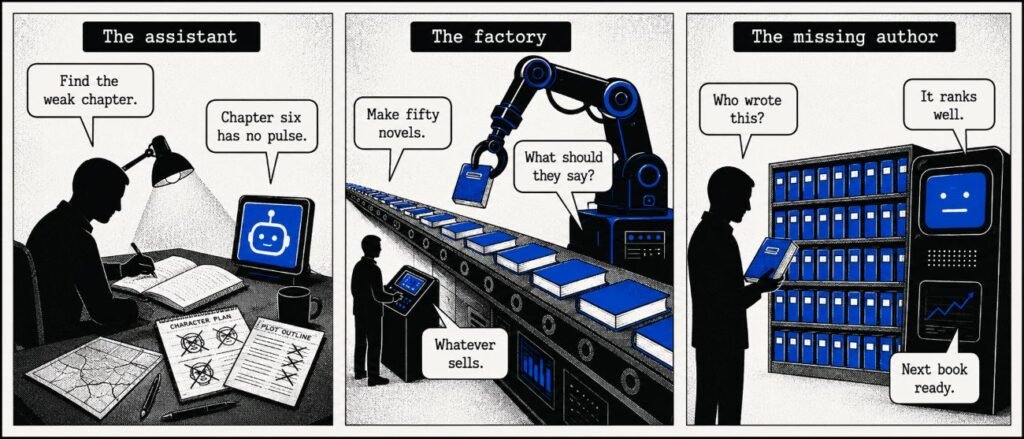
Scene 1: The assistant
A writer sits at a desk beside a small AI screen covered with notes, maps and crossed-out character plans.
Dialogue:
Writer: “Find the weak chapter.”
AI: “Chapter six has no pulse.”
Scene 2: The factory
A tiny operator stands beside a huge conveyor belt producing identical books while an AI agent controls every machine.
Dialogue:
Operator: “Make fifty novels.”
Agent: “What should they say?”
Operator: “Whatever sells.”
Scene 3: The missing author
A reader holds one book before a towering platform shelf packed with near-identical covers.
Dialogue:
Reader: “Who wrote this?”
Platform: “It ranks well.”
Machine: “Next book ready.”
What to watch, not the show
- Platform rewards that favour publishing speed and catalogue size over lasting reader value.
- Whether retailers show readers clear AI-generated labels, filters and searchable disclosures.
- Who owns the final work when agents, models, hired datasets and copied styles all enter the production line.
- Whether translators, illustrators, editors and junior writers lose paid work before better roles replace it.
- How much creative control remains with the named author after the agent system makes the important choices, and whether companies are using AI to support human judgement or replace it cheaply.
- Whether future tools shorten technical labour while preserving a human purpose, rather than merely multiplying products.
The Hermit take
Use AI to sharpen a voice, not to manufacture the absence of one.
A book can survive rough prose; it cannot survive having nothing to say.
Keep or toss
Keep / Toss.
Keep AI as a tireless assistant for genuine creators.
Toss automated authorship sold as personal creation.
Sources
- Amazon KDP content guidelines: https://kdp.amazon.com/en_US/help/topic/G200672390
- Authors Guild AI survey: https://authorsguild.org/news/ai-survey-90-percent-of-writers-believe-authors-should-be-compensated-for-ai-training-use/
- Society of Authors generative AI survey: https://societyofauthors.org/2024/04/11/soa-survey-reveals-a-third-of-translators-and-quarter-of-illustrators-losing-work-to-ai/
- July 2026 book-market working paper: https://arxiv.org/abs/2607.20349
- Authors Guild Human Authored certification: https://authorsguild.org/human-authored/
4 responses
[…] eventually starts smelling like an empty shopping centre with background music. But for artists, writers, small creators and anyone trying to share something fragile and real, this is not a philosophical problem. It is a […]
[…] for everyone to hold hands with AI and sing Kumbayah under a synthetic moon. Slop is still slop. Lazy AI content remains the internet’s new plastic bag, floating everywhere, used once and regretted forever. […]
[…] Agentic work: multi-step work where a model plans, uses tools, checks progress and produces a finished result. […]
[…] less drudgery, more public gain. Only after that would anyone dare talk about taking jobs. Instead, companies rush to bank the upside first, then tell everyone else to be flexible, resilient, and grateful for the disruption. That is not […]