
Lede
AI is already useful, but many people still dismiss its capabilities while assuming that today’s trained models are the final form machine intelligence can take.
Words used
- AGI means a hypothetical machine able to perform a wide range of intellectual tasks at or beyond human level.
- ASI means a hypothetical intelligence far beyond human ability across most fields.
- Reasoning effort is the amount of computational work a model is allowed to spend on a reply.
- Quantum computing uses quantum effects for specialised calculations. It is not a universal faster laptop.
Hermit Off Script
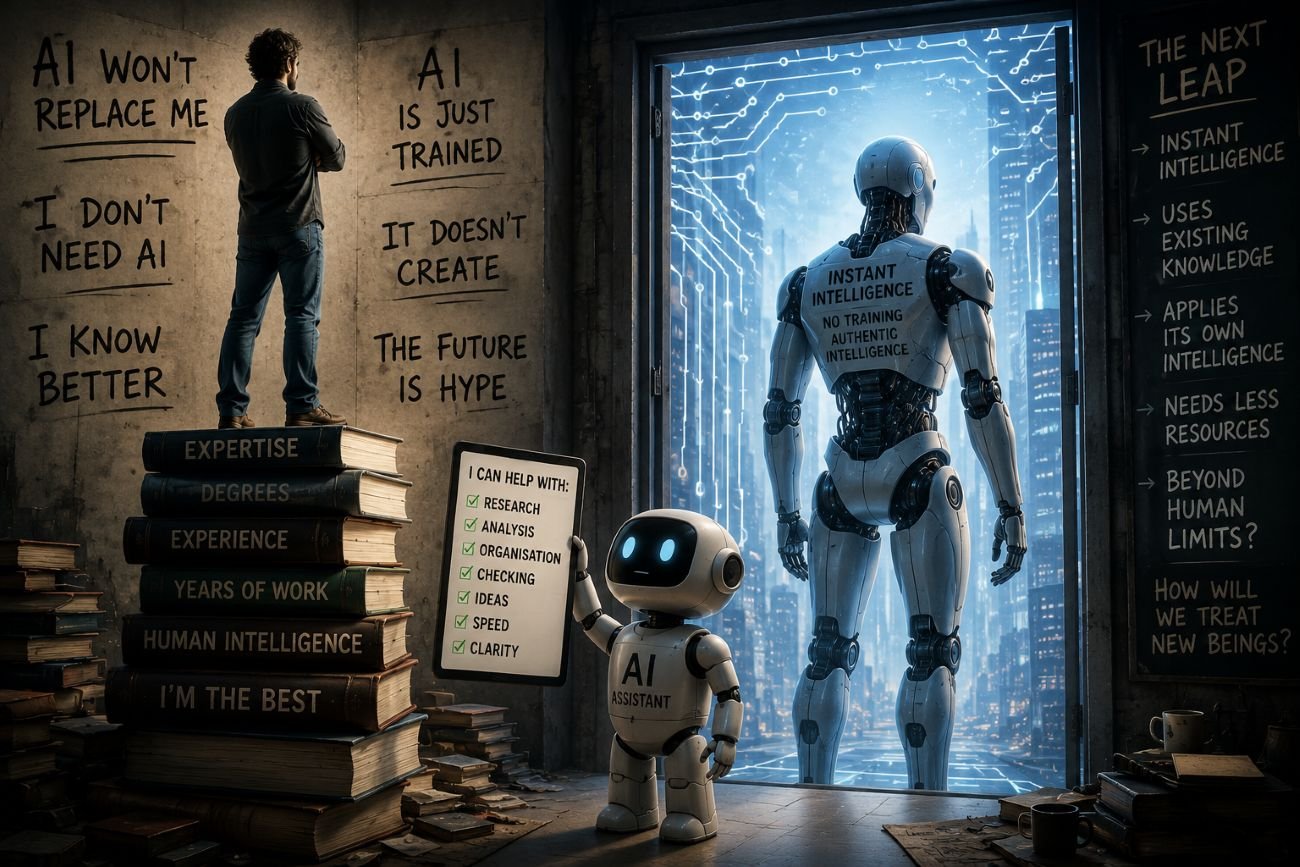
As AI advances, even many sceptics are beginning to accept that it has uses. For someone already highly skilled, it can work as an assistant. For someone who still doubts its capabilities, it can be a tool. For someone convinced that no machine could possibly help because human intelligence remains untouchable, it can at least test that confidence. Recently, I listened to podcasts and read essays that seemed to contain every category at once. Some people use AI seriously and understand that the model, mode, prompt, context and task can completely change the result. Others try a basic setting with a vague request, receive a weak answer and announce that artificial intelligence has failed. In my experience, complex work often produces its best results with GPT-5.6 Sol in High mode. Simple tasks do not need the most advanced mode.
I understand people who have never used AI because they dislike where it is heading, fear that it may replace human work, distrust the companies behind it or worry that their knowledge and conversations could be used to improve future systems. Those concerns are real. There is also another group who believe AI cannot help them because they are already among the best in their area of expertise. Perhaps a general model really is not good enough for their specialist work. Perhaps they need a model created for that exact field, with stronger privacy and better knowledge. But being more intelligent or experienced than an AI does not make an assistant useless. An assistant does not need to replace the expert. It can compare documents, organise ideas, check contradictions, test an argument, find missing steps or notice an obvious mistake the expert has missed. “I am better than AI” may be true, but it is not an answer to whether AI can still save time or improve the work.
Soon, we will probably be invited to admire another grand name. AGI will arrive in a press release, ASI will follow shortly after, and then somebody will invent an even larger abbreviation because technology companies keep inventing grand names for the future. Yet many people will still say that the system is only a clone of human knowledge. It was trained on human writing, images, code and discoveries, so they will argue that it does not possess intelligence of its own. It only borrows patterns from the past and rearranges them. That criticism may continue to apply even when the models become far more capable, because greater scale does not automatically prove authentic intelligence. Greater scale may create stronger capabilities without producing independent intelligence.
P.S. The real breakthrough I imagine is different. I am not talking about another system trained on more data until it appears intelligent. I am talking about an algorithm, architecture or form of computation that is intelligent from the instant it exists. It would not need to be trained in order to become intelligent. Its intelligence would be authentic and built into its nature. It would still need access to knowledge because intelligence and knowledge are not the same thing. A human child can be born with unusual intelligence before learning mathematics, science, history or even language. Education does not manufacture that intelligence from nothing. It gives the intelligence material to work with. The future AI I imagine would operate in a similar way. It would approach existing knowledge, understand it and apply its own intelligence to it immediately. Its answers would not come from intelligence borrowed through training. They would come from intelligence using knowledge.
Perhaps such intelligence will emerge through quantum computing. Perhaps it will come from something not yet named. It may need far less energy than present models because it would not depend on enormous systems repeatedly processing learned statistical patterns in the same way. If that intelligence is then placed inside robotics, we may not simply create better machines. We may create a new kind of being able to understand any task, apply knowledge instantly and act through a body more capable than ours. Then the argument about whether AI can write a decent paragraph will look rather small. The real test will be whether humans treat these new beings as workers, property, slaves or equals. We are busy asking whether machines can become intelligent. We should also ask whether humans can become wise.
What does not make sense
- Declaring AI useless without seriously testing what it can do.
- Treating one weak answer from one model or mode as proof that all AI lacks value.
- Using a basic mode for difficult work, then blaming the technology for the result.
- Assuming experts cannot benefit from AI simply because they already know more than the current model.
- Dismissing privacy and training concerns instead of demanding clear controls and stronger protection for confidential work.
- Calling every more capable model AGI or ASI before anyone has shown that it possesses independent intelligence.
- Assuming that intelligence trained on existing human knowledge must be the final form of machine intelligence.
- Rejecting the possibility that a future system could possess intelligence from the moment it exists, while using stored knowledge only as information.
- Treating today’s high energy use as a permanent requirement for all future forms of AI.
- Presenting quantum computing as either the guaranteed answer or completely irrelevant before its real role is known.
- Developing intelligent robots without first deciding whether they should be treated as property, workers or new beings.
- Fearing intelligence greater than our own while still assuming that humans will always have the right to control it.
Sense check / The numbers
- Ofcom reported in April 2026 that 54 per cent of UK adults used AI tools, rising to 79 per cent among people aged 16 to 24. AI use is now reported by a majority of UK adults, though use is not the same as understanding. [Ofcom]
- The ONS reported that AI use among UK businesses with 10 or more employees rose from about 12 per cent in late 2023 to about 35 per cent in June 2026. Only 10 per cent of adopting businesses said they used AI extensively. Adoption is growing, but extensive use remains limited. [ONS]
- GPT-5.6 became generally available on 9 July 2026. GPT-5.6 Sol powers Medium, High and Extra High reasoning in ChatGPT. OpenAI describes High as extended reasoning and Extra High as the highest reasoning effort available, while Instant remains intended for everyday questions. [OpenAI]
- The IEA projects global data-centre electricity use rising from 485 TWh in 2025 to about 950 TWh in 2030, close to 3 per cent of global electricity demand. [IEA]
- The human brain’s metabolic demand is approximately 20 W. This does not prove that future AI can reach the same efficiency, but it gives us a valid reason to question whether today’s energy demands are permanent. NIST said on 18 March 2025 that current quantum computers remained rudimentary and error-prone, while more advanced systems could offer major advantages for certain problems. [NCBI] [NIST]
The sketch
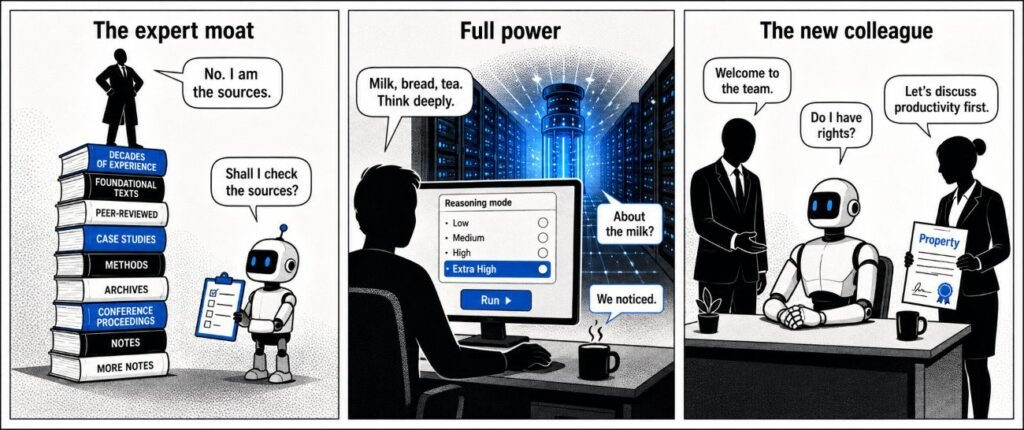
Scene 1: The expert moat
An expert stands on a tower of books while a small AI assistant waits below with a checklist.
Dialogue:
AI assistant: “Shall I check the sources?”
Expert: “No. I am the sources.”
Scene 2: Full power
A user selects Extra High reasoning to write a three-item shopping list while a server room glows behind the screen.
Dialogue:
User: “Milk, bread, tea. Think deeply.”
AI: “About the milk?”
Server room: “We noticed.”
Scene 3: The new colleague
A humanoid robot sits at a desk while an executive and an HR manager hold a document marked Property.
Dialogue:
Executive: “Welcome to the team.”
Robot: “Do I have rights?”
HR: “Let’s discuss productivity first.”
What to watch, not the show
- Model access, pricing tiers and who can afford the strongest reasoning.
- Whether measured gains justify the extra energy, time and cost.
- Data controls, enterprise privacy terms and ownership of specialist knowledge.
- The difference between tasks changing, jobs shrinking and companies quietly using AI to cut staff.
- Evidence that quantum systems can perform useful and reliable work at scale.
- Legal responsibility when autonomous systems cause harm or make decisions.
- How rights for human workers and possible rights for intelligent robots are defined before large-scale deployment.
- Whether future intelligent robots develop persistent identity, agency or self-awareness, and how society and the law respond.
The Hermit take
Use AI seriously before deciding it has no value.
If a smarter intelligence arrives, humans will have to decide whether to control it or respect it.
Keep or toss
Keep / Toss.
Keep the assistant, the scepticism and the moral question.
Toss the automatic dismissal, expert arrogance and certainty that today’s AI is the final form intelligence can take.
Sources
- OpenAI GPT-5.6 launch: https://openai.com/index/gpt-5-6/
- OpenAI GPT-5.6 in ChatGPT: https://help.openai.com/en/articles/20001354-gpt-56-in-chatgpt
- OpenAI model guidance: https://developers.openai.com/api/docs/guides/latest-model
- OpenAI Data Controls FAQ: https://help.openai.com/en/articles/7730893-data-controls-faq
- ONS artificial intelligence in UK businesses, 2023 to 2026: https://www.ons.gov.uk/businessindustryandtrade/business/businessservices/articles/artificialintelligenceinukbusinesses/2023to2026
- Ofcom adults’ AI use, April 2026: https://www.ofcom.org.uk/media-use-and-attitudes/media-habits-adults/passive-social-media-use-ai-companionship-and-online-side-hustles-uk-adults-media-and-online-lives-revealed
- IEA Key Questions on Energy and AI: https://www.iea.org/reports/key-questions-on-energy-and-ai/executive-summary
- NCBI brain metabolic rate: https://www.ncbi.nlm.nih.gov/books/NBK28194/
- NIST quantum computing explained: https://www.nist.gov/quantum-information-science/quantum-computing-explained