
Lede
AI is being sold either as the thing that steals your job or the thing that gives you a virtual workforce, while the useful answer is less dramatic: make it your assistant and keep the judgement.
Words used
- AI agent: Software that can plan and perform several linked tasks using tools with limited step-by-step direction.
- Abundance: Here, the idea that intelligence, assistance and specialised skills become cheap enough to be widely available.
Hermit Off Script
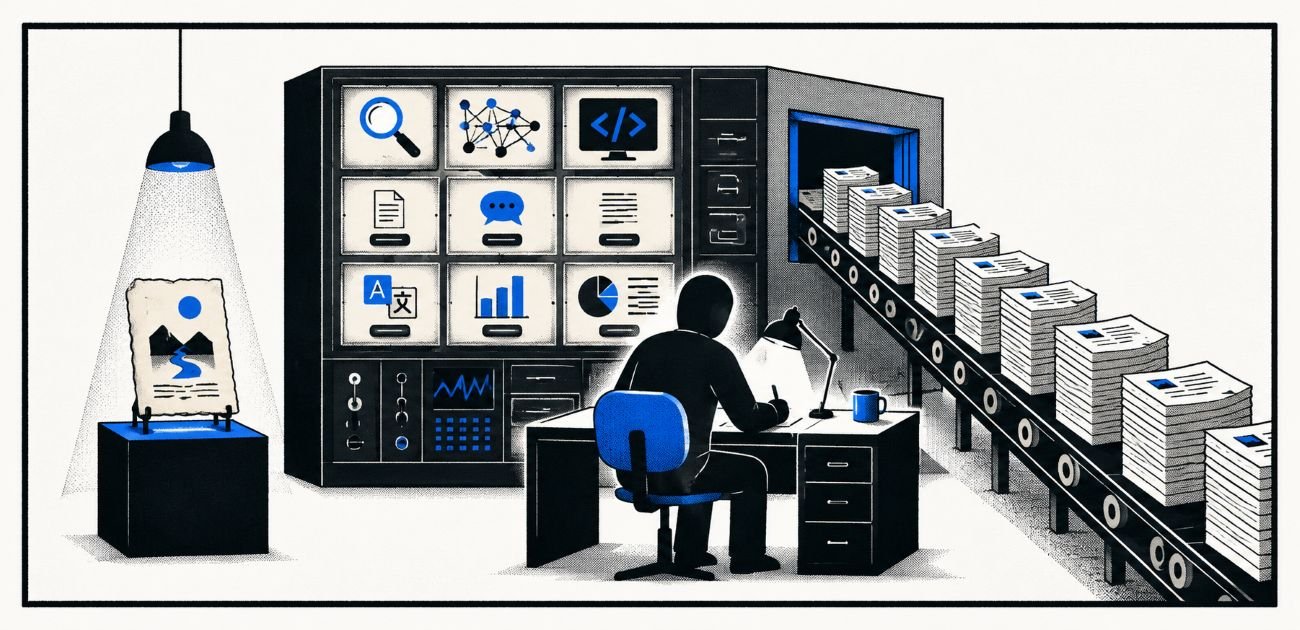
Why use AI agents at all? I think the useful answer is far less dramatic than the job-apocalypse argument. I keep hearing AI discussed as the thing that will replace jobs, creativity and critical thinking, as if the only two settings are “human does everything” and “machine takes the chair”. Yet some of the people building the biggest AI systems use a very different word: abundance. Sam Altman wrote in 2024 about each person eventually having a “personal AI team”, and OpenAI used “Building abundant intelligence” as the title of a July 2026 post. That makes more sense to me once I remove the sales pitch. I would rather think of AI as an assistant – absurdly capable in some areas, cheap compared with hiring a team of specialists, available whenever I need it, and still requiring somebody to tell it what matters. It doesn’t ask for a salary, but it isn’t free. There are subscriptions, compute, electricity, privacy concerns, mistakes and the time spent checking them. The machine can bring coding, research, translation, design help and analysis closer to one person’s desk, but access to a skill is not the same as owning that skill. If the assistant gives me hours back, I can spend those hours thinking, writing, learning or doing something more human than copying information between boxes. That is the version of abundance I can understand: less friction between an idea and the ability to test it. The danger is obvious. If everyone uses the same cheap intelligence to produce ten thousand competent things nobody needed, abundance becomes a landfill with good grammar.
P.S. Maybe that is exactly why the human touch becomes more valuable. In a world where almost anyone can generate almost anything, genuinely human work may become the rare object – like an antique, a first edition or a hand-made piece whose value comes partly from the fact that somebody actually spent a piece of their life making it. Everyone gets a factory. Meaning becomes the gold.
What does not make sense
- Treating AI as either a redundancy notice or an electronic messiah when its most practical role may simply be assistant.
- Assuming that access to expert-level help means the user suddenly owns the underlying skill.
- Calling unlimited output “abundance” when nobody has established that the extra output deserves to exist.
- Complaining that AI will destroy human creativity while willingly handing it every creative decision.
- Saying the assistant costs nothing because it doesn’t collect a salary, while ignoring subscriptions, infrastructure, energy and verification.
- Using the time AI saves to generate more disposable work instead of buying back time for human thought.
Sense check / The numbers
- Stanford’s 2026 AI Index says 88 per cent of surveyed organisations were using AI in 2025, while 70 per cent used generative AI in at least one business function. AI agent deployment was still in single digits across nearly all business functions. [Stanford AI Index]
- The same report estimates annual US consumer value from generative AI at $172 billion by early 2026, up from $112 billion a year earlier, and says most of these tools remain free or close to it. Cheap access is already real. Zero-cost intelligence is not. [Stanford AI Index]
- An NBER study covering 5,179 customer-support agents found that access to a generative AI assistant increased productivity by 14 per cent on average and by 34 per cent for novice and lower-skilled workers. That looks rather more like skill amplification than a robot simply removing the chair. [NBER]
- AI agents are still very much assistants requiring supervision. Stanford reports that accuracy on the OSWorld computer-task benchmark rose from roughly 12 per cent to 66.3 per cent, meaning current systems still fail roughly 1 attempt in 3 on that benchmark. [Stanford AI Index]
- The World Economic Forum’s 2025 jobs report projects 170 million jobs created and 92 million displaced by 2030, for a net increase of 78 million. Those figures cover several economic and technological forces, not AI alone, which is precisely why “AI takes all jobs” makes a poor economic model. [WEF]
The sketch
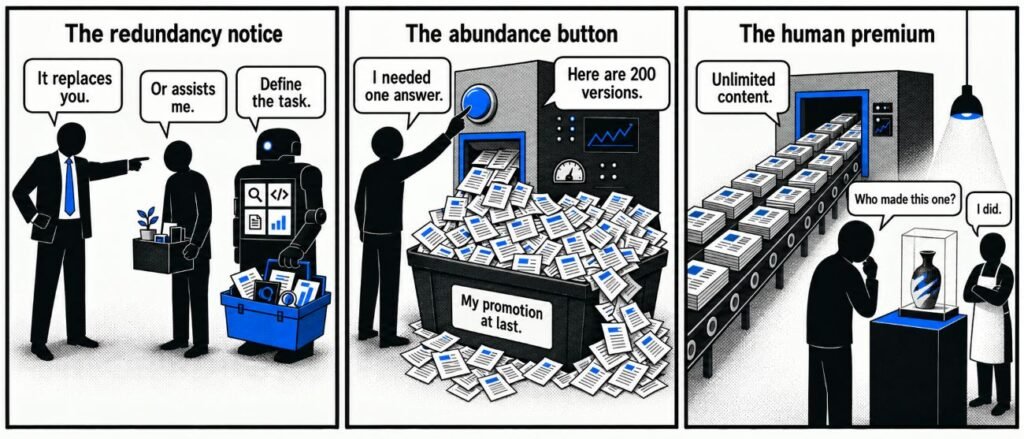
Scene 1: The redundancy notice
A manager points at a worker while a large AI assistant stands beside the worker carrying a toolbox full of research, coding and writing tools.
Dialogue:
Manager: “It replaces you.”
Worker: “Or assists me.”
AI: “Define the task.”
Scene 2: The abundance button
A person presses one button on a giant machine. Hundreds of nearly identical pages pour from the other side into an overflowing bin.
Dialogue:
Person: “I needed one answer.”
Machine: “Here are 200 versions.”
Bin: “My promotion at last.”
Scene 3: The human premium
An endless conveyor carries identical machine-made objects past a small display containing a single visibly handmade object.
Dialogue:
Machine: “Unlimited content.”
Buyer: “Who made this one?”
Human: “I did.”
What to watch, not the show
- Pricing. If advanced assistance ends up locked behind expensive tiers, “abundance” becomes another rented utility.
- Labour incentives. Watch whether companies use AI to make workers more capable or simply use it as an excuse to remove payroll.
- Skill loss. An assistant that teaches is useful; an assistant that quietly replaces every difficult thought can leave the user weaker.
- Platform incentives. Systems rewarded for producing more content will happily produce more content, whether anybody asked for it or not.
- Reliability. Agents doing multi-step work still need verification, especially when a wrong action matters more than an ugly paragraph.
- Ownership and provenance. Human-made labels, disclosure and evidence of authorship may matter more as synthetic output becomes ordinary.
- Infrastructure. Cheap assistance to the user still rests on expensive chips, data centres, electricity and networks somewhere else.
The Hermit take
Use AI to buy back human time, not to manufacture human absence.
If creation becomes infinite, meaning becomes the scarce material.
Keep or toss
Keep.
Keep AI as the ridiculously capable assistant.
Toss the belief that cheap output automatically creates valuable abundance.
Sources
- Stanford AI Index 2026, Economy: https://hai.stanford.edu/ai-index/2026-ai-index-report/economy
- Stanford AI Index 2026, Technical Performance: https://hai.stanford.edu/ai-index/2026-ai-index-report/technical-performance
- NBER, Generative AI at Work: https://www.nber.org/papers/w31161
- World Economic Forum, Future of Jobs Report 2025: https://www.weforum.org/press/2025/01/future-of-jobs-report-2025-78-million-new-job-opportunities-by-2030-but-urgent-upskilling-needed-to-prepare-workforces/
- Sam Altman, The Intelligence Age: https://ia.samaltman.com/
- OpenAI, Building abundant intelligence: https://openai.com/index/building-abundant-intelligence/
Leave a Reply