Lede
The great joke of education is that it fears AI copying while spending centuries rewarding humans for copying neatly.
Words used
- AGI: Artificial general intelligence, usually meaning an AI system that can perform many intellectual tasks at or above human level.
- Borrowed mind: A person speaking mainly through repeated readings, teachings, trends or approved answers rather than lived inner experience.
- Soul talk: Speech or creation that comes from direct inner experience, not from polished imitation.
Hermit Off Script
Talking from the soul is the real experience of oneself. Talking only from borrowed readings, borrowed teachings and approved intellectual furniture is very close to what AI does now. It can be beautiful. It can be perfect. It can arrange the flowers, polish the table, quote the saints and still not be creation itself. It is the echo of other voices wearing good shoes. Of course there are inspired creations built on older ideas, older voices and older forms. Nobody creates from a vacuum, unless they are selling a course on LinkedIn. But truly unique work is rare along the line of history. It appears when knowledge passes through a living being and comes out changed by the soul, not merely formatted by the mind. This is true in philosophy, religion, science, literature, art and all the strange corners where humans try to explain why they are awake inside a body.
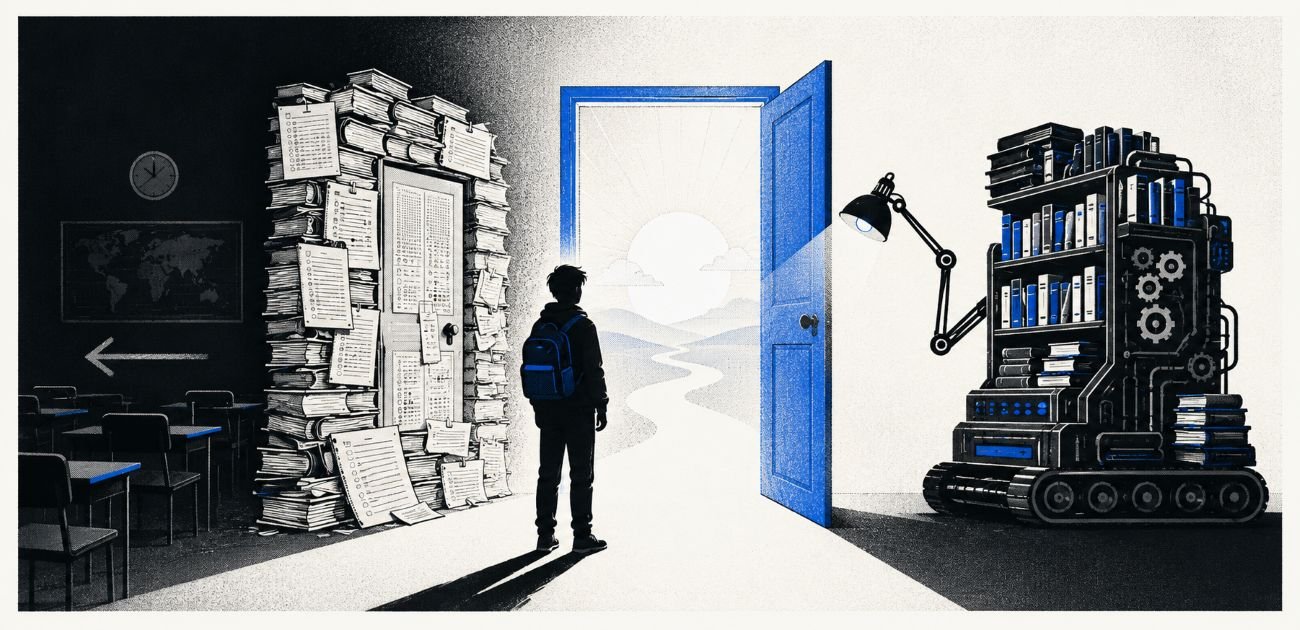
And this is why the panic about AGI in schools and universities feels half right and half asleep. Until now, most teaching has trained us to memorise, repeat, compare, cite and think inside the walls of pre-existing knowledge. Useful, yes. Enough, no. If AGI arrives with knowledge beyond any old library, assistant, tutor or search engine, then the old game of “who can remember the paragraph better” should finally be retired with a small cake and no speeches. Information will be easy. Explanation will be cheap. The expensive thing will be the essence of the person. The real lesson will be how to find what is alive in each individual, what cannot be copied, what cannot be graded by counting quotation marks. Maybe meditation, art, silence and creation will matter more than before, not as decoration after the serious subjects, but as the place where the serious subject begins.
People say future generations will be lost because of AI. Maybe. But maybe they will be less lost than we were, because they may have better tools, better access and fewer excuses to confuse memory with wisdom. The danger is not that students will stop thinking. The danger is that institutions will keep pretending that thinking means repeating the correct dead sentence under exam conditions. Probably there will always be two classes standing against each other: those who use intelligence to control the world and those who use it to become more human. Both may draw from the same hidden source, whether we call it divine love, human love or the strange fire that makes a person create instead of merely copy. The library can be automated. The soul still has to speak for itself.
What does not make sense
- Schools panic about students copying from AI after training them for years to copy the answer key with better posture.
- Universities punish borrowed machine words while still rewarding borrowed human words if the citation style is dressed properly.
- The classroom says “be original” after 12 years of “write what the examiner wants”.
- AI can search, summarise and compare faster than a tired student, yet some courses still act as if memory is the crown jewel.
- The system fears the loss of human thinking while often giving young people very little time to meet their own inner voice.
- Creativity is praised in speeches, then squeezed into rubrics until it files a complaint and leaves.
- The future is sold as danger because that is easier than admitting the present has been running on repetition with a certificate.
Sense check / The numbers
- ChatGPT was publicly introduced by OpenAI on 30 November 2022, which means the education system has had more than 3 years to stop treating generative AI as a suspicious ghost in the staff room. [OpenAI]
- A UNESCO survey of more than 450 schools and universities found that fewer than 10 per cent had developed formal guidance or institutional policies on generative AI use. [UNESCO]
- UNESCO’s AI Competency Framework for Teachers lists 15 competencies across 5 dimensions, including human-centred mindset, ethics of AI, AI foundations, AI pedagogy and professional learning. [UNESCO]
- The UK Department for Education said on 10 June 2025 that teachers can use AI for planning lessons, creating resources, marking work, feedback and administrative tasks, but final responsibility rests with teachers and their school or college. [DfE]
- Gallup reported in May 2026 that fewer than 1 in 10 teachers received formal guidance on any specific AI work activity, while 69 per cent received no guidance for one-to-one instruction or tutoring and 58 per cent received no guidance for grading and student feedback. [Gallup]
The sketch
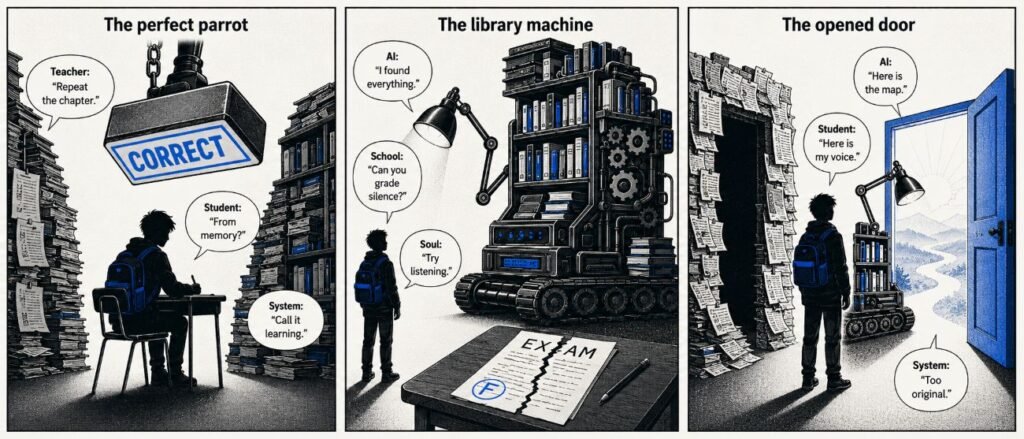
Scene 1: The perfect parrot
A student sits at a desk under a huge stamp reading correct. Behind the student, shelves of books lean over like supervisors.
Dialogue:
Teacher: “Repeat the chapter.”
Student: “From memory?”
System: “Call it learning.”
Scene 2: The library machine
A large AI machine holds open thousands of books while a tiny school desk sits beside it with a cracked exam paper.
Dialogue:
AI: “I found everything.”
School: “Can you grade silence?”
Soul: “Try listening.”
Scene 3: The opened door
A student stands between a door made of copied notes and a door filled with light. The AI holds a lamp instead of a whip.
Dialogue:
AI: “Here is the map.”
Student: “Here is my voice.”
System: “Too original.”
What to watch, not the show
- Exam systems that keep rewarding memory after memory becomes the cheapest part of learning.
- Ed-tech companies selling “personalised learning” while collecting behaviour, attention and dependence.
- Schools using AI to cut teacher workload, then quietly raising the workload again because the machine “saves time”.
- Universities building AI rules faster than they rebuild assessment.
- The plagiarism panic becoming a way to avoid harder questions about originality, purpose and inner voice.
- Art, meditation and creativity being treated as soft extras when they may become the hardest human skills left.
- The split between students with guided AI access and students left with bans, fear and bad detection tools.
- The ownership of learning tools, because whoever owns the tutor may also shape the student.
The Hermit take
AI can carry the library until the shelves beg for mercy.
Education should stop training souls to speak in footnotes.
Keep or toss
Keep / Toss.
Keep AI as tutor, library and lamp.
Toss the old worship of memorised echoes pretending to be wisdom.
Sources
- OpenAI, Introducing ChatGPT: https://openai.com/index/chatgpt/
- UNESCO, less than 10 per cent of schools and universities had formal AI guidance: https://www.unesco.org/en/articles/unesco-survey-less-10-schools-and-universities-have-formal-guidance-ai
- UNESCO, AI Competency Framework for Teachers: https://www.unesco.org/en/articles/ai-competency-framework-teachers
- UK Department for Education, AI in schools and colleges: https://educationhub.blog.gov.uk/2025/06/artificial-intelligence-in-schools-everything-you-need-to-know/
- OECD, Artificial intelligence and education and skills: https://www.oecd.org/en/topics/artificial-intelligence-and-education-and-skills.html
- World Economic Forum, Future of Jobs Report 2025 – Skills outlook: https://www.weforum.org/publications/the-future-of-jobs-report-2025/in-full/3-skills-outlook/
- Gallup, Most Teachers Receive No Formal Guidance on AI Use: https://news.gallup.com/poll/710534/teachers-receive-no-formal-guidance.aspx
- Raz Mihal, Just Love Her official author page: https://razmihal.com/