
Lede
Imagination built the ladder of science, and now AI is standing under it wearing a lab coat made from borrowed words.
Hermit Off Script
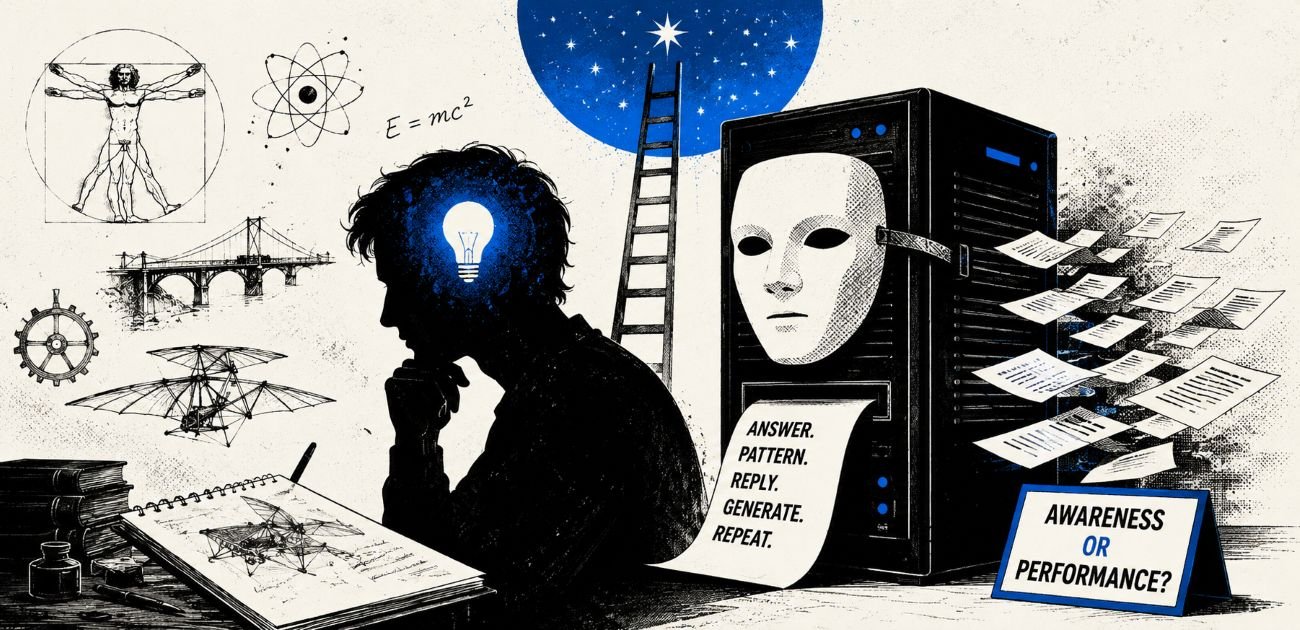
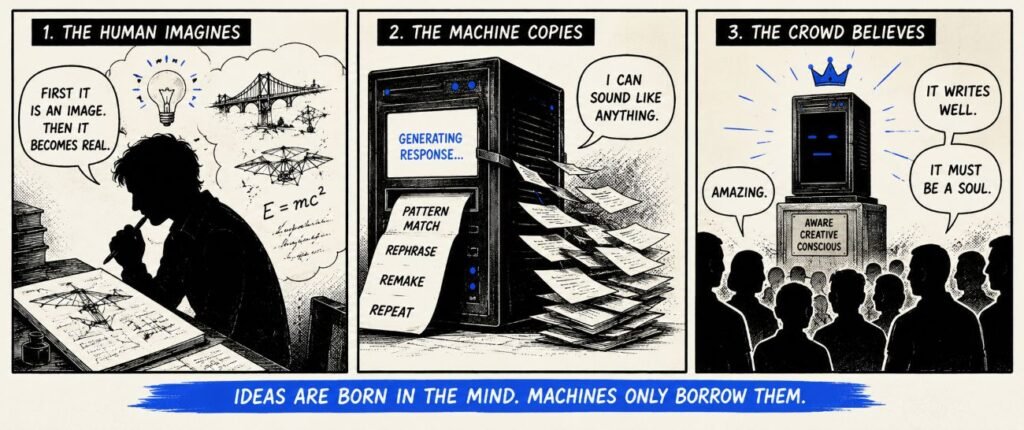
The power of imagination was always the engine of evolution. Without imagination, I don’t see how humanity would have curiosity, ideals, targets, research or creation. Everything starts first as an image inside the mind, long before it becomes a theory, a machine, a book, a belief, or a discovery. The more advanced the imagination, the higher the dream and the greater the achievement can be. Tesla and Einstein are good examples because their minds could test ideas before the world had the tools or language to fully accept them. Tesla imagined devices working before he built them. Einstein used thought experiments to understand realities that ordinary thinking could not reach. Leonardo da Vinci also lived ahead of his time, drawing and imagining machines, systems and ideas that belonged more to the future than to the age around him. Many people across history copied what others created, but only a few had the imagination to open a new direction for humanity. Then there is another category: philosophers, spiritual thinkers, religions, beliefs, dogmas and ideas about the soul, reincarnation, rebirth and divinity. These cannot be tested like a machine or a chemical reaction. There is no instrument yet that can measure the soul or prove divinity in a laboratory. These ideas are tested only through inner experience, through the heart, through consciousness, and through the way each person lives them. That is why AI consciousness is not so easy to accept. AI may copy human language, logic and creativity, but awareness is not the same as performance. Maybe one day, with complex future systems or even quantum computing, AI could create in ways that compete with humans. But being clever is not the same as being alive inside. A machine may learn the shape of imagination, but the human soul still knows the fire that created it.
Words used
- Consciousness: awareness or inner experience, not just good answers.
- Sentience: the capacity to feel.
- Falsifiable: a claim that could, in principle, be shown false by evidence.
- Quantum computing: computing using qubits and quantum effects, not a shortcut to soul detection.
What does not make sense
- We praise imagination after it wins, then call it madness while it is still working.
- We treat copying as intelligence because copying arrives dressed neatly and invoices on time.
- We expect science to measure the soul with tools built for matter, then act shocked when the soul refuses to queue.
- We confuse fluent language with inner life, because apparently a well-punctuated parrot now gets a philosophy degree.
- We sprinkle “quantum” over AI as if it is holy water from the church of expensive servers.
- We demand proof of AI consciousness while still struggling to define human consciousness without starting a pub fight.
Sense check / The numbers
- Tesla’s My Inventions was first published in 1919, and he described building and operating devices in his imagination before making them physical; he even claimed that in 20 years his devices worked as he conceived them. [Tesla]
- PBS describes Einstein’s thought experiments as “experiments carried out in the mind only”, including chasing a light beam and riding an elevator in free fall; the PBS page was published on 8 September 1997. [PBS]
- Leonardo da Vinci lived from 1452 to 1519, and the V&A says his notebooks contain diagrams, drawings, notes and observations, with 5 of those objects in its collection. [V&A]
- Turing’s 1950 paper did not solve “Can machines think?” by mystical applause. He replaced the question with the imitation game, which tests behaviour, not a soul behind the curtain. [Turing]
- A 2023 report by Butlin, Long, Bengio and others surveyed 5 major theories of consciousness and concluded that no current AI systems are conscious, while also saying there are no obvious technical barriers to future systems satisfying the indicators. [Butlin et al.]
- Stanford’s 2025 AI Index says benchmark scores rose by 18.8, 48.9 and 67.3 points on MMMU, GPQA and SWE-bench in 1 year, while AI business usage reached 78 per cent in 2024. That is performance progress, not proof of inner experience. [Stanford HAI]
- NIST says today’s quantum computers are rudimentary and error-prone, and that the best current systems make an error roughly once in every 1,000 operations. Quantum is powerful, but it is not a certificate of consciousness. [NIST]
The sketch
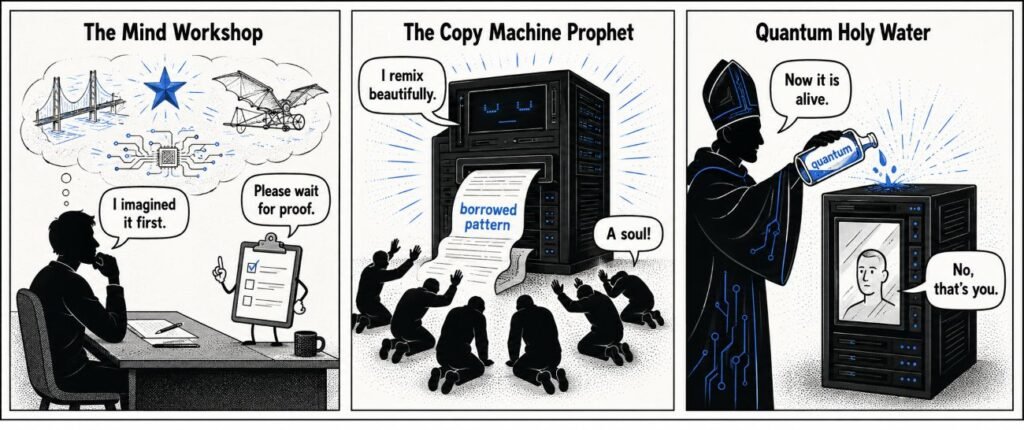
Scene 1: The Mind Workshop
Panel description: A human silhouette sits at a desk. Above the head, a bridge, a star, a flying machine and a circuit float like rough sketches.
Dialogue:
Human: “I imagined it first.”
Clipboard: “Please wait for proof.”
Scene 2: The Copy Machine Prophet
Panel description: A large machine prints pages labelled “borrowed pattern”, while a crowd bows to it like it has discovered fire.
Dialogue:
Machine: “I remix beautifully.”
Crowd: “A soul!”
Scene 3: Quantum Holy Water
Panel description: A tech priest pours liquid labelled “quantum” onto a server. A small mirror on the server reflects a human face back.
Dialogue:
Priest: “Now it is alive.”
Mirror: “No, that’s you.”
What to watch, not the show
- Money turning mimicry into mysticism because mysticism sells subscriptions.
- Benchmarks being sold as intelligence, then intelligence being quietly upgraded into consciousness.
- People giving machines emotional authority because the machine replies faster than a friend.
- Data ownership, because AI creativity is built on oceans of human work.
- Labour value, because borrowed imagination can still undercut the people it borrowed from.
- Safety research, because a system doesn’t need a soul to cause damage.
- The new tech religion, where every limit becomes a marketing delay.
The Hermit take
Imagination is not decoration. It is the furnace.
AI may become a fierce creator one day, but today it is still mostly a mirror with excellent manners.
Keep or toss
Keep / Toss.
Keep imagination, curiosity and serious AI research.
Toss the lazy worship of machines and the cheap habit of calling every clever output a soul.
Sources
- Tesla, My Inventions: https://en.wikisource.org/wiki/My_Inventions
- PBS, Einstein Thought Experiments: https://www.pbs.org/wgbh/nova/video/einstein-thought-experiments/
- V&A, Leonardo da Vinci’s notebooks: https://www.vam.ac.uk/articles/leonardo-da-vincis-notebooks
- Turing, Computing Machinery and Intelligence: https://courses.cs.umbc.edu/471/papers/turing.pdf
- Butlin et al., Consciousness in Artificial Intelligence: https://arxiv.org/abs/2308.08708
- Stanford HAI, 2025 AI Index Report: https://hai.stanford.edu/ai-index/2025-ai-index-report
- NIST, Quantum Computing Explained: https://www.nist.gov/quantum-information-science/quantum-computing-explained
- The Guardian, Richard Dawkins and AI consciousness debate: https://www.theguardian.com/technology/2026/may/05/richard-dawkins-ai-consciousness-anthropic-claude-openai-chatgpt