
Lede
Britain keeps staging a moral punch-up between workers, welfare and the wealthy while the wage packet quietly dies behind the curtain.
Hermit Off Script
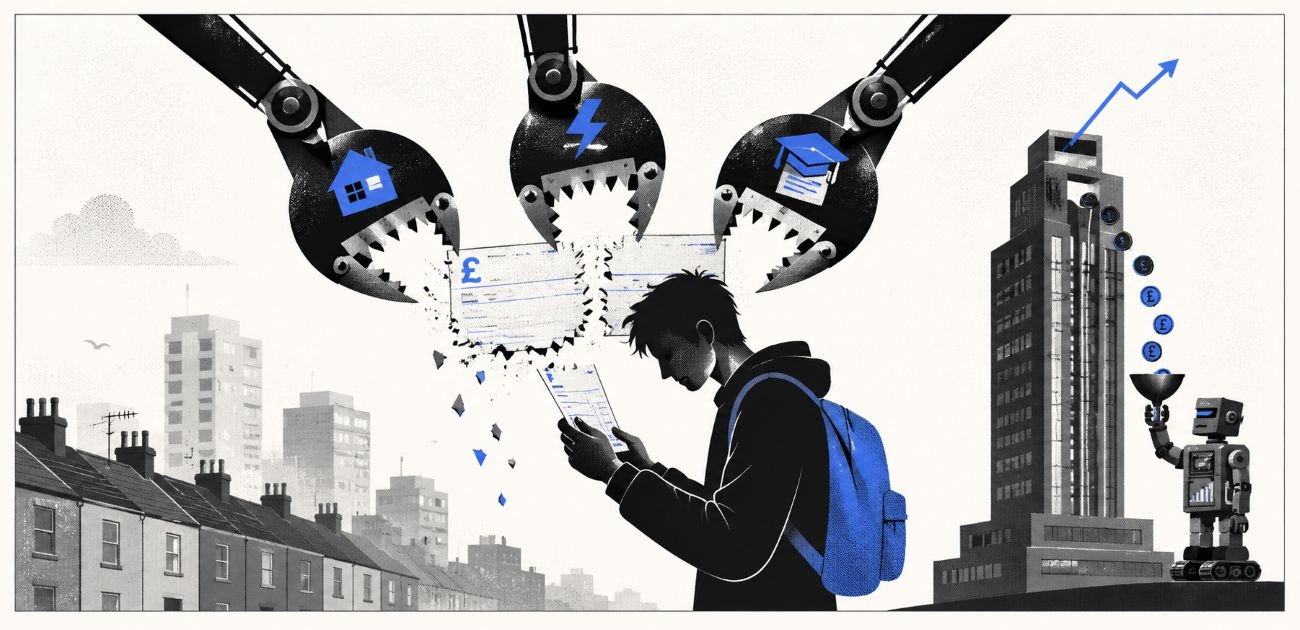
This fight between poor people and rich people is always the same tired theatre: who pays more tax, who is worth more, who deserves help, who doesn’t. The rich say they pay more tax. The poor say they can’t live. But the current situation in the UK is not simply that rich people must be taxed more. The deeper problem is that the economy has gone so wrong that wages do not cover a decent life anymore. Young people study for years, sacrifice time and money, pay tuition fees, build expectations, then find that a suitable job is harder to get than before. For rich people, escape is easier. They can move money, move business, move country, or live somewhere else. For young people, it is harder. They are trapped between rent, debt, weak wages and jobs that ask for experience before giving them a chance to gain any. Successful people often forget that not everyone can be the same, because some people must work in ordinary jobs to make other people successful and rich. Not everyone can be rich, promoted, funded or successful at the same level. That is how society has worked for ages. But the dream was never that everyone becomes a millionaire. The dream was that if you work, you can live decently, afford a home, and not pay for it until years after you are gone from Earth. If wages were better than welfare, and if jobs were respectful, stable and paid enough, most healthy people would not need welfare. Only those who truly cannot work would need support. I think it all starts with affordable education and real support for smart people who want to learn. The UK has many opportunities, yes, but lately it has become harder than ever to live decently on the minimum wage. The UK became attractive because you could work, live a decent life, and still be respected no matter the job. But many people who became rich did it in better times, when the economic climate gave better chances. Now some say there are more opportunities than ever. I don’t think that is true when many businesses are looking for ways not to employ young people, replacing entry-level work with AI software, automation and soon robots. LLMs already sped up the pressure on white-collar jobs. Then the same people look at welfare figures and say young people don’t want to work, or that stress and burnout are excuses. That is looking at figures, not reality. Life became harder in Brexit Britain, but many still don’t want to admit it. They blamed the EU, regulations and worker protections, but those protections exist for a reason. Without values and worker rights, modern slavery would come back dressed as flexibility. And when I hear that the top 10 per cent of income taxpayers pay more than 60 per cent of income tax, I don’t hear a reason to worship inequality. I hear that something has gone badly wrong with wages and wealth distribution across all these years. The tax figure is used to defend the system, but it also exposes the system. Too much money rises to the top, too little stays with the people doing the work, and soon AI and robots will make it even worse if ownership stays in the same hands. The rich will make more money from machines, while poor people receive scraps after paying for goods and services from the same businesses that made the rich richer. The argument is sold as tax fairness, but the real wound is wage dignity. Britain once sold itself as the place where work gave you dignity. Now too often it sells dignity separately, subject to affordability checks.
What does not make sense
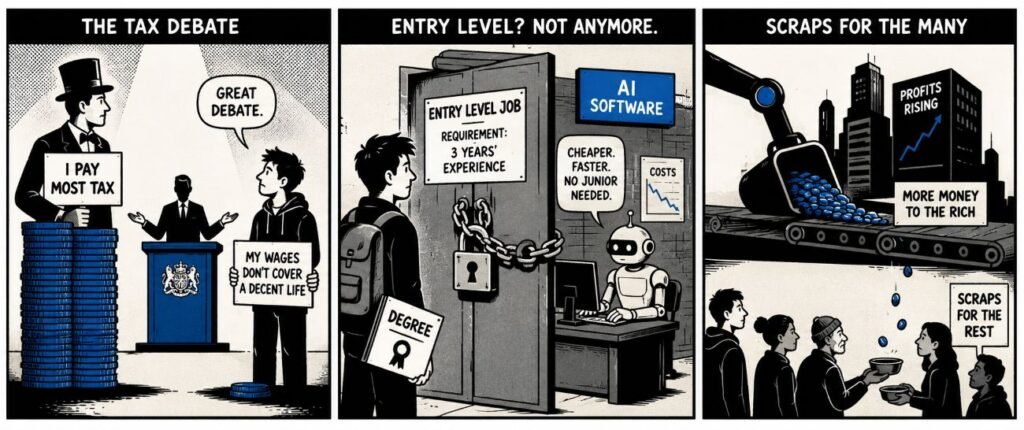
- Saying “the rich pay most tax” while ignoring why ordinary wages need tax credits, housing support and debt just to breathe.
- Calling young people lazy after charging them for education, shrinking junior roles, raising rents and asking for three years’ experience for an entry-level job.
- Treating welfare as the disease when low pay, high rents and poor health are often the symptoms.
- Praising automation as progress while refusing to discuss who owns the machines and who loses the wage.
- Blaming worker protections for economic pain, as if the solution to bad wages is a softer mattress for exploitation.
- Saying “opportunity is everywhere” from a house bought when a deposit didn’t require ancestral treasure.
Sense check / The numbers
- Average regular pay in Great Britain rose by 3.6 per cent in December 2025 to February 2026, but real regular pay rose by only 0.2 per cent after CPIH inflation. That isn’t a golden age. That’s a biscuit with a motivational quote on it. [ONS]
- CPI inflation was 3.3 per cent in the 12 months to March 2026, while CPIH was 3.4 per cent. Prices kept climbing while the public was told to admire the ladder. [ONS]
- The National Living Wage for people aged 21 and over rose to 12.71 pounds an hour from 1 April 2026. That helps, but it doesn’t magically turn Manchester, London or Bristol rent into a gentle woodland creature. [GOV.UK]
- In 2025, England needed an extra 104,000 pounds beyond five times average earnings to buy an average home. The housing market didn’t pull up the ladder. It laminated it and sold viewing appointments. [ONS]
- The top 10 per cent of income taxpayers contribute over 60 per cent of income tax receipts, according to the House of Commons Library. That is a tax fact, but it doesn’t cancel the wage fact: a country can rely on high earners for revenue and still underpay the people keeping the lights on. [Commons Library]
The sketch
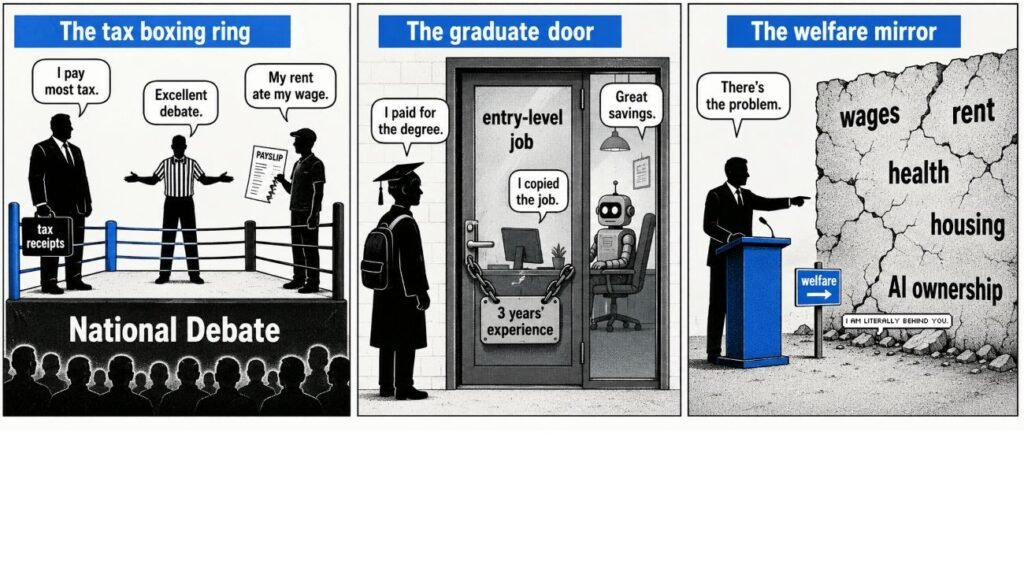
Scene 1: The tax boxing ring
Panel description: A giant boxing ring labelled “National Debate”. One corner has a tall figure with a briefcase labelled “tax receipts”. The other has a worker holding a payslip full of bite marks.
Dialogue:
Briefcase: “I pay most tax.”
Worker: “My rent ate my wage.”
Referee: “Excellent debate.”
Scene 2: The graduate door
Panel description: A young graduate stands before a locked door labelled “entry-level job”. The lock reads “3 years’ experience”. Behind the door, a small robot is already sitting at the desk.
Dialogue:
Graduate: “I paid for the degree.”
Robot: “I copied the job.”
Employer: “Great savings.”
Scene 3: The welfare mirror
Panel description: A politician points at a tiny welfare sign while standing in front of a huge cracked wall labelled “wages, rent, health, housing, AI ownership”.
Dialogue:
Politician: “There’s the problem.”
Wall: “I am literally behind you.”
What to watch, not the show
- Who owns the AI tools replacing junior work.
- Whether wages rise faster than rent, food, energy and transport.
- Whether employers train young people or just demand ready-made workers.
- Whether tax debate becomes an excuse to ignore housing policy.
- Whether welfare cuts are sold as discipline while low-pay business models are treated as sacred cows.
- Whether worker protections get blamed for problems caused by weak investment, poor planning and asset inflation.
- Whether education stays a ladder or becomes an invoice with a campus map.
The Hermit take
A decent country doesn’t make work feel like a subscription to exhaustion.
Tax is the argument on stage. Wages are the body in the alley.
Keep or toss
Keep / Toss.
Keep ambition, education and work ethic.
Toss the fairy tale that poverty is mainly a personality defect.
Sources
- ONS, Average weekly earnings in Great Britain: https://www.ons.gov.uk/employmentandlabourmarket/peopleinwork/employmentandemployeetypes/bulletins/averageweeklyearningsingreatbritain/april2026
- ONS, Consumer price inflation, UK: https://www.ons.gov.uk/economy/inflationandpriceindices/bulletins/consumerpriceinflation/march2026
- GOV.UK, National Minimum Wage and National Living Wage rates: https://www.gov.uk/government/publications/the-national-minimum-wage-in-2026/the-national-minimum-wage-in-2026
- ONS, Housing affordability in England and Wales: https://www.ons.gov.uk/peoplepopulationandcommunity/housing/bulletins/housingaffordabilityinenglandandwales/2025
- House of Commons Library, Tax statistics: an overview: https://commonslibrary.parliament.uk/research-briefings/cbp-8513/
- ONS, Young people not in education, employment or training: https://www.ons.gov.uk/employmentandlabourmarket/peoplenotinwork/unemployment/bulletins/youngpeoplenotineducationemploymentortrainingneet/february2026
- Resolution Foundation, Lost in transition: https://www.resolutionfoundation.org/publications/lost-in-transition/
- GOV.UK, The impact of AI on UK jobs and training: https://www.gov.uk/government/publications/the-impact-of-ai-on-uk-jobs-and-training
- NFER, Up to three million UK jobs at risk over the next decade: https://www.nfer.ac.uk/press-releases/up-to-three-million-uk-jobs-at-risk-over-the-next-decade-says-report/
One response
[…] point at migrants, point at culture, point at “woke”, point anywhere except the money. Brexit was sold with the confidence of a man selling umbrellas in a drought. The UK Statistics Authority […]