Lede
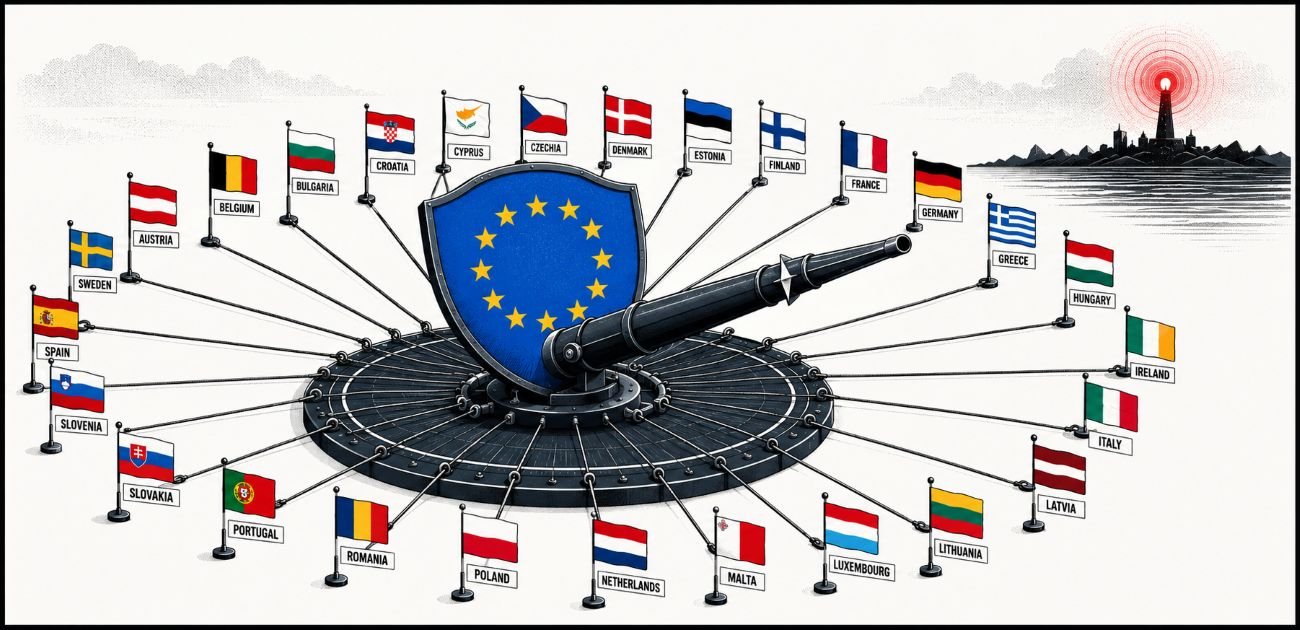
The EU built a shared market powerful enough to shape global rules, then left foreign policy behind a door that still needs 27 keys.
Hermit Off Script
The EU should speak with one voice on foreign policy and defence because a political bloc that cannot decide how to protect itself will eventually depend on somebody else to decide for it. Europe already has the institutions, the money, the armed forces and the legal structure. The EU has common economic rules, courts, trade policy and standards that reach into almost every part of national life. Yet when the subject becomes war, sanctions, weapons or an immediate threat, the system returns to 27 governments protecting their own position first and the whole project second.
The different languages, traditions and national laws aren’t the weakness. They are part of Europe and should remain. The weakness is having 27 defence ministries buying equipment separately, setting different priorities and waiting for national approval while Russia uses military force, while China can use trade, investment, technology and strategic dependency to pressure individual governments. Those powers don’t need to control the whole EU. They only need one useful veto, one dependent economy or one government willing to delay a common response.
If the EU accepts shared rules for banking, trade, competition and law because disorder would damage every member, defence should also have a common core. That means joint procurement, compatible equipment, shared intelligence, cyber defence, air defence, minimum readiness and one chain of command for an agreed emergency.
Trump can mock Europe because European governments still rely heavily on American protection while presenting separate defence budgets as proof of sovereignty. The EU spends hundreds of billions, contains a nuclear-armed member in France, fields large national forces and still struggles to act as one strategic power. The money exists. The soldiers exist. The political authority does not.
But one European army cannot mean handing military power to an office in Brussels and calling the problem solved. A shared force would need elected authority, parliamentary scrutiny, legal limits, national representation and clear rules for when force can be used. Otherwise Europe would replace paralysis with power that nobody can properly control.
I don’t want one central government deciding every foreign dispute or erasing national identity. I want one binding defence structure when the survival of European democracies is at stake. Many countries can remain. The command facing an incoming missile cannot.
P.S. Update – 2 August 2026
The Ceuta border crisis exposed a similar failure of divided authority: one emergency crossed the border while policing, asylum rules and political responsibility remained scattered across different systems. Europe still meets one crisis with several desks and no single receipt.
What does not make sense
- The EU can impose common economic rules across 27 countries, but common foreign policy can still be stopped by one government.
- European countries defend national sovereignty by depending heavily on an American president they cannot elect.
- Governments announce higher defence budgets while continuing to duplicate weapons, procurement systems and command structures.
- Europe discusses strategic independence while many of its military systems still rely on United States intelligence, logistics and technology.
- A European army is demanded without first defining who commands it, who dismisses that commander and who authorises military action.
- National traditions are presented as an argument against shared defence, although nobody has proposed defending Estonia with a Portuguese grammar book.
- Trump is treated as the source of Europe’s weakness when he is mainly the man pointing at the unlocked door and charging admission.
Sense check / The numbers
- The European Union has 27 member states, and common foreign and security policy remains one of the areas where the Council generally requires unanimity. One government can therefore delay or block a position supported by the other 26. [Council of the EU]
- Article 42 of the Treaty on European Union says the common defence policy may lead to a common defence, but only when the European Council decides unanimously and member states follow their constitutional procedures. The doorway exists, but it still has 27 locks. [EUR-Lex]
- EU defence spending reached EUR 343 billion in 2024, a rise of 19 per cent from 2023 and equal to 1.9 per cent of EU gross domestic product. The European Defence Agency projected EUR 381 billion and 2.1 per cent for 2025. [European Defence Agency]
- The EU Rapid Deployment Capacity became operational in May 2025 and can deploy up to 5,000 troops for external crisis operations. That is useful, but it isn’t a continental army capable of defending Europe. [EEAS]
- European NATO allies and Canada spent more than USD 571 billion on defence in 2025 in constant 2021 prices, equal to 2.3 per cent of their combined gross domestic product. The figure was 1.4 per cent in 2014. Europe has increased the money considerably. The missing item is still unified political power. [NATO]
The sketch
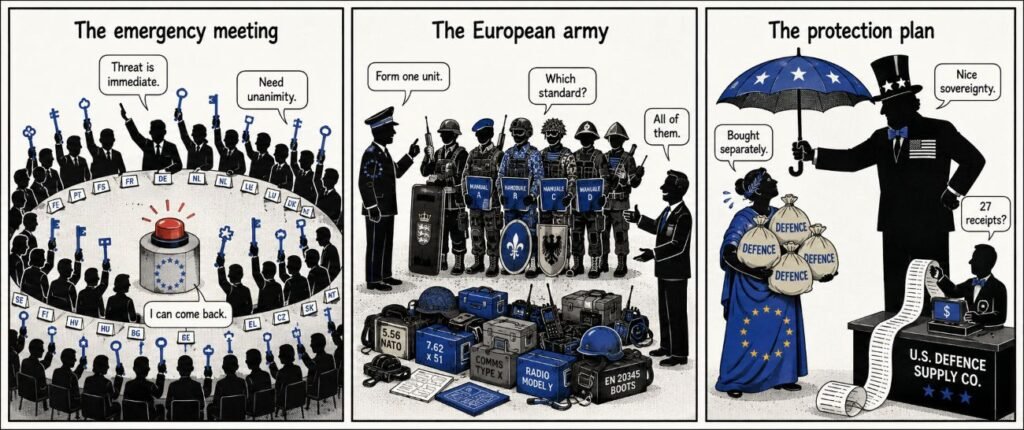
Scene 1: The emergency meeting
Twenty-seven ministers stand around one red alarm button, each holding a different key.
Dialogue:
Chair: “Threat is immediate.”
Minister: “Need unanimity.”
Alarm: “I can come back.”
Scene 2: The European army
Twenty-seven soldiers arrive wearing different equipment and carrying incompatible instruction manuals.
Dialogue:
General: “Form one unit.”
Soldier: “Which standard?”
Supplier: “All of them.”
Scene 3: The protection plan
Europe stands beneath a small umbrella held by the United States while carrying several bags marked defence spending.
Dialogue:
Trump: “Nice sovereignty.”
Europe: “Bought separately.”
Cashier: “27 receipts?”
What to watch, not the show
- Whether unanimity is removed or limited for sanctions, security assistance and urgent foreign-policy decisions.
- Whether governments buy weapons jointly rather than announcing similar national programmes that cannot work together.
- Whether Europe creates a permanent command structure instead of another temporary committee with an impressive abbreviation.
- Whether any shared military authority is controlled by elected institutions and national parliaments.
- Whether European defence strengthens NATO or wastes money duplicating structures already available through NATO.
- Whether Russia, China or other governments use trade, energy, political funding or disinformation to influence individual European vetoes.
- Whether defence spending produces ammunition, air defence, logistics and trained personnel rather than patriotic press conferences.
- Whether the United Kingdom can join a wider European defence structure without rejoining the European Union.
The Hermit take
Europe has enough money and soldiers to matter.
It lacks the political machinery to make them arrive as one power.
Keep or toss
Keep / Toss.
Keep Europe’s languages, national cultures, democratic governments and cooperation with NATO.
Toss the veto paralysis, duplicated defence systems and the fantasy that strategic dependence is national sovereignty.
Sources
- Council voting rules and unanimity: https://www.consilium.europa.eu/en/council-eu/how-does-the-council-vote/unanimity/
- Treaty on European Union, Article 42: https://eur-lex.europa.eu/legal-content/EN/TXT/HTML/?uri=CELEX%3A12008M042
- EU defence spending in 2024 and 2025 projection: https://eda.europa.eu/news-and-events/news/2025/09/02/eu-defence-spending-hits-343-bln-in-2024-eda-data-shows
- EU Rapid Deployment Capacity: https://www.eeas.europa.eu/eeas/common-security-and-defence-policy-eu-rapid-deployment-capacity-becomes-operational_en
- NATO defence expenditure and 5 per cent commitment: https://www.nato.int/en/what-we-do/introduction-to-nato/defence-expenditures-and-natos-5-commitment
- Trump’s warning that the US may not defend NATO members that spend too little: https://www.reuters.com/world/trump-if-nato-members-dont-pay-us-wont-defend-them-2025-03-07/
- EU-China summit, trade pressure and export controls: https://www.consilium.europa.eu/en/press/press-releases/2025/07/24/25th-eu-china-summit-eu-press-release/
- EU dependence on Chinese critical raw materials: https://commission.europa.eu/topics/competitiveness/green-deal-industrial-plan/european-critical-raw-materials-act_en
One response
[…] and lawful returns as five separate meetings in five separate buildings. This is another version of Europe’s problem with divided authority: the crisis crosses borders while responsibility remains trapped inside national offices. Spain had […]