
Lede
We count love by years and books by sales because meaning refuses to fit neatly into a spreadsheet.
Hermit Off Script
No relationship in my life has lasted longer than 6 years. I mean the whole catalogue: marriage, living with someone I loved, or loving someone who rejected me, ignored me or managed both. Apparently, the heart also offers unpaid internships.
And yes, I know how it sounds to roast a feeling like this. Why not keep quiet? Why place private failure on a public table and invite everyone to inspect the cracks?
Because this has been part of my way of life, and I have written books from it while wrestling with the machinery that turns spiritual work into ratings, keywords and sales. One is published here. One was published a long time ago in another country. Another is waiting to be published. I am not rushing. Publishing has not become the income that keeps me alive, which may say more about the usual meaning of success than any motivational speech ever will.
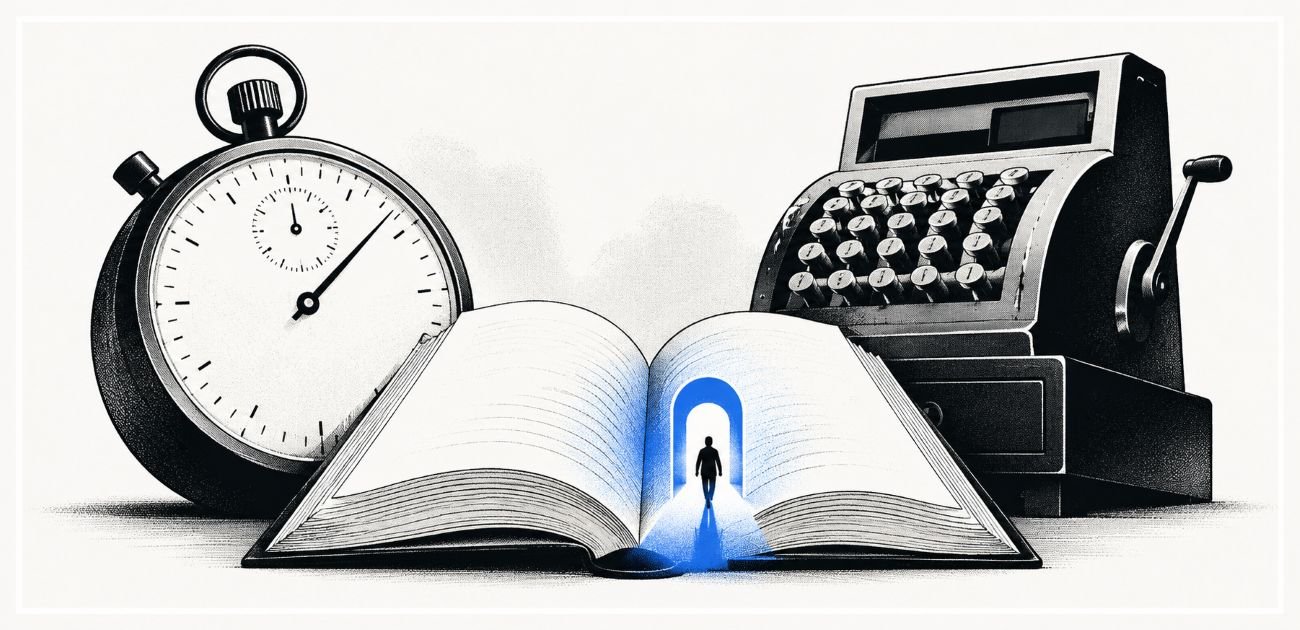
The public formula is wonderfully tidy: if it sells, it must be right. If it does not sell, perhaps it should apologise for existing. A book can be spiritually empty but commercially excellent, and the cash register will still pronounce it profound.
If I measured success by readers, ratings and downloads, the result would not be a total failure. It might even look respectable. But that is still someone else’s scoreboard, built by platforms that reward visibility more easily than meaning. I am not greatly interested in how many people clicked, bought, praised or abandoned a book halfway through while promising to return after dinner.
My real question is harder and far less useful to an algorithm: did anyone live better because of it? Did someone understand and accept that divine love is more than a simple feeling? Did the words help anyone see love beyond possession, romance, reward or the panic of being chosen?
That line of thought continues through the books because the idea is still opening rather than closing. The market can count copies. It cannot count awakenings.
P.S. This roast is based on personal experience, but memory is not a court transcript and satire is not a witness statement. Some details have been condensed or framed for clarity, humour and reflection. The feelings are real. The interpretation is mine.
What does not make sense
- Treating the length of a relationship as proof of its quality, as though misery becomes meaningful after renewing the contract.
- Assuming rejection cancels love rather than ending the possibility of a mutual relationship.
- Calling a book successful only after enough strangers have paid for it.
- Using ratings and downloads as evidence that a reader’s inner life changed.
- Expecting spiritual writing to justify itself with the same scoreboard used for shampoo and kitchen appliances.
- Praising authors for sincerity, then asking where they rank on the sales chart.
- Pretending that commercial success proves an idea is true rather than successfully marketed.
Sense check / The numbers
- CREATe’s 2022 author earnings study was issued to around 60,000 writers. Of the respondents, 1,104 supplied earnings information for the 2020/21 tax year. [CREATe]
- Authors who spent at least 50 per cent of their working time writing reported median self-employed writing earnings of GBP 7,000. That was a real-terms fall of 38.2 per cent from the 2018 survey. [CREATe]
- Across the report’s wider author sample, median self-employed writing earnings were GBP 2,000 for 2020/21, down 38 per cent in real terms from 2016/17. Publishing a book and earning a living remain distant relatives who exchange cards at Christmas. [CREATe]
- For opposite-sex marriages ending in divorce in England and Wales in 2023, the median duration was 12.7 years. Among those lasting less than 30 years, the most common duration was exactly 6 years, accounting for 5,418 divorces. The 6-year mark is apparently less a private curse than a surprisingly busy exit. [ONS]
The sketch
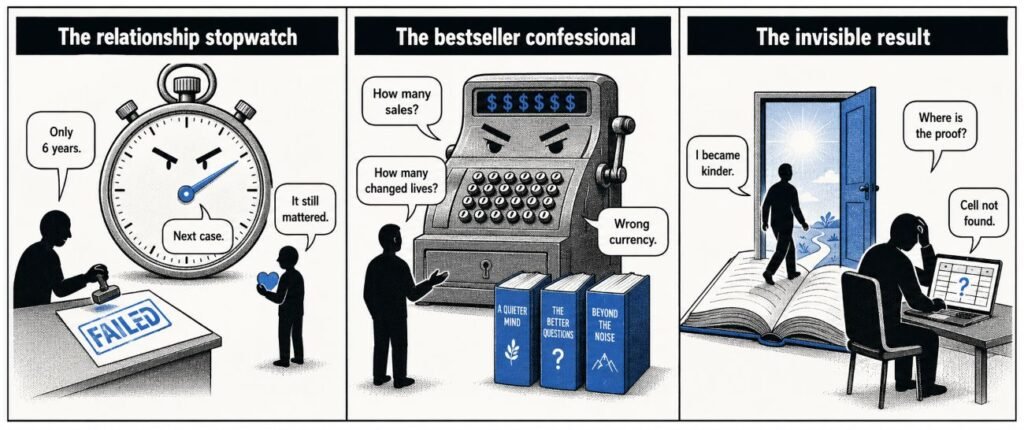
Scene 1: The relationship stopwatch
A large stopwatch towers over a person holding a small heart. A scorekeeper stamps a form marked “FAILED”.
Dialogue:
Scorekeeper: “Only 6 years.”
Person: “It still mattered.”
Stopwatch: “Next case.”
Scene 2: The bestseller confessional
An author stands before a cash register wearing a judge’s wig. Three books sit beside him.
Dialogue:
Cash Register: “How many sales?”
Author: “How many changed lives?”
Cash Register: “Wrong currency.”
Scene 3: The invisible result
A reader walks through a doorway rising from an open book while an accountant searches an empty spreadsheet.
Dialogue:
Accountant: “Where is the proof?”
Reader: “I became kinder.”
Spreadsheet: “Cell not found.”
What to watch, not the show
- Sales charts reward visibility, timing and marketing power more reliably than depth.
- Rating systems compress private experiences into sortable stars because platforms need quick data.
- Publishing economics pushes authors towards constant promotion while writing income remains painfully low.
- Romantic culture treats duration as proof, although a long relationship can become habit wearing matching towels.
- Spiritual ideas are easier to sell after they have been simplified, branded and stripped of their difficulty.
- Platforms can count purchases and downloads but rarely show whether a reader finished, understood or applied a book.
- A culture obsessed with measurable success eventually stops attempting anything whose value appears slowly.
The Hermit take
A relationship can end without becoming meaningless.
A book can sell quietly and still open a door that money cannot see.
Keep or toss
Keep / Toss.
Keep the honest measure of changed lives.
Toss the cash register pretending to be a philosopher.
Sources
- CREATe, UK Authors’ Earnings and Contracts 2022: https://www.create.ac.uk/wp-content/uploads/2022/12/ALCS_AuthorsEarningsReport_accessibleformat.pdf
- Office for National Statistics, Divorces and dissolutions in England and Wales: 2023: https://www.ons.gov.uk/peoplepopulationandcommunity/birthsdeathsandmarriages/divorce/bulletins/divorcesinenglandandwales/2023