
Lede
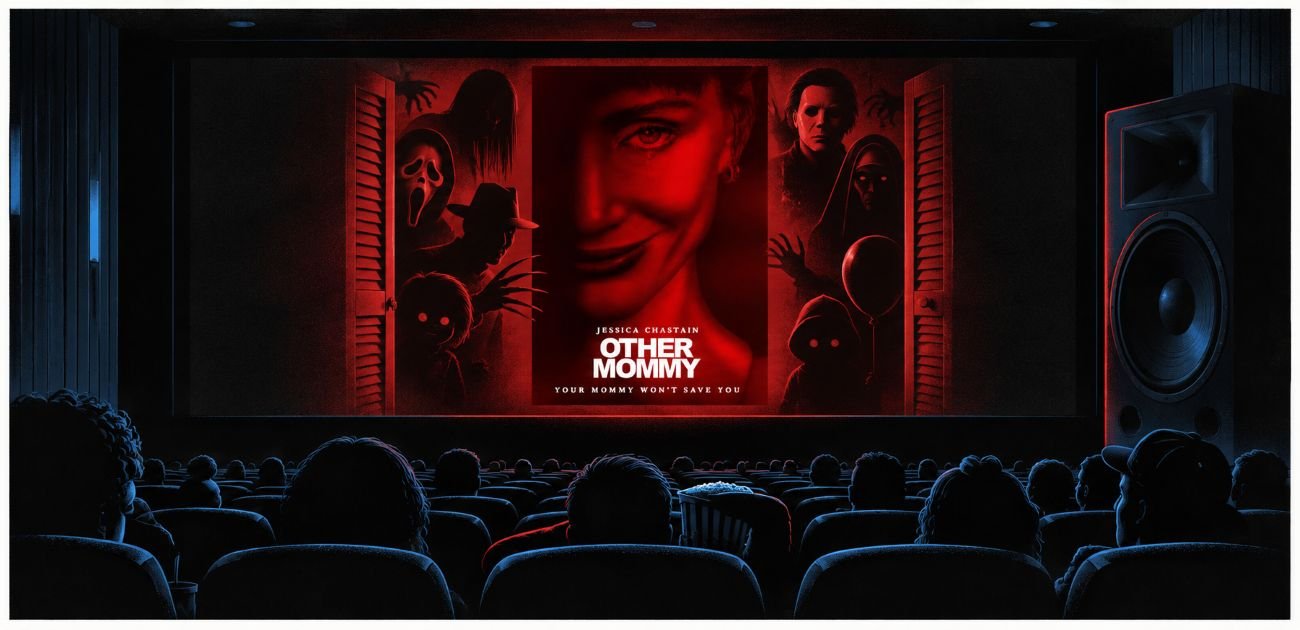
Other Mommy finally gets the cinema sound right, then squeezes a whole family reunion of familiar horror ideas into a picture that barely seems interested in filling the screen.
Hermit Off Script
Other Mommy has made me wonder whether some horror directors still remember that their films are supposed to be shown on actual cinema screens. After Obsession and Backrooms, here I am again, sitting in front of an enormous screen and feeling as though somebody has placed a television in the middle of it.
I really don’t know whether this is becoming a trend, whether it’s a deliberate artistic decision or whether the people making and distributing these films simply don’t care how they end up looking in an ordinary cinema. I’m not demanding that every film fill every inch of the screen. There are perfectly good reasons for choosing different formats. But when I go to the cinema, I expect the big screen to offer something that my television cannot. Otherwise, what exactly am I paying for? A larger black border?
At least the sound was good this time. That deserves a mention because previous experiences left me wondering whether some cinema sound systems were designed to reproduce horror or simply cause it. This time, I could actually enjoy the sound without wondering whether something was wrong with the equipment. A welcome improvement, even if getting the basics right shouldn’t feel like a special achievement.
As for the film itself, it was OK. Nothing particularly terrible, but nothing that made me think I’d discovered the next great horror film either. What kept distracting me was the impression that I was watching several horror genres muddled together. Ghosts, poltergeists, the unsettling expressions and supernatural tricks from Smile, and enough nightmare logic that A Nightmare on Elm Street could easily have wandered into the story.
I could almost imagine Freddy Krueger turning up halfway through, looking around and deciding he had finally found a film where nobody would question his presence.
Now, I’m not suggesting that Rob Savage deliberately copied any of these films. I have no evidence of that, and these are simply the associations that came into my mind while watching. Perhaps the influences are entirely different. But the result felt like somebody had gathered several familiar horror ingredients, thrown them into the same production and hoped that the combination would feel new.
Some moments worked. Others felt familiar enough that I could almost guess which corner of horror cinema they had come from.
And that’s what left me slightly disappointed. The central idea of a frightening double of your own mother has enough potential to carry a film without inviting every ghost, poltergeist and nightmare creature in the neighbourhood.
The sound finally managed to fill the cinema. The picture and the imagination still seemed to be renting a smaller room.
Movie synopsis
Eight-year-old Bela lives with her parents, Ursula and Russ, in a household troubled by growing tensions. When a sinister presence begins appearing from her closet, Bela encounters something that looks and sounds remarkably like her mother. She calls the entity “Other Mommy”.
As the mysterious figure becomes increasingly involved in Bela’s life, its threatening behaviour forces the family to confront a supernatural danger that exploits the bonds between parent and child.
Directed by Rob Savage, the film is adapted from Josh Malerman’s novel Incidents Around the House and combines supernatural horror with a story about family relationships, trust and vulnerability.
Cast and credits
Director: Rob Savage
Writers: Nathan Elston (screenplay), based on the novel Incidents Around the House by Josh Malerman
Genre: Supernatural horror, psychological horror, mystery and thriller
Main cast: Jessica Chastain (Ursula / Other Mommy), Jay Duplass (Russ), Arabella Olivia Clark (Bela), Dichen Lachman, Arian Moayed and Karen Allen
Composer: Patrick Jonsson
Production company/studio: Blumhouse Productions, Atomic Monster and Spin a Black Yarn; distributed by Universal Pictures
Runtime: 93 minutes
Release year and platform: 2026; theatrical release in the UK and United States on 9 October 2026
What does not make sense
- A smaller picture inside a bigger cinema screen. Other Mommy uses a 2.20:1 image, but reports from some screenings describe that picture sitting inside a smaller projection area with black borders on every side. A premium-sized auditorium can end up presenting what looks like an expensive television.
- A cinema-format decision becomes the audience’s problem. Different image shapes are legitimate creative choices. Poorly adapted presentation is a separate issue. Film distributors and cinemas should make those choices work together rather than expecting viewers to accept whatever rectangle appears.
- The director may be getting blamed for the wrong thing. Framing, digital cinema packaging and local projection settings are different decisions. A boxed picture does not, by itself, establish who was responsible.
- The central horror idea has to compete with a crowded collection of familiar scares. A creature imitating a child’s mother is disturbing enough. Adding more supernatural tricks does not automatically make the threat more original.
- The familiar horror vocabulary threatens to overwhelm the story. Shapeshifting, sinister expressions, ghostly manifestations and nightmare imagery can all work individually. Together, they risk becoming a catalogue of devices instead of a distinctive film.
- Good cinema sound has become an unexpected achievement. Clear, enjoyable sound should be a normal part of the ticket price, not something that feels worthy of congratulations.
Sense check / The numbers
- 9 October 2026 and 93 minutes. Other Mommy received its theatrical release on 9 October, with a listed runtime of 1 hour and 33 minutes. Its relatively short running time helps keep the story moving, but does not necessarily give its competing horror ideas enough room to develop. [Universal Pictures] [IMDb]
- 2.20:1 inside 1.85:1. A published cinema review identifies the film’s image as 2.20:1, carried in a 1.85:1 flat cinema package. Projectionist discussions report the same F220 presentation. In some 2.39:1 auditoriums, that can produce black borders around all four sides of the image unless the presentation is appropriately optimised. These reports explain the likely technical problem, but do not establish the configuration of every screening. [DVDfever] [Projectionist reports]
- 2 principal cinema presentation formats. The InterSociety Digital Cinema Forum identifies Flat at 1.85:1 and Scope at 2.39:1. Film imagery can use other ratios, but the way it is packaged and projected matters. A deliberate frame shape does not require an unnecessarily small-looking picture. [ISDCF]
- 2 versions of the same mother. Jessica Chastain plays both Ursula and the sinister Other Mommy. The film’s main conflict therefore already contains a strong visual and psychological premise: the familiar person and the threatening imitation. That is a substantial idea without needing a parade of additional horror conventions. [Universal Pictures]
- USD 27.5 million in its opening North American weekend. According to Associated Press, Other Mommy opened in 3,365 cinemas and reached USD 45.2 million worldwide during its debut. Commercial interest is clearly present. Those figures measure ticket sales, however, not whether every auditorium delivered an impressive presentation. [AP]
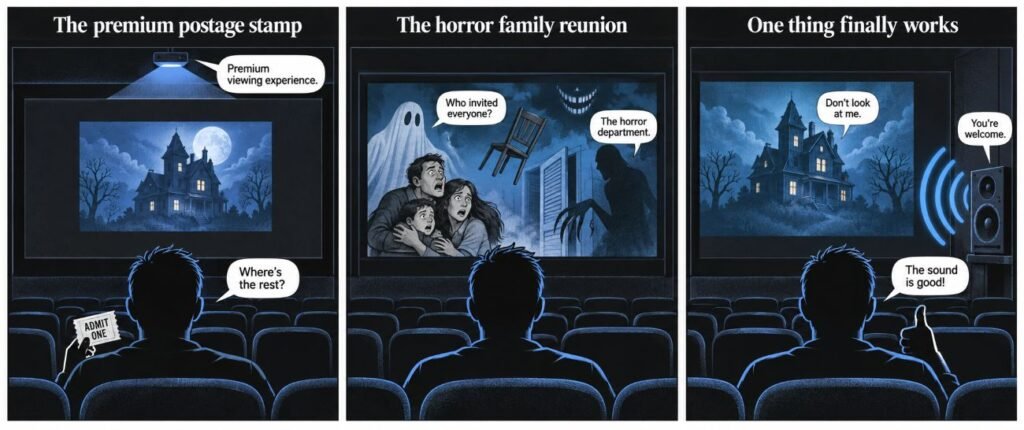
The sketch
Scene 1: The premium postage stamp
An enormous cinema screen contains a much smaller glowing rectangle surrounded by black space. A lone viewer sits beneath it, holding a cinema ticket.
Dialogue:
Viewer: “Where’s the rest?”
Projector: “Premium viewing experience.”
Scene 2: The horror family reunion
Inside the small cinema image, a ghost, a floating chair, an enormous grin and a shadowy nightmare figure crowd around a frightened family standing beside a closet.
Dialogue:
Ghost: “Who invited everyone?”
Nightmare: “The horror department.”
Scene 3: One thing finally works
The same viewer sits in the auditorium. A large speaker sends out clean sound waves, while the small picture remains unchanged.
Dialogue:
Viewer: “The sound is good!”
Speaker: “You’re welcome.”
Screen: “Don’t look at me.”
What to watch, not the show
- Cinema distribution and presentation: A film’s chosen aspect ratio should be supported by sensible digital packaging and projection arrangements. The distinction between creative framing and avoidable windowboxing deserves more attention.
- Cinema accountability: Customers should be able to distinguish intentional presentation choices from auditorium configuration problems. Better explanations and consistent quality checks would help.
- The economics of familiar horror: The strong opening box office demonstrates continuing demand for supernatural horror. Commercial success, however, cannot settle whether a film’s creative ideas feel fresh.
- Genre recycling: Modern horror increasingly draws on a large shared vocabulary of supernatural doubles, distorted faces, childhood fears and threatening domestic spaces. The challenge is making those familiar elements serve a particular story.
- Sound quality across screenings: The earlier complaints surrounding The End of Oak Street showed how an auditorium’s audio presentation can become more memorable than the film. Other Mommy’s more enjoyable sound is a useful reminder that individual screening experiences can differ.
- The cinema-versus-home question: Films presented in small-looking rectangles invite comparisons with home viewing. Cinema needs to offer an advantage that goes beyond a larger wall and a ticket.
The Hermit take
Other Mommy is watchable, but its collection of familiar horrors never quite becomes a distinctive nightmare.
At least the sound has improved. The cinema screen still needs convincing.
Keep or toss
Keep / Toss.
Keep the unsettling central premise, the capable cast, the occasional effective scares and the welcome improvement in sound.
Toss the crowded horror recipe and the cinema presentation that turns an enormous screen into a frame around a much smaller picture.
Sources
- Universal Pictures, official film details and production information: https://www.othermommymovie.ca/
- IMDb, film details, cast, crew, composer and runtime: https://www.imdb.com/title/tt36586020/
- Rotten Tomatoes, film synopsis and theatrical information: https://www.rottentomatoes.com/m/other_mommy
- DVDfever, cinema review and discussion of the 2.20:1 image and 1.85:1 package: https://dvd-fever.co.uk/other-mommy-the-dvdfever-cinema-review-jessica-chastain/
- Cinema projectionist discussion of F220 presentation and auditorium settings: https://www.reddit.com/r/MovieTheaterEmployees/comments/1x14pli/other_mommy_aspect/
- InterSociety Digital Cinema Forum, projector aspect ratios and formats: https://www.isdcf.com/registry/projectoraspectratios/
- Associated Press, opening weekend box office, 12 October 2026: https://apnews.com/article/2ea3e0be66e1761851209e45e34ca32c
- The Guardian, film review and discussion of the competing horror elements: https://www.theguardian.com/film/2026/oct/09/other-mommy-movie-review
Disclaimer: This article contains satire and personal film criticism. The cinema presentation and sound comments describe an individual viewing experience, not a technical audit of the auditorium. Comparisons with other horror films are subjective impressions, not allegations of copying.
Leave a Reply