
Lede
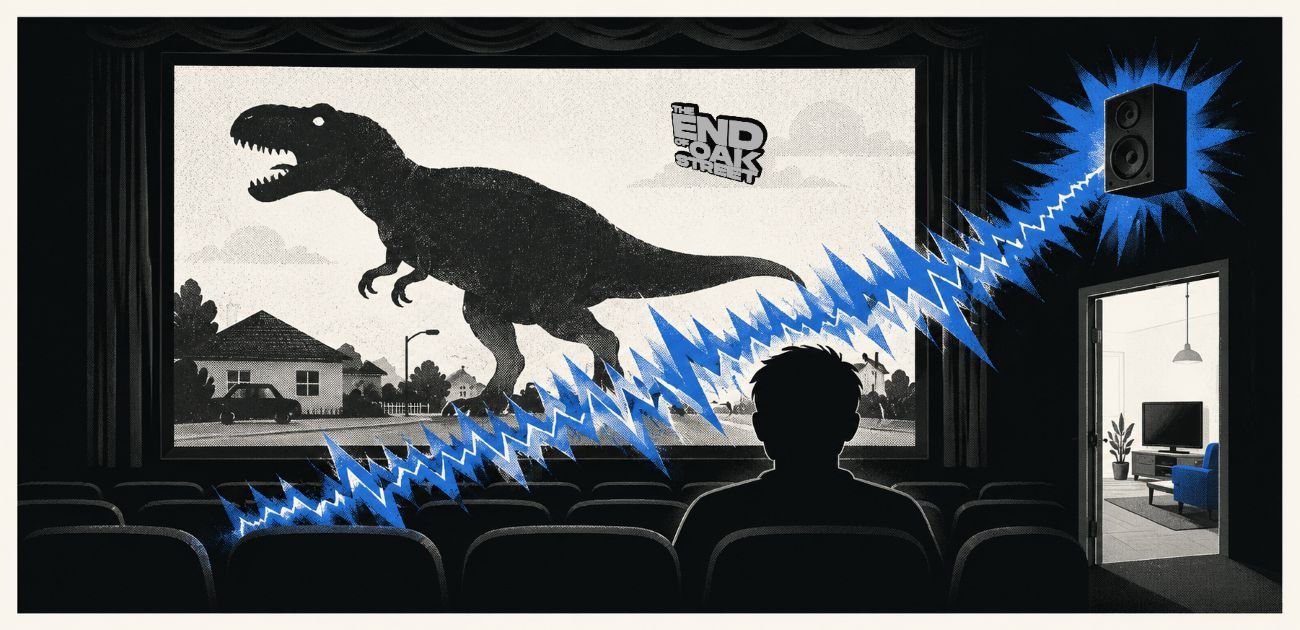
A watchable dinosaur film became secondary to a cinema screen whose sound made me miss the television I had left at home.
Hermit Off Script
Maybe I’m too pretentious, but if Screen 1 is supposed to be anywhere near the forefront of cinema, I have a problem. That same creepy, high-pitched, almost voice-like sound was back. It was in the commercials. It was in the trailers. Then it followed me into the movie itself. At some point I stopped wondering whether The End of Oak Street had bad sound and started questioning my own reality. Am I the only one hearing this? Does everybody else simply accept it? Have they never watched something on a better screen or listened through a better sound system at home or in another cinema?
I can’t diagnose an auditorium from my seat, but there is an obvious common denominator. When advertisements, unrelated trailers and the feature all arrive with the same irritating sound character, I can’t sensibly blame every film. So I owe Obsession, Backrooms and a few others a partial apology. I blamed the movies when the screen may have been the bigger problem.
And that changes the whole cinema argument for me. Unlimited sounds wonderful until unlimited means unlimited opportunities to sit through a sound system that gets on my nerves. I am reaching the point where I would rather give up Screen 1 and probably ordinary screens altogether. Paying less, or having the screening included in a membership, doesn’t make an irritating experience suddenly enjoyable.
Once I mentally removed the cinema problem, The End of Oak Street itself was watchable. It had ups and downs, but it did the job. The dinosaurs also made me feel as though Jurassic Park had quietly opened another branch office. Maybe part of that is simply how normal visual effects like these have become. Things that once looked impossibly expensive can now appear almost routine. But I can’t exactly call this film cheap – its reported production budget is around $85 million. So perhaps the bigger change isn’t that dinosaurs are cheap. It is that dinosaurs no longer automatically feel special.
The more uncomfortable comparison was waiting for me at home. I had left behind more streaming series than I can count, available immediately, on a screen and sound system I already know I enjoy. During this film I genuinely found myself wondering why I had left them.
So yes, maybe saying cinema is cooked is dramatic. The national numbers don’t say cinema is dead either. But for me the ordinary multiplex screen is losing the argument very quickly.
There is still one room that can make me leave home: IMAX.
The End of Oak Street | Official Trailer
Movie synopsis
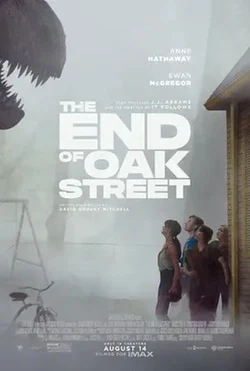
A mysterious cosmic event tears Oak Street out of suburbia and transports the Platt family’s neighbourhood somewhere unknown. Denise and Greg Platt, together with their children Audrey and Brian, find their familiar surroundings connected to a dangerous prehistoric environment. With dinosaurs and other threats around them, the family has to remain together and work out how to survive in a place where the rules of their ordinary life no longer apply.
Cast and credits
Director: David Robert Mitchell
Writers: David Robert Mitchell
Genre: Science fiction, survival, adventure, mystery, thriller
Main cast: Anne Hathaway, Ewan McGregor, Maisy Stella, Christian Convery
Composer: Michael Giacchino
Production company/studio: Bad Robot, Jackson Pictures; presented and distributed by Warner Bros. Pictures
Runtime: 99 minutes according to Cineworld; IMDb lists 100 minutes
Release year and platform: 2026; theatrical release, including IMAX
What does not make sense
- If adverts, unrelated trailers and the feature all carry the same unpleasant sound character in one auditorium, blaming each production separately stops making much sense.
- An Unlimited subscription encourages more cinema visits, but unlimited access has limited value when the quality of the auditorium makes repeated visits less appealing.
- A film can cost around $85 million, use modern visual effects and receive an IMAX release, yet the final experience can still be weakened by the ordinary auditorium presenting it.
- Cinemas sell the advantages of the big screen, but screen size alone is a weak argument when home televisions and sound systems can provide a cleaner and more comfortable experience.
- Dinosaurs remain expensive to put convincingly on screen, yet decades of Jurassic Park and other effects-heavy films have made the spectacle familiar enough that technical achievement no longer guarantees a sense of wonder.
- Standard auditoriums are caught in an awkward position if premium formats provide the memorable cinema experience while home viewing provides the convenience. The ordinary screen then has to explain what advantage it still offers.
Sense check / The numbers
- Cineworld scheduled a special Unlimited preview for 10 August 2026, ahead of the film’s general Cineworld release on 14 August 2026 – a 4-day head start for subscribers. [Cineworld]
- Cineworld gives the runtime as 99 minutes, while IMDb lists 100 minutes. Apparently even time itself lost a minute somewhere on Oak Street. [Cineworld/IMDb]
- The reported production budget is about $85 million, according to both Rotten Tomatoes’ background report and The Numbers. Whatever else the dinosaurs are, they aren’t evidence of a shoestring production. [Rotten Tomatoes/The Numbers]
- Warner Bros. scheduled the international rollout from 12 August 2026, with North America following on 14 August, including IMAX. IMDb lists an IMAX 1.90:1 presentation alongside 12-track digital and IMAX 6-track sound formats. [Warner Bros/IMDb]
- UK cinemas recorded 123.5 million admissions in 2025, around 30 per cent below 2019, while box-office revenue still reached £996.8 million. Cinema isn’t dead, but audiences haven’t returned to their pre-pandemic visiting habits either. [BFI]
The sketch
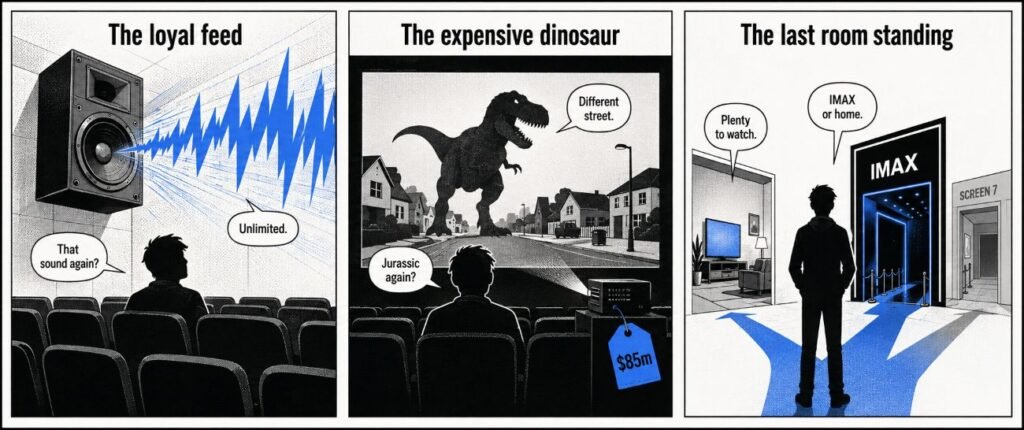
Scene 1: Unlimited annoyance
A tiny viewer sits beneath an enormous cinema speaker while a jagged sound wave stretches across the auditorium.
Dialogue:
Viewer: “That sound again?”
Speaker: “Unlimited.”
Scene 2: The expensive dinosaur
A huge dinosaur fills the cinema screen while a small price tag beside the projector reads “$85m”.
Dialogue:
Viewer: “Jurassic again?”
Dinosaur: “Different street.”
Scene 3: The last room standing
A viewer stands between a comfortable living room full of streaming choices and an IMAX entrance, while the ordinary cinema door remains behind him.
Dialogue:
TV: “Plenty to watch.”
Viewer: “IMAX or home.”
What to watch, not the show
- Cinema sound quality depends heavily on auditorium maintenance, calibration and equipment condition. A strong film mix cannot compensate for a poorly performing room.
- Premium formats are becoming part of cinema’s value argument. If IMAX and similar screens consistently provide the experience audiences expect, ordinary screens risk becoming the cheaper version rather than the default version.
- Subscription schemes can increase attendance, but frequency means little if customers stop trusting the quality of the screens included in the subscription.
- Multiplexes now compete directly with increasingly capable home setups. Large televisions, better speakers, streaming libraries and no travel make staying home a serious alternative rather than a compromise.
- Expensive visual effects no longer guarantee spectacle feels special. Decades of increasingly convincing CGI have raised audience expectations to the point where an $85 million dinosaur film can still feel visually familiar.
- The longer standard screens fail to offer a clear advantage over home viewing, the more cinema risks concentrating its strongest appeal around premium formats and major event releases.
The Hermit take
The film is watchable. The ordinary cinema experience was the real roast.
If IMAX is the only screen that can beat my living room, the multiplex has a bigger problem than dinosaurs.
Keep or toss
Keep / Toss.
Keep The End of Oak Street as an easy, imperfect dinosaur watch.
Toss Screen 1 until the sound deserves another chance, and keep IMAX for the films worth leaving home for.
Sources
- Warner Bros. official film site and synopsis: https://www.endofoakstreet.com/
- Cineworld format and release information: https://www.cineworld.co.uk/static/en/uk/blog/watch-the-end-of-oak-street-imax-4dx-screenx-superscreen
- Cineworld Unlimited preview: https://www.cineworld.co.uk/films/the-end-of-oak-street-unlimited-screening/ho00014956
- IMDb film page: https://www.imdb.com/title/tt27165187/
- IMDb technical specifications: https://www.imdb.com/title/tt27165187/technical/
- Rotten Tomatoes film background and reported budget: https://editorial.rottentomatoes.com/article/everything-we-know-about-the-end-of-oak-street/
- The Numbers production budget: https://www.the-numbers.com/movie/End-of-Oak-Street-The-%282026%29
- BFI official UK cinema statistics for 2025: https://www.bfi.org.uk/news/official-bfi-statistics-2025
One response
[…] was no IMAX for my screening, but at least the ordinary screen was fine. After my recent Screen 1 sound experiences, “fine” has become an achievement. I have been trying to avoid that auditorium since […]