
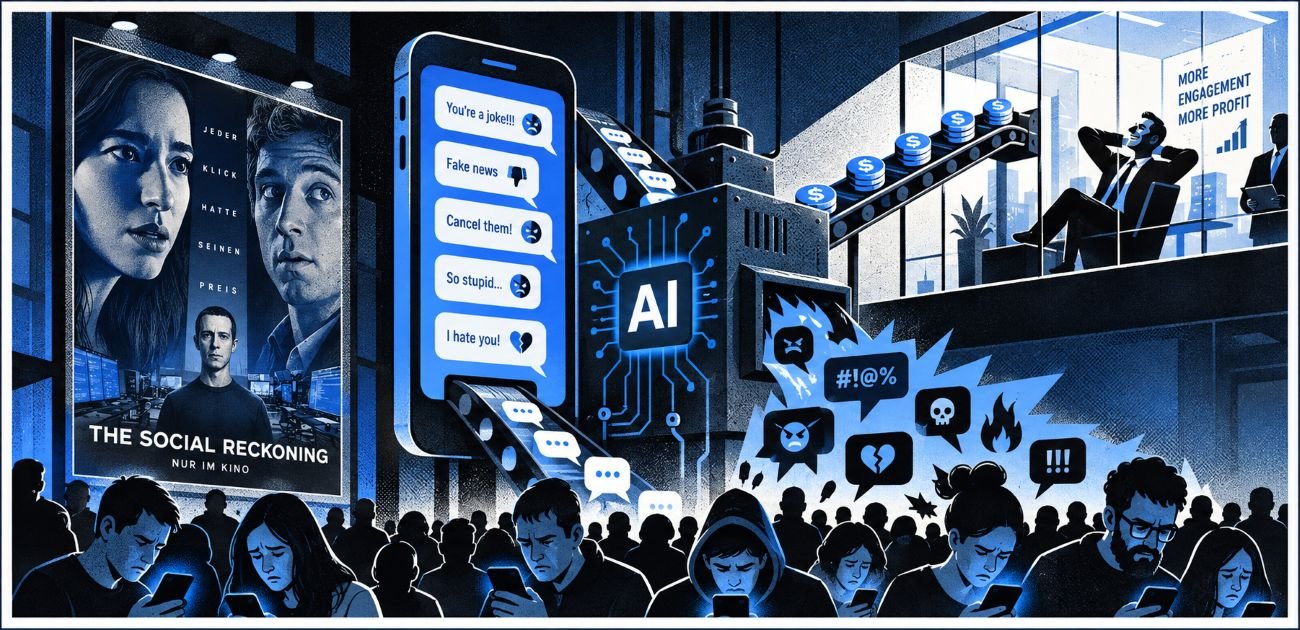
Lede
The Social Reckoning brings Facebook’s scandals to the cinema while its parent company, now called Meta, prepares to sell the world another technological revolution.
Hermit Off Script
After The Uprising dragged me back into the old struggle between the poor and the rich, I thought cinema might give history a little rest. Apparently not. This time, The Social Reckoning brings a more recent true story into the spotlight, one that isn’t even finished. And what a familiar story it is.
The film starts with that lovely idea that social media is a good thing because it gives everyone a voice. And yes, I agree. It connects people, helps isolated individuals find communities, gives ordinary people opportunities they never had before and lets us organise, communicate and share our lives without asking permission from someone powerful. Wonderful. Then humans came along and tinkered with the algorithms, because apparently giving everyone a voice wasn’t profitable enough unless the shouting could be monetised. And there it was. Anger, fear, hatred, misinformation and every unpleasant human instinct found a place to gather, grow and influence the world. People who might once have remained isolated in their bitterness could suddenly find thousands of others willing to agree with them. Instead of making humanity wiser, parts of social media became very efficient at helping us become worse together. All while somebody counted the advertising revenue. Excellent business, apparently.
And I can’t watch this without thinking about AI. Because the same pattern is happening again, only this time the technology is far more capable. Social media helped fulfil genuine human needs for connection and belonging. AI can help us learn, create, work, solve problems and perhaps improve lives in ways we haven’t fully imagined. But both can also help people with malicious intentions manipulate, deceive, exploit and cause suffering on a far greater scale. The technology isn’t born evil. The people deciding how to use it, how to sell it and what to reward are another matter entirely. I don’t see much comfort in a future where the same appetite for power gets access to stronger machines.
And please, spare me the fairy tale that billionaires built these platforms because they couldn’t sleep at night worrying about the poor. I don’t believe the promise of connection was ever separate from the opportunity to make money and accumulate influence. A service can genuinely help millions of people while its owners become extraordinarily wealthy from controlling it. That’s precisely why the bargain deserves scrutiny. As I argued before, the rich get frontier AI while everyone else is expected to admire the opportunities from a respectful distance.
Then there is Facebook becoming Meta. Convenient, isn’t it? The scandals were public, whistleblowers were talking, regulators were asking difficult questions, and suddenly the parent company had a fresh name and a grand vision of the metaverse. Officially, that was the reason for the rebrand. Fine. I’m not claiming a change of name proves an attempt to escape responsibility. I am saying that a different sign above the door doesn’t repair what happens inside the building. And now Meta is investing enormous sums in AI, positioning itself among the powerful companies shaping the next technological age. From social networking to artificial intelligence, the business opportunities keep growing. The people at the top don’t seem particularly interested in becoming less powerful.
As for the acting, I had another little problem. Jeremy Allen White arrived and I could still see The Bear. Then Mikey Madison appeared and Anora followed her into the film. Both are talented actors, but their previous roles stayed so firmly in my head that I sometimes felt those characters had simply changed professions. One left the kitchen for investigative journalism, the other traded her old life for corporate whistleblowing. Perhaps that’s the price of memorable performances. The actors move on. My brain apparently refuses to update the casting.
Still, the film has a worthwhile story to tell, even if the story itself doesn’t offer much comfort. The whistleblower speaks, the journalist investigates, the public discovers what powerful people would rather keep quiet, and the machinery carries on. I don’t think the wealthy will suddenly become poor, or the powerful voluntarily surrender their influence, simply because the public has learnt another unpleasant truth.
The technology keeps getting smarter. The hunger behind it remains embarrassingly primitive.
THE SOCIAL RECKONING – New Trailer (4K)
Movie synopsis
The Social Reckoning follows Frances Haugen, a Facebook employee who becomes increasingly concerned about the company’s internal knowledge of the effects of its platforms. She works with Wall Street Journal journalist Jeff Horwitz to bring confidential documents into public view.
Based on the real whistleblowing behind the 2021 Facebook Files investigation, the film dramatises their efforts to expose problems involving content recommendation systems, user safety and corporate accountability. Aaron Sorkin presents the story as a companion piece to his earlier screenplay for The Social Network, shifting attention from Facebook’s creation to the consequences of its growth.
Cast and credits
Director: Aaron Sorkin
Writers: Aaron Sorkin
Genre: Biographical drama, thriller
Main cast: Mikey Madison as Frances Haugen, Jeremy Allen White as Jeff Horwitz, Jeremy Strong as Mark Zuckerberg, Betty Gilpin, Wunmi Mosaku, Billy Magnussen, Bill Burr
Composer: Alexandre Desplat
Production company/studio: Columbia Pictures, Sony Pictures Entertainment
Runtime: Approximately 112 minutes
Release year and platform: 2026. Released in UK cinemas on 9 October 2026.
What does not make sense
- Social media promised everyone a voice, but the systems deciding which voices travel furthest belong to companies whose revenues depend heavily on advertising and attention.
- Platforms encourage people to form communities, then face criticism when recommendation systems help harmful communities find new audiences.
- The algorithms were developed and adjusted by humans, yet corporate explanations can make damaging consequences sound like unfortunate weather conditions.
- An enormous technology company can pay a historic privacy penalty and remain powerful enough to influence the next generation of digital services.
- A corporate name changes, a technological vision changes, executives announce another exciting future, and the public is expected to judge the business by its latest promises.
- The AI revolution is being led partly by companies still facing difficult questions about their existing platforms. Apparently, unresolved accountability is no obstacle to selling the next miracle.
- Whistleblowing can reveal serious problems, but exposing wrongdoing, securing regulatory reform and changing a company’s financial incentives are three very different achievements.
- The film tells a David and Goliath story. Outside the cinema, Goliath has a growing infrastructure budget and another investor presentation.
Sense check / The numbers
- $5 billion – the price of a privacy scandal. In July 2019, Facebook agreed to pay a $5 billion penalty to settle US Federal Trade Commission charges involving breaches of an earlier privacy order. That was a major regulatory intervention, but it concerned privacy violations, not a general legal finding that Facebook’s algorithms caused every harm attributed to them. [FTC]
- 5 October 2021 – the whistleblower testifies. Frances Haugen appeared before the US Senate’s Commerce Committee, drawing attention to internal Facebook research and concerns about the safety of its platforms, particularly for younger users. Her evidence helped bring corporate decision-making into public scrutiny. [US Senate]
- 28 October 2021 – Facebook’s parent company becomes Meta. Just 23 days after Haugen’s Senate appearance, the company announced its new corporate identity. Meta officially explained the rebrand through its metaverse ambitions. The timing invites criticism, but it does not establish that escaping scandal was the company’s motive. [Meta]
- $60.80 billion in three months. Meta reported revenue of $60.80 billion for the second quarter of 2026, up 28 per cent from the same period in 2025. Its family of apps averaged approximately 3.60 billion daily active people in June 2026, according to company estimates. The figures demonstrate the enormous commercial scale of these platforms; they do not establish that their effects on users are beneficial. [Meta Q2 2026]
- $130 billion to $145 billion – the next investment bill. In July 2026, Meta forecast capital expenditure of between $130 billion and $145 billion for the full year, supporting AI development and its existing business. This is projected infrastructure spending, not realised AI profit or spending exclusively on AI. The scale nevertheless demonstrates how much capital the company can put behind its next technological ambitions. [Meta Q2 2026]
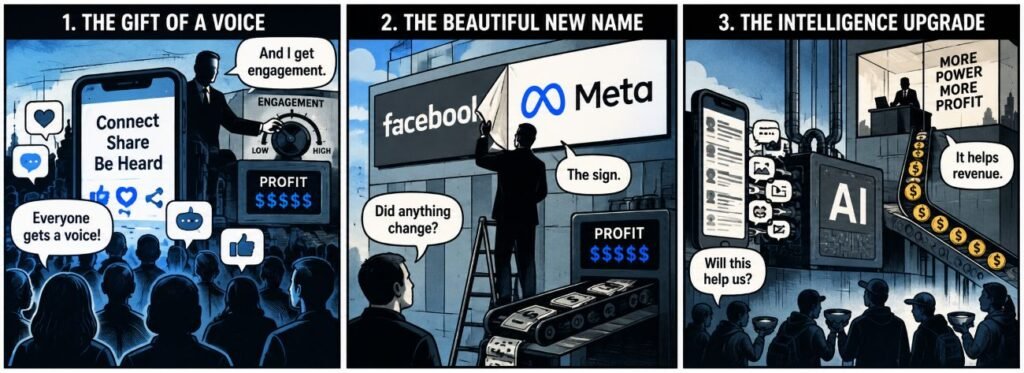
The sketch
Scene 1: The gift of a voice
A crowd of ordinary silhouettes stands around a giant smartphone displaying speech bubbles. Behind the screen, a suited executive adjusts an engagement dial while a cash counter fills.
Dialogue:
User: “Everyone gets a voice!”
Executive: “And I get engagement.”
Scene 2: The beautiful new name
The same executive replaces an OLD NAME sign with NEW NAME above the same giant machine. The money counter continues running while a concerned user examines the unchanged machinery.
Dialogue:
User: “Did anything change?”
Executive: “The sign.”
Scene 3: The intelligence upgrade
The same executive connects the smartphone machine to an enormous AI processor. Small people stand below holding empty cups while coins travel upwards into a glass executive office.
Dialogue:
User: “Will this help us?”
Executive: “It helps revenue.”
What to watch, not the show
- The attention economy: Whether recommendation systems continue rewarding material that attracts engagement even when its wider social effects are harmful.
- Concentrated ownership: How a small number of companies can control the infrastructure through which billions communicate, obtain information and increasingly access AI.
- Platform accountability: Whether regulators can inspect recommendation systems, demand meaningful evidence and enforce improvements rather than merely collecting penalties.
- The next AI business model: Whether sophisticated AI tools expand genuine opportunity or deepen dependence on a handful of powerful technology providers.
- Control of information: The danger of treating follower counts as proof while journalists, researchers and whistleblowers struggle to make evidence visible.
- Corporate incentives: Whether companies change damaging practices when doing so reduces engagement, revenue or growth.
- The AI safety question: Whether firms are building power before public safeguards, and who has the authority to decide when their systems are safe.
- Wealth and influence: Who receives the financial returns from AI expansion, who carries the risks and whether the public gets any meaningful say in the bargain.
The Hermit take
A new corporate name cannot settle an old account.
The next technological revolution deserves more accountability than the last.
Keep or toss
Keep / Toss
Keep the whistleblower’s story, the investigative journalism and the reminder that exposing powerful institutions still matters. Keep the performances, even when familiar faces bring their previous characters along.
Toss the comforting idea that exposure alone fixes a system, and the belief that another corporate rebrand or technological breakthrough automatically means progress for humanity.
Sources
- Sony Pictures, official film synopsis and credits: https://www.sonypictures.co.uk/movies/social-reckoning
- British Board of Film Classification, UK release and runtime: https://www.bbfc.co.uk/release/the-social-reckoning-q29sbgvjdglvbjpwwc0xmte4mda5
- Apple Music, Alexandre Desplat film score: https://music.apple.com/us/album/the-social-reckoning-original-motion-picture-soundtrack/6816234712
- Reuters, Aaron Sorkin and the true story behind the film: https://www.reuters.com/technology/aaron-sorkin-why-he-made-another-movie-about-facebook-how-real-life-translates-2026-10-07/
- US Senate, Frances Haugen testimony, 5 October 2021: https://www.commerce.senate.gov/meetings/subcommittee-protecting-kids-online-testimony-from-a-facebook-whistleblower/
- FTC, Facebook’s $5 billion privacy settlement: https://www.ftc.gov/news-events/news/press-releases/2019/07/ftc-imposes-5-billion-penalty-sweeping-new-privacy-restrictions-facebook
- Meta, October 2021 corporate rebranding announcement: https://about.fb.com/news/2021/10/facebook-company-is-now-meta/
- Meta Investor Relations, second-quarter 2026 results and capital expenditure forecast: https://investor.atmeta.com/investor-news/press-release-details/2026/Meta-Reports-Second-Quarter-2026-Results/
Disclaimer: This article is satire, film criticism and opinion based on publicly available reporting and corporate disclosures. The film dramatises real events, and interpretations of corporate motives and social consequences are distinguished from established facts.
Leave a Reply