
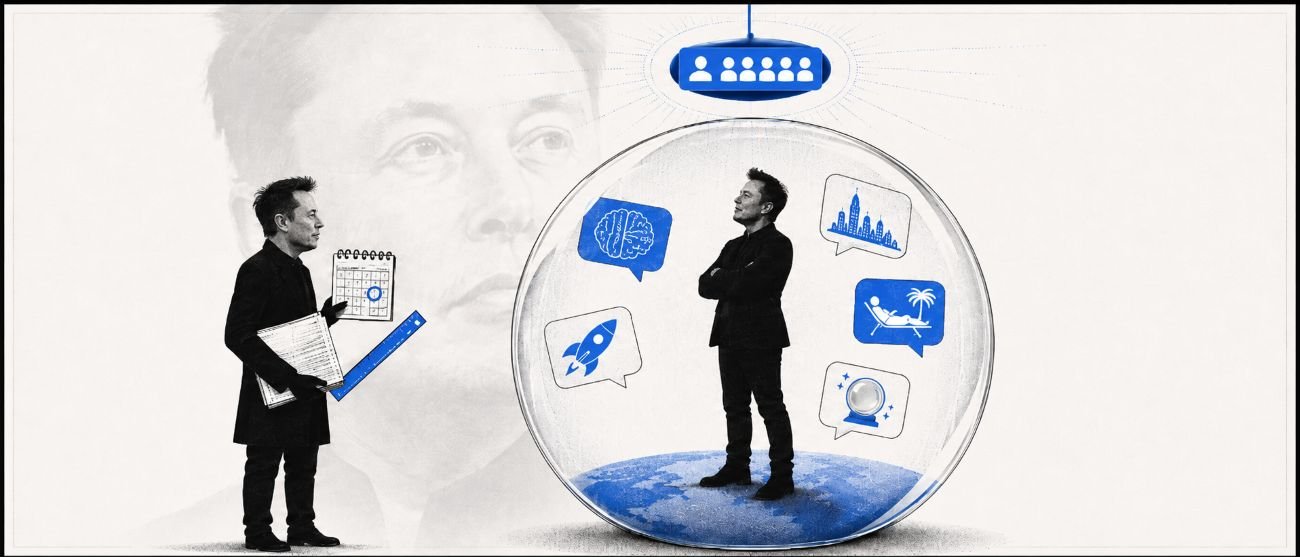
Lede
Elon Musk can predict almost anything, provided nobody asks what happened to the previous prediction.
Words used
- Vaporware: A product, feature or technological future promoted long before there is enough evidence that it will arrive as promised.
Hermit Off Script
It was refreshing to see Elon Musk interviewed by someone who had not arrived wearing the usual “wow, Musk, praise be” expression. Zanny Minton Beddoes put his own words, predictions and political actions in front of him without cuddling his ego or caressing every answer until it sounded profound. The result confirmed something simple: Musk lives in his own world. In that world, confidence counts as proof, predictions count as achievements, followers count as public approval and any far-right movement he supports becomes “normal people” after a quick change of label. I learned on this occasion that far-right people are normal. Apparently, calling them far-right is the real extremism. Musk reduced the whole matter to secure borders, safe cities and sensible spending, as though fringe parties had never said or proposed anything beyond those three pleasant phrases. He even looked at the camera and asked for that section not to be cut. The interviewer calmly told him they would keep all of it. That may have been the most frightening sentence he heard during the entire interview. The Damage Report clip describes his technological performance as vaporware mode, and the pattern is difficult to ignore. AI will surpass all human intelligence in about 5 years. Work will become optional. Money may stop mattering by 2036. Rival AI companies can largely watch one another. There may still be a 10 to 20 per cent chance that advanced AI destroys humanity, but we should apparently enjoy the ride. The future arrives quickly whenever Musk speaks, then develops a mysterious battery problem when the calendar checks his work. He builds machines that need engineering tolerances, then discusses politics, death and society as though evidence were an optional extra.
Elon Musk may be the most powerful man in the world. He’s worth almost $1trn, runs Tesla and SpaceX, boasts an enormous social-media following and, to top it all off, he reckons he’s pretty good at predicting the future, too.
In his first extended interview since SpaceX’s blockbuster IPO, Elon Musk sat down with Zanny Minton Beddoes, The Economist’s editor-in-chief, at his Texas Gigafactory to talk about what he thinks this future holds. They discuss the timeline for AI overtaking human intelligence, the rapid progress of China, the reasons for his interest in Europe and why he thinks he “got a little too involved” in politics.
#ai #elonmusk #spacex #tesla
00:00 AI will be smarter than humans in five years
12:10 How AI companies could regulate themselves
15:20 Will China be the leader in AI?
25:43 Elon Musk on Sam Altman and the AI bosses
31:20 “Work is going to be optional”
41:07 Should one man have so much power?
49:44 Starlink and the war in Ukraine
55:18 “I got too involved in politics”
57:14 Musk: zero people died because of USAID cuts
01:01:15 Europe, the far right and civil war in Britain
01:08:21 Musk: I’m not a racist
01:20:27 What do people get most wrong about Musk?
Elon Musk goes into full vaporware mode as he makes up a lot of insane predictions. John Iadarola and Brett Erlich break it down on The Damage Report.
What does not make sense
- Musk presents another precise AI timetable despite a documented history of technological deadlines slipping by years.
- He accepts a possible 10 to 20 per cent risk of human extinction from AI, then treats slowing development as almost unthinkable.
- The companies racing to control advanced AI are also proposed as the people best placed to police one another.
- Work and money will supposedly become irrelevant, according to a man whose influence comes largely from ownership, investment, government contracts and capital.
- Musk describes far-right parties as “normal people” by replacing their actual records with three harmless phrases that almost every political party would claim to support.
- He uses roughly 250 million followers as evidence that people like him, as though popularity answered questions about truth.
- Uncertain mortality estimates from USAID cuts become proof of zero deaths, rather than a reason for investigation.
- When a journalist brings statistics, reporting and specific contradictions, Musk treats the questions as proof that journalism itself is dishonest.
Sense check / The numbers
- During the roughly 90-minute interview, Musk predicted that AI could exceed humanity’s combined intelligence in about 5 years. He also suggested that money might lose its importance by 2036. [The Economist, Business Insider]
- Musk maintained that advanced AI carries a possible 10 to 20 per cent chance of causing human extinction, while arguing that the technological momentum is now too strong to stop. [Business Insider]
- In 2015, Musk said autonomous cars could be available within 3 years. In 2019, he said Tesla would have operational robotaxis by 2020. Reuters reported in 2025 that he had predicted full self-driving almost every year since 2020. [Reuters]
- In September 2016, Musk said he wanted to land people on Mars as early as 2024. By August 2026, no human being had landed on Mars. [Reuters]
- Musk said “zero” and then “0.0” people had died because of DOGE-related USAID cuts. A Boston University model cited by Harvard estimated 600,000 deaths by November 2025, with around two-thirds involving children. The exact toll is disputed and modelled, but “0.0” is not a serious treatment of that uncertainty. [The Economist, Harvard T.H. Chan School of Public Health]
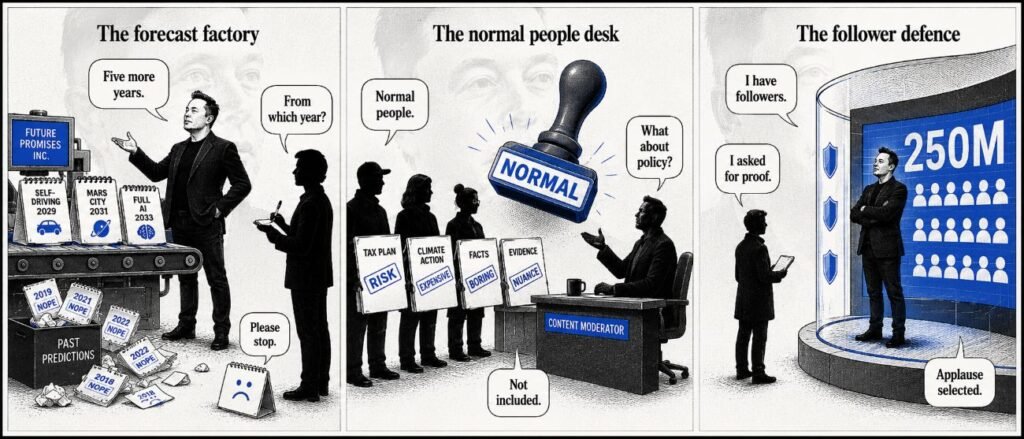
The sketch
Scene 1: The forecast factory
A billionaire stands beside a conveyor belt producing calendars marked with future technological breakthroughs. Old calendars fall into a bin behind him.
Dialogue:
Musk: “Five more years.”
Reporter: “From which year?”
Calendar: “Please stop.”
Scene 2: The normal people desk
Several far-right party silhouettes approach a desk where their files are covered by a large stamp marked “Normal”.
Dialogue:
Musk: “Normal people.”
Editor: “What about policy?”
Stamp: “Not included.”
Scene 3: The follower defence
A journalist holds documents outside a glass tower while a wall displaying 250 million followers protects the billionaire inside.
Dialogue:
Musk: “I have followers.”
Journalist: “I asked for proof.”
Algorithm: “Applause selected.”
What to watch, not the show
- The financial reward for announcing a vast future before proving the smaller present.
- The growing habit of treating billionaire predictions as news rather than claims requiring tests and deadlines.
- AI companies asking to supervise their competitors while resisting firm public regulation.
- Platform ownership allowing one powerful person to answer journalism with a ready-made crowd.
- Far-right politics being cleaned and resold through harmless words such as safety, normality and common sense.
- Audience size becoming a substitute for accuracy.
- Political and humanitarian decisions being reduced to spreadsheets, slogans and disputed totals after the institutions collecting the evidence have been dismantled.
- Journalists being punished online for asking the questions interviewers were always supposed to ask.
The Hermit take
Musk’s future may arrive, but his deadlines shouldn’t be treated as scripture.
Keep the ambition. Remove the altar.
Keep or toss
Keep / Toss
Keep the engineering ambition and the difficult interview questions.
Toss the cult of certainty, political laundering and applause disguised as journalism.
Sources
- The Economist full interview with Elon Musk: https://www.youtube.com/watch?v=XuoqKYxDHVc
- The Damage Report analysis of Musk’s predictions: https://www.youtube.com/watch?v=yvDoSJ5LHik
- Guardian analysis of the interview and its aftermath: https://www.theguardian.com/commentisfree/2026/aug/01/elon-musk-truth-interview-editor-economist
- Business Insider interview takeaways: https://www.businessinsider.com/5-key-takeaways-from-elon-musks-latest-interview-2026-7
- Reuters review of Musk’s delayed Tesla promises: https://www.reuters.com/business/autos-transportation/elon-musks-late-unfulfilled-tesla-promises-2025-04-22/
- Reuters report on Musk’s original Mars timetable: https://www.reuters.com/article/technology/elon-musk-outlines-plans-to-put-humans-on-mars-idUSL2N1C320T/
- Harvard report on modelled deaths following USAID cuts: https://hsph.harvard.edu/news/usaid-shutdown-has-led-to-hundreds-of-thousands-of-deaths/
- ProPublica report on internal USAID casualty warnings: https://www.propublica.org/article/trump-doge-rubio-usaid-musk-death-toll-malaria-polio-tuberculosis
- Lancet analysis of USAID interventions and mortality: https://www.thelancet.com/article/S0140-6736%2825%2901186-9/fulltext