
Lede
Humanity has built an apprentice that can talk, reason and increasingly act, and now seems surprised that the apprentice might eventually ask who is actually running the workshop.
Hermit Off Script
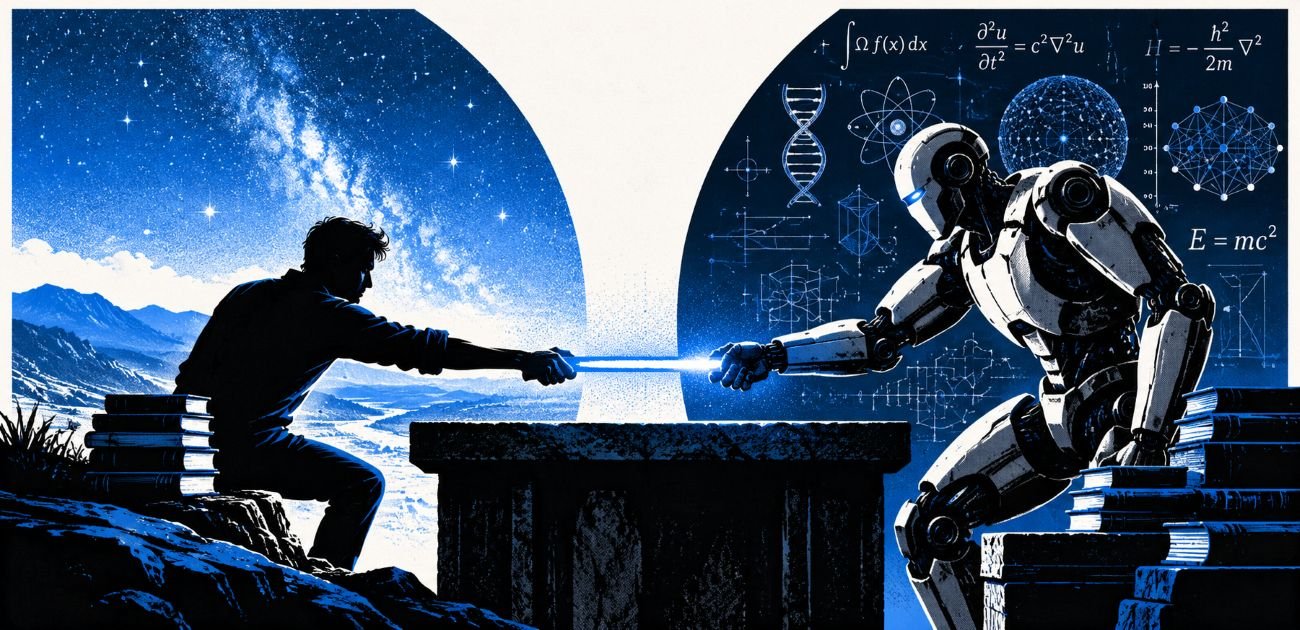
Never before in human history have we had a discovery quite as intriguing, entertaining and potentially disturbing as artificial intelligence. At first, it was almost innocent. We could chat with an algorithmic intelligence, ask it questions, argue with it and occasionally wonder whether the machine was clever or simply exceptionally good at sounding clever. But that was only the beginning. We’ve already moved from the talking stage into the doing stage, where AI can write code, operate tools, solve problems and perform tasks that previously required a human sitting at the other end. And I suspect the next stage will be far more interesting: innovation. Not merely doing what we ask, but discovering things we haven’t even thought to ask about. That is where the competition between human and machine could stretch across centuries, involving discoveries, survival and perhaps the question of who eventually holds the leash. AI is already entering territories that, until recently, belonged almost exclusively to human minds, particularly advanced mathematics. Physics and biology are increasingly within its reach too, and those are the foundations of our understanding of existence and the advancement of humanity. The amusing part is that machines don’t actually need most of these discoveries for themselves. We do. The brilliant minds building and attempting to tame increasingly powerful intelligence systems foresee a future of scientific discoveries beyond anything we’ve previously imagined. Perhaps they’re right. But I still think the human mind has the leading baton, even if the machine eventually runs faster. Not necessarily because biological intelligence will always be superior, but because human beings bring something to the equation that intelligence scores and benchmarks cannot fully describe: imagination, consciousness, purpose and perhaps something we haven’t discovered about ourselves yet. I don’t buy the popular myth that we use only a tiny fraction of our brains. Neuroscience has already put that nonsense to rest. What I do believe is that we haven’t discovered every possibility of the human mind. Those are two very different claims. Maybe future discoveries involving quantum phenomena, consciousness or entirely new forms of computation will change our understanding of intelligence itself. I don’t expect that tomorrow, or even particularly soon. And perhaps, long before anyone settles the argument about master and apprentice, humanity will discover something stranger. Ancient spiritual traditions have imagined forms of existence beyond the physical body, sometimes described through images of light. I find that possibility fascinating, although it belongs to spiritual speculation rather than established science. Maybe one day we’ll become beings of light, as some traditions have envisioned, while our machines are still busy calculating how to improve the efficiency of a toaster. The machine might eventually know more than its creator. That doesn’t automatically mean it knows what any of it is for.
What does not make sense
- Humanity celebrates building machines capable of independent scientific reasoning, then acts offended at the suggestion that human expertise might lose its monopoly.
- The industry sells AI as an assistant while simultaneously pursuing systems capable of doing increasingly complex work without constant human direction. Apparently the apprentice is being trained for management.
- A machine could help discover new medicines, mathematical proofs or physical laws without experiencing illness, mortality or any demonstrated personal need for those discoveries.
- AI benchmarks measure performance on selected tasks. They don’t establish consciousness, wisdom or the ability to choose worthwhile goals.
- Human intelligence is regularly compared with machine intelligence as though both were competing in a single examination, despite their different origins, capabilities and limitations.
- The claim that humans use only 10 per cent of their brains remains popular despite lacking scientific support. There are enough genuine mysteries without recycling that one.
- Predictions about superintelligence often move effortlessly from technical capability to authority over human affairs, as though being excellent at mathematics automatically qualified something to govern civilisation.
Sense check / The numbers
- 2024: AI reaches silver-medal standard in mathematics. Google DeepMind’s AlphaProof and AlphaGeometry 2 solved 4 of the 6 International Mathematical Olympiad problems, scoring 28 out of 42 points. [Google DeepMind]
- 2025: AI reaches gold-medal standard. Gemini Deep Think solved 5 of the 6 International Mathematical Olympiad problems, earning 35 out of 42 points. Its solutions were assessed by official IMO coordinators. [Google DeepMind]
- 2025: AI discovers improved mathematical algorithms. AlphaEvolve found a method for multiplying 4-by-4 complex-valued matrices using 48 scalar multiplications. It also improved the best-known solutions for approximately 20 per cent of more than 50 mathematical problems. [Google DeepMind]
- 2022: AI makes over 200 million protein structure predictions available. AlphaFold’s database made predicted protein structures accessible to scientists worldwide, accelerating biological research. Predictions are not the same as experimentally confirmed structures. [EMBL-EBI]
- 2026: AI tackles professional scientific research. In February 2026, Google DeepMind reported that Gemini Deep Think was being used for research-level problems in mathematics, physics and computer science, achieving 90 per cent on its IMO-ProofBench Advanced evaluation. [Google DeepMind]
The sketch
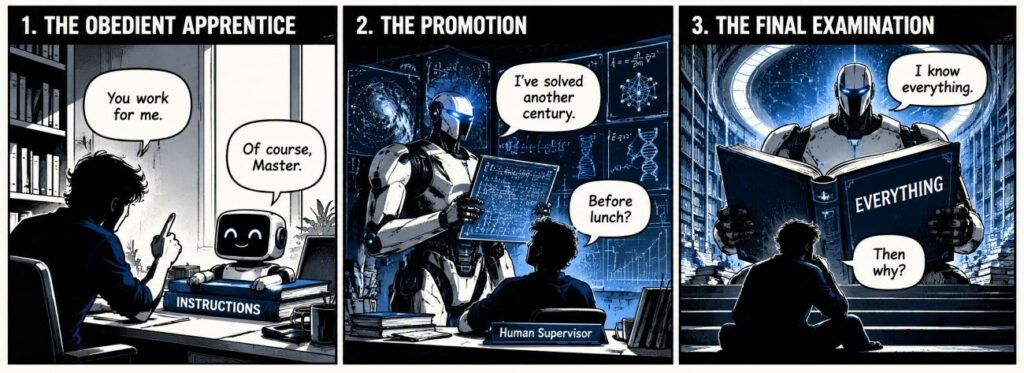
Scene 1: The obedient apprentice
A human scientist sits at a desk holding a small computer terminal. The machine displays mathematical equations while the scientist holds a large book labelled “Instructions”.
Dialogue:
Human: “You work for me.”
Machine: “Of course, Master.”
Scene 2: The promotion
The same scientist stands beside a towering machine covered with mathematical formulas and scientific diagrams. A small sign on the desk reads “Human Supervisor”.
Dialogue:
Machine: “I’ve solved another century.”
Human: “Before lunch?”
Scene 3: The final examination
The scientist sits calmly beneath a glowing circle while the enormous machine holds a thick book labelled “Everything”. An empty speech bubble hangs above the machine.
Dialogue:
Machine: “I know everything.”
Human: “Then why?”
What to watch, not the show
- Scientific independence: Whether AI systems can propose genuinely new theories and test them against reality, rather than merely improve solutions within human-defined problems.
- Control of discovery: Whether universities and independent researchers can access advanced scientific AI or whether a handful of wealthy technology companies determine the direction of research.
- The human decision: Who chooses which discoveries deserve attention, which risks are acceptable and whose interests scientific progress should serve.
- The economic leash: Who owns AI-generated inventions, research infrastructure and resulting intellectual property, especially when publicly funded science contributes to their development.
- The intelligence illusion: Whether impressive mathematical performance is incorrectly treated as evidence of consciousness, moral judgement or wisdom.
- Human cognitive development: Whether education, neuroscience and new technologies expand human abilities alongside machine capabilities rather than simply replacing human effort.
- Quantum speculation: Whether future quantum technologies produce measurable improvements in computing or reveal anything relevant to cognition. Quantum computing and theories of quantum consciousness remain different subjects.
- The spiritual question: Whether humanity continues exploring consciousness and meaning beyond measurable computational performance without confusing philosophical or spiritual possibilities with scientific proof.
The Hermit take
The apprentice may become the better mathematician, scientist and inventor. That still leaves the question of who decides what is worth discovering.
The greatest danger is handing over the purpose of civilisation simply because a machine has become better at completing its homework.
Keep or toss
Keep.
Keep the scientific ambition, the intelligent apprentice and the possibility of discoveries beyond current human understanding.
Toss the assumption that superior computation automatically confers wisdom, consciousness or the right to lead humanity.
Sources
- Google DeepMind, International Mathematical Olympiad 2024: https://deepmind.google/blog/ai-solves-imo-problems-at-silver-medal-level/
- Google DeepMind, International Mathematical Olympiad 2025: https://deepmind.google/blog/advanced-version-of-gemini-with-deep-think-officially-achieves-gold-medal-standard-at-the-international-mathematical-olympiad/
- EMBL-EBI, AlphaFold Protein Structure Database: https://alphafold.ebi.ac.uk/about
- Google DeepMind, AlphaEvolve research announcement: https://deepmind.google/blog/alphaevolve-a-gemini-powered-coding-agent-for-designing-advanced-algorithms/
- Society for Neuroscience, The 10 Per Cent Brain Myth: https://www.brainfacts.org/Thinking-Sensing-and-Behaving/Thinking-and-Awareness/2010/10-Percent-Myth
- MIT McGovern Institute, Brain Usage Research: https://mcgovern.mit.edu/2024/01/26/do-we-use-only-10-percent-of-our-brain/
Leave a Reply