
Lede
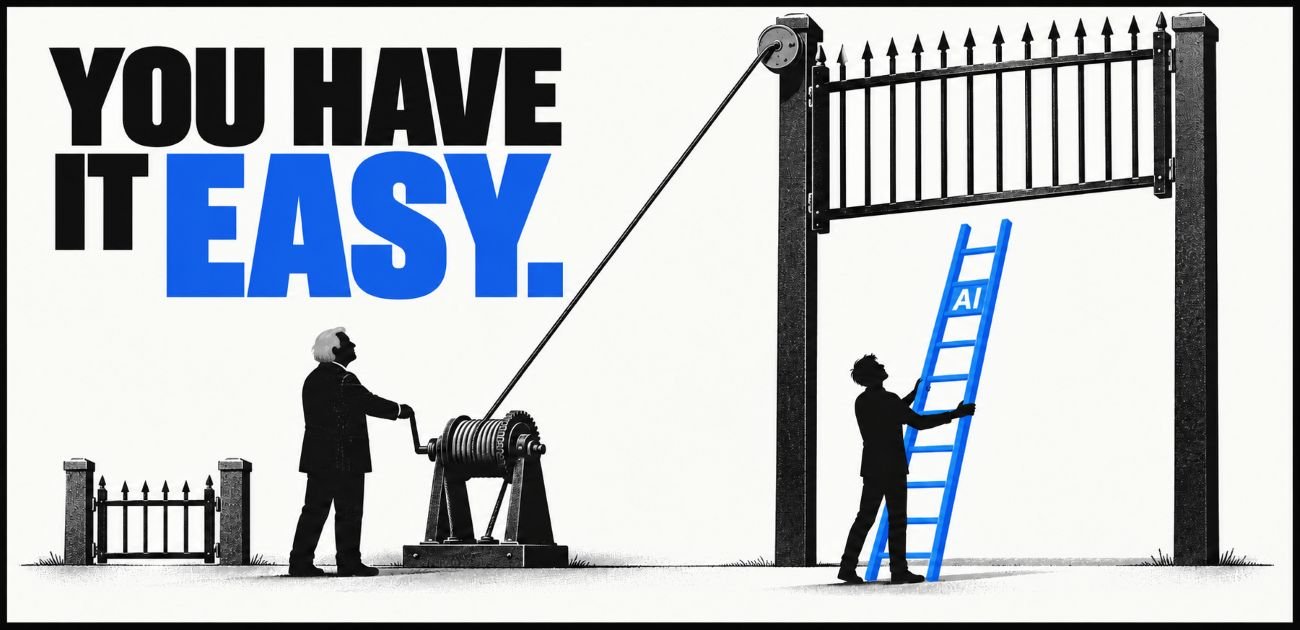
The custodians of civilisation have discovered another threat to its survival: young people using the tools they were given.
Hermit Off Script
I’m getting tired of the old generational performance: the young are spoiled, civilisation is collapsing, and apparently everything was better when ordinary life required more suffering and fewer options. I don’t doubt that previous generations struggled. They challenged misconceptions, fought restrictions and created opportunities that didn’t exist before. That’s precisely why the complaint is so ridiculous. If the purpose of progress was to make life easier, why treat an easier life as evidence of moral failure? Congratulations on building the bridge. Sorry the children aren’t swimming. I also think those claiming to defend civilisation should examine what they’re handing over. The inheritance includes useful tools and hard-won freedoms, but it can also include broken institutions, prejudice and problems nobody wanted to repair. The next generation arrives with the energy to change things and gets lectured by people who consider their own unfinished work a sacred tradition. I don’t believe suffering automatically ruins the future, either. Its consequences can be unpredictable. Something terrible may provoke change nobody could foresee, although that doesn’t make the suffering necessary or good. Nor does surviving the past qualify anyone to dictate every detail of a future they haven’t experienced. Older people can adapt, of course. But experience becomes an obstacle when it insists that adaptation should require its permission. Now AI has entered the argument. Some people admire it, use it “just for testing”, then announce that children who grow up with it will lose their critical thinking and become idiots. Apparently, borrowing intelligence is research when the established generation does it and civilisational decay when the young do. I take the risk of unthinking dependence seriously. I don’t accept that it settles the fate of an entire generation. Nor am I comfortable when young protesters celebrate authoritarian symbols or ideas hostile to democratic freedom. But those ideas didn’t hatch inside a teenager’s phone. They have histories, promoters and inherited loyalties. Youth doesn’t excuse choosing them; age doesn’t absolve those who preserved and repackaged them. Some young people also search the past for ideas that were once too advanced for their time. I can understand that. The past contains unfinished possibilities as well as thoroughly tested disasters. The difficulty is telling them apart before putting one on a banner. What interests me more is the future these tools might make possible. I suspect greater comfort could arrive alongside much harder expectations. If AI makes work that once demonstrated exceptional ability widely accessible, simply being smart or educated may no longer secure a good life. The standard could rise precisely because the tools improve. I imagine intelligence becoming more like a basic condition of participation, with greater value placed on judgement, imagination, responsibility and how people treat one another. I believe the next generation could become more knowledgeable and better educated than any before it, provided education teaches people to question the tools as well as operate them. Perhaps it will also become more humane. Perhaps change won’t always require the old rituals of confrontation, and someone refusing to fight over an insult will be showing intelligence rather than weakness. I mean restraint, not submission to injustice. Maybe war and organised hatred could eventually become relics of a less developed humanity. That’s my hope, not a forecast. The speed of change may make much of today’s supposed wisdom irrelevant, while demanding more learning and adaptability than its defenders imagine. I would welcome a civilisation that outgrows the need to turn every wounded ego into a battlefield. The ambition was to give the children a better life; the grievance is that they might actually live it.
What does not make sense
- Progress earns applause until somebody enjoys its benefits without repeating the original hardship. Then the applause becomes a disciplinary hearing.
- A generation receives credit for the opportunities it created but requests exemption from discussing the problems it passed down.
- Using AI to save an established professional time is efficiency. A student using it apparently requires an obituary for human intelligence.
- A young face carrying an old authoritarian idea is presented as proof that the future has failed. The age of the idea escapes questioning.
- Easier access to capable tools is confused with easier competition. Give everyone a ladder and the qualifying height can still increase.
- Refusing to retaliate over an insult is treated as weakness, as though civilisation were an examination in how quickly someone can overturn a table.
- Optimism can make the same mistake as nostalgia: assuming an entire generation has a predetermined moral character. A birth date isn’t a certificate of wisdom.
Sense check / The numbers
- The generational complaint has a measurable memory problem. A 2019 paper reported 5 preregistered studies involving 3,458 American adults. Participants tended to judge young people particularly harshly on qualities they themselves possessed, with biased memories contributing to the apparent decline. This supports questioning the comparison; it doesn’t prove that every criticism of young people is wrong. [Science Advances; UC Santa Barbara]
- The AI concern is real, but the familiar headline goes further than the evidence. A 2025 study surveyed 319 knowledge workers and collected 936 examples of AI use. Greater confidence in AI was associated with less reported critical thinking. These were self-reports about work practices, not measurements demonstrating that an entire generation had become less intelligent. [Microsoft Research]
- Getting the answer and learning the method can produce different results. A field experiment involving nearly 1,000 secondary-school mathematics students in Turkey found that access to a general-purpose GPT interface improved assisted practice performance. However, subsequent unaided exam performance was 17 per cent lower than the control group’s. A version designed to protect learning largely removed that penalty, without producing a significant unaided advantage. Tool design matters; access alone isn’t an education policy. [PNAS]
- Better learning is possible, too. A separate randomised study, published in 2025, involved 194 Harvard physics students. A carefully designed AI tutor produced greater learning gains in less time than the comparison classroom lessons. The researchers cautioned against assuming the result applies to every context, particularly more complex forms of reasoning. This supports a possibility, not a promise of automatic intellectual improvement. [Scientific Reports]
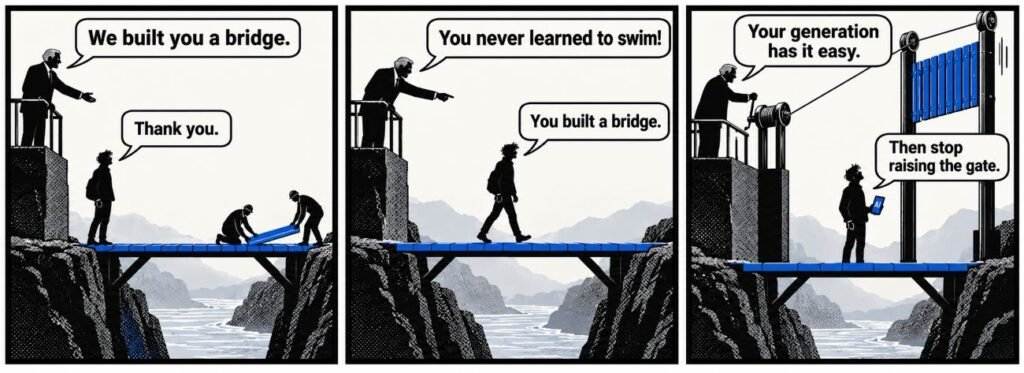
The sketch
Scene 1: The approved hardship
A senior official stands on a raised platform beside a deep trench. A younger figure waits below while workers complete a bridge across it.
Dialogue:
Official: “We built you a bridge.”
Young person: “Thank you.”
Scene 2: The unacceptable benefit
The same young person walks across the completed bridge. The official leans over the platform railing, pointing accusingly.
Dialogue:
Official: “You never learned to swim!”
Young person: “You built a bridge.”
Scene 3: The revised standard
The official operates a winch that raises an admission gate far above the bridge. The young person stands beneath it holding a small device labelled AI.
Dialogue:
Official: “Your generation has it easy.”
Young person: “Then stop raising the gate.”
What to watch, not the show
- Whether education rewards understanding or merely completed answers. A system that pays attention only to the finished page invites shortcuts.
- Who receives good teaching, reliable tools and time to learn. Wider access to AI won’t automatically remove unequal access to education.
- Whether employers turn saved time into better working lives or simply raise output targets. Easier tasks can coexist with harder conditions.
- Who benefits from generational blame. An argument about young people’s character can conveniently displace questions about institutional decisions.
- How inherited authoritarian ideas acquire fashionable packaging. Their democratic consequences deserve scrutiny regardless of the age of the person promoting them.
- Whether technological ambition includes human development. More capable machines won’t automatically teach restraint, empathy or civic responsibility.
The Hermit take
A civilisation should judge its progress by what its children can become.
Requiring them to repeat its suffering is a peculiar form of quality control.
Keep or toss
Keep / Toss
Keep experience, critical thinking and the ambition to make life better.
Toss the belief that wisdom belongs to a birth cohort or that hardship must be inherited to preserve standards.
Sources
- Science Advances, generational judgements and memory bias, university research record: https://southernct.elsevierpure.com/en/publications/kids-these-days-why-the-youth-of-today-seem-lacking/
- UC Santa Barbara, explanation of the generational prejudice research: https://news.ucsb.edu/2019/019669/kids-these-days
- Microsoft Research, AI use and self-reported critical thinking: https://www.microsoft.com/en-us/research/publication/the-impact-of-generative-ai-on-critical-thinking-self-reported-reductions-in-cognitive-effort-and-confidence-effects-from-a-survey-of-knowledge-workers/
- PNAS, generative AI and secondary-school mathematics learning: https://doi.org/10.1073/pnas.2422633122
- Scientific Reports, controlled trial of AI tutoring in undergraduate physics: https://www.nature.com/articles/s41598-025-97652-6
Editorial disclaimer: This article combines sourced research, satire and personal opinion. Its vision of more educated, humane and peaceful future generations is a possibility, not an established scientific prediction. The sketch is fictional.
Leave a Reply