
Lede
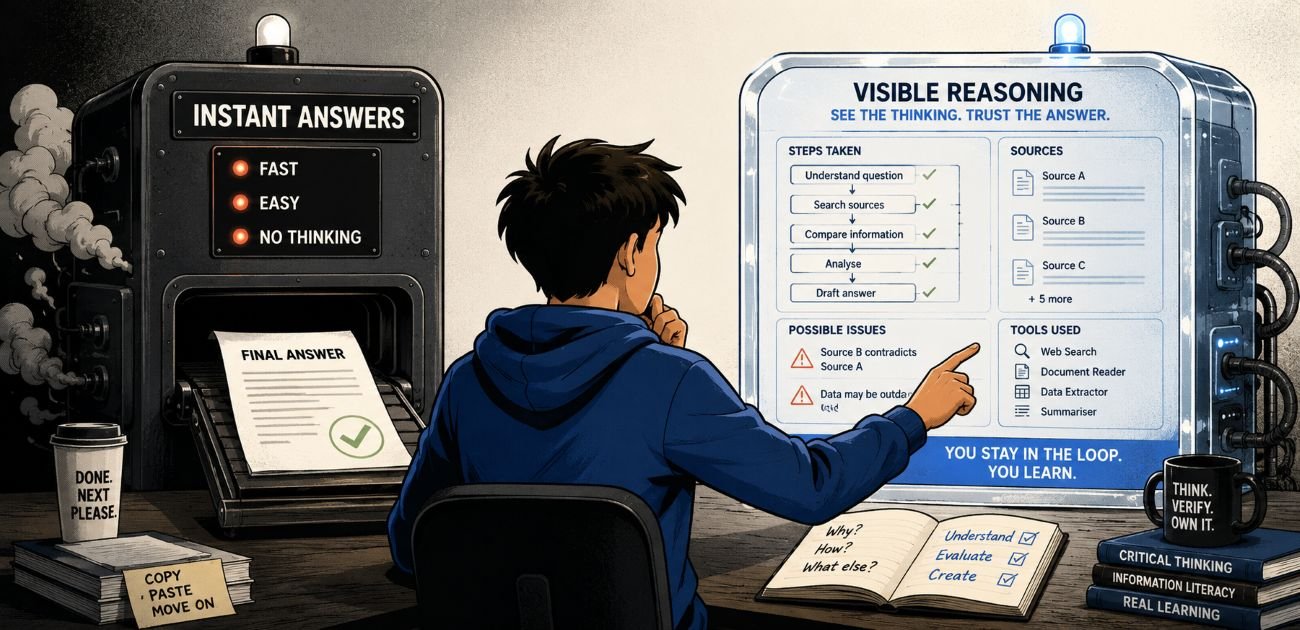
The danger is not that teenagers use AI, but that they may stop seeing the thinking that makes an answer worth trusting.
Words used
- AI agents: Tools that can take actions for a user, such as searching, summarising, comparing or creating.
- Reasoning view: The visible explanation of why a model used certain steps, tools or sources.
- Cognitive offloading: Handing mental work to a tool, sometimes helpfully, sometimes lazily.
Hermit Off Script
AI and teenagers is not a simple tragedy where the machine appears and the brain leaves the building with a small suitcase. The real problem starts when we use only instant answers and stop following the reasoning behind the actions. Before this, even a lazy search still forced you to do something. You searched for resources. You opened source after source. You checked what matched, what contradicted, what was useless, what was worth keeping. Then you collected what you needed and created or updated the work yourself. That process was not glamorous. It was slow, messy and occasionally made you hate tabs as a life form. But it taught you judgement. In the era of agents and instant answers, the user can become a passenger. The tool searches, reads, compares, writes and smiles politely while the human watches the final result arrive like room service. If the person is already a professional, fine. They can assess the task. They can smell when something is wrong. They know the shape of a good answer because they have built enough bad ones by hand. But if the person has no foundation and only relies on the answer provided, they may not know whether the result is correct, half-correct or wearing a clever little hat made of nonsense. That is where reasoning matters. When you can see the why, the possible errors, the sources, the tools used and the steps taken, the model becomes more than a vending machine for confidence. It can teach. It can show what was missed. It can make the hidden process visible. Maybe the best way to avoid the coming idiocracy is not less AI, but more human action inside the task. Not passive use. Not blind trust. A symbiosis between human and model, where the machine moves fast but the human still learns how to walk.
What does not make sense
- Schools panic about cheating, then often teach AI as a forbidden box instead of a process students must learn to inspect.
- Platforms sell instant answers as productivity, then act surprised when users stop caring how the answer was made.
- Students are told to be “AI literate”, but many tools hide the steps that would actually build literacy.
- A professional can challenge a model because they have judgement; a beginner may confuse fluency with truth.
- The market wants agents that do everything, while education still needs learners who can explain anything.
Sense check / The numbers
- Pew surveyed 1,458 US teens and parents from September 25 to October 9, 2025; 57 per cent of teens said they had used chatbots to search for information, and 54 per cent said they had used them for schoolwork. [Pew]
- Pew also found that 59 per cent of teens thought students at their school used AI chatbots to cheat at least somewhat often, while 10 per cent said they did all or most of their schoolwork with chatbot help. [Pew]
- UNESCO published guidance on generative AI in education on September 7, 2023, calling for a human-centred approach and age-appropriate use, including limits on independent conversations with GenAI platforms. [UNESCO]
- OECD PISA 2022 data found that around 30 per cent of students across OECD countries reported being distracted by digital devices in most or every maths lesson, and those distracted in most or every lesson scored 15 points lower in maths after controls. [OECD]
- A randomised controlled trial with 120 undergraduate students found that unrestricted ChatGPT users scored 57.5 per cent on a 45-day retention test, compared with 68.5 per cent for students using traditional study methods. This is not final proof for teenagers, but it is a warning flare for lazy use. [SSRN]
The sketch
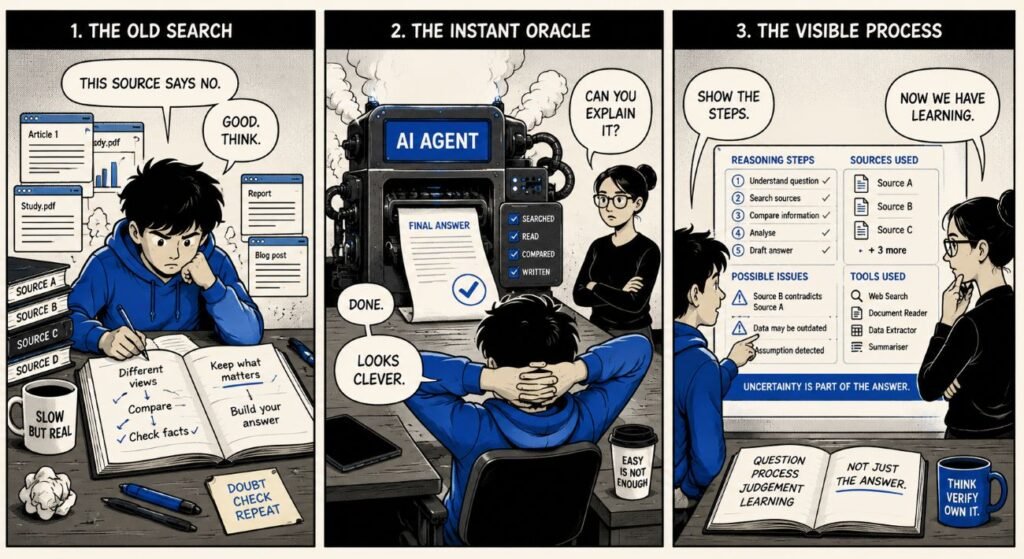
Scene 1: The old search
Panel description. A teenager sits at a desk with open books, browser tabs and a notebook full of crossed-out lines.
Dialogue:
Teenager: “This source says no.”
Book: “Good. Think.”
Scene 2: The instant oracle
Panel description. The same teenager sits back while a giant agent machine prints a finished essay.
Dialogue:
Agent: “Done.”
Teenager: “Looks clever.”
Teacher: “Can you explain it?”
Scene 3: The visible process
Panel description. The teenager stands beside the agent, pointing at sources, warnings and reasoning steps on a large board.
Dialogue:
Teenager: “Show the steps.”
Agent: “Uncertainty is part of the answer.”
Teacher: “Now we have learning.”
What to watch, not the show
- Tools that hide sources, steps and uncertainty behind smooth answers.
- Schools banning AI without teaching verification, prompt discipline and source checking.
- Agent systems built for convenience rather than learning.
- Homework formats that reward final output instead of process evidence.
- Parents who see the finished grade but not the invisible dependency.
- Platforms that turn “help me learn” into “do it for me”.
- Assessment rules that still pretend the pre-AI internet is coming back.
The Hermit take
The answer is not to ban the machine.
The answer is to make the student keep their hands on the wheel.
Keep or toss
Keep / Toss.
Keep AI as tutor, mirror and critic.
Toss AI as invisible homework servant.
Sources
- Pew, How Teens Use and View AI: https://www.pewresearch.org/internet/2026/02/24/how-teens-use-and-view-ai/
- UNESCO, Guidance for generative AI in education and research: https://www.unesco.org/en/articles/guidance-generative-ai-education-and-research
- OECD, PISA 2022 Results Volume II, digital device distraction: https://www.oecd.org/en/publications/pisa-2022-results-volume-ii_a97db61c-en/full-report/component-14.html
- Brookings, What the research shows about generative AI in tutoring: https://www.brookings.edu/articles/what-the-research-shows-about-generative-ai-in-tutoring/
- SSRN, ChatGPT as a Cognitive Crutch: Evidence from a Randomized Controlled Trial on Knowledge Retention: https://papers.ssrn.com/sol3/papers.cfm?abstract_id=5353041