
Lede
Given enough years, meeting your younger self might feel less like meeting yourself and more like meeting a stranger who happens to remember your childhood.
Hermit Off Script
As we age, I don’t think we remain exactly the same person who happened to collect more birthdays. There are shadows of that person still there, of course. Memories. Habits. Certain instincts. Maybe fears, loves and peculiar little things that somehow survive everything. But the mind looking through those same eyes can become remarkably different.
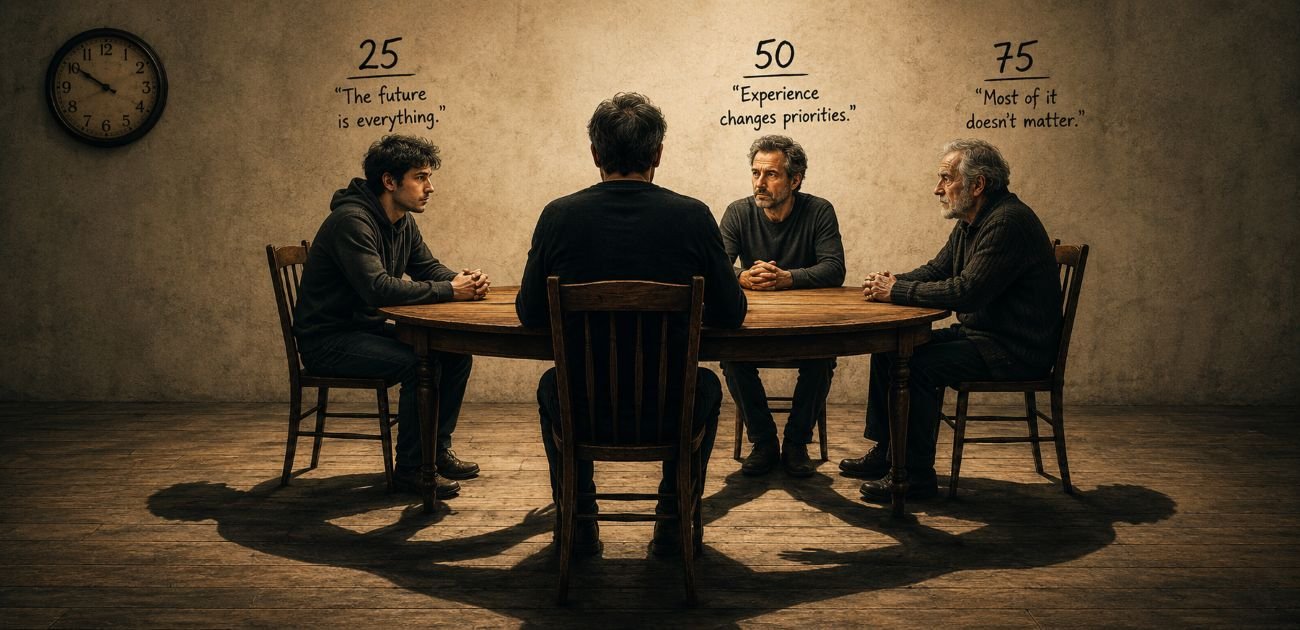
I don’t know whether we should count this transformation by decades, or perhaps imagine checkpoints every 25 years. The number itself doesn’t matter much. What interests me is the meeting.
Imagine sitting opposite yourself from 25 years ago.
Same biological history. Same name. Same childhood. Same memories up to the point where your lives split. Yet how long would it take before you disagreed?
Perhaps five minutes.
The younger version might believe things you no longer believe, want things you no longer want and worry desperately about things you now consider almost irrelevant. You might recognise the emotional shadows behind those thoughts without recognising the conclusions anymore.
And your younger self might have exactly the same problem with you.
“Who the hell did I become?”
Fair question.
To be fair, perhaps this transformation is stronger in people for whom learning never stops. If I spend 25 years questioning what I know, reading, experiencing, failing, observing people, changing my mind and learning new things, it would be stranger if my thinking remained identical. What would all that learning have been for?
There is something comforting in continuity, but perhaps we exaggerate it. We talk about “finding ourselves” as though somewhere inside us sits one finished person waiting to be discovered. Maybe there isn’t. Maybe there is simply a continuing person being revised by time.
The shadow remains. The mind keeps moving.
What does not make sense
- We expect adults to learn throughout life, then treat changing your mind as evidence that you somehow betrayed your “real self”.
- We talk about personality as identity while simultaneously accepting that experience can alter judgement, priorities, confidence and behaviour.
- We romanticise our younger selves while forgetting that younger us operated with considerably less information.
- We say “I’ve always been this way” about a creature whose brain, relationships, responsibilities, knowledge and environment have spent decades changing.
- We treat consistency as authenticity even when consistency can simply mean refusing to update.
Sense check / The numbers
- A 2022 meta-analysis examined 189 longitudinal samples involving 178,503 participants for personality rank-order stability and 276 samples involving 242,542 participants for mean-level personality change. It found both stability and change across the lifespan. [Psychological Bulletin]
- The same meta-analysis found little evidence that personality rank-order stability keeps increasing after age 25. Personality becomes comparatively stable, but age 25 is not a psychological “save file” after which nothing moves. [Psychological Bulletin]
- An earlier review found that many average personality changes are particularly noticeable between ages 20 and 40, including increases in self-confidence, self-control and emotional stability, while change can continue through middle and old age. [Current Directions in Psychological Science]
- A longitudinal German study followed 14,718 adults and found that age affected personality in complex ways, with the stability of several Big Five traits peaking roughly between ages 40 and 60 rather than remaining perfectly fixed throughout adulthood. [Journal of Personality and Social Psychology]
- A lifespan study of 91 adults aged 18 to 92 examined perceived similarity with past and future selves across intervals ranging from 1 month to 10 years. Interestingly, older participants generally showed greater self-continuity, suggesting that ageing does not simply make our previous selves feel increasingly alien. [Psychology and Aging]
The sketch
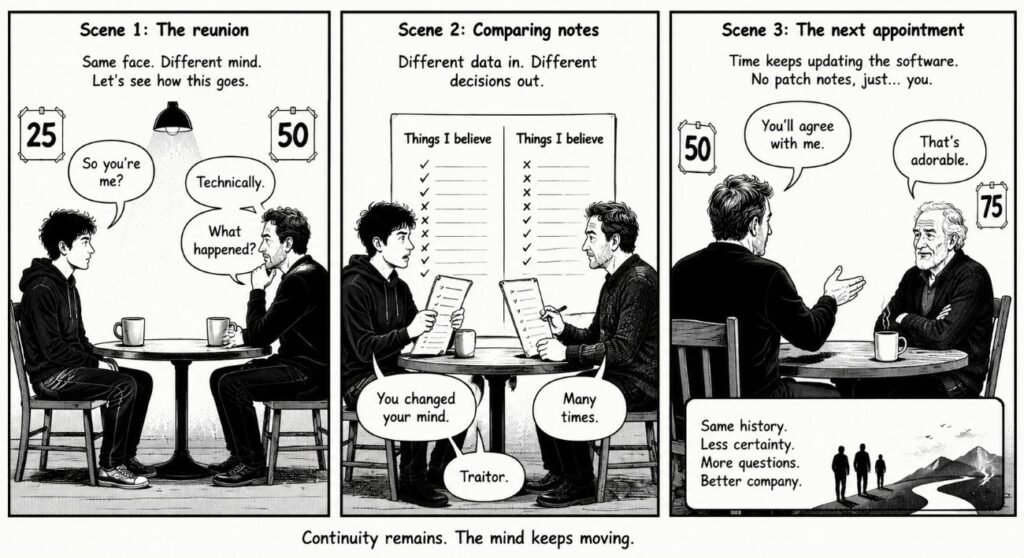
Scene 1: The reunion
Two identical silhouettes sit across a table. One is marked “25”, the other “50”.
Dialogue:
25: “So you’re me?”
50: “Technically.”
25: “What happened?”
Scene 2: Comparing notes
Both versions hold long lists headed “Things I believe”. Almost nothing lines up.
Dialogue:
25: “You changed your mind.”
50: “Many times.”
25: “Traitor.”
Scene 3: The next appointment
The 50-year-old turns towards another chair occupied by a silhouette marked “75”.
Dialogue:
50: “You’ll agree with me.”
75: “That’s adorable.”
What to watch, not the show
- Lifelong learning. New information matters only if we permit it to alter old conclusions.
- Identity politics in the personal sense – the pressure to defend something simply because “I’ve always believed it”.
- Nostalgia. Memory can preserve a flattering reconstruction of the person we used to be.
- Intellectual rigidity. Growing older does not guarantee growing wiser.
- Experience versus repetition. Twenty-five years of learning is different from repeating the same year 25 times.
- Self-continuity. Change does not require pretending that our previous selves were unrelated people. The interesting tension is precisely that they were us.
The Hermit take
Perhaps wisdom begins when you can disagree with the person you used to be without hating them.
I would be more worried if 25 years taught me nothing.
Keep or toss
Keep / Toss.
Keep the shadows, memories and continuity.
Toss the idea that remaining exactly the same person is proof of authenticity.
Sources
- Personality stability and change meta-analysis, Psychological Bulletin: https://pubmed.ncbi.nlm.nih.gov/35834197/
- Personality Trait Change in Adulthood, Current Directions in Psychological Science: https://pmc.ncbi.nlm.nih.gov/articles/PMC2743415/
- Stability and change across the life course, Journal of Personality and Social Psychology: https://pubmed.ncbi.nlm.nih.gov/21859226/
- Temporal Self-Continuity Across the Life Span, Psychology and Aging: https://pmc.ncbi.nlm.nih.gov/articles/PMC5014720/
- Stranger or a clone? Future self-connectedness review: https://pubmed.ncbi.nlm.nih.gov/34488025/
Satire, commentary and personal reflection for discussion. The psychological research supports personality change and continuity across adulthood, not a literal 25-year identity cycle.
Leave a Reply