
Lede
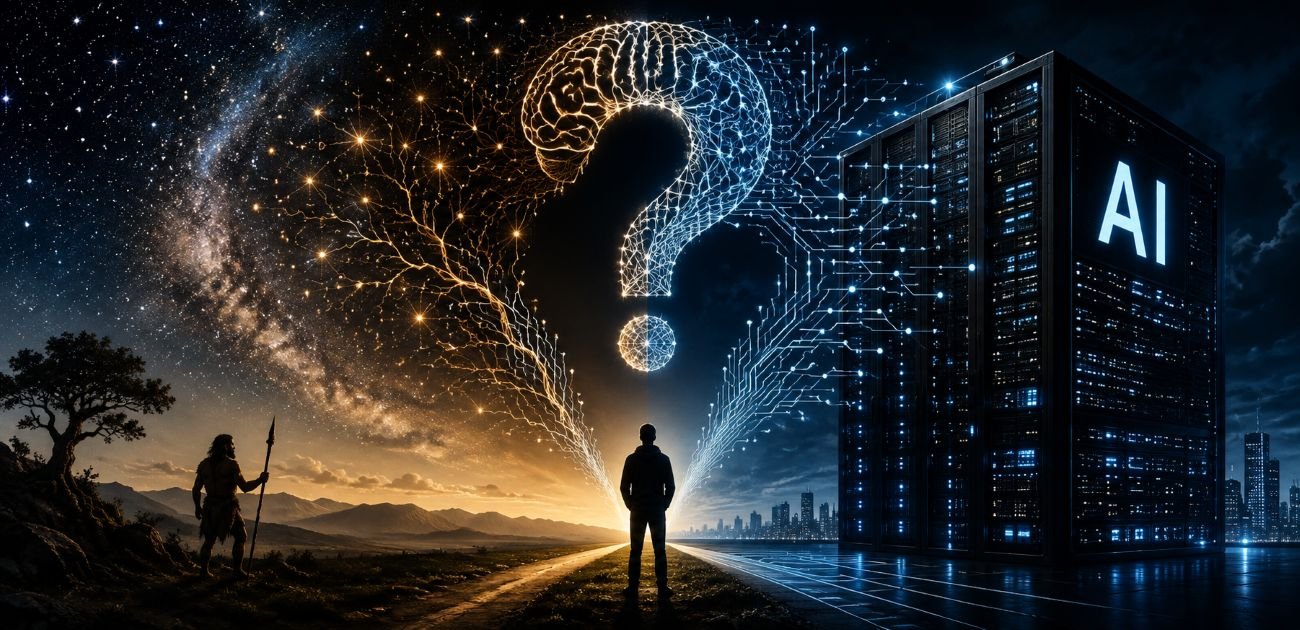
We are preparing ourselves for machines smarter than humanity while treating the possibility that humanity came from a greater intelligence as primitive thinking.
Words used
- Superintelligence: intelligence substantially beyond ordinary human cognitive ability across many important areas.
- Divine Love: my term for Love understood as something fundamental to existence, rather than merely an emotion produced by humans.
Hermit Off Script
God is a fascinating word because humans seem able to adjust its power depending on what argument they need. God is almighty when we pray for miracles, powerful when religion needs authority, mysterious when something cannot be explained, then strangely limited when the discussion becomes uncomfortable. The same happens with Love. People can call love sacred, life-changing and the greatest force in existence, but suggesting that Love itself might be Divine Love, or that Love is God rather than God merely possessing love, suddenly sounds too much.
What amazes me even more is watching some of the brightest minds humanity has produced work towards artificial superintelligence. We can seriously discuss creating an intelligence greater than ourselves. We can spend billions trying to build it. We can debate whether it might discover things humans cannot understand. Apparently an intelligence beyond human comprehension is perfectly respectable once it needs electricity.
But turn the direction around.
Why couldn’t human intelligence itself be the result of something similar?
I’m not claiming science proves God. It doesn’t. I’m asking why the intellectual possibility is treated so differently. AI begins with accumulated human knowledge and training, then the ambition is for it eventually to exceed the intelligence that created it. My spiritual interpretation of humanity runs almost in reverse. What if what we called God represented an intelligence containing knowledge beyond anything an individual human could comprehend, and human existence gradually expressed fragments of that intelligence through biological evolution, learning, culture and thousands of years of accumulated knowledge?
Homo sapiens didn’t wake up one Tuesday with physics, antibiotics and Wi-Fi. Knowledge accumulated. Some extraordinary minds pushed it forward, while everyone else inherited the benefits. During roughly the last century especially, scientific and technological progress has made abilities that once would have looked supernatural completely ordinary. I can speak into a small rectangle in England and someone in Seoul can see my face almost instantly. Try explaining that to somebody from 1026 without eventually being accused of witchcraft.
Maybe part of our fear of AI comes from believing we are only simple humans building something that may become greater than us. If you believe there is nothing greater within human existence, superintelligence naturally looks like our replacement.
I see another possibility.
Perhaps we haven’t reached the limits of human intelligence, consciousness or Love. Perhaps the miracle was never supposed to be a man walking across water. The simplest experience of genuinely loving another being is already extraordinary when you stop treating familiarity as an explanation.
Centuries of religion trained people to look for God in miracles, authority and supernatural power. Materialism then reacted by demanding measurable evidence. Somewhere between the two, ordinary existence became boring simply because we became accustomed to it.
Maybe a future superintelligence will look at humanity differently. Maybe instead of teaching us that machines became gods, it will help us recognise how extraordinary the human being already was.
And perhaps AI and humans will progress together. Or perhaps humans will eventually discover limits in themselves that we currently don’t even know exist. AI may gain extraordinary knowledge, speed and memory, but whether machinery can ever possess whatever produced subjective human experience, consciousness and Love remains unanswered.
We are racing to manufacture a god while barely investigating whether we have misunderstood the miracle that manufactured us.
What does not make sense
- Intelligence beyond humanity is considered a serious technological possibility, while intelligence beyond humanity as an explanation for existence is often dismissed before the argument even begins.
- We accept that intelligence can accumulate across generations of machines, yet routinely underestimate how much human intelligence already depends on knowledge accumulated across generations of people.
- God is described as omnipotent, then quietly given human-sized limitations whenever theology needs an escape hatch.
- Love is called profound until someone suggests it might tell us something fundamental about existence rather than merely something about brain chemistry.
- We expect future AI to reveal truths humans cannot currently understand while assuming today’s human understanding is sufficient to declare which metaphysical possibilities are impossible.
Sense check / The numbers
- Homo sapiens has existed for about 300,000 years. Fossils associated with early Homo sapiens at Jebel Irhoud in Morocco were dated to approximately 315,000 years ago, with an uncertainty of about 34,000 years. [Smithsonian] [Nature]
- Modern estimates of the number of neurons in a human brain are not as settled as the familiar “86 billion” figure suggests. A 2025 review in Brain reported published estimates ranging from about 61 billion to 99 billion neurons. [Brain]
- Estimates of total synapses are even larger. A recent neuroscience paper cites estimates ranging from roughly 600 trillion to 7 quadrillion synapses in the adult human brain. That does not prove anything spiritual, but it is a useful reminder of how much remains inside the object doing the arguing. [PMC]
- OpenAI’s published Charter defines AGI as highly autonomous systems that outperform humans at “most economically valuable work”. Its 2023 AGI discussion described the goal more broadly as AI systems “generally smarter than humans”. The technology industry therefore already treats beyond-human machine intelligence as a legitimate research objective rather than a supernatural concept. [OpenAI]
- Belief in God remains common even in increasingly secular societies. Pew’s international data published in 2026 reported that 57 per cent of UK respondents said they believed in God, compared with 78 per cent in the United States and 100 per cent in Indonesia and Kenya. The argument over God clearly hasn’t disappeared. [Pew Research Center]
The sketch
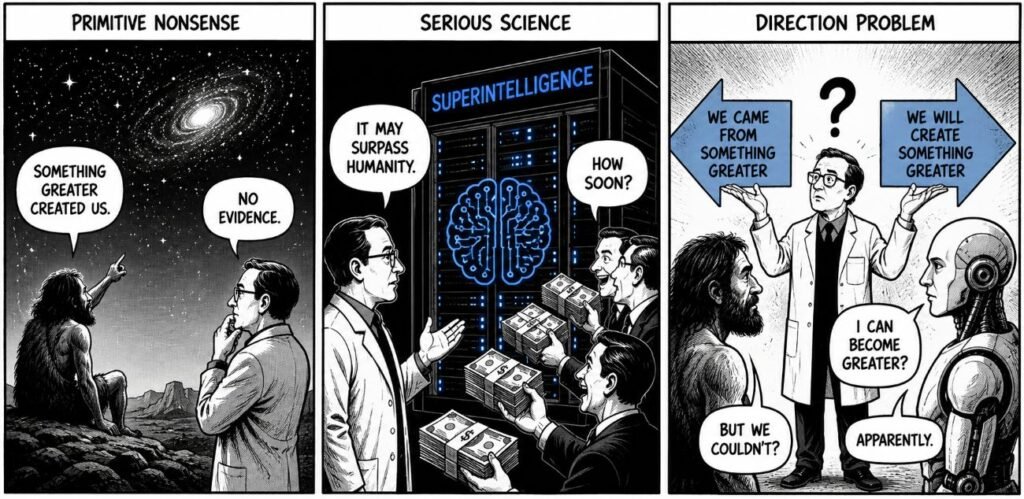
Scene 1: Primitive nonsense
An ancient human silhouette looks upwards at a huge field of stars while a modern scientist stands beside a whiteboard.
Dialogue:
Ancient human: “Something greater created us.”
Scientist: “No evidence.”
Scene 2: Serious science
The scientist now stands beside a giant server labelled SUPERINTELLIGENCE while investors feed stacks of money into it.
Dialogue:
Scientist: “It may surpass humanity.”
Investor: “How soon?”
Scene 3: Direction problem
The ancient human and a humanoid machine stare at each other while the scientist stands between them holding two arrows, one pointing forwards and one backwards.
Dialogue:
Machine: “I can become greater?”
Human: “Apparently.”
Ancient human: “But we couldn’t?”
What to watch, not the show
- Definitions. “God”, “intelligence”, “consciousness”, “AGI” and “superintelligence” can become moving targets when an argument gets difficult.
- Evidence. AI progress is empirically measurable. God and Divine Love are metaphysical claims. Treating them identically would be bad reasoning, even when comparing the assumptions surrounding them is useful.
- Human exceptionalism. AI debates often assume humans are simultaneously intelligent enough to create superintelligence and too limited to contain anything we haven’t yet understood.
- Reductionism. Explaining biological mechanisms involved in love doesn’t automatically settle every philosophical question about what love means or why conscious experience exists.
- AI theology. As machines become more capable, language once reserved for gods – omniscience, creation, transcendence and powers beyond human comprehension – increasingly appears in technological discussions.
- Partnership. The more useful future may be neither machines replacing humans nor humans permanently controlling machines, but different forms of intelligence extending what each can discover.
The Hermit take
If humans can create an intelligence greater than themselves, asking whether something greater preceded human intelligence isn’t a stupid question.
Maybe the next superintelligence will teach us less about becoming gods and more about how little we understood ourselves.
Keep or toss
Keep / Toss.
Keep the questions about intelligence, consciousness, Love and human potential.
Toss the habit of calling one unknown “impossible” while raising billions to manufacture another.
Sources
- Smithsonian Human Origins, Homo sapiens: https://humanorigins.si.edu/evidence/human-fossils/species/homo-sapiens
- Smithsonian, our species arose at least 300,000 years ago: https://humanorigins.si.edu/research/whats-hot-human-origins/our-species-arose-least-300000-years-ago
- Nature, Jebel Irhoud dating and Homo sapiens origins: https://www.nature.com/articles/nature22335
- Brain, neuron-number estimates: https://pmc.ncbi.nlm.nih.gov/articles/PMC11884752/
- Human brain synaptic-density research: https://pmc.ncbi.nlm.nih.gov/articles/PMC11326867/
- OpenAI Charter, definition of AGI: https://openai.com/charter/
- OpenAI, Planning for AGI and beyond: https://openai.com/index/planning-for-agi-and-beyond/
- Pew Research Center, international belief in God data: https://www.pewresearch.org/chart/in-places-where-more-people-believe-in-god-larger-shares-connect-that-belief-with-morality/
Disclaimer: The argument that God may represent a prior superintelligence, that Divine Love is fundamental to existence, and that humans may contain unrealised capacities is philosophical and spiritual commentary. The scientific sources above establish facts about human evolution, the brain and AI terminology. They do not establish the existence of God or Divine Love.
Leave a Reply