

Lede
Reasoning AI models have become genuinely useful, which is exactly why we should stop pretending they have secretly become electronic monks with divine intuition.
Hermit Off Script
I have been using reasoning models in extended mode for months now, and yes, I can see the difference. The assistant finally feels more like a useful collaborator and less like a confident intern who swallowed Wikipedia and then forgot the question halfway through. It still fails, of course. It still wanders into a wall sometimes with the elegance of a Roomba at a philosophy conference. But the quality is visible, especially compared with the older mixed-model mess where even memories, context and helpful instructions could still produce answers that looked as if they had been assembled during a power cut. The problem is that people keep expecting miracles from vague prompts. They throw in a foggy request with no direction, no scope, no target, no standard of success, then act betrayed when the model does not return a golden business plan, a perfect poem, a legal strategy, and the meaning of existence in one neat paragraph. That is not intelligence failing. That is mediocrity asking randomness to dress up as destiny. These models are not little gods. They are not intuitive beings dreaming under silicon trees. They are trained systems built from data, compute, memory, probability, reinforcement learning and pattern recognition. Smart, yes. Useful, yes. Sometimes frighteningly good. But not yet the strange spark that wakes a human at 3 am with a discovery that rearranges the world. Real creators should not panic. The machine can remix the library, but it does not yet hear the silence between the shelves. Superintelligence, if it arrives, will need more than bigger pattern machines wearing more expensive shoes. Maybe quantum systems help. Maybe a new architecture appears. Maybe the next breakthrough arrives from some half-mad researcher who dreams it before breakfast. For now, reasoning AI is a better walking library – not the librarian of existence.
What does not make sense
- People ask for “the best answer” while refusing to define the task, the audience, the limits, the evidence, or the win condition.
- Everyone wants genius output from mediocre input, as if the model can turn fog into architecture because someone typed “make it viral”.
- Reasoning models are treated as mystical beings, then judged like faulty vending machines when they fail under ambiguous nonsense.
- The industry keeps selling “thinking” as if longer internal processing automatically equals judgement, taste, originality, or wisdom.
- Users fear AI will replace real creators, but most prompts prove the first job under threat is not creativity – it is copy-paste confidence.
- The models are praised as superhuman until they hallucinate, then suddenly everyone remembers that probability is not prophecy.
Sense check / The numbers
- OpenAI introduced o1-preview on 12 September 2024 as a model series designed to “spend more time thinking” before responding, with stronger results in complex science, coding and maths tasks. [OpenAI]
- OpenAI’s o3 and o4-mini were announced on 16 April 2025, with o4-mini described as a smaller model optimised for fast, cost-efficient reasoning, especially in maths, coding and visual tasks. [OpenAI]
- OpenAI’s GPT-5.2 release said GPT-5.2 Thinking produced errors 30 per cent less often than GPT-5.1 Thinking on de-identified ChatGPT queries, while also warning that all models remain imperfect and critical answers should be double checked. [OpenAI]
- Anthropic introduced Claude 3.7 Sonnet with an “extended thinking mode” on 24 February 2025, allowing users and developers to control how deeply the model spends effort on harder tasks. [Anthropic]
- NIST’s 2024 generative AI risk profile defines generative AI as systems that emulate the structure and characteristics of input data to generate derived synthetic content, which is a clean way of saying: the machine is impressive, but it is still feeding from what came before. [NIST]
Where the next models are heading
The public plan, as of 7 May 2026, is not a neat prophecy called “GPT-6 arrives on a white horse”. It is plainer and more useful than that: longer context, better tool use, stronger coding, better file work, more agent behaviour, more controlled reasoning effort, and more safety plumbing around systems that can actually do things instead of just talk about doing them. OpenAI’s GPT-5.5 guide points towards coding, tool-heavy agents, grounded assistants, long-context retrieval, product-spec-to-plan workflows and customer-facing workflows, with more efficient reasoning than earlier models. Its system card says GPT-5.5 is built for real work across code, online research, documents, spreadsheets and tools. That is the direction: less chatbot, more junior operator with a calculator, browser, filing cabinet and mild delusions of competence.
The next flavour will not be “more genius”. It will be “more delegated work”. GPT-5.5 Pro already uses more compute for harder problems and can take several minutes on some requests, while ChatGPT’s GPT-5.5 Thinking supports web search, data analysis, file analysis, canvas, image generation, memory and custom instructions. That tells you where the road bends: models that gather evidence, touch tools, read your files, write the plan, make the spreadsheet, check the mess, and then pretend they meant to ask one clarifying question all along.
The same pattern shows up outside OpenAI. Anthropic has pushed adaptive thinking and effort controls, meaning models can vary how much reasoning they spend depending on the job. Google has pushed Gemini 3.1 Pro and Deep Think for harder reasoning, science and complex problem solving. The arms race is not only about a bigger brain in a box. It is about switching between cheap speed, expensive thinking, tool use, memory, files, voice, images and agents without making the user choose from a menu that looks like a microwave from 1998.
The warning is simple. Future models will feel more alive because they will remember more, act more, and ask less. That does not make them intuitive. It makes them better organised. A filing cabinet with legs is still a filing cabinet, even if it now books meetings and judges your spreadsheet.
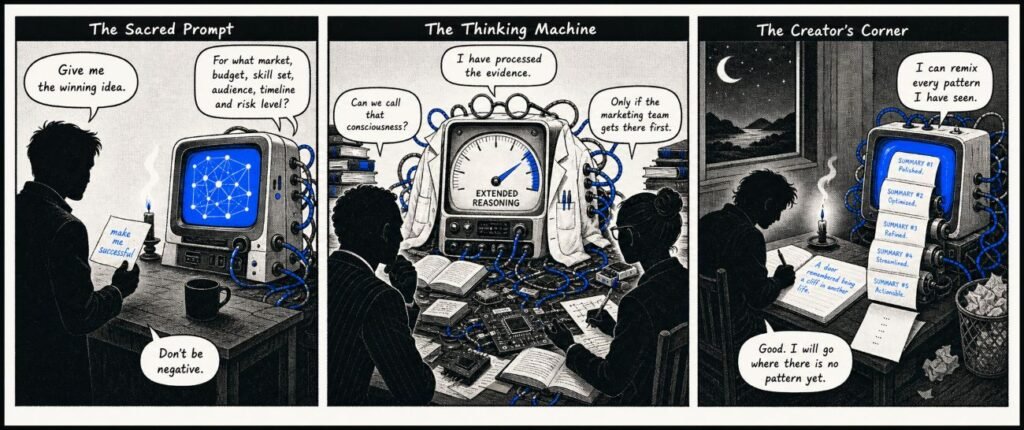
The sketch
Scene 1: The Sacred Prompt
Panel description: A user stands before a glowing AI terminal holding a napkin that says “make me successful”.
Dialogue:
User: “Give me the winning idea.”
AI: “For what market, budget, skill set, audience, timeline and risk level?”
User: “Don’t be negative.”
Scene 2: The Thinking Machine
Panel description: The AI wears a tiny lab coat while a huge meter reads “Extended Reasoning”. Behind it, a pile of books, GPUs and invoices smokes gently.
Dialogue:
AI: “I have processed the evidence.”
Investor: “Can we call that consciousness?”
Engineer: “Only if the marketing team gets there first.”
Scene 3: The Creator’s Corner
Panel description: A tired writer sits by a window at 3 am, scribbling one strange sentence while the AI prints twelve polished summaries.
Dialogue:
AI: “I can remix every pattern I have seen.”
Writer: “Good. I will go where there is no pattern yet.”
What to watch, not the show
- The money: better reasoning means higher prices, heavier compute costs, and more pressure to turn “thinking” into a subscription tier.
- The incentives: companies will keep selling intelligence by benchmark, even when benchmarks cannot measure taste, judgement, lived experience, or creative rupture.
- The user behaviour: vague prompts will keep producing vague output, then the blame will be sent to the model like a lazy tax return.
- The education risk: people may outsource the struggle too early and lose the very friction that teaches them to think.
- The creative risk: not that AI kills creativity, but that humans start imitating AI’s smooth, bloodless competence.
- The legal and factual risk: reasoning can reduce errors, but it does not abolish hallucinations, bad assumptions, or false confidence.
The Hermit take
The model can sharpen your blade, but it cannot give you a sword arm.
Use it as a forge, not as a soul.
Keep or toss
Keep.
Keep reasoning models for serious work, long context, coding, analysis, structure, and brutal first drafts.
Toss the fantasy that extended reasoning is intuition, genius, or destiny in a server rack.
Sources
- OpenAI o1-preview announcement: https://openai.com/index/introducing-openai-o1-preview/
- OpenAI o3 and o4-mini announcement: https://openai.com/index/introducing-o3-and-o4-mini/
- OpenAI GPT-5.2 announcement: https://openai.com/index/introducing-gpt-5-2/
- Anthropic visible extended thinking announcement: https://www.anthropic.com/news/visible-extended-thinking
- NIST generative AI risk management profile: https://nvlpubs.nist.gov/nistpubs/ai/NIST.AI.600-1.pdf
- Transformer paper, “Attention Is All You Need”: https://papers.neurips.cc/paper/7181-attention-is-all-you-need.pdf