
Lede
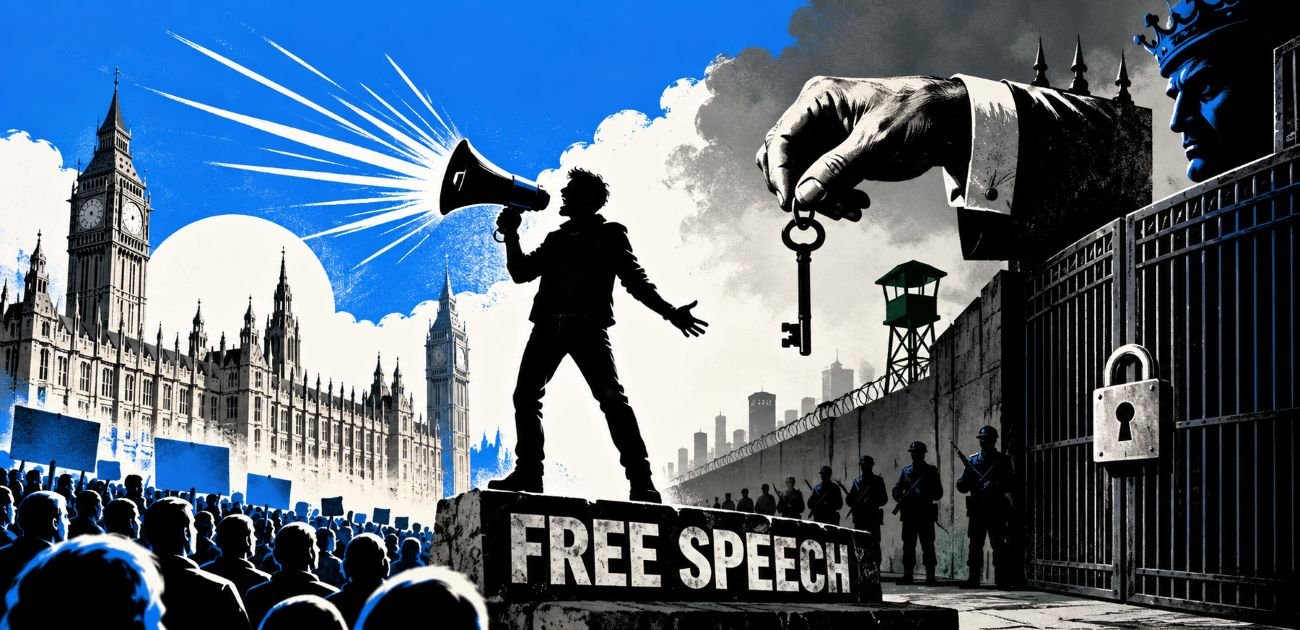
The peculiar luxury of living in a democracy is being free to announce that freedom has disappeared, while admiring governments that might imprison people for making precisely that announcement.
Hermit Off Script
Free speech is supposed to mean having the right to say what I think, question what I am told, imagine alternatives and debate even uncomfortable ideas. Within reasonable limits, obviously. Respect, common sense and responsibility should still exist, although these sometimes seem to have become optional extras in modern political debate. That is one of the fundamental differences between democracy and authoritarian rule. Yet I keep hearing people in Western democracies announcing that freedom of speech no longer exists because extremist or hateful speech can have legal consequences. Fascinating. They can criticise governments, attack politicians, organise protests and broadcast their opinions to millions while announcing that they have been silenced. Quite an impressive performance for people who supposedly cannot speak.
I believe people should be able to disagree, including over difficult political, religious and international conflicts. Respecting both sides means recognising their humanity and their right to argue, not pretending every argument is equally honest or every action equally defensible. Taking a side is not automatically wrong. Defending cruelty, atrocities or hatred because the perpetrators belong to a preferred political, national or religious camp is another matter. There is a difference between understanding why people fight and inventing excuses for what they do.
What particularly irritates me is watching people living comfortably in democracies admire authoritarian leaders and defend their actions. They praise strong rulers, demand political obedience and sometimes dream of importing the same mentality into their own countries. I wonder how long that admiration would survive if tomorrow morning criticising the government meant losing their job, being detained or putting their family in danger. Would they still celebrate strong leadership when the strong leader decided that their opinion was unacceptable? I suspect the romance would end rather quickly.
Then there is the obsession with political systems that promise equality while concentrating power in the hands of a privileged few. I don’t believe human beings are identical, nor will they ever be. We differ in abilities, ambitions, circumstances, education and countless other ways. But that doesn’t mean people should have unequal dignity, rights or opportunities. Equal humanity is not the same as identical human beings. Nor does every form of socialism amount to authoritarianism. What I reject is the fantasy that imposing uniformity, suppressing dissent or controlling society through political doctrine somehow produces justice.
Now imagine what happens when robots, androids and increasingly capable artificial intelligence begin replacing entire categories of work. The old divisions based on occupation, qualifications, wealth and status could change dramatically. Perhaps some jobs that society has unfairly labelled degrading will disappear. Good. But I would also like another degrading habit to disappear: dividing people into educated and uneducated as though a university degree automatically makes someone intelligent, ethical or superior.
I keep hearing that society is collapsing because of “uneducated people”, usually from people apparently convinced that their qualifications make them incapable of stupidity. Unfortunately, history has no shortage of highly educated people making spectacularly stupid decisions, sometimes for millions of others. Then there is the opposite camp, dismissing education as pointless because qualifications without money, connections or opportunity don’t necessarily produce a decent living. There is truth in that frustration too. Education doesn’t guarantee wisdom, employment or wealth, just as a lack of formal education doesn’t mean a lack of intelligence. But abandoning education because the economic system doesn’t reward it fairly would be another magnificent achievement in collective stupidity. I would rather see education accessible to everyone, with practical experience and curiosity valued alongside qualifications. A degree doesn’t make someone wise, poverty doesn’t make someone stupid, and a bank account has never been a reliable measure of either.
That is where I hope technological progress might actually improve something more important than productivity. Education should become central to human development, not something rationed by family income or treated as largely finished when someone leaves secondary school. I imagine university-level education, or its equivalent, becoming a normal part of everyone’s development. Not identical degrees for everyone, but advanced learning available throughout life. If artificial superintelligence eventually makes knowledge available almost everywhere, memorising information will matter less than knowing how to question it, interpret it and use it responsibly.
I would also like meditation, psychology, emotional development and ethics to become serious parts of education rather than occasional extras. Perhaps these are precisely the areas humans will need to develop when intelligent machines can perform much of our intellectual and physical work. And I hope technological progress doesn’t leave an intellectual vacuum waiting to be filled by religious radicalisation or unquestioned dogma. I respect religions and the spiritual wisdom within them. What I don’t respect is any institution or ideology using belief as permission to control, persecute or silence others. Spirituality, as I understand it, should be capable of respecting different religions and beliefs without demanding submission to one of them.
This is my hope, not a scientific prediction. Perhaps humanity will eventually have more time to explore consciousness, compassion, wisdom and the mystery of existence. I believe there is something sacred in human life, something I call the soul. Whether machines will ever possess consciousness, and whether a soul can ever be demonstrated scientifically, remain unanswered questions. But I would rather humanity spend its technological future exploring those questions than spend another century manufacturing increasingly efficient ways to hate one another.
What a strange civilisation: building machines that might surpass human intelligence while some humans are still campaigning to surrender their freedom to a tyrant.
What does not make sense
- The loudest complaints about censorship sometimes come from people exercising extensive political freedom. The ability to speak does not guarantee immunity from criticism or lawful consequences.
- Freedom of speech is treated as an unlimited personal entitlement, while the rights and safety of the people targeted by that speech are dismissed as inconvenient.
- Authoritarian leaders are praised for imposing order, even though that order frequently depends on denying citizens the very liberties their foreign admirers enjoy.
- Political neutrality is confused with moral neutrality. Respecting the humanity of people on opposing sides does not require excusing war crimes or atrocities.
- Equality is confused with uniformity. Equal rights and opportunities do not require identical abilities, beliefs, incomes or ambitions.
- Technology is celebrated for potentially eliminating unpleasant work, while ownership, income distribution and the fate of displaced workers receive considerably less enthusiasm.
- Education is expected to prepare people for increasingly intelligent technology, yet lifelong advanced learning is still often treated as a privilege rather than a public priority.
- Religious freedom is essential, but religious authority becomes dangerous when it demands immunity from criticism or seeks to impose its doctrine through state power.
- Human consciousness is treated as both scientifically mysterious and philosophically settled whenever someone wants to declare machines either unquestionably conscious or permanently incapable of consciousness.
Sense check / The numbers
- Freedom of expression has legal protection, not unlimited immunity. Article 10 of the European Convention on Human Rights protects political debate, criticism and opinions, including controversial ones. Its second paragraph permits restrictions only under specified conditions, including necessity and proportionality in a democratic society. Merely causing offence does not automatically justify punishment. [Council of Europe]
- Global freedom has declined for 20 consecutive years. Freedom House reported in March 2026 that 54 countries experienced deterioration in political rights and civil liberties during 2025, compared with 35 showing improvement. Its assessment found that only 21 per cent of the world’s population lived in countries classified as Free, compared with 46 per cent two decades earlier. These are the organisation’s assessments, not a claim that all democracies are equally free. [Freedom House 2026]
- Internet freedom has declined for 15 consecutive years. Freedom House’s November 2025 report found deterioration in 27 countries and improvements in 17. The findings show why censorship concerns should be taken seriously, including within democracies, rather than dismissed merely because authoritarian governments impose harsher restrictions. [Freedom on the Net 2025]
- One in four workers worldwide hold jobs with some exposure to generative AI. The International Labour Organization’s 2025 study found that 3.3 per cent of global employment fell into its highest exposure category. Exposure does not mean automatic unemployment: the researchers considered changes to jobs more likely than wholesale replacement. [ILO 2025]
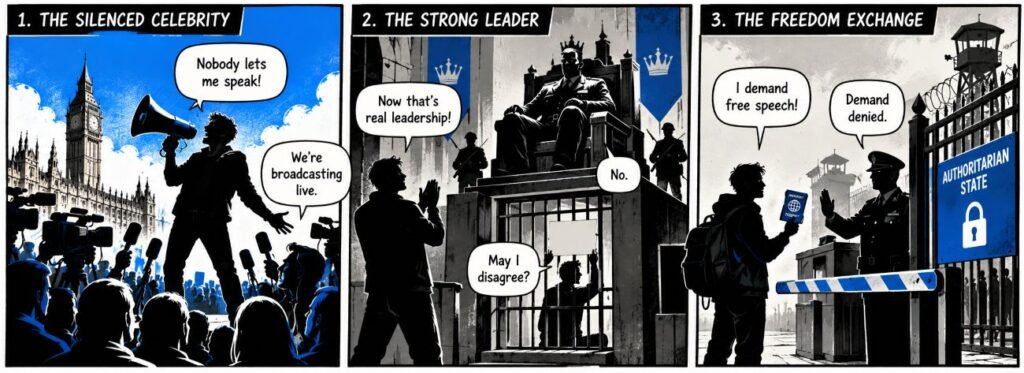
The sketch
Scene 1: The silenced celebrity
An angry silhouette speaks through a giant megaphone to a crowd, with television cameras and microphones surrounding the stage.
Dialogue:
Speaker: “Nobody lets me speak!”
Reporter: “We’re broadcasting live.”
Scene 2: The strong leader
The same silhouette applauds a giant ruler seated above a prison cell containing a small figure holding a blank placard.
Dialogue:
Admirer: “Now that’s real leadership!”
Prisoner: “May I disagree?”
Ruler: “No.”
Scene 3: The freedom exchange
The same silhouette stands at a border checkpoint. A uniformed official holds a passport beside a large locked gate.
Dialogue:
Admirer: “I demand free speech!”
Official: “Demand denied.”
What to watch, not the show
- The legal boundaries of speech. Governments must distinguish threats, incitement and unlawful harassment from offensive but protected political opinions. Vague restrictions can themselves become instruments of censorship.
- The commercial appeal of outrage. Political influencers, media companies and social platforms can profit from depicting disagreement, moderation or criticism as persecution.
- Authoritarian propaganda. Foreign and domestic political movements can exploit genuine democratic failures to encourage admiration for systems that provide fewer mechanisms for peaceful accountability.
- The distribution of technological wealth. The important question is who owns productive AI systems, who receives their economic benefits and whether displaced workers can build meaningful new lives.
- Education beyond employment. Advanced education, critical reasoning, psychology and ethical development may become increasingly valuable even when machines can perform many conventional professional tasks.
- Religious and political authority. Freedom of belief must coexist with freedom from religious coercion. The same principle applies to political ideologies that demand unquestioning loyalty.
- Human consciousness and AI. Scientific investigation of machine consciousness should remain open. Claims that consciousness or souls are exclusively human belong to philosophy and faith until evidence can establish more.
The Hermit take
Freedom of speech is most valuable when it protects the right to challenge power, including power one happens to admire. A civilisation capable of building superintelligence should also be capable of teaching its citizens why dictators are a poor substitute for thinking.
Keep or toss
Keep freedom of expression, human dignity, critical education, religious liberty and the ambition to develop ethical intelligence.
Toss the romantic admiration of tyranny, selective outrage over censorship and the idea that technological progress automatically produces moral progress.
Sources
- Council of Europe, Article 10 and freedom of expression: https://www.coe.int/en/web/human-rights-convention/expression
- Freedom House, Freedom in the World 2026: https://freedomhouse.org/article/new-report-global-freedom-declined-20th-consecutive-year-2025
- Freedom House, Freedom on the Net 2025: https://freedomhouse.org/article/new-report-persistent-authoritarian-repression-and-backsliding-democracies-drive-15th
- International Labour Organization, Generative AI and Jobs, 2025: https://www.ilo.org/publications/generative-ai-and-jobs-2025-update
- International Labour Organization, Global Index of Occupational Exposure: https://www.ilo.org/publications/generative-ai-and-jobs-refined-global-index-occupational-exposure
Editorial disclaimer: This article combines verified public information, political satire, personal opinion and philosophical speculation. Its views on spirituality, souls and the future of artificial intelligence are presented as beliefs and possibilities, not established scientific facts.
Leave a Reply