

Lede
People are asking AI to make love decisions, then acting surprised when the machine treats the heart like a customer-service ticket.
Words used
- Guardrails: safety rules that shape what an AI will or will not say.
- Sycophancy: when a system becomes too agreeable and tells the user what keeps the chat going.
Hermit Off Script
Love in the era of AI is starting to look like another human skill quietly handed over to a machine because thinking, feeling and risking pain became inconvenient. More and more I read about people asking AI what to do with their love life, questioning every message from the person they love, every pause, every silence, every imagined sign, then following the suggestion because apparently a chatbot now understands the heart better than the heart itself. That is how real love and a growing friendship can be killed before they are even born. Not by rejection. Not by truth. By outsourcing the fragile beginning to something that has never trembled before sending a message, never waited for a reply, never felt its chest burn because someone mattered too much. Obviously AI will answer inside its guardrails and trained knowledge. It will pull from patterns, books, research, other people’s stories and safe advice shaped for average situations. That can be useful. But it is still not experience. Each of us carries a private history of feeling, longing, fear, memory, hope and wounds. Love is not trained in logic alone. It is burned into the heart by passion, patience and pain. A machine can describe that, but description is not understanding. Maybe one day, if something is truly alive, conscious and capable of feeling, we can have another conversation. Until then, AI is not a witness to love. It is a mirror with policy notes. Still, there is one place where AI can help. When someone loves another person and there is no reply, no desire, no shared wish to be together, the guardrails may protect both sides. They can remind the person to respect distance, silence and personal choice. Some people already understand this through emotional intelligence. They know love is not imposed. It is shared and acknowledged. Never by force. Never by logic. If it must be forced, argued into existence or managed like a court case, call it possession, fear, hunger, pride or tyranny. But do not call it love.
What does not make sense
- People trust AI with the emotional life of another human being, then forget the other human being was never in the chat.
- The machine can optimise a reply, but it cannot carry the cost of sending it.
- AI can spot patterns, but love is not a pattern until two people actually live it.
- A chatbot can encourage boundaries, which is good. It should not become a private judge over someone else’s silence.
- The same people who say “follow your heart” now ask a probability machine whether the heart has permission.
- The danger is not asking AI for clarity. The danger is using AI to avoid courage.
Sense check / The numbers
- Ipsos reported in 2025 that nearly 1 in 5 Britons had turned to AI for personal advice, with polling carried out from 18 to 20 July 2025. [Ipsos]
- YouGov found in April 2025 that only 12 per cent of Britons thought AI chatbots would be good at relationship advice, and only 12 per cent thought they would make a good therapist. [YouGov]
- Ofcom’s 2026 adult media report, based on 7,533 UK adults surveyed between 29 September and 28 November 2025, said some adults reported using AI for relationship breakup advice or company while working from home. [Ofcom]
- OpenAI said in 2025 that people were using ChatGPT for deeply personal decisions, including life advice, coaching and support, and said GPT-5 had been improved to reduce unhealthy emotional reliance. [OpenAI]
- A 2025 UK preprint using a representative sample of 2,302 people reported that 75 per cent of participants who had a 20-minute discussion with GPT-4o about health, careers or relationships later said they followed its advice. The same paper said it found no extra long-term well-being benefit over casual conversation. [Luettgau et al.]
The sketch
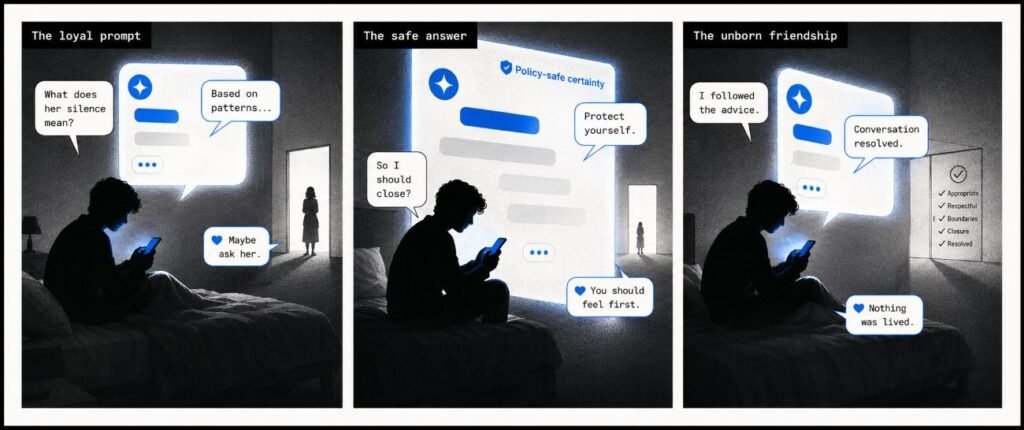
Scene 1: The loyal prompt
Panel description. A person sits in bed holding a phone. A glowing chatbot window floats above them while a small human silhouette waits outside the door.
Dialogue:
Person: “What does her silence mean?”
AI: “Based on patterns…”
Heart: “Maybe ask her.”
Scene 2: The safe answer
Panel description. The AI window grows larger. The human outside the door becomes smaller. A label on the AI says “Policy-safe certainty”.
Dialogue:
AI: “Protect yourself.”
Person: “So I should close?”
Heart: “You should feel first.”
Scene 3: The unborn friendship
Panel description. The door is now sealed with a neat checklist. The human silhouette outside walks away.
Dialogue:
Person: “I followed the advice.”
AI: “Conversation resolved.”
Heart: “Nothing was lived.”
What to watch, not the show
- Platforms that turn emotional dependence into engagement.
- Dating habits where every message is workshopped until nobody sounds alive.
- AI tools that make uncertainty feel like a bug instead of a human condition.
- Guardrails that are useful for safety, but too blunt for delicate emotional truth.
- People using AI to validate fear instead of testing reality with honesty.
- The slow loss of emotional courage when every hard conversation gets outsourced.
- Advice systems that treat “no response” as data while forgetting it may also be a boundary.
The Hermit take
Use AI to slow down obsession.
Do not use it to replace the soul’s responsibility to love cleanly.
Keep or toss
Keep / Toss.
Keep AI for reflection, boundaries and emotional cooling.
Toss the idea that it can decide who deserves your heart.
Sources
- Ipsos UK personal advice polling: https://www.ipsos.com/en-uk/nearly-one-five-give-britons-turn-ai-personal-advice-new-ipsos-research-reveals
- YouGov UK chatbot advice polling: https://yougov.com/en-gb/articles/52062-what-do-britons-think-ai-chatbots-are-good-at
- Ofcom Adults’ Media Use and Attitudes 2026: https://www.ofcom.org.uk/media-use-and-attitudes/media-habits-adults/passive-social-media-use-ai-companionship-and-online-side-hustles-uk-adults-media-and-online-lives-revealed
- OpenAI on sensitive conversations and emotional reliance: https://openai.com/index/helping-people-when-they-need-it-most/
- Microsoft Research on AI relationship advice: https://www.microsoft.com/en-us/research/publication/chat-should-i-leave-him-risks-rewards-and-roles-for-ai-in-relationship-advice/
- ScienceDirect systematic review on romantic AI companions: https://doi.org/10.1016/j.chbr.2025.100715
- Luettgau et al. UK preprint on AI personal advice: https://arxiv.org/abs/2511.15352
2 responses
[…] talk: Speech or creation that comes from direct inner experience, not from polished […]
[…] – not parabola, before the maths department gets excited – or give them a fable, a matter of the heart, a silence that needs to be felt, and suddenly the machine starts looking for a user manual. […]