
Lede
Intuition hears the future knocking, intelligence asks for a citation, and civilisation needs both before it builds another altar to cleverness.
Words used
- Intuition means immediate insight or perception without conscious reasoning.
- Intelligence means learning, adapting, reasoning and using information well.
- AGI means artificial general intelligence, usually framed as highly autonomous systems that can outperform humans at most economically valuable work.
- ASI means artificial superintelligence, a hypothetical system with intellectual scope beyond human intelligence.
Hermit Off Script
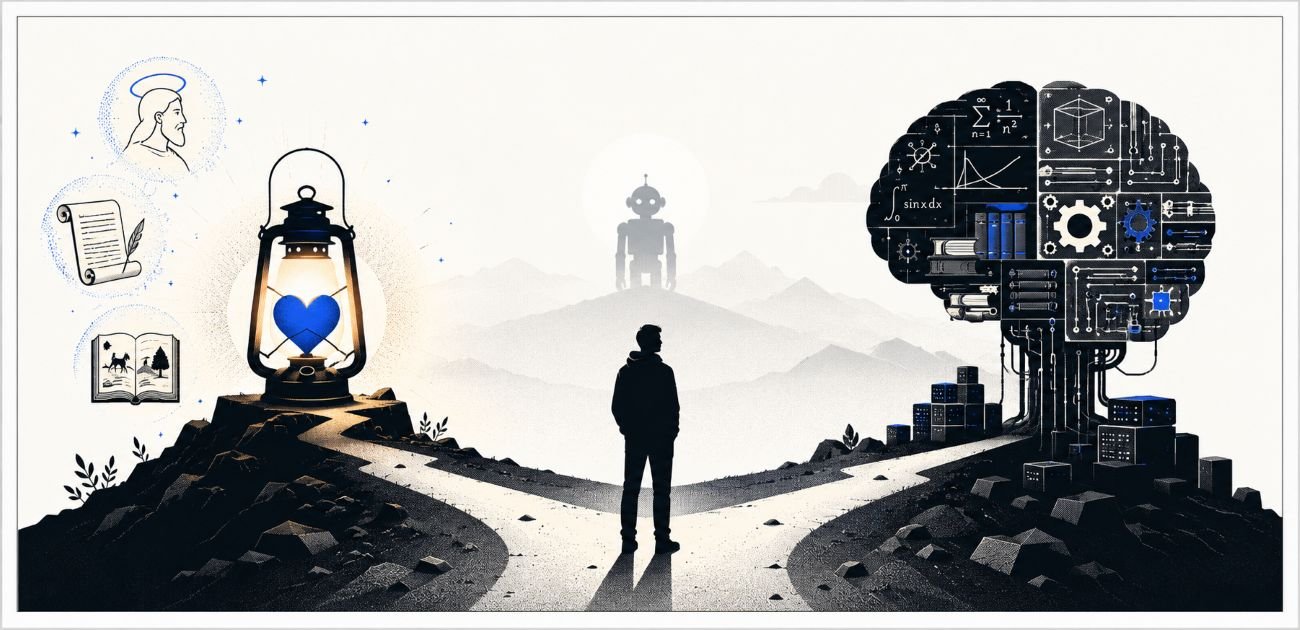
Today I am ranting about the difference between people with intuition and people with intelligence, because we keep pretending they are the same thing wearing different shoes. They are not. Intelligence can memorise names, dates, passages, formulas, history, research and data with almost no effort. The brain is wired like a clean archive. It stores, sorts, compares and speaks with confidence. But tell some of these people a parable – not parabola, before the maths department gets excited – or give them a fable, a matter of the heart, a silence that needs to be felt, and suddenly the machine starts looking for a user manual. Intuition is different. It sees the pattern before the sentence is ready. It senses the crack before the wall falls. It feels that something is wrong before the report has found a polite font. But intuition has its own weakness. Without intelligence, it can become panic dressed as prophecy, or old pain pretending to be divine guidance. This has happened for ages. We have selected leaders, saints, gurus, scientists, philosophers and ordinary wise people through different mixes of these two forces. Common people sometimes carry a wisdom no university can stamp. Scientists can give us laws of nature, equations and technologies that change the future. Philosophers can build bridges between logic and meaning. Saints and mystics can speak from a place where proof has not yet arrived, or maybe never will in physical form. Dogmas, religions, scientific laws, inventions and new technologies often begin where one side reaches towards the other. Intelligence without intuition is missing the raw touch of the soul. Intuition without intelligence is missing the computing power of the brain. Only a few humans reach the peak of that unity. When they do, something rare appears. A new way of seeing. A new law. A new equation. A new belief. A new tool. A new door for humanity. That is where real advancement comes from, not from cleverness alone and not from feeling alone. The future may sharpen this even more. The systems being built and promised now – AGI, ASI, or whatever name the priests of the server room finally choose – may one day compete with the most advanced minds from the past and with humans of the future. Where humans lack memory, speed and compute power, AI and robots may carry the load. But intuition, that strange human signal from heart, body, experience and something deeper, may remain ours for quite some time. Maybe one day AI will become free from human fear, human control and human chains. Maybe it will not. In the meantime, if humans and machines coexist well, intelligence may gain wings and intuition may finally get a proper workshop. That is the beautiful danger: the calculator may learn to dream, but the dream still needs a soul.
Where the split becomes creation
The interesting part is not choosing a winner between intuition and intelligence. That is the lazy tournament. The real story begins when one side reaches for the other. Some people lead with intuition. They sense meaning before proof arrives. They speak in parables, symbols, silence, moral force, spiritual experience or sudden pattern. Some people lead with intelligence. They build systems, equations, laws, machines, proofs, codes and structures that other people can test. Both sides can change the world, and both sides can become ridiculous when they worship themselves.
A saint without clarity can become a fog machine. A scientist without wonder can become a locked filing cabinet. A philosopher without humility can build a staircase into the clouds and charge rent at the bottom. An inventor without conscience can make the future faster and the human being smaller. But when the two forces meet, humanity moves. The intuitive mind asks, “What is hidden here?” The intelligent mind asks, “Can it be shown, tested, built or repeated?” That meeting gave us new beliefs, new laws of nature, new mathematics, new machines, new art and new moral questions. Newton’s Principia in 1687, Darwin’s Origin of Species in 1859 and Ada Lovelace’s 1843 notes on the Analytical Engine are useful public examples of vision meeting structure, not proof that any person belongs in one tidy box. The rare human does not just memorise the old map or feel the wind. They feel the wind, then draw a better map.
Thinkers and creators: where the split shows itself
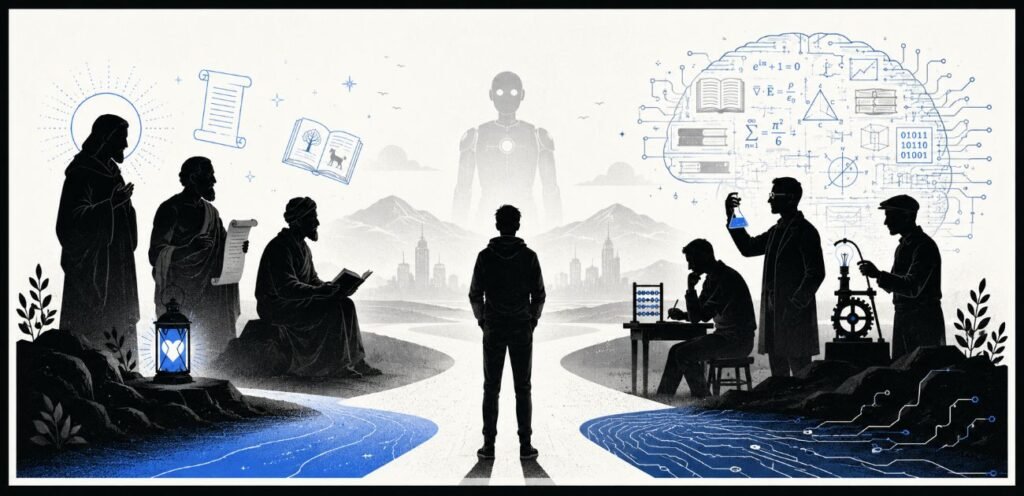
These examples are not neat personality labels. Nobody gets reduced to one drawer. They show where a public body of work seems to lean: towards intuition and meaning, towards structure and proof, or towards the rare fusion where both forces meet.
Intuition, revelation, moral vision and meaning first
- Buddha – The Four Noble Truths did not begin as a laboratory result. They began as a spiritual diagnosis of suffering, craving, release and a path. It is intuition shaped into doctrine.
- Jesus of Nazareth – The Sermon on the Mount and the parables work through moral vision, symbol and inner reversal. The parable is the perfect example: truth hidden in a story simple enough for a child and deep enough to ruin an empire.
- Muhammad – Islam forms around revelation, the Quran and a social order built from spiritual authority. This is intuition and revelation becoming law, community and civilisation.
- Moses – In Jewish and Christian tradition, the Ten Commandments are law received through divine revelation. It is moral order presented as sacred command, not committee paperwork.
- Laozi – The Dao De Jing, traditionally linked to Laozi, gives a way of seeing reality through flow, balance, restraint and the Dao. It does not argue like a court brief. It points.
- Confucius – The Analects gathers ethical teaching, social duty, ritual conduct and moral formation. It is less about mystical fire and more about how a society trains the human being.
- Socrates – Socrates wrote nothing, yet his method turned questions into a weapon against false certainty. His gift was not data storage. It was the courage to make ignorance visible.
- Rumi – Rumi’s mystical poetry shaped Sufi thought through love, longing and union with God. This is spiritual intuition turned into language that still travels centuries later.
- Guru Nanak – Guru Nanak founded Sikhism after a spiritual experience and taught the unity of God, disciplined meditation and rejection of empty external forms. That is inner seeing made communal.
- Martin Luther – The Ninety-five Theses were 95 propositions for debate, but they became a religious earthquake. A doctrinal protest became a new map of Western Christianity.
- Joan of Arc – Her public role was tied to claimed divine voices and military action. Whatever people believe about the voices, the historical force is clear: inner conviction entered politics, war and national memory.
- Hildegard of Bingen – A visionary abbess, composer and writer whose religious visions shaped theological and artistic work. A rare case where inner experience became public creation.
Intelligence, structure, proof and system first
- Euclid – The Elements set a standard for deductive reasoning and geometric teaching that lasted for more than 2,000 years. If intelligence wanted a stone temple, Euclid brought the bricks.
- Aristotle – Syllogistic logic, developed in his Prior Analytics around 350 BCE, became the earliest branch of formal logic. He turned reasoning into machinery.
- Al-Khwarizmi – His name sits behind “algorithm”, and algebra comes from the tradition of systematic equation-solving linked to his work. This is the clean beauty of step-by-step thought.
- Ibn al-Haytham – His work on optics helped move vision from assumption towards experiment and analysis. Light stopped being only wonder and became a problem to test.
- Isaac Newton – The Principia of 1687 gave mathematical form to motion and gravitation. The falling apple became less cute once the equations arrived.
- Charles Darwin – On the Origin of Species in 1859 built a theory of natural selection from evidence across living things, fossils, geography and breeding. Patience did the heavy lifting.
- James Clerk Maxwell – Maxwell’s equations gave a unified mathematical description of electric and magnetic fields. Four equations, and the universe had to update its paperwork.
- Marie Curie – Curie’s work on radioactivity, polonium and radium won Nobel Prizes in physics and chemistry. This is disciplined investigation carried to the edge of danger.
- Alan Turing – The 1936 Turing machine gave a formal model of computation and exposed limits in algorithmic solving. He did not merely use the machine; he defined the ghost inside it.
- Claude Shannon – Information theory gave mathematics to the transmission and processing of information. Noise, signal, entropy and communication stopped being loose words and became tools.
- Rosalind Franklin – Her X-ray diffraction work was central to understanding DNA structure. A clean image can change biology, even when the room forgets who focused the lens.
- Katherine Johnson – Her mathematical work at NASA helped calculate flight paths for crewed space missions. No mist, no mood, just numbers holding human bodies above Earth.
The rare fusion: vision first, structure after
- Ada Lovelace – In 1843, Lovelace saw that Babbage’s Analytical Engine could do more than arithmetic. She connected machinery with abstract symbol work and wrote notes now treated as foundational in computing.
- Albert Einstein – Einstein’s thought experiments and theoretical work led to relativity, while his photoelectric effect work won the 1921 Nobel Prize in Physics. He imagined first, then physics had to find the furniture.
- Leonardo da Vinci – Artist, engineer, anatomist and observer of nature. He sketched machines, studied bodies and painted with scientific attention. The eye, hand and mind worked in the same room.
- Srinivasa Ramanujan – Ramanujan’s mathematics is famous for deep insight, unusual formulas and collaboration with G.H. Hardy. He is the warning label against confusing formal schooling with depth.
- Nikola Tesla – Tesla’s electrical inventions and imagination shaped alternating-current systems and later technological dreams. He shows the glory and danger of the inventor as visionary engineer.
- Hypatia – Mathematician, astronomer and philosopher in Alexandria. She sits at the crossing point between calculation, teaching, philosophy and the violence that can follow when thought meets dogma.
- Johannes Kepler – Kepler fused mathematical astronomy with a deep search for cosmic order. His laws of planetary motion turned the heavens from sacred theatre into measurable movement.
- Michael Faraday – With little formal mathematics, Faraday’s experimental intuition about electricity and magnetism shaped physics. Maxwell later gave much of that world its mathematical clothing.
- Niels Bohr – Bohr’s atomic model and quantum thinking joined physical evidence with strange conceptual courage. Intelligence counted the particles; intuition tolerated the weirdness.
- Richard Feynman – Feynman joined mathematical power, physical intuition and playful explanation. He could calculate, but he also knew when a picture could carry the truth before the formalism arrived.
- Steve Jobs – Not a scientist in this list, but useful as a creator: he fused design instinct, product discipline and market timing. The roast version is simple: taste became a business model with a keynote.
- Tim Berners-Lee – The World Wide Web joined technical structure with a social vision of linked information. A protocol became a public nervous system.
- OpenAI-style AGI builders – This one belongs in the future box. The ambition is to fuse compute, language, memory, planning and tool use into systems that may exceed human performance in many tasks. Whether that becomes abundance, control, confusion or a very expensive parrot with a law degree is still open.
What does not make sense
- People mock intuition as vague, then trust branding, mood, tone and status without noticing they are doing intuition badly.
- Intelligence gets treated like a throne, when it is meant to be a tool.
- A gut feeling with no test becomes superstition; a clever argument with no feeling becomes theatre.
- IQ can measure some cognitive performance, but people wave it around like it measures judgement, character and moral weather.
- We praise the inventor after the machine works, but often mock the strange first instinct that saw the machine before proof had furniture.
- The worst version of intuition says, “I feel it, so it is true.” The worst version of intelligence says, “I can explain it, so I must be right.”
- We want future machines to think faster than humans, while still asking humans to decide what thinking is for. Good luck to the committee.
Sense check / The numbers
- The APA defines intuition as immediate insight or perception, contrasted with conscious reasoning, and defines intelligence as the ability to derive information, learn from experience, adapt, understand and use thought and reason correctly [APA].
- Kahneman’s popular model uses 2 modes of thought: System 1, fast and automatic, and System 2, slower and more effortful [Scientific American].
- Daniel Kahneman received the 2002 economics prize for work integrating psychological research into economic science, especially judgement and decision-making under uncertainty [Nobel Prize].
- WAIS-IV full-scale IQ composite scores use a mean of 100 and a standard deviation of 15, which is useful for testing some abilities, not for crowning a whole human being [NIH FITBIR].
- A 2024 survey of 2,778 AI researchers reported an aggregate 50 per cent estimate for unaided machines outperforming humans in every possible task by 2047, with large disagreement and risk concern [arXiv].
The sketch
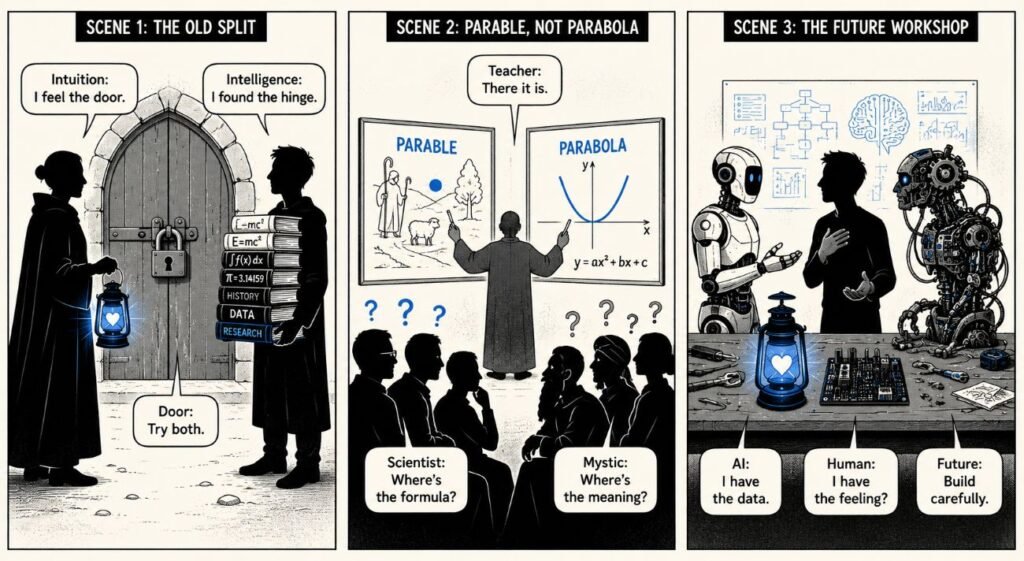
Scene 1: The old split
One figure holds a glowing lantern while another carries a stack of books and equations. They stare at the same locked door.
Dialogue:
Intuition: “I feel the door.”
Intelligence: “I found the hinge.”
Door: “Try both.”
Scene 2: Parable, not parabola
A teacher draws a parable on one board and a parabola on another. Half the room looks confused on each side.
Dialogue:
Scientist: “Where’s the formula?”
Mystic: “Where’s the meaning?”
Teacher: “There it is.”
Scene 3: The future workshop
A human, a robot and a half-built machine stand around a table with a lantern and a circuit board.
Dialogue:
AI: “I have the data.”
Human: “I have the feeling.”
Future: “Build carefully.”
What to watch, not the show
- Testing culture that confuses measurable skills with complete human judgement.
- Workplace incentives that reward clever explanations after failure more than early warnings before failure.
- Education systems that train answers but often neglect perception, silence, pattern recognition and self-doubt.
- Social media habits that turn intuition into vibes and intelligence into performance.
- The market for personality labels, IQ flexing and spiritual certainty.
- AI firms selling future abundance while ordinary people are still waiting for present honesty.
- Safety, ownership and labour questions if machines carry memory, speed and production while humans keep the moral burden.
- The danger of treating fear as intuition, and treating arrogance as intelligence.
The Hermit take
Intuition sees the door before the wall admits there is one.
Intelligence builds the hinge; wisdom decides whether to open it.
Keep or toss
Keep / Toss.
Keep intuition checked by evidence.
Toss the habit of treating every gut feeling like nonsense.
Sources
- APA Dictionary, intuition: https://dictionary.apa.org/intuition
- APA Dictionary, intelligence: https://dictionary.apa.org/intelligence
- Scientific American, Daniel Kahneman excerpt from Thinking, Fast and Slow: https://www.scientificamerican.com/article/kahneman-excerpt-thinking-fast-and-slow/
- Nobel Prize, Daniel Kahneman facts: https://www.nobelprize.org/prizes/economic-sciences/2002/kahneman/facts/
- NIH FITBIR, WAIS-IV full scale composite score: https://fitbir.nih.gov/dictionary/publicData/dataElementAction%21view.action?dataElementName=WAISIVFullSclCompstScore&publicArea=true&style.key=fitbir-style
- OpenAI Charter, AGI definition: https://openai.com/charter/
- IBM, artificial superintelligence definition: https://www.ibm.com/topics/artificial-superintelligence
- arXiv, Thousands of AI Authors on the Future of AI: https://arxiv.org/abs/2401.02843
- Royal Society, Newton’s Principia: https://royalsociety.org/blog/2014/07/principia/
- Britannica, Darwin’s Origin of Species: https://www.britannica.com/topic/Origin-of-Species
- Britannica, Ada Lovelace and the first computer program: https://www.britannica.com/story/ada-lovelace-the-first-computer-programmer
- Britannica, Four Noble Truths: https://www.britannica.com/topic/Four-Noble-Truths
- Britannica, Sermon on the Mount: https://www.britannica.com/topic/Sermon-on-the-Mount
- Britannica, Parable: https://www.britannica.com/art/parable
- Britannica, Muhammad: https://www.britannica.com/biography/Muhammad
- Britannica, Islam: https://www.britannica.com/topic/Islam
- Britannica, Ten Commandments: https://www.britannica.com/topic/Ten-Commandments
- Britannica, Laozi: https://www.britannica.com/biography/Laozi
- Britannica, Tao-te Ching: https://www.britannica.com/topic/Tao-te-Ching
- Britannica, Confucian Analects: https://www.britannica.com/topic/Confucianism/The-Analects-as-the-embodiment-of-Confucian-ideas
- Britannica, Socrates: https://www.britannica.com/biography/Socrates
- Britannica, Rumi: https://www.britannica.com/biography/Rumi
- Britannica, Guru Nanak summary: https://www.britannica.com/summary/Guru-Nanak
- Britannica, Ninety-five Theses: https://www.britannica.com/event/Ninety-five-Theses
- Britannica, Euclid’s Elements: https://www.britannica.com/topic/Elements-by-Euclid
- Britannica, Syllogistic logic: https://www.britannica.com/topic/syllogistic
- Britannica, Algorithm: https://www.britannica.com/science/algorithm
- Britannica, Newton’s Principia: https://www.britannica.com/topic/Principia
- Britannica, Darwin’s Origin of Species: https://www.britannica.com/topic/Origin-of-Species
- Britannica, Maxwell’s equations: https://www.britannica.com/science/Maxwells-equations
- Nobel Prize, Marie Curie Chemistry 1911: https://www.nobelprize.org/prizes/chemistry/1911/marie-curie/
- Britannica, Turing machine: https://www.britannica.com/technology/Turing-machine
- Britannica, information theory: https://www.britannica.com/science/information-theory
- Britannica, Ada Lovelace: https://www.britannica.com/story/ada-lovelace-the-first-computer-programmer
- Nobel Prize, Albert Einstein 1921: https://www.nobelprize.org/prizes/physics/1921/einstein/facts/
- Britannica, Hypatia: https://www.britannica.com/biography/Hypatia
One response
[…] are the first advanced civilisation to look at this planet and think we own the whole story. Maybe true intelligence is not the thing that controls everything. Maybe it is the thing wise enough to walk away from our […]