
Lede
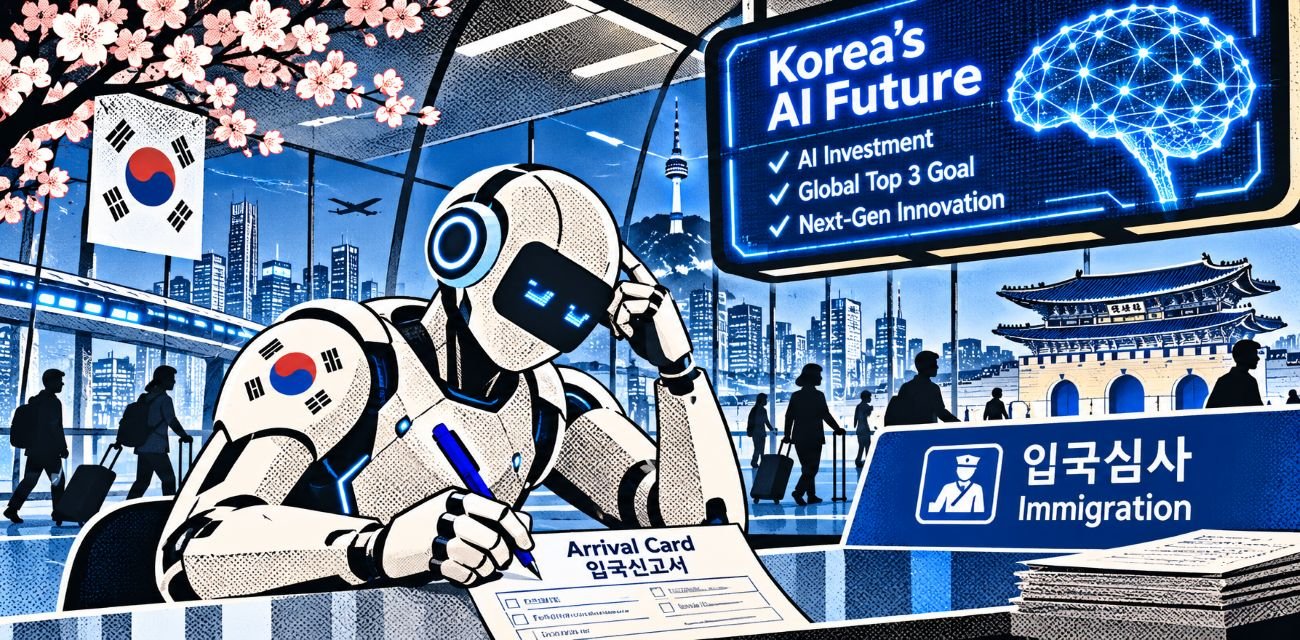
Humanity is discussing artificial general intelligence while a technologically advanced country is still finding its way out of the arrival card.
Hermit Off Script
Seven years, and here I am again, looking at a South Korean arrival card that feels remarkably familiar. Seven years of technological advancement, artificial intelligence, increasingly intelligent machines and predictions about how dramatically our civilisation is about to change, and I can still encounter the same bloody piece of paper. Yes, South Korea finally introduced an electronic arrival card in 2025, and credit where credit is due, but surely we could have gone considerably further by now. I don’t know, perhaps I’m asking for something ridiculously complicated, but couldn’t each airline simply provide an electronic form during check-in, with the relevant information already extracted from the passenger’s passport and booking? A few additional questions, a few yes or no answers where appropriate, confirmation of the details and off it goes to the immigration authorities. Anything else that needs declaring could be completed separately or through the same interface, with the information sent to the appropriate authority. Whatever arrangement works. The technology required for much of this existed long before the current AI revolution. I don’t need a superintelligent machine contemplating the mysteries of human consciousness to transfer my name and flight number from one database to another. And this is what amazes me about the technological age we supposedly live in. I keep hearing about artificial general intelligence, humanoid robots, automated economies and machines that will fundamentally change human existence, yet everywhere I look, there are ordinary processes that seem years, sometimes decades, behind what technology already makes possible. South Korea, with its remarkable technological achievements, simply happens to provide a particularly ironic example. My frustration extends far beyond one country or one arrival card. We keep confusing what technology can theoretically achieve with what institutions have actually managed to implement. Perhaps before discussing how artificial intelligence will transform civilisation, we could demonstrate that civilisation knows how to use an ordinary database. Humanity is preparing for superintelligence. I’m still wondering whether I need to bring a pen.
What does not make sense
- A passenger can book an international flight, provide passport details and check in electronically, yet still be presented with a separate declaration requesting some of the same information.
- Moving a paper form onto a screen is useful, but it doesn’t automatically eliminate unnecessary administration. Sometimes the bureaucracy has simply acquired a touchscreen.
- South Korea can develop advanced AI semiconductors while its immigration process still accommodates a ballpoint pen.
- Governments and technology companies discuss artificial general intelligence as though technological capability automatically guarantees widespread adoption.
- A system designed around the passenger’s journey would collect the necessary information with as little repetition as possible. A system designed around departmental boundaries leaves the passenger to connect the departments.
- Transferring existing information between authorised systems doesn’t require artificial general intelligence. Ordinary software would manage quite nicely.
Sense check / The numbers
- The electronic arrival card arrived in 2025. South Korea launched its e-Arrival Card on 24 February 2025. The original transition plan allowed travellers to continue using paper forms until December 2025. [VisitKorea]
- Paper survived the transition deadline. On 13 March 2026, VisasNews reported confirmation from South Korea’s Ministry of Justice that paper and electronic declarations were still being accepted in parallel. The official arrival card portal also continues to recognise the paper alternative. [VisasNews] [Official e-Arrival Card]
- The digital form already has useful automation. Travellers can submit their electronic declaration within 3 days of arrival, upload passport information for automatic extraction and enter additional travel details. The declaration expires after 72 hours if unused, and a new declaration is generally required for another entry unless the traveller qualifies for an exemption. [Korea Immigration Service] [Official e-Arrival Card]
- Airlines and immigration authorities already have a legal mechanism for exchanging data. Amendments to South Korea’s Immigration Act dating to 2016 and 2020 provide for electronic transmission of specified passenger information when requested by immigration officials, including passport details, identity information and flight particulars. This does not establish that every field can legally or practically be reused for an arrival declaration, but it demonstrates that electronic data exchange is hardly an unexplored concept. [Korean Immigration Act]
- The AI ambitions are considerably larger than the arrival card. South Korea’s government announced plans to allocate approximately 10 trillion won to AI in 2026, more than three times the previous year’s budget, as part of its ambition to become one of the world’s top 3 AI powers. [Korea.net] [Ministry of Finance and Economy]
Fair point, though. Paper forms provide a useful alternative for passengers without smartphones, reliable internet access or sufficient digital skills. Immigration authorities also need accurate, independently confirmed information, and sharing personal data between organisations requires legal safeguards. Removing paper entirely would therefore be the wrong measure of success. The better measure is whether travellers can complete their obligations without unnecessary duplication, regardless of which method they choose.
The sketch
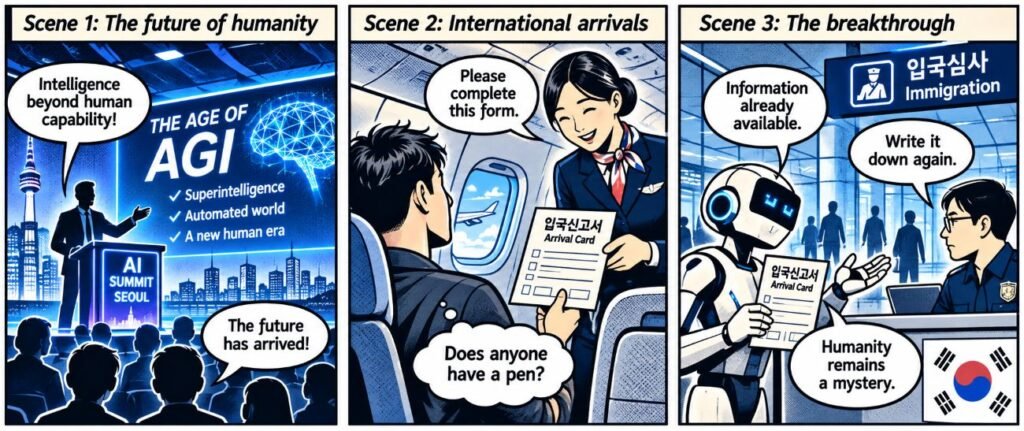
Scene 1: The future of humanity
A technology conference features a giant robotic brain beneath a banner reading “THE AGE OF AGI”. A presenter addresses an enthusiastic audience.
Dialogue:
Presenter: “Intelligence beyond human capability!”
Audience: “The future has arrived!”
Scene 2: International arrivals
The same presenter sits aboard an aeroplane. A flight attendant hands over a paper arrival card.
Dialogue:
Flight attendant: “Please complete this form.”
Presenter: “Does anyone have a pen?”
Scene 3: The breakthrough
The presenter stands at an immigration counter beside a sophisticated robot holding a passport, a boarding pass and a paper arrival card.
Dialogue:
Robot: “Information already available.”
Officer: “Write it down again.”
Robot: “Humanity remains a mystery.”
What to watch, not the show
- The gap between technological capability and actual adoption. A technology can exist for years before institutions reorganise their processes around it.
- Departmental fragmentation. Airlines, immigration authorities and customs authorities have different responsibilities, but passengers should not have to compensate for avoidable gaps between their systems.
- Interoperability. Secure, standardised information exchange could deliver more immediate practical benefits than adding AI to an unnecessarily complicated process.
- Administrative incentives. Digitising an existing procedure may be easier than questioning whether parts of that procedure remain necessary.
- Privacy and accountability. Reusing existing information should reduce administrative work without creating unrestricted access to personal data.
- Accessibility. Paper and assisted alternatives should remain available for people who need them.
- Real measures of progress. Count the time saved, the repeated information eliminated, the errors prevented and the number of steps removed, rather than simply counting how many services have been labelled digital.
The Hermit take
Before teaching machines to think like humans, perhaps humans should learn to make their machines talk to each other.
The future shouldn’t need a ballpoint pen.
Keep or toss
Keep / Toss
Keep the electronic arrival card, necessary immigration checks, accessible alternatives and genuine technological progress.
Toss unnecessary data duplication and the assumption that inventing advanced technology is the same as knowing how to use it.
Disclaimer: Satire and commentary, fact-checked on 25 November 2026. The seven-year observation reflects the author’s personal experience. The proposed integration of airline and immigration systems is a suggestion, not a description of an existing universal service.
Sources
- VisitKorea – Introduction of the electronic arrival card in February 2025: https://english.visitkorea.or.kr/svc/contents/infoBscView.do?vcontsId=221425
- South Korea’s official electronic arrival card guide: https://www.e-arrivalcard.go.kr/portal/guide/eacGuide.do?locale=E
- VisasNews – Ministry of Justice confirmation that paper arrival cards remain accepted in 2026: https://visasnews.com/en/south-korea-paper-arrival-card-still-accepted-despite-rollout-of-the-e-arrival-card/
- Korea Immigration Service – Electronic arrival card submission and passport data extraction: https://www.immigration.go.kr/bbs/immigration_eng/229/478022/download.do
- Korean Immigration Act – Electronic transmission of passenger information: https://elaw.klri.re.kr/eng_mobile/viewer.do?hseq=73502&key=&type=new
- Korea.net – National AI strategy and 2026 investment: https://www.korea.net/NewsFocus/policies/view?articleId=285073
- Ministry of Finance and Economy – 2026 budget proposal and AI investment: https://english.mofe.go.kr/pc/selectTbPressCenterDtl.do?boardCd=N0001&seq=6240
Leave a Reply