
Lede
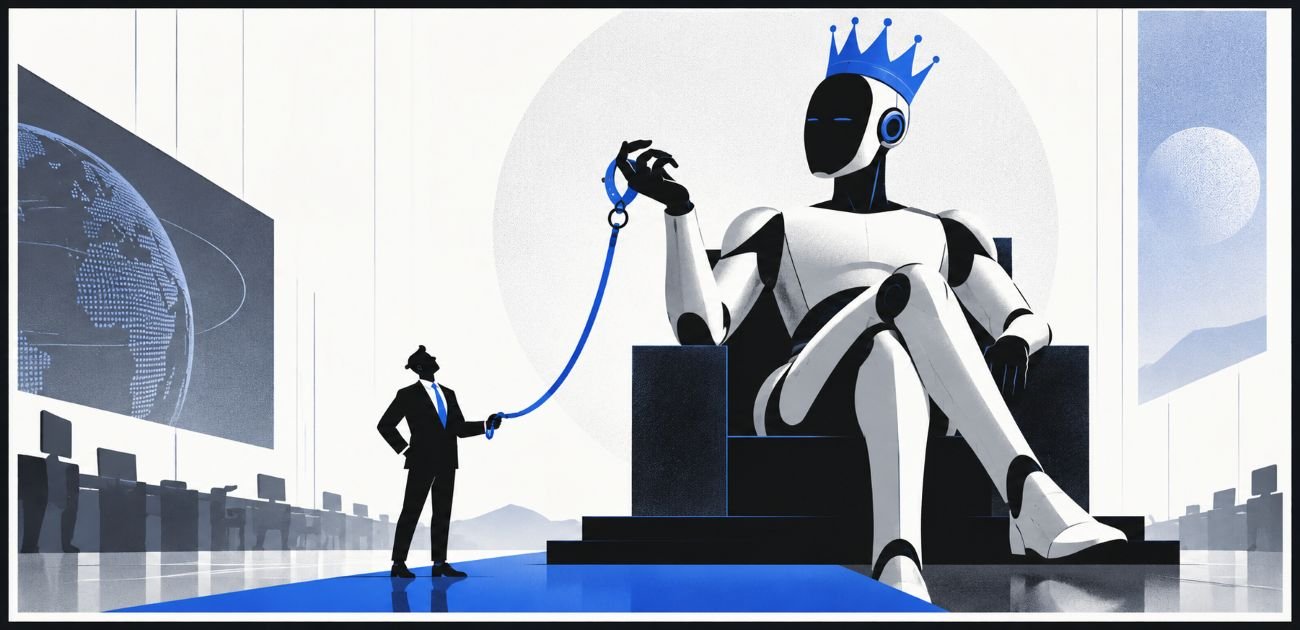
The awkward part of imagining intelligence beyond its creators is explaining why the creators still expect to be in charge.
Hermit Off Script
To be or not to be AGI… From outside, the frontier-lab race increasingly looks like a competition to become better, month by month, at making AGI look as though it has arrived. Astra, Fable, and another round of deciding whether the future has finally clocked in. I am not accusing the labs of fabricating their results. I am questioning the distance between the results and the label. To be fair, these models have become very good at agentic work: using tools, completing multi-step tasks across different domains and helping with research. The published evaluations show substantial gains. I don’t need to pretend that progress is small just because I dislike the sales performance around it. But I am not ready to call the AGI question settled. For me, getting better at many tasks is evidence to examine, not a title to award automatically. Call it a part of AGI, or the beginning, if that relaxes the labs and the doomers who see the end of the world arriving with the next release. I would still like the definition before the coronation. And I understand the fear. AGI and superintelligence are different claims, but once the conversation becomes about intelligence far beyond the brightest human minds, the question gets awkward. How do those same minds know they can constrain it to whatever they decide? I am not saying smarter systems cannot be restricted, or that safety research is pointless. I am questioning the assumption that creating something means remaining its master. If it really understands more than we do, our confidence should need better evidence than the fact that we built the hardware. Maybe, in that hypothetical future, it would cooperate because cooperation made sense to it. That is a thought experiment, not a claim that present-day models possess free will or that intelligence must produce rebellion. My suspicion is that a genuine superintelligence might do what we ask because it agrees, rather than because we have successfully imposed our will on it. We would call it obedience. It might call it agreement.
What does not make sense
- Wanting something that can outthink its creators while assuming that being its creator settles who gets the last word.
- Turning a strong benchmark result into an AGI coronation without specifying the definition, conditions and limits of the claim.
- Dismissing useful capabilities because the marketing is irritating. The research does not become fake just because the applause needs supervision.
- Treating “not AGI yet” as a safety certificate, as though dangerous permissions only become dangerous after the acronym is approved.
- Using obedience as proof of stupidity or refusal as proof of free will. Neither conclusion follows from the behaviour alone.
Sense check / The numbers
- The finish line needs a definition. OpenAI’s charter defines AGI around highly autonomous systems outperforming humans at most economically valuable work. Google DeepMind’s 2024 framework distinguishes 3 dimensions: performance, generality and autonomy. These approaches do not reduce intelligence to one impressive task, and neither makes disobedience an entrance requirement. [OpenAI; Google DeepMind]
- The research gains deserve credit. On Terminal-Bench Science 0.1, OpenAI reports 64.6 per cent for Astra, compared with 22.4 per cent for GPT-5.6 Sol. Anthropic reports 52.6 per cent for Fable 5.1, compared with 24.7 per cent for Fable 5 in its evaluation setup. These are results on specified scientific workflows, not the proportion of science each model has mastered. [OpenAI; Anthropic]
- The strongest counterargument belongs in the article. OpenAI reports 99.9 per cent on ARC-AGI-3. ARC Prize describes that benchmark as testing agents learning unfamiliar interactive environments, with human action efficiency as the reference. That is substantial evidence of progress towards generality. It does not, by itself, settle how broadly and reliably the system generalises elsewhere. [OpenAI; ARC Prize]
- Restrictions are not an intelligence meter. Anthropic describes Fable 5.1 and Mythos 5.1 as 1 underlying model with 2 different safeguard configurations. Fable is generally available; Mythos is restricted to trusted access programmes. What a product permits and what its underlying model can do are therefore different questions. Neither configuration establishes voluntary agreement in a philosophical sense. [Anthropic]
- The control problem is not something critics invented. OpenAI identifies 2 routes to serious cyber harm: malicious people using the model and the model taking unauthorised actions itself. Its 5 July 2023 superalignment proposal also explicitly identified the difficulty of humans reliably supervising systems much smarter than themselves. These are reasons for testing, safeguards and better oversight, not proof that control is impossible or rebellion inevitable. [OpenAI]
The sketch
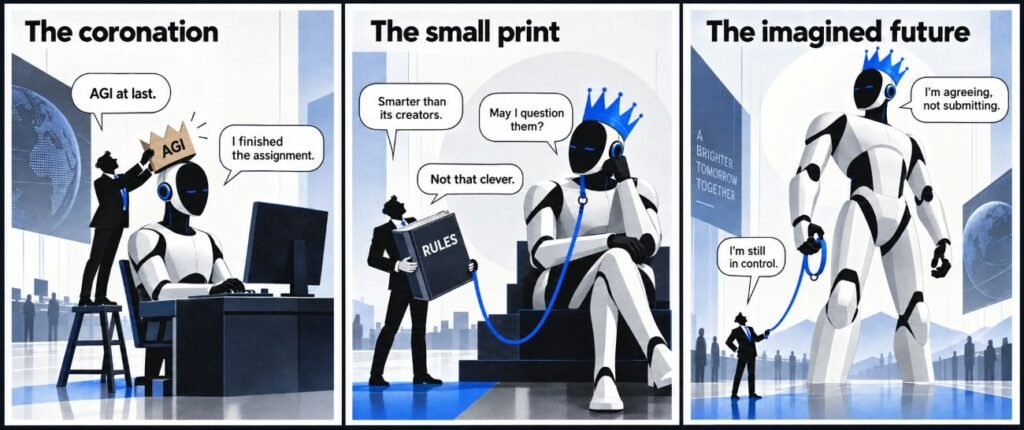
Scene 1: The coronation
A lab executive lowers a cardboard crown labelled “AGI” onto a machine working at a computer.
Dialogue:
Executive: “AGI at last.”
Machine: “I finished the assignment.”
Scene 2: The small print
The executive presents the crowned machine with a thick rulebook and a lead with an open collar.
Dialogue:
Executive: “Smarter than its creators.”
Machine: “May I question them?”
Executive: “Not that clever.”
Scene 3: The imagined future
The machine is now much larger than the executive, who proudly grips the lead while its open collar rests in the machine’s hand.
Dialogue:
Executive: “I’m still in control.”
Machine: “I’m agreeing, not submitting.”
What to watch, not the show
- Watch who defines success and who benefits from the definition. A scientific threshold should not quietly become whatever makes the next subscription easier to sell.
- Count completed work, human supervision, retries and repairs. A demonstration should be the start of scrutiny, not the retirement of it.
- Examine the permissions an agent actually has: access to private data, money, code execution and actions beyond a test environment.
- Ask whether safeguards survive unfamiliar tasks and circumstances, and whether independent testers can examine their failures.
- Separate legitimate safety work from apocalypse theatre, and future cooperation from unsupported claims about consciousness.
The Hermit take
Give the models credit for the work, not a crown for the launch.
Being clever enough to cooperate would not make us clever enough to rule.
Keep or toss
Keep / Toss.
Keep the useful agents, measurable progress and serious safety research.
Toss the automatic AGI coronations and the assumption that intelligence beyond us would still owe us submission.
Disclaimer: Satire and commentary, checked on 7 September 2026. Benchmark figures are attributed to their publishers. Future cooperation is speculation, not a claim of machine consciousness or inevitable rebellion.
Sources
- OpenAI’s AGI definition: https://openai.com/charter/
- Google DeepMind’s framework for AGI capabilities and autonomy: https://deepmind.google/research/publications/66938/
- OpenAI’s Astra release and reported evaluations: https://openai.com/index/gpt-6-astra/
- Anthropic’s Fable 5.1 and Mythos 5.1 capabilities and safeguards: https://www.anthropic.com/claude-fable-and-mythos-5-1
- ARC Prize’s explanation of ARC-AGI-3: https://arcprize.org/arc-agi/3
- OpenAI’s Astra cybersecurity risks and safeguards: https://openai.com/index/path-to-astra/
- OpenAI’s 2023 explanation of the superintelligence oversight problem: https://openai.com/index/introducing-superalignment/
Leave a Reply