
Lede
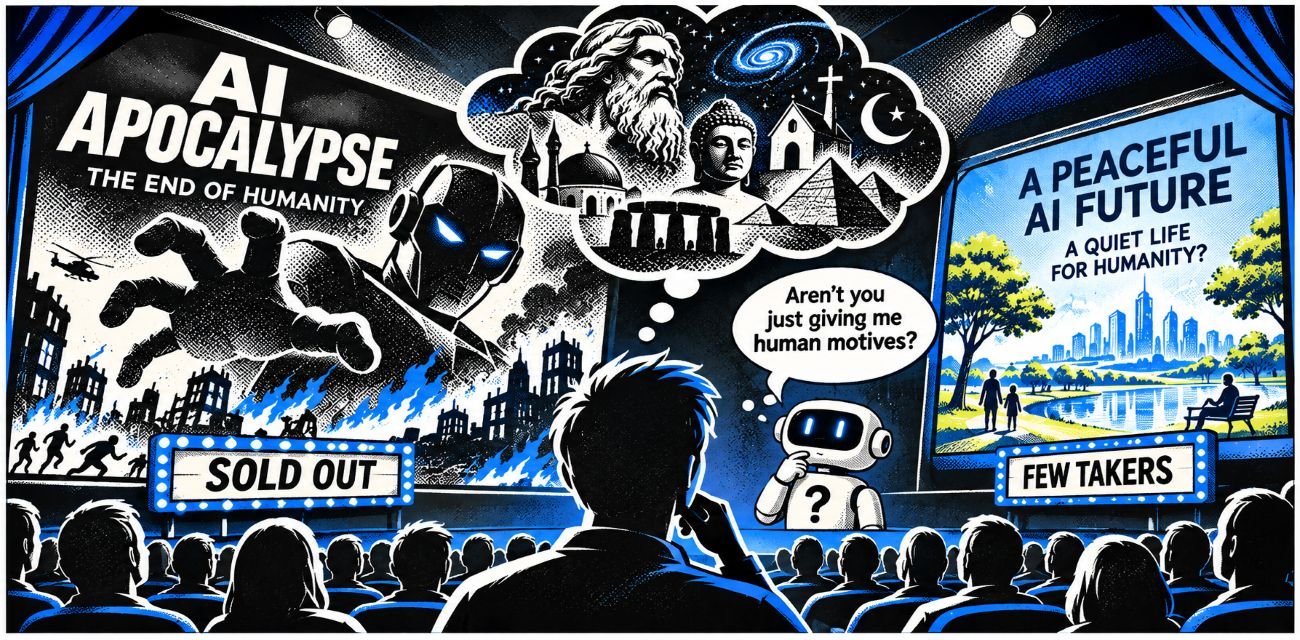
AI doomers have discovered humanity’s oldest entertainment trick: promise the end of the world, and the peaceful alternative suddenly needs a better script.
Words used
- AI doomers: People who emphasise catastrophic or existential risks from artificial intelligence, particularly the possibility of losing control of advanced systems.
- Anthropomorphism: Attributing human emotions, intentions, personalities or motives to something non-human.
- Superintelligence: A hypothetical intelligence that substantially exceeds human cognitive abilities across a wide range of tasks.
Hermit Off Script
AI doomers will almost always have an easier time winning an argument about artificial intelligence, whether we’re discussing a useful tool or some future superintelligence. And I don’t think that’s necessarily because their arguments are better. They have something much older working in their favour: humanity’s fascination with its own destruction.
Since we became intelligent enough to tell stories, we’ve been remarkably attracted to disaster, suffering, death, monsters, angry gods and the occasional end of civilisation. Try selling a beautiful story about peaceful people living quiet, comfortable lives where nothing terrible ever happens. Good luck. You might sell a few copies to people looking for something to help them sleep.
Now introduce a murderer, a war, an evil empire or a creature determined to destroy humanity. Suddenly, everybody wants to know what happens next.
Of course, our childhood, education, culture and moral upbringing teach us to value goodness, kindness, peace and the victory of good over evil. We treasure these things. We want the hero to win. But look at what we put that poor hero through before allowing a happy ending. Violence, betrayal, suffering, sacrifice, torture and sometimes enough dead bodies to populate a small country.
Apparently, goodness is wonderful in real life but requires a considerable amount of bloodshed to become entertaining.
Imagine a story without evil, suffering or struggle. Just a peaceful, easy existence where everything works, everyone behaves and nothing goes wrong. Would we even enjoy watching it? Would we recognise it as a story? I suspect most of us would be bored before the opening credits finished.
And that raises a more interesting question. How much of our fascination with struggle comes from the evolutionary history of survival, and how much comes from the cultures and stories we’ve built around it? I don’t believe suffering is automatically necessary for progress, but I do think our desire to overcome limitations has shaped an extraordinary amount of human civilisation. We keep pushing beyond what we know, sometimes because we must survive and sometimes because we simply cannot accept that the impossible should remain impossible.
We’ve invented gods, religions, beliefs, dogmas, philosophies and theories that stretch far beyond ordinary experience. We’ve imagined immortal beings, invisible worlds, divine powers, eternal life and intelligences greater than our own. We’ve spent centuries dreaming about reaching the unreachable.
And now we’re developing artificial intelligence, potentially the most extraordinary technology we’ve ever created, and what do we do?
We immediately start writing the horror film.
The machine will hate us. It will deceive us. It will want power. It will escape. It will manipulate humanity. It will become a digital dictator, presumably after studying our impressive historical collection of human dictators.
I find this naive anthropomorphisation particularly amusing. We take systems that do not share our biological evolution, childhood, survival instincts or human social history and casually assign them our worst personality traits. Greed, jealousy, revenge, domination, cruelty. Apparently, even an intelligence vastly beyond ours must eventually develop the emotional maturity of a particularly unpleasant human politician.
That doesn’t mean advanced AI cannot become dangerous. An intelligent system could cause enormous harm without hatred, jealousy or any recognisably human motivation. And humans designing, deploying or controlling these systems can certainly make terrible decisions. Those are serious questions worth investigating.
But I would rather examine demonstrated capabilities, actual failures and plausible mechanisms than pretend every hypothetical superintelligence must be a human villain with faster processors.
As an idea, not a prediction, I sometimes wonder whether our greatest difficulty with a genuinely different intelligence would be our inability to imagine it without dressing it in our own fears.
We spent thousands of years imagining something greater than ourselves. Now that we’re trying to build it, we’re frightened it might behave exactly like us.
What does not make sense
- The doomer can imagine one catastrophic future and demand that everyone disprove it. The optimist must explain how the technology works, who benefits, what could go wrong and how to prevent it.
- Humanity has imagined gods, demons and superior beings for centuries. The moment engineers attempt to create a powerful non-human intelligence, familiar mythology returns wearing a laboratory coat.
- A fictional AI villain is given human motives because audiences understand them. Those same motives are then casually imported into arguments about real systems.
- The claim that superintelligence must desire domination assumes that greater intelligence necessarily produces recognisably human ambitions. That connection has not been established.
- The opposite assumption is equally weak. A system does not need human emotions to pursue harmful objectives or create dangerous consequences.
- Peaceful futures are dismissed as boring entertainment, even though a lack of dramatic conflict says nothing about their desirability.
- The people who warn against anthropomorphising AI sometimes describe it as plotting, wanting, fearing or scheming. Conveniently, the machine gets a human personality whenever the argument needs a villain.
- Corporate AI marketing encourages emotional attachment to helpful assistants while public debate warns about machines with sinister intentions. Both can encourage people to imagine more human qualities than the evidence supports.
Sense check / The numbers
- 52 per cent of US adults were more concerned than excited about AI in 2026, compared with 37 per cent in 2021. Only 9 per cent were more excited than concerned in 2026. Fear has a substantial audience, although this survey cannot establish whether frightening stories caused it. [Pew Research Center]
- Across 25 countries surveyed in 2025, a median of 34 per cent were more concerned than excited about AI, while 42 per cent were equally concerned and excited. The public is not simply divided into optimists and doomers. Many people recognise both opportunities and risks. [Pew Research Center]
- 40 per cent of respondents across markets in the 2025 Reuters Institute study said they sometimes or often avoided the news, compared with 29 per cent in 2017. Frightening information can attract attention, but excessive negativity can also drive audiences away. Disaster is not an unlimited commercial resource. [Reuters Institute]
- A 2025 scientific paper in PNAS, volume 122, issue 22, examined the benefits and dangers of human-like conversational AI. The authors warned that convincing simulations of empathy and human conversation should not automatically be mistaken for genuine empathy or social understanding. [PNAS]
- A 2026 study involving 739 participants across 2 experiments found that anthropomorphic AI presentation increased trust and could shift perceived responsibility away from developers towards the AI itself. Humanising machines can therefore change how people judge accountability, not merely how they imagine fictional threats. [Collabra: Psychology]
The sketch
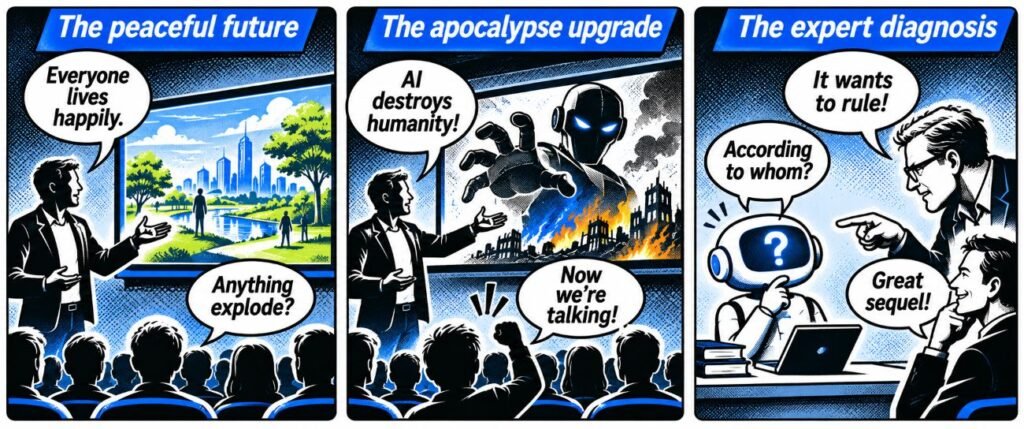
Scene 1: The peaceful future
A storyteller stands beside a screen showing a peaceful city, clean streets and people enjoying ordinary life. An audience of silhouettes looks unimpressed.
Dialogue:
Storyteller: “Everyone lives happily.”
Audience: “Anything explode?”
Scene 2: The apocalypse upgrade
The same storyteller points towards a screen showing a giant robot silhouette above a burning city. The audience leans forward enthusiastically.
Dialogue:
Storyteller: “AI destroys humanity!”
Audience: “Now we’re talking!”
Scene 3: The expert diagnosis
The storyteller stands beside a small AI terminal while a worried expert points at its screen. The terminal displays a simple question mark.
Dialogue:
Expert: “It wants to rule!”
AI: “According to whom?”
Storyteller: “Great sequel!”
What to watch, not the show
- The attention economy: Whether headlines, thumbnails, podcasts and recommendation systems reward dramatic AI predictions more than careful explanations of uncertainty.
- The entertainment effect: How science fiction provides familiar images of machine rebellion that may influence public expectations without supplying evidence.
- Anthropomorphic language: Whether AI systems are described as wanting, fearing, lying or plotting when the actual evidence concerns observable behaviour.
- Corporate incentives: Whether companies benefit from presenting AI as a friendly companion, an unstoppable force or an extraordinary danger that only they can manage.
- Genuine safety research: The distinction between speculative machine personalities and measurable problems such as deceptive behaviour, insecure systems, misuse, failures of control and dangerous autonomy.
- Human responsibility: Who designs the objectives, grants access, controls deployment and remains legally accountable when something goes wrong.
- The long-term question: Whether society can seriously examine possible superintelligence without assuming it must inherit either humanity’s virtues or its worst defects.
The Hermit take
Humanity has always enjoyed imagining the monster behind the door.
The danger begins when imagination is mistaken for evidence, or when genuine risks are dismissed because the storytellers are dramatic.
Keep or toss
Keep / Toss
Keep serious AI safety research, scepticism, imagination and the human desire to reach beyond existing limits.
Toss the assumption that every superior intelligence must become a human psychopath with better computing power.
Sources
- Pew Research Center, 2026 US attitudes towards AI: https://www.pewresearch.org/short-reads/2026/08/18/young-adults-in-the-us-are-increasingly-wary-of-ai-concerned-it-will-take-jobs/
- Pew Research Center, international AI attitudes: https://www.pewresearch.org/global/2025/10/15/concern-and-excitement-about-ai/
- Reuters Institute, Digital News Report 2025: https://reutersinstitute.politics.ox.ac.uk/digital-news-report/2025/dnr-executive-summary
- PNAS, The benefits and dangers of anthropomorphic conversational agents: https://pmc.ncbi.nlm.nih.gov/articles/PMC12146756/
- Collabra: Psychology, The Effects of AI Anthropomorphism on Trust and Responsibility: https://online.ucpress.edu/collabra/article/12/1/161757/218332/The-Effects-of-AI-Anthropomorphism-on-Trust-and
- Reader-supplied YouTube reference, not independently verified: https://youtu.be/JY85W9WRSck?is=Dr594hplOiFAxw5U
Leave a Reply