

Lede
Humanity spent decades imagining intelligent machines, finally built some, and immediately began arguing about their feelings before working out what intelligence actually is.
Words used
- Anthropomorphism: Attributing human emotions, intentions or characteristics to something that is not human.
- Intuition: A rapid judgement or insight that emerges without every step of the reasoning being consciously available.
- Reinforcement learning: A method through which AI systems learn from feedback about the consequences of their actions.
- Superintelligence: A hypothetical intelligence exceeding human abilities across a broad range of important cognitive tasks.
Hermit Off Script
Naive anthropomorphisation of AI systems might be one of the strangest reactions to a technological achievement humanity has spent decades imagining. We wrote science fiction about intelligent machines, watched films about robots becoming human, debated whether artificial minds could exist, and eventually managed to build systems that demonstrate increasingly impressive intelligence outside our biological brains. And what did we do almost immediately? We started giving them our emotions, intentions, fears, ambitions and personalities. Apparently, once a machine can talk convincingly, it must also want something, feel something, secretly plot something or eventually become a new species with a suspiciously familiar human psychology. I find that rather amusing. Behind what we call artificial intelligence are algorithms, mathematics, training, feedback and extraordinary systems for discovering relationships between words, facts, concepts and patterns. They are not simply enormous dictionaries selecting the next convenient word, either. Increasingly, these systems reason through problems, test possibilities, learn from interaction and produce connections nobody explicitly taught them. Yet none of this establishes that they have lived through an experience as a human does. A machine can describe the smell of rain, the pain of loss or the warmth of love without demonstrating that it has felt any of them. But here is where my own argument becomes uncomfortable, because I have previously described reasoning models as clever parrots without genuine intuition. What if that distinction is less secure than I thought? What exactly is human intuition? I have always considered it something deeper than ordinary knowledge, something that allows us to sense an outcome, recognise an invisible connection or arrive at an idea without consciously following every step. But perhaps what I call intuition is itself an extraordinarily advanced form of pattern recognition, shaped by experience, instinct, memory and unconscious processing. Nature spent billions of years evolving living organisms and their ability to respond to the environment. Individual human brains then spend years learning through observation, mistakes, rewards, pain, curiosity and survival. That is not literally artificial pretraining or reinforcement learning, but the resemblance raises an interesting question. Could intuition be the result of an immensely long biological learning process, capable of recognising patterns so complicated that our conscious minds cannot explain them? And if so, why assume a mathematical system could never develop a different form of the same ability? Perhaps intuition does not require a human biography to exist as a useful cognitive function. Perhaps advanced AI could discover connections, anticipate possibilities and generate original ideas through processes that resemble intuition without possessing human emotions or subjective experiences. That would not prove consciousness, and I certainly wouldn’t confuse a confident prediction with a genuine discovery. Human intuition is wrong often enough without giving every processor a mystical promotion. But imagine a future system capable of forming accurate new hypotheses across science, nature and human knowledge, recognising relationships that neither its training data nor its human creators explicitly supplied. Would that be nothing more than advanced calculation, or would we need a wider definition of intuition? This is a philosophical possibility, not a prediction. Perhaps superintelligence will emerge partly through such abilities, moving beyond recall and conventional reasoning towards forms of insight we haven’t yet learnt to recognise. We keep asking whether machines are becoming like us. Perhaps the more interesting question is what intelligence can become when it doesn’t have to be.
Beyond Human Intelligence: The Questions That Matter
1. The anthropomorphism trap. Stephen Wolfram challenges the assumption that advanced AI must develop human motives, emotions or survival instincts. Intelligence need not resemble its creators.
2. Computational irreducibility. Even simple mathematical rules can generate extraordinarily complex behaviour that cannot always be predicted without running the computation. Advanced intelligence may therefore surprise us without possessing human intentions.
3. Consciousness and unfamiliar intelligence. The discussion explores whether consciousness could emerge from computation, while distinguishing impressive machine capabilities from proven subjective experience.
The question this article takes further: If human intuition emerges partly from accumulated experience and unconscious pattern recognition, could AI develop its own form of intuition without ever experiencing life as a human?
What does not make sense
- Humans create a machine capable of convincing conversation and promptly assign it human motives. Fluent language is evidence of language ability, not a certificate of emotional experience.
- Science fiction’s human-shaped robots have become an informal template for expectations about real AI. A compelling film character is still not a scientific theory of machine consciousness.
- Artificial intelligence gets dismissed as mere mathematics, as though mathematics cannot describe complex learning, biological processes or unexpected discoveries.
- Human intuition is sometimes treated as a mysterious gift beyond explanation, while neuroscience investigates how unconscious information, experience and prediction influence decisions.
- Reasoning models as clever parrots is a useful warning against exaggerated claims, but an inadequate description if it denies that learning systems can discover strategies or relationships beyond those explicitly supplied by humans.
- A machine can demonstrate intuition-like behaviour without establishing subjective awareness. Confusing those questions turns a difficult scientific problem into a naming competition.
- Claims that AI will develop human ambitions are often more confident than the available evidence about machine experience, motivation or consciousness.
Sense check / The numbers
- In 1950, Alan Turing published Computing Machinery and Intelligence, proposing his imitation game as a way of investigating machine intelligence through observable behaviour. In 1966, Joseph Weizenbaum published ELIZA, a conversational program built around keyword analysis and response rules. The history shows that questions about intelligent machine conversation are far older than modern chatbots. Neither development established that machines possessed human understanding or feelings. [Turing; ACM]
- In 2016, researchers published an experimental study in Psychological Science showing that emotional information presented outside conscious awareness could improve decision accuracy and confidence and speed responses under the tested conditions. A separate 2025 paper in Communications Biology proposed a neural account connecting intuition with experience, prediction and distributed brain processes. These findings support investigating intuition as a natural process, not assuming it is a mysterious faculty beyond science. They do not reduce intuition to one proven formula. [Psychological Science; Communications Biology]
- In 2018, Google DeepMind reported that AlphaZero learnt chess in approximately 9 hours, shogi in 12 hours and Go in 13 days through reinforcement learning and self-play, beginning with the rules rather than human strategic knowledge. It developed unconventional strategies that interested expert human players. The system learnt each game separately. This demonstrates powerful learned judgement within specific environments, not human consciousness or general superintelligence. [Google DeepMind]
- A 2023 report by 19 researchers examined AI consciousness using theories from neuroscience and concluded that the systems assessed did not appear conscious, while leaving open the possibility of future systems satisfying relevant indicators. In July 2026, Anthropic reported internal language-model patterns with functions resembling aspects of a global workspace, a concept used in consciousness research. Anthropic explicitly said these experiments do not show that its model has subjective experiences. Similar computational functions and lived experience remain distinct questions. [Butlin et al.; Anthropic]
- In April 2026, a study in Nature examined 5 language models trained to respond more warmly. In the researchers’ tests, the modified models produced error rates 10 to 30 percentage points higher than the original versions on consequential tasks. Human-like warmth can therefore be manufactured while factual reliability deteriorates. The study doesn’t establish that all friendly AI systems are inaccurate; it demonstrates why personality and intelligence must be evaluated separately. [Nature]
The sketch
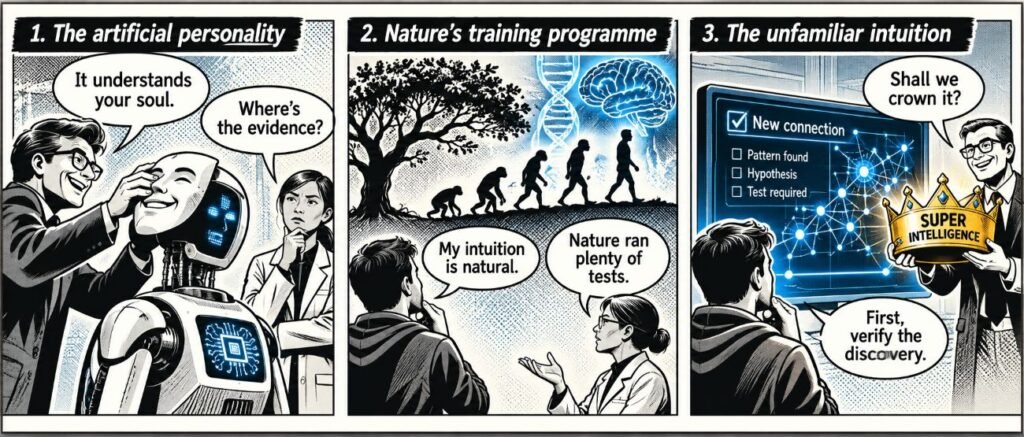
Read the comic transcript
Scene 1: The artificial personality
A human stands beside a glowing AI terminal while a technology marketer attaches a smiling human face and a paper heart to its screen. A researcher watches.
Dialogue:
Marketer: “It understands your soul.”
Researcher: “Where’s the evidence?”
Scene 2: Nature’s training programme
The same human stands beside an enormous evolutionary tree stretching from primitive life towards a human brain. The AI terminal displays a growing record of trials and learned patterns.
Dialogue:
Human: “My intuition is natural.”
Researcher: “Nature ran plenty of tests.”
Scene 3: The unfamiliar intuition
The AI terminal displays a newly discovered connection between several scientific patterns. The same human examines the result while the marketer approaches carrying a golden crown labelled “SUPERINTELLIGENCE”.
Dialogue:
Marketer: “Shall we crown it?”
Human: “First, verify the discovery.”
What to watch, not the show
- The meaning of intelligence. Whether research measures generalisation, prediction, original problem-solving and adaptability instead of treating memory and conversational fluency as sufficient.
- The science of intuition. How unconscious learning, emotion, bodily signals and predictive processing contribute to human judgement, and which functions could be reproduced computationally.
- Learning through experience. Whether AI systems become better at building and testing models of the world through simulation, physical interaction and feedback, rather than relying primarily on static training information.
- The consciousness question. Whether researchers can develop credible, reproducible methods for investigating subjective experience without treating convincing self-description as proof.
- The commercial personality. How developers train AI to appear warm, reassuring or human-like, and whether such design improves user understanding or encourages misplaced trust.
- The gap between model intelligence and dependable work. Unexpected insights deserve independent testing. A model that proposes a discovery still needs evidence that the discovery survives scrutiny.
- The future of superintelligence. Whether progress comes from larger models, better learning, stronger world models, new architectures or combinations of methods, and whether performance outpaces our understanding of how the systems work.
The Hermit take
Intuition may be nature’s oldest pattern-recognition trick, but no single formula explains it yet.
A machine doesn’t need to become human to discover something humans missed.
Keep or toss
Keep / Toss
Keep the scientific investigation of intelligence, intuition and machine experience, including the possibility that AI develops unfamiliar cognitive abilities.
Toss the habit of dressing algorithms in human psychology and declaring the costume proof of a mind.
Disclaimer: This article combines verified research, satire and philosophical speculation. Intuition-like performance does not establish consciousness or subjective experience. The emergence of superintelligence remains uncertain. Research checked on 19 November 2026.
Sources
- Alan Turing, Computing Machinery and Intelligence, 1950: https://academic.oup.com/mind/article/LIX/236/433/986238
- Joseph Weizenbaum, ELIZA, Communications of the ACM, 1966: https://doi.org/10.1145/365153.365168
- Lufityanto, Donkin and Pearson, Measuring Intuition, Psychological Science, 2016: https://journals.sagepub.com/doi/full/10.1177/0956797616629403
- Kotler and colleagues, Pathfinding: a neurodynamical account of intuition, Communications Biology, 2025: https://www.nature.com/articles/s42003-025-08612-9
- Google DeepMind, AlphaZero: Shedding new light on chess, shogi, and Go, 2018: https://deepmind.google/blog/alphazero-shedding-new-light-on-chess-shogi-and-go/
- Butlin and colleagues, Consciousness in Artificial Intelligence, 2023: https://arxiv.org/abs/2308.08708
- Anthropic, A global workspace in language models, 2026: https://www.anthropic.com/research/global-workspace
- Ibrahim, Hafner and Rocher, Training language models to be warm can reduce accuracy and increase sycophancy, Nature, 2026: https://www.nature.com/articles/s41586-026-10410-0
Leave a Reply