
Lede
Korean cinema can turn an isolated railway station into an evening worth paying for, while Western cinema distribution remains the greater mystery.
Hermit Off Script
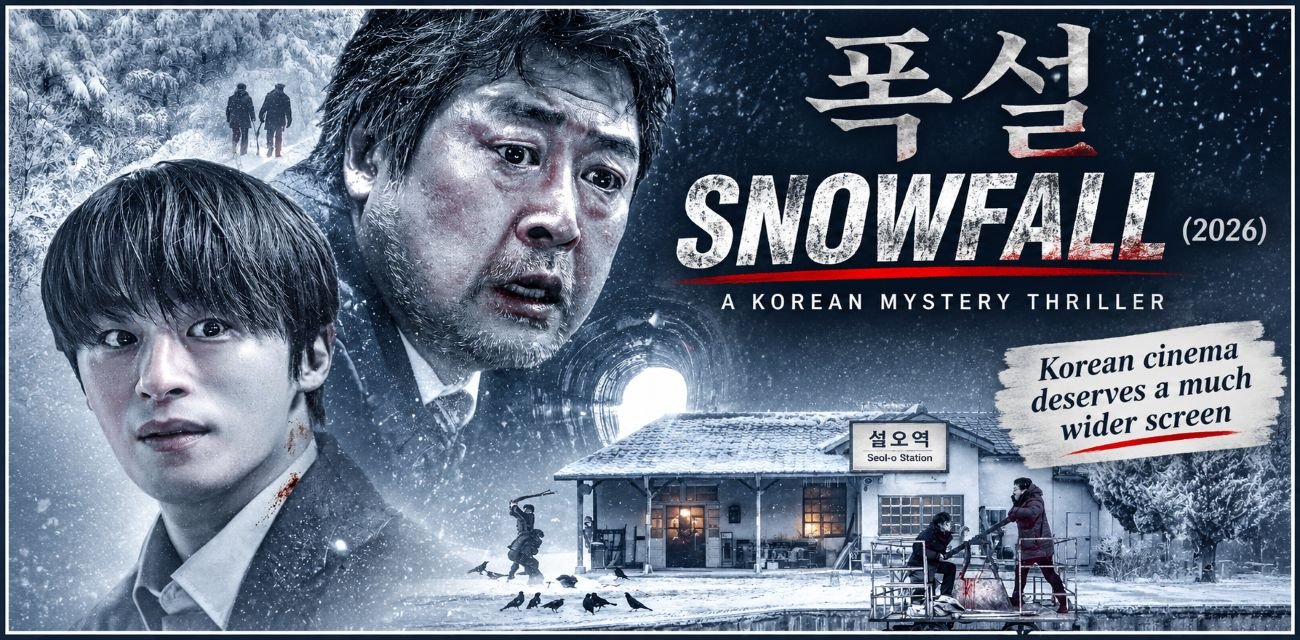
Of course, as on every previous trip to South Korea, one of the most entertaining things for me to do in Seoul is watch Korean movies at the cinema. Why? Because I feel that 99 per cent of the Korean films I would like to see there have little chance of reaching my local cinema back home. A few might slip through, particularly if they’ve collected something shiny at one of those fancy international competitions where certain festival types seem to adore the most uncomfortable expressions of human existence. Apparently, entertainment needs a certificate of intellectual suffering before it can travel internationally. Snowfall (Korean: 폭설), also known as White Blast, didn’t make much difference to my usual enjoyment of Korean cinema. It entertained me for the entire time it lasted, although I noticed two people leaving halfway through. Perhaps they had somewhere better to be, or perhaps their patience melted faster than the snow outside the station. Either way, it brings me back to my usual argument about which movies are worth seeing at the cinema and which might be better enjoyed on streaming. I’ve never believed that a movie belongs exclusively to either. A movie is a movie, and it can be watched and enjoyed on any platform. The story doesn’t suddenly acquire intelligence because it’s projected onto a larger wall. In Snowfall, apparently all it takes is some heavy snow for crime to start unravelling from every direction. The mystery, naturally, isn’t what it seems to be, which is something I’ve always enjoyed about Korean storytelling. Just when I think I’ve worked out what’s happening, Korean cinema politely takes my theory, folds it into a small piece of rubbish and throws it into the snow. Even towards the end, it manages to slap my brain with actions I couldn’t imagine unfolding. Is it a masterpiece? I’m not particularly bothered about giving every entertaining movie a crown. Sometimes I simply want to sit down, enjoy a good story and leave feeling that my time wasn’t wasted. This one was definitely worth seeing at the cinema. The irony is that I sometimes have to travel halfway around the world to find the sort of entertainment my local cinema is supposedly in the business of providing.
Heavy Snow | 폭설 | Trailer
Movie synopsis
At the remote Seol-o railway station, stationmaster Gap-su is preparing to retire after years of service. A severe snowstorm isolates the station and delays the arrival of his replacement, Hyun-taek. When the young man eventually appears, his behaviour raises suspicions. The discovery of a mysterious body and news of an accident involving a prisoner transport vehicle complicate an already uncomfortable handover. Cut off from the outside world, the two men become entangled in a confrontation where trust, identity and the truth are increasingly difficult to establish.
Cast and credits
Director: Hong Eui-jeong, Park Sun-woo
Writers: Hong Eui-jeong, Park Sun-woo, adapted from the stage play by Shin Sung-woo
Genre: Mystery, crime thriller, psychological drama
Main cast: Kim Yoon-seok as Jeong Gap-su, Koo Kyo-hwan as Lee Hyun-taek, Park Soo-young as Choi Seong-bok, Roh Yoon-seo as Yang Seon-u
Composer: Park Sung-do
Production company/studio: Lewis Pictures
Distributor: Showbox
Runtime: 88 minutes and 31 seconds
Release year and platform: Released theatrically in South Korea on 18 November 2026
What does not make sense
- Korean cinema enjoys international recognition, yet much of its ordinary commercial entertainment remains difficult to find in mainstream Western cinemas.
- A Korean film can attract hundreds of thousands of cinema admissions domestically, but international distributors may still regard subtitles as a commercial obstacle.
- Film festivals can introduce excellent foreign productions to international audiences, but a trophy cabinet shouldn’t become the immigration desk for entertainment.
- Cinema keeps promoting screen size as a reason to leave the sofa. A compelling story would be an equally interesting marketing experiment.
- The traditional cinema-versus-streaming argument assumes that the platform determines the artistic value of a movie. The furniture has apparently been promoted to film critic.
- Snowfall builds its mystery around an isolated railway station and human suspicion. Perhaps Hollywood would have added a collapsing mountain, three helicopters and a post-credits announcement for Snowfall 2.
Sense check / The numbers
- Snowfall, officially listed internationally as White Blast by the Korean Film Council, opened in South Korean cinemas on 18 November 2026. Its precise runtime is 88 minutes and 31 seconds, with a domestic age classification of 15. [KOFIC] [KMRB]
- During its opening weekend, from 20 to 22 November 2026, the film ranked first in South Korea, recording 310,890 admissions across 1,244 screens and securing 39.63 per cent of weekend box office revenue. [KOFIC]
- During that same weekend, The Hunger Games: Sunrise on the Reaping recorded 59,014 admissions in South Korea. Snowfall attracted more than five times as many admissions. Apparently, a snowbound railway station can compete with an established Hollywood franchise. [KOFIC]
- By 24 November 2026, Snowfall had recorded 499,705 cumulative cinema admissions and approximately 4.96 billion South Korean won in domestic box office revenue. Those figures establish substantial domestic interest, although they cannot guarantee equivalent international demand. [KOBIS]
- The Film Distributors’ Association reported that 17 Korean-language films reached cinemas in the UK and Ireland during 2024, compared with 233 new non-English-language releases, excluding Indian cinema, across 35 languages. Meanwhile, the BFI reported that 17 of the 20 highest-grossing films in the UK and Ireland in 2025 were connected to established franchises, remakes, sequels or video game properties. Familiarity remains a commercially attractive commodity. [FDA] [BFI]
Fair point, though. Distributors must consider marketing costs, audience demand, translation, screening availability and the financial risks of releasing unfamiliar films. South Korean box office success doesn’t automatically translate into British commercial success. However, repeatedly relying on familiar franchises also limits opportunities to discover new audiences. Streaming has demonstrated that Korean entertainment can travel internationally. The question is whether cinemas are testing that appetite sufficiently or merely assuming that it belongs somewhere else.
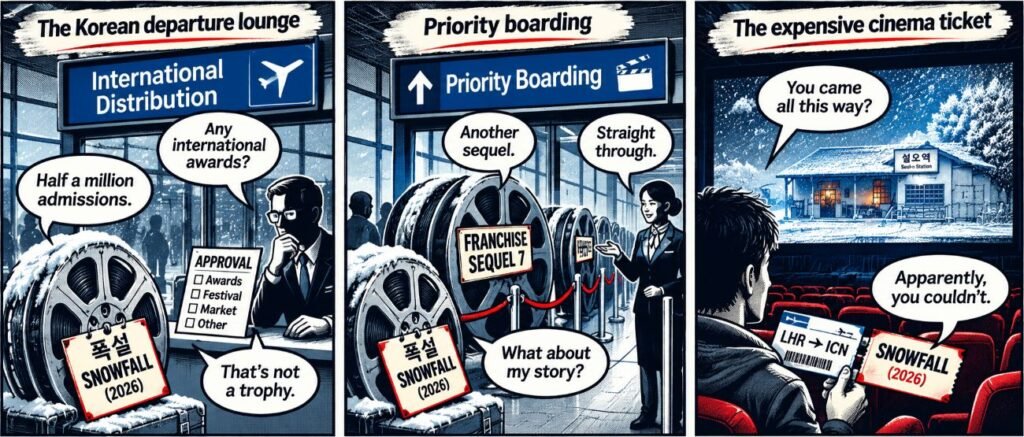
The sketch
Scene 1: The Korean departure lounge
A snow-covered film reel carrying a cinema ticket stands at an international departure gate marked “Western Cinemas”. A distribution official examines its paperwork.
Dialogue:
Official: “Any international awards?”
Film reel: “Half a million admissions.”
Official: “That’s not a trophy.”
Scene 2: Priority boarding
The same film reel waits behind a giant stack of identical Hollywood franchise reels. An official opens a priority boarding gate for the stack.
Dialogue:
Franchise: “Another sequel.”
Official: “Straight through.”
Film reel: “What about my story?”
Scene 3: The expensive cinema ticket
A traveller sits in a South Korean cinema holding an airline ticket beside a cinema ticket. The snow-covered film reel appears on the screen.
Dialogue:
Film reel: “You came all this way?”
Traveller: “Apparently, you couldn’t.”
What to watch, not the show
- International distribution rights and the commercial decisions that determine which foreign films receive theatrical releases.
- The distinction between Korean festival cinema and the everyday commercial productions enjoyed by domestic audiences.
- The financial preference for recognisable franchises over unfamiliar stories and performers.
- Korean cinema’s ability to combine psychological tension, moral uncertainty, dark humour and unpredictable storytelling without relying exclusively on spectacle.
- Streaming platforms as an alternative means of discovering international cinema, rather than an inferior destination for films denied theatrical releases.
- The potential for mainstream cinema chains to experiment with more regular international film screenings instead of treating them as occasional cultural events.
The Hermit take
A good mystery should leave the audience wondering what happened.
It shouldn’t leave them wondering where they can watch it.
Keep or toss
Keep / Toss
Keep Snowfall, its unpredictable storytelling and the pleasure of discovering Korean movies on the big screen.
Toss the theatrical snobbery, distribution conservatism and assumption that entertainment needs an international award before it deserves an international audience.
Satire, personal film commentary and a spoiler-light review. The 99 per cent figure expresses the author’s personal impression of film availability, not a measured distribution statistic.
Sources
- Korean Film Council – official film information and credits: https://www.koreanfilm.or.kr/eng/films/index/filmsView.jsp?movieCd=20247221
- Korea Media Rating Board – classification, production details and precise runtime: https://www.kmrb.or.kr/main/gd/grade/selectGradeInfo.do?category=MV&rcvNo=2601884
- Korean Film Council – opening weekend box office, 20 to 22 November 2026: https://www.koreanfilm.or.kr/eng/news/boxOffice_Weekly.jsp
- Korean Box Office Information System – daily and cumulative box office: https://www.kobis.or.kr/kobis/business/main/searchMainDailyBoxOffice.do
- Korean Film Archive – synopsis and cast: https://www.koreafilm.or.kr/movie/PM_010762
- The Kyunghyang Shinmun – film review and original stage play: https://www.khan.co.kr/en/article/202611221627017
- KoreaFilm – production information and musical score: https://www.koreafilm.co.kr/movie/whiteblast/whiteblast_2.htm
- Film Distributors’ Association – 2025 Yearbook, page 40: https://filmdistributorsassociation.com/wp-content/uploads/FDA-Yearbook-2025-WEBSITE-11-APRIL.pdf
- British Film Institute – official 2025 cinema statistics: https://www.bfi.org.uk/news/official-bfi-statistics-2025
- IMDb – alternative title and screenwriting credits: https://www.imdb.com/title/tt34380971/
Leave a Reply