

Lede
Hope takes nearly an hour to properly show its hand, then spends the rest of the film demonstrating why impatience is sometimes the audience’s problem.
Hermit Off Script
When I saw Hope was actually available on the big screen, my heart skipped a beat. I had heard the praise coming out of Cannes, but mostly I was excited because Korean films at the cinema still feel absurdly rare in the West. K-dramas? Everywhere now. K-pop? You can hardly move without bumping into it. But Korean films, the part I genuinely think can stand beside Hollywood on spectacle while refusing to copy its rhythm, still arrive like somebody has accidentally left a side door open at the multiplex. And, oh boy, Hope did not fail me. It started exactly how some of my favourite Korean films start: slowly enough that part of my brain began asking whether anything was going to happen at all. Where is the monster? Are we actually going to see the bloody thing? Then the film begins tightening the screws. A little more. A little more. And suddenly that slow beginning was not wasted time. It was the spring being compressed.
The filming itself was half the pleasure. The camera does not merely record what is happening. Movement, distance, angles and framing keep playing with the emotion of a scene, sometimes before the story has even told me what I should be afraid of. Then Hope starts throwing genres at me. Mystery. Horror. Action. Science fiction. Comedy. Human stupidity. Cosmic stupidity. Probably several other forms of stupidity I have forgotten because I was laughing too hard. And yes, somewhere inside all this panic, destruction and extraterrestrial trouble, it finds time for a story about someone needing a shit while aliens are nearby. I lost it. Completely. That was the moment when the film stopped behaving like something that needed to stay inside one respectable genre and simply became cinema having fun.
By the end, I did not feel the 160 minutes. I wanted to see it again. Or see the next one, if there ever is one. That is the strange thing about pace: a film can be long without feeling slow, and a shorter film can make you inspect the emergency exit. Watching Heart of the Beast afterwards was frankly unfair to Heart of the Beast. Hope had already melted my brain, squeezed my heart and reminded me why I still bother going to the cinema.
Hollywood has the machinery. Korean cinema keeps reminding me that machinery still needs a pulse.
P.S. And kudos to the female character who had more balls than almost everyone else from the moment people started running for their lives until the very end. While panic was doing laps around the village, she kept moving towards the danger.
HOPE | Official Trailer
Movie synopsis
In the remote South Korean community of Hope, police chief Bum-seok and officer Sung-ae struggle to protect the village after a mysterious creature begins attacking the area. Meanwhile, Sung-ki and a group of locals head into the mountains to track the beast, only to find themselves becoming the hunted. What begins as confusion and fear spreads into increasingly destructive conflict as nobody fully understands what they are facing.
Cast and credits
Director: Na Hong-jin
Writers: Na Hong-jin
Genre: Science fiction, thriller, action
Main cast: Hwang Jung-min, Zo In-sung, Hoyeon, Michael Fassbender, Alicia Vikander, Taylor Russell, Cameron Britton
Composer: Michael Abels
Production company/studio: Forged Films Co., Ltd., with Plus M Entertainment and Westworld listed by Cannes as secondary production companies
Runtime: 156 minutes according to KOFIC; 160 minutes according to Cannes and IMDb
Release year and platform: 2026 theatrical release; opened in UK and Irish cinemas on 25 September 2026, distributed theatrically by NEON.
What does not make sense
- A 160-minute monster film can spend almost its first hour withholding the creature and somehow feel more alive than films sprinting from explosion to explosion.
- Western cinemas have successfully discovered Korean television, Korean music and Korean food, yet Korean films can still feel like rare wildlife on mainstream screens.
- The film throws horror, action, mystery, science fiction and comedy into the same pot, while plenty of bigger studio films apparently require a committee meeting before changing tone.
- A ridiculous toilet story during extraterrestrial chaos should murder the tension. Instead, it somehow makes the whole thing more human.
- The camera is doing emotional work while many modern blockbusters seem satisfied if the expensive object remains approximately inside the frame.
- Hope makes patience part of the entertainment, then rewards it instead of using “slow burn” as an excuse for having forgotten the matches.
Sense check / The numbers
- Hope competed for the Palme d’Or at the 2026 Cannes Film Festival, where Cannes lists the film at 160 minutes. That establishes the festival pedigree, although it does not mean critical opinion was unanimous. [Cannes]
- KOFIC records 4,575,046 admissions and $35,778,572 in South Korean box-office revenue as of 16 September 2026, from a release reaching 2,424 screens. That is substantial domestic theatrical business, not merely festival enthusiasm. [KOFIC]
- The South Korean theatrical release began on 15 July 2026, while UK and Irish cinemas received the film on 25 September 2026. Its UK premiere had already taken place on 16 August at the Edinburgh International Film Festival in IMAX. [KOFIC] [KoBiz]
- As of 25 September 2026, Rotten Tomatoes listed Hope at 78 per cent from 159 critic reviews and 77 per cent from more than 500 verified audience ratings. That indicates broadly positive reception, not universal agreement. [Rotten Tomatoes]
- RogerEbert.com’s review notes that the film waits almost 1 hour before properly revealing the creature behind the chaos. In other words, the slow build Raz felt is built into the film’s structure rather than imagined during a particularly long popcorn refill. [RogerEbert.com]
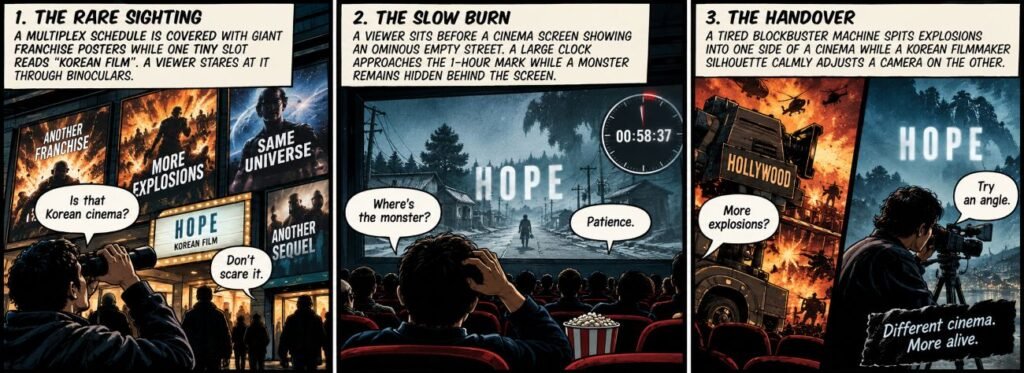
The sketch
Scene 1: The rare sighting
A multiplex schedule is covered with giant franchise posters while one tiny slot reads “Korean film”. A viewer stares at it through binoculars.
Dialogue:
Viewer: “Is that Korean cinema?”
Schedule: “Don’t scare it.”
Scene 2: The slow burn
A viewer sits before a cinema screen showing an ominous empty street. A large clock approaches the 1-hour mark while a monster remains hidden behind the screen.
Dialogue:
Viewer: “Where’s the monster?”
Film: “Patience.”
Scene 3: The handover
A tired blockbuster machine spits explosions into one side of a cinema while a Korean filmmaker silhouette calmly adjusts a camera on the other.
Dialogue:
Blockbuster: “More explosions?”
Camera: “Try an angle.”
What to watch, not the show
- Distribution power: screening schedules still decide whether Korean films travelling beyond Korea receive a genuine audience or a token slot.
- Theatrical confidence: Hope was sold through cinemas and premium formats rather than treated as streaming content with a brief promotional detour.
- Pacing: withholding information can create tension when the film is actively building something underneath the silence.
- Genre rules: horror, science fiction, action and comedy do not need customs checkpoints between them.
- International casting: the film combines major Korean performers with Michael Fassbender, Alicia Vikander, Taylor Russell and Cameron Britton without turning itself into an English-language Hollywood imitation.
- Visual authorship: camera position, movement and framing can carry tension before visual effects or creatures arrive.
- Cinema economics: films like Hope are exactly why arguments about getting people off the sofa should begin with giving them something worth leaving it for.
The Hermit take
Hope reminded me why I still go to the cinema: craft can make 160 minutes feel dangerously short.
Korean cinema does not need to imitate Hollywood when it can make Hollywood look sleepy.
Keep or toss
Keep
Keep the slow build, the camera work, the genre chaos, the stupidly well-timed comedy and the confidence to make the audience wait before opening the cage.
Sources
- Festival de Cannes official Hope listing and credits: https://www.festival-cannes.com/en/f/hope/
- Korean Film Council film database, release and box-office figures: https://www.koreanfilm.or.kr/eng/films/index/filmsView.jsp?movieCd=20233219
- KoBiz report on UK and Ireland theatrical release: https://www.koreanfilm.or.kr/eng/news/news.jsp?blbdComCd=601006&mode=VIEW&seq=6473
- Rotten Tomatoes critic and audience figures: https://www.rottentomatoes.com/m/hope_2026
- RogerEbert.com Cannes review and slow-build discussion: https://www.rogerebert.com/reviews/hope-na-jong-hin-movie-review-2026
- The Guardian Cannes review: https://www.theguardian.com/film/2026/may/18/hope-review-non-stop-gonzo-alien-battling-is-top-quality-entertainment
Leave a Reply