
Lede
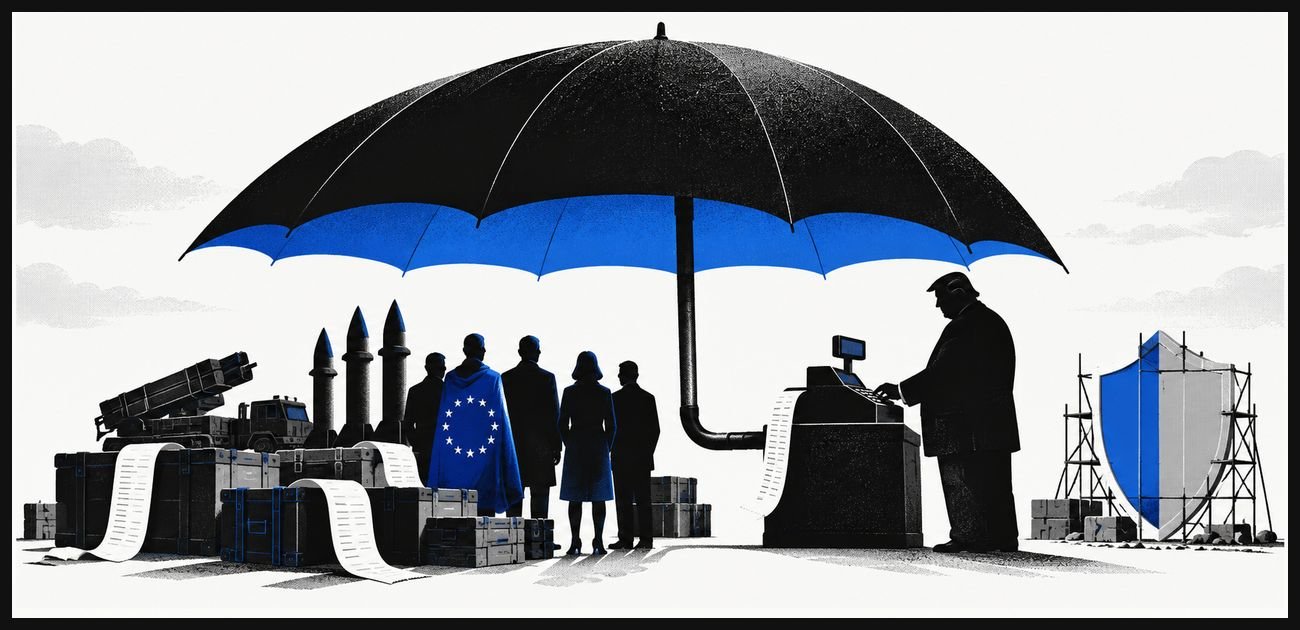
Europe spent decades relying on American protection, only to discover that its biggest security partner could become its loudest debt collector.
Hermit Off Script
Europe has spent decades trusting the United States to protect it, buying American military equipment and building its security around an alliance that was supposed to defend everyone. Now Trump comes along and explains that Europe hasn’t done enough to protect itself. Apparently, the customer is to blame for becoming dependent on the supplier. I find that a rather magnificent business model. Sell someone the equipment, encourage them to rely on your protection, become the world’s most powerful military force, and then complain that your customer isn’t independent enough. Of course, European governments didn’t simply transfer their defence budgets into an American bank account. They financed their own militaries and bought weapons from American manufacturers. The United States also spent enormous amounts of its own money. But European purchases helped sustain American military industries and influence, and Europe became increasingly dependent on capabilities controlled elsewhere. So I can’t accept the idea that America carried Europe without benefiting from the arrangement. Then comes Trump, the dumb-smart president who reminds me of artificial intelligence nowadays. Like an AI system trained on a mountain of old information, he can produce something that sounds clever, deliver it with tremendous confidence and somehow arrive at an answer that makes very little sense. The noise is impressive. The judgement is another matter. And what bothers me is that even Europe has started accepting the accusation that it simply didn’t pay enough. I think the real failure was different. Europe failed to build enough power of its own. It relied on someone else’s weapons, technology, intelligence and political decisions when it should have been developing the ability to defend its own democratic future. That means investing in military production, research, artificial intelligence, cybersecurity and the institutions needed to act together. There is another absurdity I find even more offensive. Europe opened its doors to migrants, refugees, people escaping suffering and others who needed a decent chance at life. Now some politicians behave as though offering those people shelter caused every economic and political failure of the past decades. I don’t consider protecting vulnerable people a European mistake. I consider it one of the finest things democracy can do. Naturally, immigration needs functioning laws, borders, housing and public services. But blaming the helpless for failures of planning and leadership is a convenient way to avoid examining the people actually responsible. The far right understands this very well. Why discuss industrial policy, security dependence or government incompetence when a frightened family makes such an affordable scapegoat? Britain was another loss for European unity. I believe the EU could have done more to preserve that relationship, while British politics allowed a complicated democratic decision to become a battlefield of resentment, misinformation and promises that deserved far more scrutiny. Russia attempted to interfere in the Brexit debate, although that doesn’t establish that interference determined the result. The British electorate still made its own choice. What troubles me is how easily divisions can be exploited, particularly when political campaigns and social media systems reward anger more than understanding. Brexit weakened the political cohesion of a democratic Europe at precisely the moment that cohesion was becoming more important. And now Europe faces pressure from authoritarian governments, economic competitors, unreliable allies and political movements within its own borders that question the very democratic values they enjoy. Yet I’m not without hope. I believe crises can bring capable, intelligent and decent people into leadership, people who understand that strength means more than shouting, blaming or buying another missile. Europe and Britain have no shortage of such people. They need the political courage and opportunity to lead. I want Europe to become powerful enough to protect its own future, while remembering why that future deserves protection. The vulnerable were never Europe’s greatest weakness. Its willingness to depend on somebody else’s shield was.
What does not make sense
- The protection paradox. American politicians complain about European dependence while American defence companies benefit from selling equipment to European countries. A business relationship suddenly becomes a moral lecture when the invoice arrives.
- The imaginary unpaid NATO bill. National defence spending is not a subscription paid to Washington. Trump has repeatedly described allied spending as though the American president runs an international debt-collection agency.
- The security dependence nobody wanted to discuss. European governments bought advanced American weapons, but many systems also depend on American software, maintenance, intelligence or logistical support. Ownership is less reassuring when somebody else controls essential parts of the equipment.
- The forgotten obligation. NATO’s collective-defence clause has been invoked only once, following the attacks against the United States in 2001. An alliance apparently looks rather different depending on which side needs help.
- The convenient European confession. European defence spending has risen substantially, yet the debate is often reduced to whether Europe spends enough rather than whether it can act effectively with what it buys.
- The migrant as universal explanation. Economic stagnation, government failures, housing shortages and declining public confidence are blamed on vulnerable people. OECD research shows that immigration’s net fiscal effects are generally small, although consequences vary between countries and communities. Blaming migrants cannot substitute for examining policy failures.
- The Brexit shortcut. Foreign interference attempts are real security concerns. Claiming that Russian bots caused the referendum result, however, goes beyond the evidence. Domestic political decisions and responsibility cannot simply be outsourced to Moscow.
- The technological contradiction. Europe wants strategic independence while depending on foreign military systems and major AI providers. Buying advanced technology is useful. Losing the ability to build or control essential technology is considerably less impressive.
- The political theatre. Leaders turn public office into theatre, then describe their performances as foreign policy. The people who actually need stable alliances rarely get a speaking part.
Sense check / The numbers
- NATO is not a protection racket with an American bank account. NATO’s collective budgets and programmes amount to up to EUR 5.3 billion in 2026. Most allied defence spending is national expenditure on each country’s own armed forces and capabilities. The United States contributes to NATO’s shared funding; other members do not simply send their defence budgets to Washington. [NATO; Full Fact]
- European purchases have substantially benefited American arms suppliers. SIPRI reports that the United States supplied 58 per cent of major arms imported by the 29 European NATO members during 2021-25. America also accounted for 42 per cent of global major-arms exports in that period. These figures measure arms-transfer volumes, not the total money paid by Europe or the source of America’s entire military power. [SIPRI]
- Europe has increased defence spending, although important gaps remain. NATO reports that European allies and Canada increased their combined defence expenditure from approximately 1.4 per cent of GDP in 2014 to 2.3 per cent in 2025. At the June 2025 Hague summit, allies committed to reaching 5 per cent of GDP annually by 2035, including at least 3.5 per cent for core defence and up to 1.5 per cent for wider security-related spending. Higher spending is a commitment, not proof of operational independence. [NATO]
- Collective defence has already worked in America’s favour. NATO invoked Article 5 for the first and only time in its history after the terrorist attacks of 11 September 2001 against the United States. European allies have therefore supported American security under the alliance’s central commitment, contrary to the suggestion that protection has always flowed in one direction. [NATO]
- Brexit was a democratic vote, and the interference question requires precision. On 23 June 2016, 51.9 per cent voted Leave and 48.1 per cent voted Remain. In October 2026, MI5’s director acknowledged Russian interference attempts but did not establish that they changed the referendum outcome. Britain’s democratic choice and the vulnerabilities exploited around it must be examined separately. [Electoral Commission; Guardian; UK Parliament]
The sketch
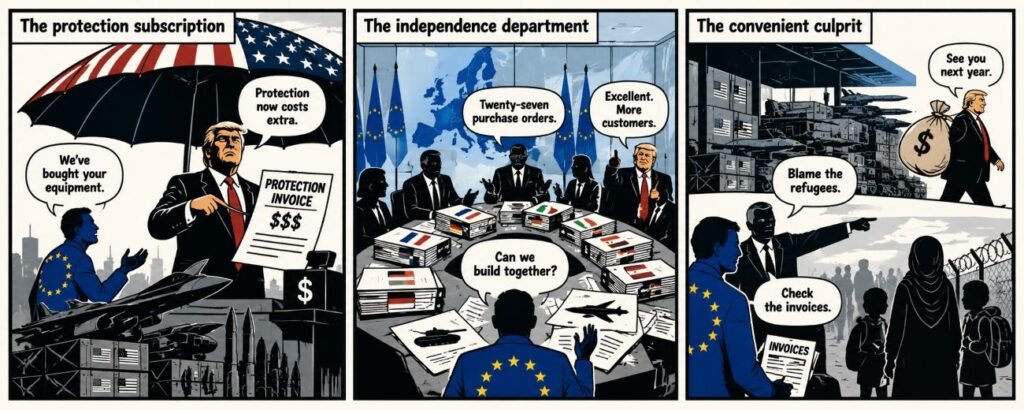
Scene 1: The protection subscription
A European silhouette stands beneath an enormous American umbrella, carrying a pile of weapons receipts. An American salesman holds a new invoice while standing beside a cash register.
Dialogue:
Europe: “We’ve bought your equipment.”
Salesman: “Protection now costs extra.”
Scene 2: The independence department
The same European silhouette enters a meeting room filled with national defence ministers. The table is covered with separate weapons catalogues, purchase orders and incompatible equipment.
Dialogue:
Europe: “Can we build together?”
Minister: “Twenty-seven purchase orders.”
Salesman: “Excellent. More customers.”
Scene 3: The convenient culprit
The European silhouette stands between an expensive military warehouse and a small group of refugees beneath a shelter. A politician points towards the refugees while the American salesman carries away a bag of money.
Dialogue:
Politician: “Blame the refugees.”
Europe: “Check the invoices.”
Salesman: “See you next year.”
What to watch, not the show
- Military money and ownership. Whether Europe invests in shared manufacturing, ammunition, air defence, logistics and independent maintenance, rather than simply purchasing more equipment whose essential components depend on foreign suppliers.
- European defence leadership. Whether national governments can agree on command arrangements, common procurement and emergency decisions without abandoning democratic accountability. More money without effective coordination is an expensive form of hesitation.
- Artificial intelligence and technological independence. Whether Europe and Britain develop competitive AI capabilities, secure computing infrastructure, autonomous defence systems and home-grown research, while keeping effective human oversight over military uses.
- The European defence investment programme. Whether the EU’s EUR 150 billion SAFE loan instrument strengthens European production, cooperation and technological control, instead of merely subsidising additional dependence.
- British-European cooperation. Whether the UK and EU strengthen practical defence, intelligence, technology and economic relationships despite Brexit. Political separation does not require strategic stupidity.
- Misinformation and political manipulation. Whether authorities investigate foreign interference, covert influence and coordinated online manipulation with verifiable evidence, while also scrutinising domestic campaigns that spread misleading claims.
- Immigration and democratic responsibility. Whether governments maintain lawful borders, workable asylum systems and adequate public services without turning human suffering into campaign material for extremist movements.
- American reliability. Whether NATO commitments remain credible across changes of administration, and whether Europe’s investment decisions reflect actual security risks rather than the latest presidential complaint.
- The next generation of leaders. Whether Europe rewards politicians who can deliver measurable outcomes, defend democratic institutions and cooperate across borders instead of those who merely manufacture new enemies.
The Hermit take
Europe cannot defend democracy forever with somebody else’s permission.
A Europe that abandons its humanity to become stronger has already lost what it was supposed to defend.
Keep or toss
Keep / Toss
Keep NATO cooperation, democratic solidarity, humanitarian protection, capable leadership and investment in independent European defence and technology.
Toss strategic complacency, duplicated military spending, scapegoating and the idea that an ally must accept political humiliation to receive protection.
Sources
- NATO, funding structure and common budgets: https://nato.int/en/what-we-do/introduction-to-nato/funding-nato
- Full Fact, US contributions to NATO: https://fullfact.org/world/us-nato-contributions/
- SIPRI, Trends in International Arms Transfers, March 2026: https://www.sipri.org/publications/2026/sipri-fact-sheets/trends-international-arms-transfers-2025
- NATO, deterrence, defence spending and 2025 commitments: https://nato.int/en/what-we-do/deterrence-and-defence/deterrence-and-defence
- NATO, collective defence and Article 5: https://nato.int/en/what-we-do/introduction-to-nato/collective-defence-and-article-5
- Reuters, Trump’s March 2025 remarks on defending NATO allies: https://www.reuters.com/world/trump-if-nato-members-dont-pay-us-wont-defend-them-2025-03-07/
- OECD, economic impact of migration: https://www.oecd.org/en/topics/economic-impact-of-migration.html
- Electoral Commission, official EU referendum results: https://www.electoralcommission.org.uk/media-centre/official-result-eu-referendum-declared-electoral-commission-manchester
- Guardian, MI5 director on Russian attempts to interfere in Brexit, 13 October 2026: https://www.theguardian.com/politics/2026/oct/13/russia-brexit-eu-referendum-interference-mi5
- UK Parliament, 2020 government answer on evidence of successful Brexit interference: https://questions-statements.parliament.uk/written-questions/detail/2020-07-21/HL7122
- European Commission, defence readiness and SAFE investment programme: https://commission.europa.eu/topics/defence/future-european-defence_en
Disclaimer: This article is political satire and commentary based on publicly available evidence. It criticises governments, political decisions, institutions and public conduct. It does not assign collective blame to American citizens, migrants, refugees or British voters. The AI comparison and satirical dialogue are rhetorical commentary, not factual quotations or assessments.
Leave a Reply