Lede
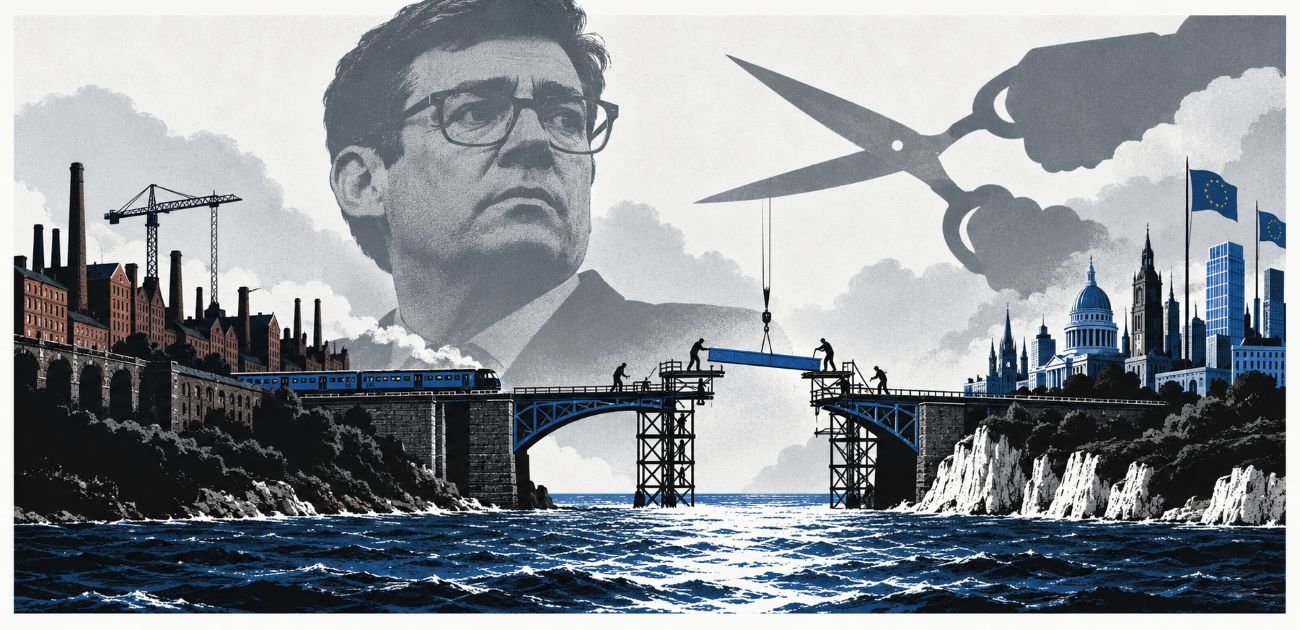
Britain has found a new Prime Minister in the North, but rebuilding its strength may require admitting that leaving Europe’s biggest political and economic partnership was a rather expensive way of proving independence.
Hermit Off Script
Britain has a new hope for the future, and this time it comes from the North. Andy Burnham is now Prime Minister, and perhaps he can bring back some of the strength and unity the United Kingdom once enjoyed. I am not expecting a miracle from Manchester, but after years of political experiments, broken promises and arguments over who betrayed whom, a government willing to reconsider Britain’s relationship with Europe would already be a welcome change. Apparently, discovering that your neighbours are useful is now a revolutionary political idea.
I believe the future of Britain lies in a closer relationship with the European Union, perhaps eventually returning to the fold. Both Britain and Europe have lost something by separating. Britain lost influence over decisions affecting its largest trading relationship, while Europe lost the direct participation of a major economy, diplomatic power and military partner. Neither side has become helpless, of course, but there is a difference between being independent and deliberately making cooperation harder. Britain spent years promising to take back control, only to discover that geography had not bothered to read the referendum result.
What concerns me even more is the world beyond Brexit. Powerful countries have their own interests, and divided democratic nations are easier to pressure than countries capable of acting together. Trade, energy, technology, information and military security can all become instruments of influence. I cannot help wondering how much of the political division across Europe benefits governments that have little interest in seeing strong, united democracies.
Democracy and the freedoms people enjoy were not handed down as generous gifts from history. Generations suffered, protested and fought wars to establish rights that are now treated almost as permanent features of modern life. I find it extraordinary that we can celebrate those sacrifices every year while casually weakening the cooperation that helps protect their achievements. History provides plenty of evidence that democratic societies can fail. It offers considerably fewer guarantees that they will recover.
Burnham’s interview with Alastair Campbell and Rory Stewart on The Rest Is Politics: Leading raises a particularly uncomfortable issue through his comments about Russian interference in the 2016 Brexit referendum. The subsequent confirmation from MI5 that Russia attempted to interfere matters, but so does the distinction between attempting to influence a democratic vote and actually changing its result. I have no interest in dismissing the intelligence of millions of Leave voters. Democracy means respecting their decision, examining its consequences and accepting that future generations are entitled to make different decisions.
I also understand why some people see returning to Europe as surrendering national sovereignty. But I would question how much sovereignty is worth when exercising it alone leaves a country with less practical influence over events that affect its citizens. Britain should not return to Europe blindly, and Europe should not welcome it back without serious discussion about the responsibilities of membership. Yet continuing an unsuccessful policy simply because changing direction would be embarrassing is hardly a display of national strength.
Perhaps Burnham can bring some of that lost unity back, beginning with a more confident North and extending towards a stronger United Kingdom and a closer European future. Perhaps he will discover that governing involves more difficult compromises than proposing sensible ideas. I genuinely hope he succeeds, because another round of trial and error would leave the workers paying while the political architects prepare their next slogans.
I am not predicting a British revival. I am hoping for one.
Britain already knows how to stand alone. It is still waiting to learn what it can build together.
Rory & Alastair Interview Prime Minister Andy Burnham
What does not make sense
- Britain spent years celebrating the recovery of sovereignty while accepting new barriers to trade with the market on its doorstep. The paperwork apparently failed to recognise the victory.
- Political leaders promised more freedom, yet freedom was sold and then shrunk in practical areas such as working and settling across Europe.
- The country wants influence over European security, trade and regulation while remaining outside the institutions where many of those decisions are made.
- Britain treats cooperation with European neighbours as a possible threat to independence, then looks across the Atlantic for reassurance whenever international security becomes uncomfortable.
- A democracy is expected to honour a referendum from 2016 but is apparently not allowed to reconsider the consequences in 2026. Political decisions seem to have acquired eternal life, unlike the politicians who made them.
- Foreign attempts to influence democratic debate deserve investigation. Claiming that such interference must have determined an election, without evidence, would undermine the very democracy supposedly being defended.
- The European Union speaks of common strength but still struggles to act collectively on some major foreign policy and defence decisions. Reuniting with Britain would not automatically repair those weaknesses.
- A new Prime Minister arrives promising unity, while the political system still rewards confrontation, short-term headlines and the ability to blame the previous occupant of Downing Street.
- Closer cooperation could deliver measurable benefits, but promising a return to past greatness without explaining the costs, compromises and democratic consent is another form of political nostalgia.
Sense check / The numbers
- 20 July 2026: Andy Burnham became Prime Minister of the United Kingdom after returning to Parliament in June and becoming Labour leader on 16 July. His previous experience includes serving as Mayor of Greater Manchester from 2017, with re-elections in 2021 and 2024. The North has reached No 10, but geography alone is not an economic policy. [GOV.UK]
- 51.9 per cent against 48.1 per cent: The official result of the 23 June 2016 EU referendum was 17,410,742 votes to leave against 16,141,241 to remain, with turnout of 72.2 per cent. The decision had democratic legitimacy. That does not make its economic consequences immune to review or prevent future democratic decisions. [Electoral Commission]
- £384 billion in exports and £472 billion in imports: These were the UK’s trade figures with the European Union in 2025. The EU accounted for 41 per cent of UK exports and 50 per cent of imports. Whatever political direction Britain chooses, the European market remains central to its economy. [House of Commons Library]
- 4 per cent lower long-run productivity: The Office for Budget Responsibility’s July 2026 analysis maintains its assumption that the post-Brexit trading relationship will reduce UK productivity by around 4 per cent compared with remaining in the EU. This is a long-term forecast assumption, not proof that every economic difficulty since 2016 was caused by Brexit. [OBR]
- 20 November 2026: The next UK-EU summit is scheduled for Brussels. Burnham told Parliament that proposed discussions include food and drink trade, emissions trading, energy links, youth mobility and immigration cooperation. These are practical negotiations, not an agreement to rejoin the EU. The difference between discussing a bridge and completing one remains rather important. [Hansard]
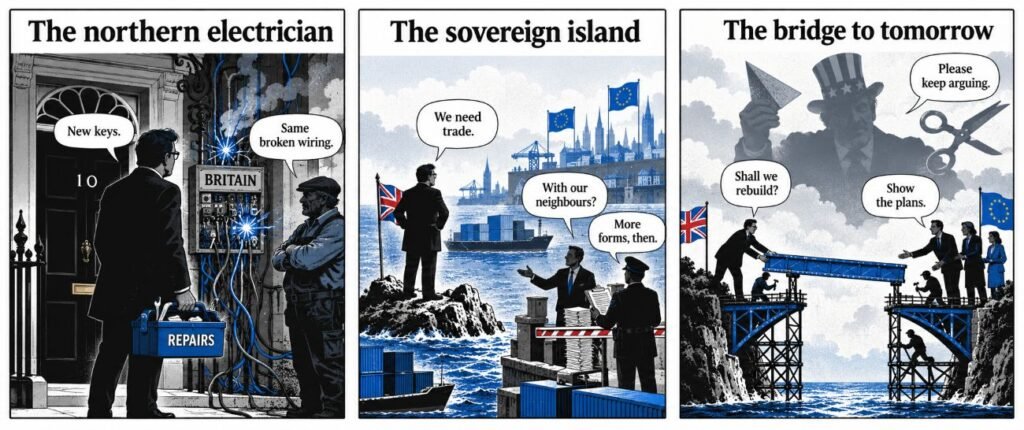
The sketch
Scene 1: The northern electrician
A Prime Minister silhouette from the North stands inside No 10 holding a toolbox marked “REPAIRS”. An old electrical switchboard marked “BRITAIN” sparks beside him.
Dialogue:
PM: “New keys.”
Caretaker: “Same broken wiring.”
Scene 2: The sovereign island
The same silhouette stands on a tiny British island surrounded by shipping containers. Across the water, European factories and markets continue operating.
Dialogue:
PM: “We need trade.”
Business: “With our neighbours?”
Customs officer: “More forms, then.”
Scene 3: The bridge to tomorrow
The Prime Minister and European representatives begin rebuilding a damaged bridge between Britain and Europe. A much larger shadowy figure behind them holds a wedge and a pair of scissors.
Dialogue:
PM: “Shall we rebuild?”
Europe: “Show the plans.”
Shadow: “Please keep arguing.”
What to watch, not the show
- The November summit: Whether proposed agreements produce signed commitments, reduced trade barriers and identifiable economic benefits rather than another joint photograph.
- The price of closer integration: Customs union membership, single market participation and full EU membership involve different obligations, including questions over regulation, migration and democratic representation. Voters deserve clear comparisons.
- Britain’s internal unity: Whether devolution, regional investment and better public services can strengthen relationships between England, Scotland, Wales and Northern Ireland without simply moving arguments between capitals.
- European strategic independence: Europe needs one voice on important security questions, but cooperation must remain accountable to democratic institutions and compatible with existing NATO responsibilities.
- Foreign interference: Whether British and European authorities improve public scrutiny of disinformation, political funding and cyber threats while distinguishing verified attempts at interference from unsupported claims about electoral outcomes.
- The economic incentives: Which industries benefit from closer trade, which sectors face adjustment costs, and whether ordinary households receive any gains.
- The next democratic mandate: Whether a future proposal for EU membership is supported by clear terms and meaningful public consent rather than presented as a decision already made.
- Burnham’s political record: Whether northern regeneration, transport reform and commitments to regional government translate into measurable improvements across the country.
- The longer danger: Whether European democracies continue cooperating despite their disagreements or allow competing national interests to create vulnerabilities that more powerful states can exploit.
The Hermit take
A stronger Britain needs more than a northern Prime Minister and a renewed argument about Europe.
The future will be decided by cooperation that delivers, not nostalgia that campaigns.
Keep or toss
Keep / Toss
Keep the willingness to reconsider Brexit, respect democratic choices, strengthen European cooperation and rebuild the country’s internal unity.
Toss the fantasy of effortless independence, the suspicion that every compromise is surrender and the belief that one leader can restore national greatness without doing the difficult work.
Disclaimer: This article is political satire and commentary based on public information and the author’s perspective. The linked interview was identified through its published programme description and independently reported remarks; its complete audio was not independently transcribed for this article. Allegations of attempted foreign interference are distinguished from evidence that a referendum result was altered.
Sources
- The Rest Is Politics: Leading, Andy Burnham interview: https://www.youtube.com/watch?v=fKTIiGmmowM
- Official podcast episode listing, 11 October 2026: https://podcasts.apple.com/gb/podcast/andy-burnham-my-relationship-with-starmer-brexit-lies/id1665265193?i=1000795811879
- UK Government, Prime Minister Andy Burnham: https://www.gov.uk/government/ministers/prime-minister
- Electoral Commission, 2016 EU referendum results: https://www.electoralcommission.org.uk/research-reports-and-data/our-reports-and-data-past-elections-and-referendums/report-23-june-2016-referendum-uks-membership-european-union
- House of Commons Library, UK-EU trade statistics: https://commonslibrary.parliament.uk/research-briefings/cbp-7851/
- Office for Budget Responsibility, Brexit analysis: https://obr.uk/forecasts-in-depth/the-economy-forecast/brexit-analysis/
- UK Parliament, Burnham’s statement of 12 October 2026: https://hansard.parliament.uk/Commons/2026-10-12/debates/54FB2EDB-83AF-40FE-8A98-A914AD221CD7/x
- House of Commons Library, UK rejoining the EU and accession requirements: https://commonslibrary.parliament.uk/research-briefings/cdp-2025-0067/
- Reuters, Burnham on Russian interference in the referendum: https://www.reuters.com/world/uk/uk-pm-burnham-says-russia-interfered-2016-brexit-vote-2026-10-11/
- The Guardian, MI5 assessment of attempted Russian interference: https://www.theguardian.com/politics/2026/oct/13/russia-brexit-eu-referendum-interference-mi5
Leave a Reply