
Lede
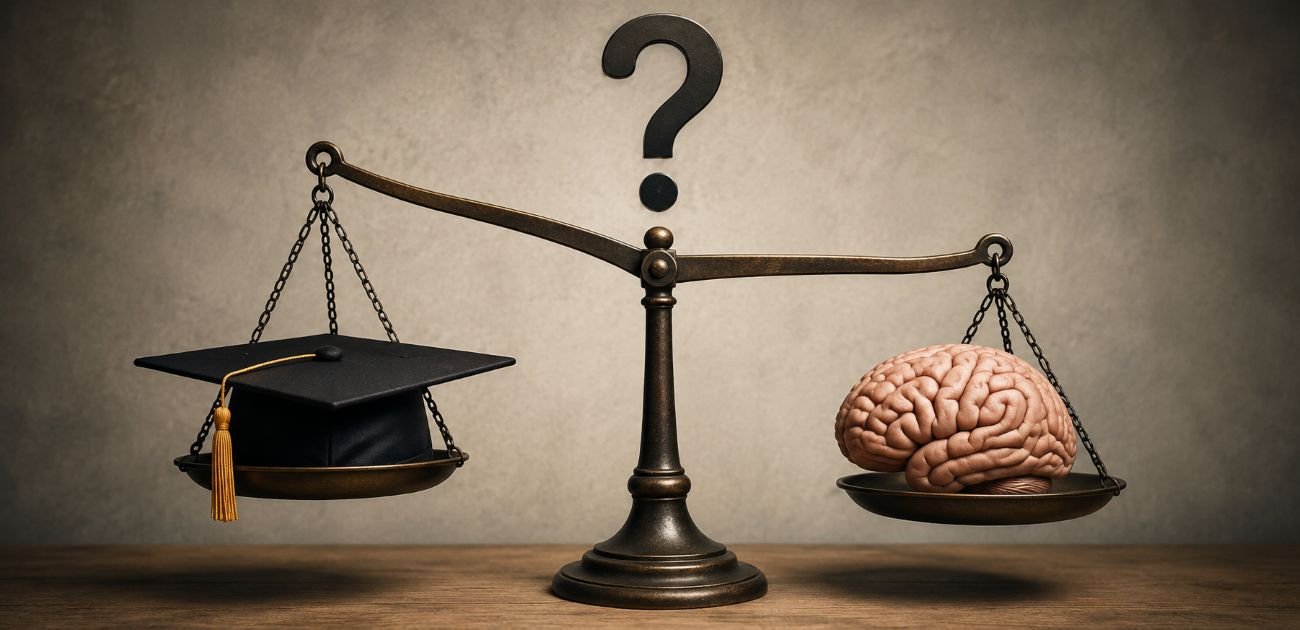
We keep using “educated” as a polite synonym for intelligent and “uneducated” as a respectable way of saying stupid, although neither equation survives much inspection.
Hermit Off Script
Stupid people, or so-called uneducated people. Intelligent people, or so-called educated people. I keep wondering why we mix these things as if they were interchangeable.
Education can give you knowledge, methods, vocabulary, discipline and access to ideas that somebody without the same opportunities may never encounter. It can even improve cognitive ability. Fine. But somewhere along the road we turned education from something a person receives into something a person supposedly is.
A degree proves that you completed a particular course of education. It doesn’t certify wisdom. Leaving school early doesn’t certify stupidity either.
Someone can have little formal education and still understand people, consequences, practical problems and contradictions remarkably well. Someone else can collect qualifications and still be unable to examine an idea once it collides with ego, ideology, status or whatever the group around them already believes.
The funny part is that educated people should know better than to make such a crude classification. If education really teaches critical thinking, then “uneducated equals stupid” should be one of the first lazy assumptions thrown into the bin.
And perhaps “stupid” itself is often too convenient. A person may lack knowledge. Another may lack opportunity. Another may be brilliant with machines and hopeless with people. Someone may understand mathematics that leaves me staring at the page like a confused potato, while having the practical judgement of that same potato.
I would rather know whether somebody thinks, learns, questions and changes their mind when the evidence changes. Education can help enormously with all four. It doesn’t issue a lifetime guarantee.
The certificate belongs on the wall. The intelligence still has to turn up every morning.
What does not make sense
- Calling somebody “uneducated” when what we actually mean is “without much formal education”.
- Treating years spent in education as a direct measurement of intelligence.
- Assuming a university graduate must be wise because they have demonstrated competence in a particular academic field.
- Assuming somebody without qualifications cannot have deep knowledge acquired through work, reading, observation or decades of experience.
- Praising critical thinking while using educational status as a shortcut that saves us from actually judging somebody’s thinking.
- Treating intelligence as a single ladder when humans can differ enormously across reasoning, memory, language, practical judgement, creativity and social understanding.
Sense check / The numbers
- A 2018 meta-analysis examined 42 data sets, more than 600,000 participants and 142 effect sizes. It estimated that an additional year of education produced roughly 1 to 5 additional IQ points. Education and intelligence therefore aren’t unrelated, but neither are they synonyms. [Psychological Science]
- In England’s 2023 adult-skills assessment, adults aged 16 to 65 averaged 272 points in literacy, 268 in numeracy and 259 in adaptive problem solving, all above the OECD averages. Yet 18 per cent were at or below Level 1 in literacy and 21 per cent were at or below Level 1 in numeracy. A population cannot sensibly be divided into two neat boxes labelled “educated smart people” and “uneducated stupid people”. [OECD]
- Among adults aged 25 to 65 in England, tertiary-educated adults scored 30 points higher in literacy than those with upper-secondary education. But the OECD also found that adults with upper-secondary education in England scored higher in literacy than tertiary-educated adults in Chile. The qualification label alone doesn’t tell you the person’s measured skill level. [OECD]
- Across the OECD’s 2023 survey, 31 countries and economies participated, and 18 per cent of adults on average lacked the most basic proficiency levels across the measured domains. Formal education has expanded enormously, but possessing access to education clearly hasn’t abolished weak skills. [OECD]
- The OECD also reported that literacy performance among tertiary-educated adults fell or failed to improve in most participating countries between survey cycles. Having more graduates doesn’t automatically mean every measured cognitive skill keeps climbing forever. [OECD]
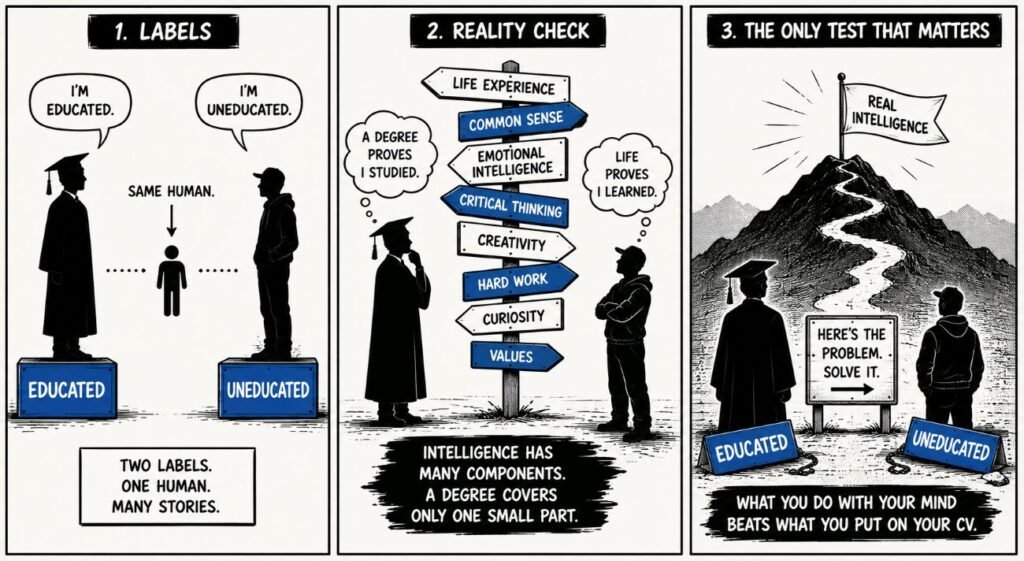
The sketch
Scene 1: Labels
Two people face each other. One wears a graduation gown and stands above a blue “EDUCATED” label. The other stands above an “UNEDUCATED” label. Between them is a simple human figure.
Dialogue:
Graduate: “I’m educated.”
Worker: “I’m uneducated.”
Caption: “Two labels. One human. Many stories.”
Scene 2: Reality check
The two people stand on opposite sides of a signpost pointing towards life experience, common sense, emotional intelligence, critical thinking, creativity, hard work, curiosity and values.
Dialogue:
Graduate: “A degree proves I studied.”
Worker: “Life proves I learned.”
Caption: “Intelligence has many components. A degree covers only one small part.”
Scene 3: The only test that matters
Both people stand at the beginning of the same difficult mountain path. Their “EDUCATED” and “UNEDUCATED” labels have been dropped on the ground. A sign points up the mountain towards “REAL INTELLIGENCE”.
Dialogue:
Sign: “Here’s the problem. Solve it.”
Caption: “What you do with your mind beats what you put on your CV.”
What to watch, not the show
- The money attached to credentials. Qualifications aren’t merely educational achievements. They are also labour-market filters.
- The class effect. Access to education depends partly on circumstances, so educational attainment cannot be treated purely as personal intellectual merit.
- Credential inflation. When more jobs demand qualifications, possessing one can become an entry ticket rather than evidence of exceptional ability.
- Intellectual tribalism. Highly educated groups aren’t magically protected from conformity, ideology, status competition or bad judgement.
- The opposite romantic mistake. Lack of formal education doesn’t automatically create common sense either. Ignorance doesn’t become wisdom merely because it avoided university.
- AI may make the distinction even more interesting. When information and technical assistance become cheap, judgement, curiosity and the ability to recognise nonsense may matter more than simply possessing information.
The Hermit take
Education can sharpen intelligence. It cannot guarantee wisdom.
I’d rather meet a mind that keeps learning than a certificate that stopped thinking.
Keep or toss
Keep / Toss.
Keep education, expertise and qualifications.
Toss the childish translation dictionary where “educated” means intelligent and “uneducated” means stupid.
Sources
- Ritchie and Tucker-Drob, meta-analysis of education and intelligence: https://pubmed.ncbi.nlm.nih.gov/29911926/
- OECD, Survey of Adult Skills 2023 – England country note: https://www.oecd.org/en/publications/survey-of-adults-skills-2023-country-notes_ab4f6b8c-en/united-kingdom_02bc78e4-en.html
- UK Department for Education, Survey of Adult Skills 2023: https://www.gov.uk/government/publications/survey-of-adult-skills-2023-national-report-for-england
- OECD, Do Adults Have the Skills They Need to Thrive in a Changing World?: https://www.oecd.org/en/publications/do-adults-have-the-skills-they-need-to-thrive-in-a-changing-world_b263dc5d-en.html
- OECD, Education at a Glance 2025 – United Kingdom: https://www.oecd.org/en/publications/education-at-a-glance-2025_1a3543e2-en/united-kingdom_c93708b1-en.html
Leave a Reply