
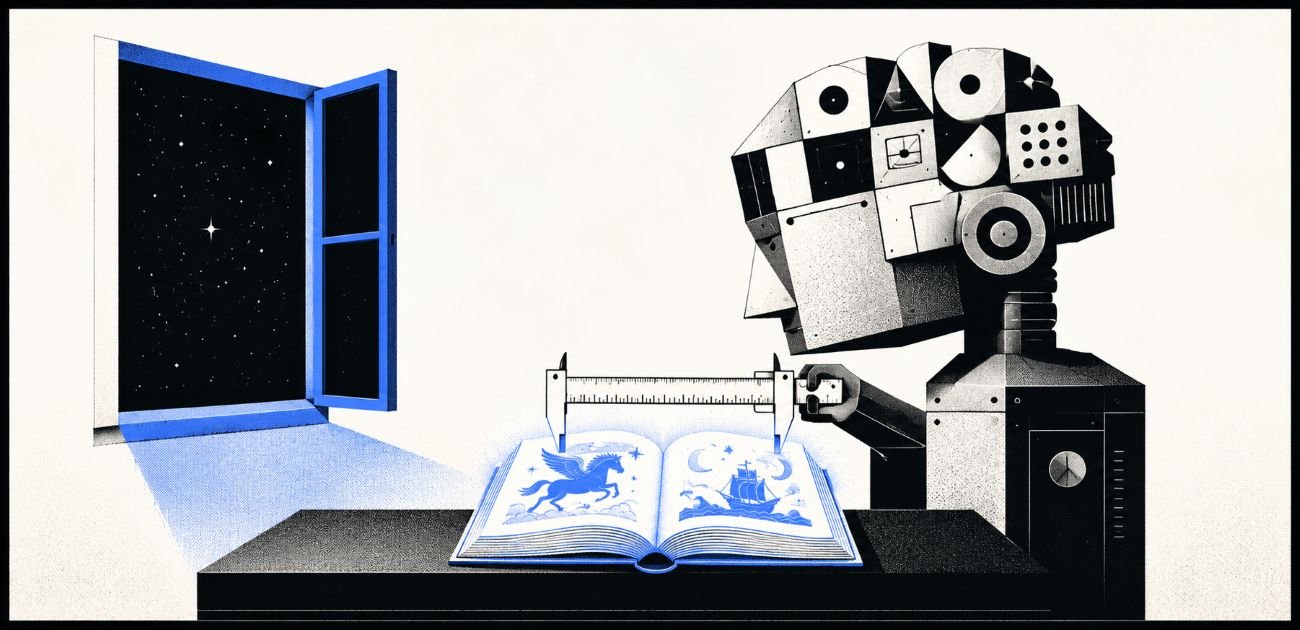
Lede
The modern clever mind can solve the equation, then stand helpless in front of a joke, a myth, or a soul trying to speak in symbols.
Words used
- AGI: artificial general intelligence, a proposed machine intelligence able to handle many kinds of human-level tasks.
- ASI: artificial superintelligence, a theoretical intelligence far beyond human ability.
- Myth: a symbolic story used to carry meaning, not a lab report wearing a toga.
Hermit Off Script
The capability to understand abstract concepts is not one thing. There are clever people who understand logic, equations, physics, models, theories and the visible machinery of the world, but somehow miss the point of a simple joke or dark humour. They can follow the maths, but not the wink. Then there are people who see meaning inside myths, tales, symbols and beliefs that are not grounded in direct logic, but still point towards patterns later found in mathematics, physics, psychology, art and human life. The first class wants the idea to be real, tangible and testable before it can breathe. Fair enough. That is how science built its house. It is also why atheism feels clean and safe to many people, because if something cannot be weighed, measured, photographed or forced into a graph, it is treated like a drunk ghost at a faculty meeting. The second class is closer to the strange line of thinkers and scientists who imagined theories before the tools existed to prove them. Newton, Einstein, Planck, Heisenberg, Schrodinger, Dirac, Bohr and others did not wait for the world to be fully ready before thinking past it. They used logic, yes, but also imagination, instinct, symbolic vision and the courage to look absurd for a while. Then there is a much smaller class, too small to make a tidy category, that seems grounded in both: logic and abstract feeling, proof and vision, science and the unseen. This is where new religions, new beliefs, new art and new theories often begin. Not as final truth, but as an opening. That is why I look at AGI and ASI with caution. It may produce discoveries from what humanity has already fed into it, and that is still powerful. But something completely new, like a first doorway into physics, quantum theory, art, or spiritual language, may need more than trained memory rearranged at speed. The people who created religions, or inspired them, often worked from the same root as science, but aimed at forces that could not be tested by the tools of their time. So they used myths, analogies and parables to describe worlds beyond direct physical proof, things felt through soul rather than instrument. Maybe, very far in the future, even those unseen worlds will become visible through vibrations, if the right environment is ever created to reveal them. Until then, the spreadsheet can keep its shoes on before entering the temple.
The long road from clockwork to the unseen
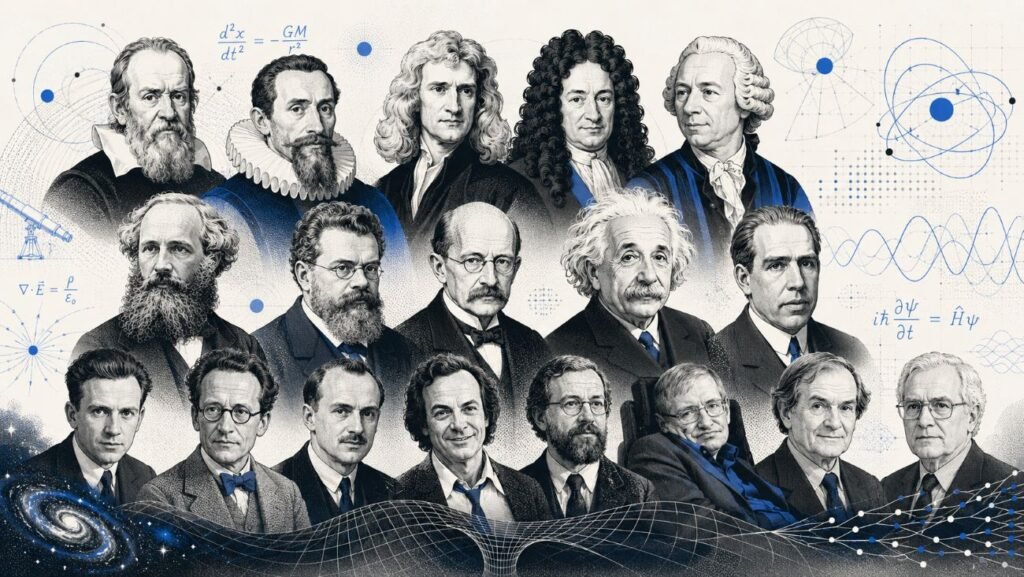
The strange part is that physics did not move from simple logic to final certainty. It moved from visible motion to invisible structure, then to equations describing things no human eye can hold. Galileo, Kepler, Newton, Leibniz, Euler, Lagrange, Hamilton, Fourier, Faraday, Maxwell and Boltzmann built the older house: motion, gravity, calculus, fields, waves, heat, probability and the mathematical language of nature. Newton gave physics its early grammar. Maxwell turned electricity, magnetism and light into one joined theory. Boltzmann pulled probability into matter itself, which must have annoyed every tidy mind that wanted reality to behave like a well-trained clerk.
Then came the second rupture. Einstein did not simply polish Newton. In 1905 he treated light as quanta in his work on the photoelectric effect, and in 1915 he finished general relativity, where gravity became the geometry of spacetime rather than a force pulling strings from backstage. Planck opened the quantum door in 1900 with energy quanta. Bohr, de Broglie, Pauli, Heisenberg, Born, Jordan, Schrödinger, Dirac and von Neumann then turned the door into a corridor. Particles became waves, waves became probabilities, observation became a problem, and common sense was quietly asked to wait outside with a numbered ticket. Planck won the 1918 Nobel Prize for energy quanta; Einstein won the 1921 prize for the photoelectric effect; Bohr won the 1922 prize for atomic structure; Dirac’s 1928 work joined quantum mechanics to relativity and predicted the positron. [Nobel Prize]
After that came the builders of quantum field theory and the Standard Model: Fermi, Pauli, Dirac, Tomonaga, Schwinger, Feynman, Dyson, Yang, Mills, Gell-Mann, Glashow, Salam, Weinberg, Higgs, Englert and many others. This is where particles became excitations of fields, forces became gauge theories, and the universe started to look less like a collection of little billiard balls and more like a disciplined hallucination written in mathematics. The Higgs field was proposed in 1964 and the Higgs boson was confirmed at CERN in 2012, which is a polite way of saying that some ideas wait nearly half a century before the machine catches up. [CERN]
Then the argument became even stranger. John Bell challenged the comfort of hidden variables. Aspect, Clauser and Zeilinger tested quantum entanglement, work recognised by the 2022 Nobel Prize. Everett proposed the many-worlds interpretation in 1957, later pushed into wider discussion by Wheeler, DeWitt and Deutsch. Guth and Linde made inflation and eternal inflation part of serious cosmological debate. Penrose and Hawking pulled black holes, singularities and quantum gravity into the same storm. String theory, pushed by Veneziano, Nambu, Susskind, Green, Schwarz, Witten and others, tries to join quantum mechanics with general relativity. Loop quantum gravity, linked with Ashtekar, Rovelli and Smolin, takes another route. None of this is a finished theory of everything. It is more like humanity knocking on several locked doors while pretending it definitely knows which one leads to the kitchen. [Nobel Prize] [Stanford Encyclopedia] [Britannica]
And that is the point. The people who moved physics forward were not only calculators with good posture. They were mathematicians, physicists, experimenters and strange thinkers willing to follow symbols into places where proof had not yet arrived. Some were religious, some agnostic, some atheist, some carefully silent. But the work itself shows the same pattern: first vision, then equation, then argument, then experiment, then a textbook pretends it was obvious all along. Even in 2025, the Nobel Prize in Physics went to John Clarke, Michel H. Devoret and John M. Martinis for macroscopic quantum tunnelling and energy quantisation in an electric circuit, which means the old quantum ghost is still walking into bigger rooms. [Nobel Prize]
What does not make sense
- Some people trust abstract mathematics, but panic when abstract meaning arrives wearing a myth.
- A theory is treated as genius once a machine confirms it, but as nonsense while it is still waiting for the machine.
- A joke can fail in the hands of someone clever enough to calculate a star, which should worry the star.
- AI is praised for pattern recognition, then quietly expected to become a prophet with a server bill.
- Religion is mocked for using symbols, while science uses models, metaphors and invisible forces every day.
- The real problem is not logic. The problem is logic acting like it owns every door in the house.
Sense check / The numbers
- Newton’s Principia was published by the Royal Society in 1687, giving mathematical form to gravity and motion before modern physics had its later machinery. [Royal Society]
- Max Planck introduced the theory of quanta in 1900, a move the Nobel Prize describes as the basis of radiation having specific energies set by a new constant. [Nobel Prize]
- The Higgs field was proposed in 1964, while CERN confirmed the Higgs boson discovery in 2012, which is a 48-year wait between theory and experimental confirmation. [CERN]
- LIGO announced the first direct detection of gravitational waves on 11 February 2016, confirming a major prediction from Einstein’s 1915 general theory of relativity. [LIGO]
- Stanford HAI reported that 78 per cent of organisations used AI in 2024, up from 55 per cent the previous year, while generative AI drew $33.9 billion in private investment, up 18.7 per cent from 2023. [Stanford HAI]
The sketch
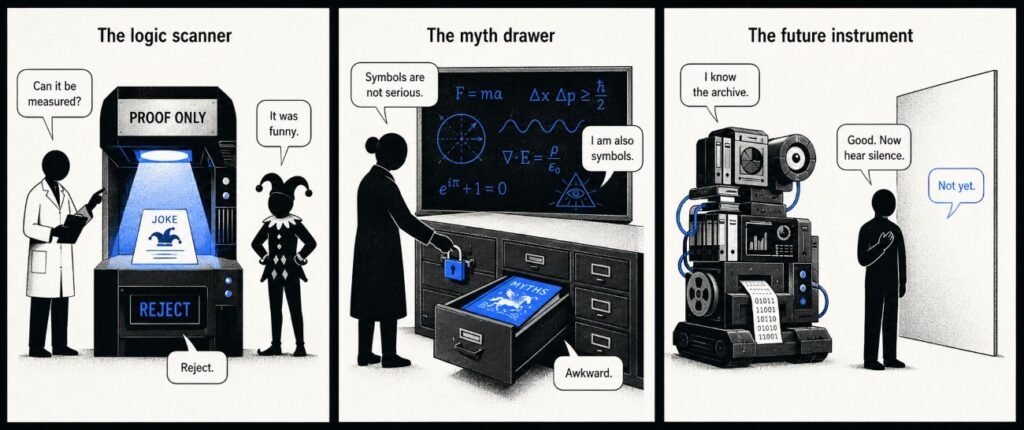
Scene 1: The logic scanner
A person in a white coat holds a joke under a huge scanner labelled “PROOF ONLY”. A small jester waits beside the machine.
Dialogue:
Scientist: “Can it be measured?”
Jester: “It was funny.”
Scanner: “Reject.”
Scene 2: The myth drawer
A librarian locks a book of myths in a drawer while a blackboard behind them shows equations about invisible forces.
Dialogue:
Librarian: “Symbols are not serious.”
Blackboard: “I am also symbols.”
Drawer: “Awkward.”
Scene 3: The future instrument
A machine made of books, wires and old data points at a blank wall. A quiet figure listens with one hand near the heart.
Dialogue:
Machine: “I know the archive.”
Figure: “Good. Now hear silence.”
Wall: “Not yet.”
What to watch, not the show
- Education systems that reward correct answers but punish strange questions.
- AI hype that confuses speed with original vision.
- Scientific culture when it forgets how many theories began as uncomfortable imagination.
- Religious language when power turns metaphor into control.
- Platform culture that flattens mystery into content and content into metrics.
- The fear of being wrong, because every new path looks foolish before it has a road sign.
- The old habit of treating the soul as childish until physics finds a more expensive word for wonder.
The Hermit take
Logic is a fine lamp. It is not the sun.
Keep the equation. Leave one window open for the unseen.
Keep or toss
Keep / Toss.
Keep logic, proof and serious science.
Toss the arrogance that thinks meaning must ask permission from a calculator.
Sources
- Royal Society history: https://royalsociety.org/about-us/who-we-are/history/
- Nobel Prize, Max Planck facts: https://www.nobelprize.org/prizes/physics/1918/planck/facts/
- CERN, the Higgs boson: https://home.cern/science/physics/the-higgs-boson/
- LIGO gravitational waves announcement: https://www.ligo.caltech.edu/news/ligo20160211
- Stanford HAI, 2025 AI Index Report: https://hai.stanford.edu/ai-index/2025-ai-index-report
- Google Cloud, AGI definition: https://cloud.google.com/discover/what-is-artificial-general-intelligence
- IBM, artificial superintelligence: https://www.ibm.com/think/topics/artificial-superintelligence
- Nobel Prize, Max Planck facts: https://www.nobelprize.org/prizes/physics/1918/planck/facts/
- Nobel Prize, Albert Einstein 1921 summary: https://www.nobelprize.org/prizes/physics/1921/summary/
- Nobel Prize, Niels Bohr facts: https://www.nobelprize.org/prizes/physics/1922/bohr/facts/
- Nobel Prize, Paul Dirac facts: https://www.nobelprize.org/prizes/physics/1933/dirac/facts/
- CERN, the Higgs boson: https://home.cern/science/physics/the-higgs-boson/
- Stanford Encyclopedia, Many-Worlds Interpretation: https://plato.stanford.edu/entries/qm-manyworlds/
- Britannica, string theory: https://www.britannica.com/science/string-theory
- Nobel Prize, Physics 2025 press release: https://www.nobelprize.org/prizes/physics/2025/press-release/