
Lede
Europe discovered that a border can fail in hours, while its politicians can turn the failure into campaign material in minutes.
Hermit Off Script
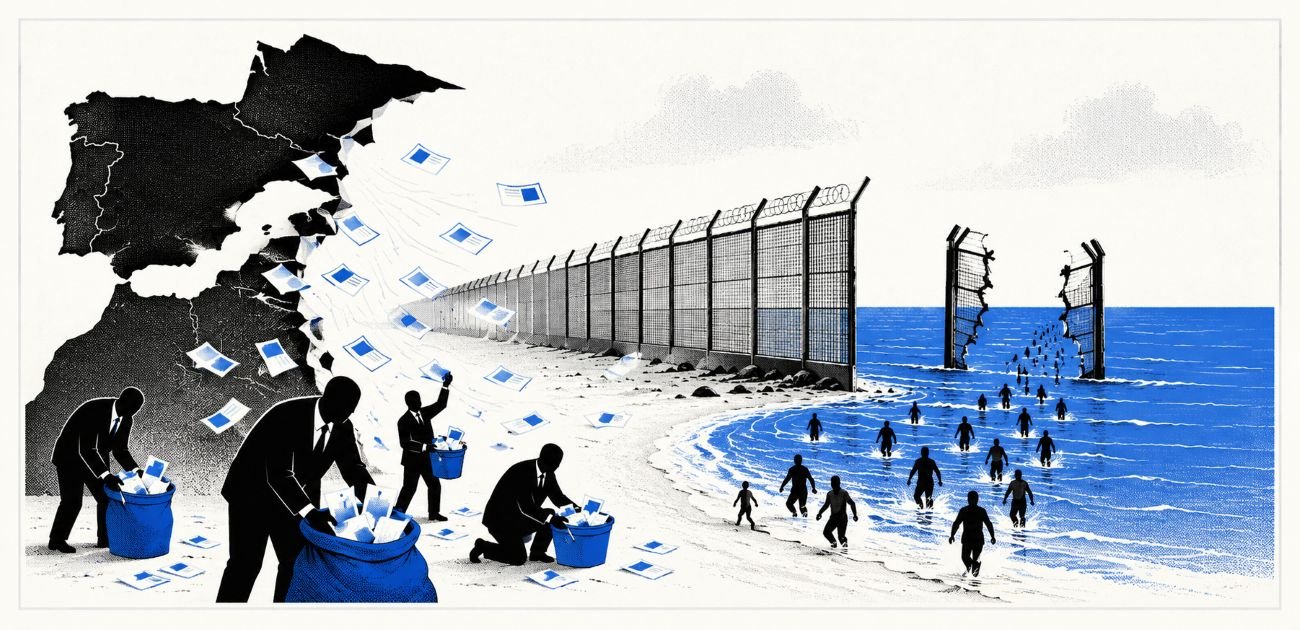
Ceuta looked like a scene from a disaster film, except the bodies were real and nobody could leave the cinema. Spain says about 50,000 people crossed from Morocco; Ceuta’s president put the number as high as 60,000. In the past, images of a border collapsing belonged mainly to war footage. This time, tens of thousands of people seeking a way into Europe moved across land and sea while a modern border simply stopped functioning. It was a mass unauthorised breach of Spanish territory, and pretending the scale doesn’t matter is how public trust gets buried under polite vocabulary. I can feel empathy for people who want safety, work and a better future. I can also remember that people already living in Spain and across the rest of Europe want those things too. Their housing, wages, schools, hospitals and sense of order aren’t hateful little luxuries. Compassion that asks nothing of government except an open gate becomes administrative surrender wearing a humanitarian badge. When rules fail at this scale, far-right parties don’t need to invent a story. Governments hand them the pictures, the fear and the campaign slogan. Then mainstream parties act surprised when frightened voters move towards whoever promises a padlock, even if that padlock comes attached to a wrecking ball. Britain has already shown how the slogan of control can create more paperwork without solving migration. Migration will happen. The real scandal is that governments still treat border control, asylum screening, legal routes, reception capacity and lawful returns as five separate meetings in five separate buildings. This is another version of Europe’s problem with divided authority: the crisis crosses borders while responsibility remains trapped inside national offices. Spain had fences, surveillance, police and the EU’s new migration rules, yet tens of thousands reached Ceuta before the system caught up. More than 48,000 returned to Morocco within 48 hours, proving that control was possible after the breach. Applying it before thousands entered the water would have been a useful refinement. I want the border of every sovereign country to be as close to foolproof as a democratic state can make it: monitored, staffed, intelligence-led and backed by rapid legal decisions. It cannot be sealed against genuine asylum claims, because law and basic humanity still exist. It can reject the idea that a mass crossing creates its own permission. Migration will continue. Chaos doesn’t have to. A government that refuses to control entry doesn’t abolish the border; it hires the far right to redraw it.
What does not make sense
- The FT headline turns two disputed details into one firm sentence: 60,000 was Ceuta’s upper estimate, Spain’s figure was about 50,000, and crossings happened by land and sea rather than through one enormous swimming gala.
- The FT says people spent days preparing, while Spain’s interior minister said there was no intelligence warning of a mass entry. Apparently tens of thousands could see the plan except the people paid to see the plan.
- A heavily guarded frontier had fences and cameras, then discovered that the sea beside the fence was also part of the frontier.
- Spain installed a 500-metre floating barrier after the mass crossing had stopped and most of the people had returned. The stable door has entered its maritime period.
- Politicians blamed Spain’s regularisation programme even though arrivals on 30 and 31 July could not qualify for a scheme requiring residence before 1 January 2026.
- Italy punished travel from Spain despite Ceuta already having identity checks that stopped unauthorised onward movement to mainland Spain and the wider Schengen zone.
- Empathy and enforcement are sold as rival products, although a humane system needs both or it becomes either chaos with good intentions or cruelty with paperwork.
Sense check / The numbers
- Spain’s Interior Ministry estimated about 50,000 crossings. Ceuta’s president gave an upper estimate of 60,000, which became the FT headline. [Reuters; FT]
- More than 48,000 people returned to Morocco within 48 hours, according to Spain. The initial breach was enormous, but it did not become 48,000 onward journeys across Europe. [Reuters]
- At least 67 bodies were recovered on the Spanish side after drownings and crushes at the breakwater and fence. Border failure is not an abstract debate when the receipt is a morgue. [Reuters]
- Ceuta had 83,567 residents on 1 January 2025. The upper estimate of 60,000 crossings was equivalent to nearly 72 per cent of that population, before most returned. [INE]
- The new floating barrier is 500 metres long, stands 30 to 70 centimetres above the water and reaches up to 1 metre below it. Spain found the missing section of its border after the emergency. [Reuters]
The sketch
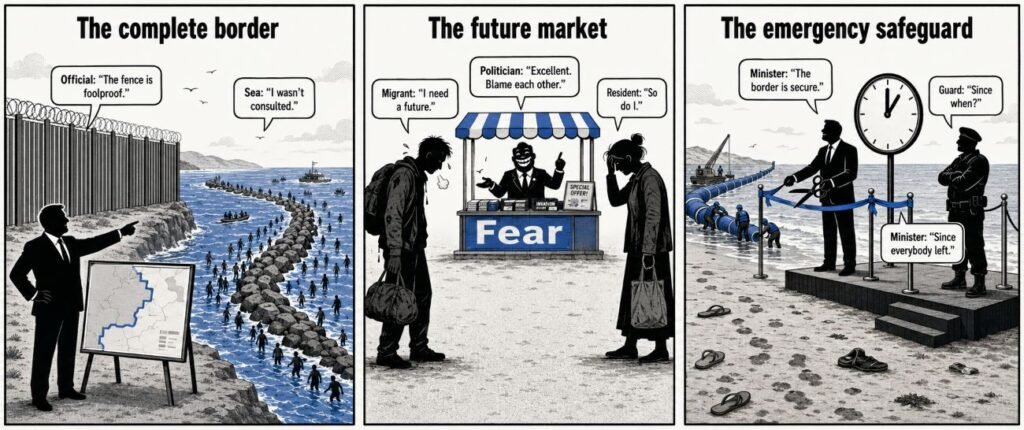
Scene 1: The complete border
A tall border fence ends at the water while thousands of silhouettes move around the breakwater. An official points proudly at a map.
Dialogue:
Official: “The fence is foolproof.”
Sea: “I wasn’t consulted.”
Scene 2: The future market
An exhausted migrant and a worried resident face each other while a politician stands behind a stall labelled “Fear”.
Dialogue:
Migrant: “I need a future.”
Resident: “So do I.”
Politician: “Excellent. Blame each other.”
Scene 3: The emergency safeguard
Workers install a floating barrier after the beach has emptied. A minister cuts a ribbon beside a clock.
Dialogue:
Minister: “The border is secure.”
Guard: “Since when?”
Minister: “Since everybody left.”
What to watch, not the show
- Whether evidence shows that Morocco deliberately loosened control or simply failed to contain the rush. Spain called Morocco a reliable partner; witnesses and analysts have raised questions. Suspicion is not proof.
- Whether investigators can trace the viral videos and false claims about the Spanish Supreme Court ruling to organised smuggling networks, opportunistic accounts or both.
- Whether the 500-metre floating barrier stops crossings or merely moves them towards a longer and deadlier route.
- Whether Spain applies rapid screening and returns under the EU Migration and Asylum Pact while preserving individual asylum claims and the ban on collective expulsion.
- Whether Ceuta receives enough staff, shelter and supplies for a surge instead of another folder marked “emergency”.
- Whether parties keep blaming the regularisation scheme after the eligibility dates have disproved the easy slogan.
- Whether European governments invest in legal work routes, readmission agreements and early intelligence, or wait for the next viral video to write policy for them.
The Hermit take
Empathy without control feeds chaos; control without humanity feeds cruelty.
A lawful border should stop mass entry, screen genuine claims and return those with no right to remain.
Keep or toss
Keep / Toss
Keep empathy, lawful asylum and controlled entry.
Toss unmanaged crossings and the politicians who discover borders only after they collapse.
Sources
- Financial Times article: https://www.ft.com/content/7c487af9-53a2-4088-bf14-1f2deb4247e9
- Reuters on the final crossing estimates and returns: https://www.reuters.com/world/africa/spain-morocco-halt-deadly-rush-spanish-enclave-after-49000-cross-day-2026-07-31/
- Reuters on the death toll and floating barrier: https://www.reuters.com/world/europe/spain-installs-floating-barrier-ceuta-after-calm-night-following-border-rush-2026-08-01/
- Reuters on social media rumours and economic hardship: https://www.reuters.com/world/europe/social-media-rumours-economic-hardship-fuel-migrant-surge-into-ceuta-2026-07-31/
- AP fact check on the regularisation claim and Morocco: https://apnews.com/article/spain-migration-ceuta-morocco-facts-50baa964ecfb07a2d19223d7ec375b91
- INE, Spain in Figures 2026: https://www.ine.es/en/prodyser/espa_cifras/EEC_FULL_PUBLICATION_26.pdf
- European Commission on the EU Migration and Asylum Pact: https://home-affairs.ec.europa.eu/policies/migration-and-asylum/pact-migration-and-asylum_en
- EU Charter of Fundamental Rights, Articles 18 and 19: https://eur-lex.europa.eu/legal-content/EN/TXT/HTML/?uri=CELEX:12012P/TXT
One response
[…] Update – 2 August 2026The Ceuta border crisis exposed a similar failure of divided authority: one emergency crossed the border while policing, asylum rules and political responsibility […]