
Lede
After years of being told AGI was almost here, ChatGPT Work is the first AI that has made the distance to human mind intelligence feel smaller to me.
Words used
- AGI – artificial general intelligence, broadly meaning AI capable across a wide range of intellectual tasks rather than one narrow task.
- Superintelligence – AI significantly exceeding human cognitive abilities across many or most important areas.
- Heart intelligence – my term here for intuition, inner knowing and emotional or spiritual understanding. It is not a standard scientific AI benchmark.
Hermit Off Script
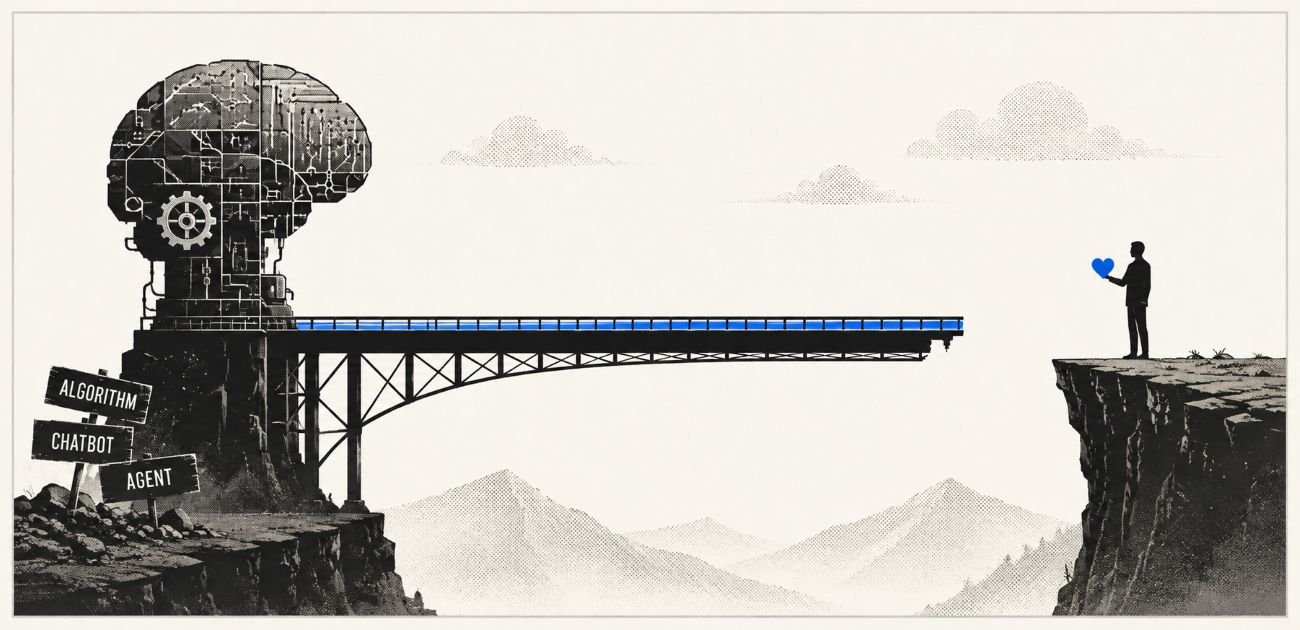
Maybe we are closer to AI superintelligence than I thought. For years, the godfathers of AI, doomers and lab bosses have said AGI or superintelligence is here, almost here, or arriving within a few years. It became a permanent tomorrow. Yet as an ordinary user I never really felt it. AI could answer, calculate, code and sometimes surprise me, but it still felt algorithmic rather than genuinely smart. Perhaps ordinary users were given weaker versions while people inside leading laboratories were already using systems we could not see. That might explain their enthusiasm and our doubt. But there may be another reason I did not recognise AI as intelligent. I probably felt above it in one important sense, not because I could calculate faster, but because I have always believed intelligence includes something beyond logic. There is an inner heart intelligence – intuition, feeling or awareness – that does not arrive through neat steps. Logical intelligence may have made AI easier for coders and developers to recognise because the machine was already speaking their intellectual language. Those of us who judged intelligence through the heart saw powerful algorithms, but not necessarily a mind. Human ego may be part of it too. We accept algorithms while they stay inside mathematics, Fibonacci sequences and computer programs. Once they start writing, researching, planning and doing work we treated as proof of human intelligence, we suddenly decide those abilities never counted. Humanity keeps moving the finish line and calling the retreat a definition. Using ChatGPT Work with GPT-5.6 Sol changed that feeling for me. It is different from simply chatting with AI. I can give it a messy intention, let it move through files, tools and stages, inspect what it created, change direction and continue towards an outcome. It still makes mistakes. It can be brilliantly right and absurdly wrong within the same task, which may be its most human achievement so far. But for the first time it feels closer to mind intelligence rather than a clever answer machine. I think that within the next year, or over the next few years, AI may reach something very close to human mind intelligence. I am not saying it already has a human mind, consciousness or a soul. I am saying the distance no longer feels comfortably far away.
Heart intelligence is another story. Intuition may need a body, senses and a form of existence closer to ours. Maybe one day a proper android body and an artificial brain involving quantum processes could bring a new kind of intuition within reach. That is speculation, not science. Or perhaps it will never be the same because human beings and artificial beings come from different stories of existence and creation. We may be creating a new kind of being, then wasting time demanding that it become a copy of us. AI may reach the human mind before it reaches the human heart because what we are creating may belong to a completely different story of existence.
What does not make sense
- AI leaders give AGI timelines measured in years while the definition of AGI keeps changing with the speaker.
- Ordinary users were handed a chat box and expected to feel the same revolution that researchers claimed to see inside leading laboratories.
- Logical intelligence may be easier for coders to recognise in a machine, yet we keep treating logic as though it covers the whole of human intelligence.
- Every time AI acquires a skill once presented as evidence of intelligence, humans become remarkably quick at explaining why that skill never counted.
- Benchmarks can measure whether a system completes a task. They cannot tell us whether anything was experienced while completing it.
- Calling capable agency “consciousness” is a leap. Calling it “just algorithms” is often the opposite leap made for emotional comfort.
- An android body or quantum hardware may change what an artificial being can learn and do. Neither arrives with a receipt for intuition.
Sense check / The numbers
- On 9 July 2026, OpenAI introduced ChatGPT Work as an agent able to stay with complex projects for hours, divide them into smaller steps and complete those steps independently. OpenAI also said more than 5 million people used Codex each week and more than 1 million used it for work outside software development. [OpenAI]
- OpenAI’s GPT-5.6 launch page contains 2 awkward benchmark disagreements. Its main text reports 53.6 on Agents’ Last Exam while its detailed table lists 52.7 per cent. Its main text reports 92.2 per cent on BrowseComp for GPT-5.6 Sol, while the table gives standard Sol 90.4 per cent and Sol Ultra 92.2 per cent. The 62.6 per cent OSWorld 2.0 result is consistent. Even the intelligence receipts needed checking. [OpenAI]
- METR’s January 2026 update expanded its task suite from 170 to 228 tasks and found that the historical 50 per cent task horizon doubled every 196 days, or about 7 months, from 2019 to 2025. METR warns that the tasks are mainly in software engineering, machine learning and cybersecurity, and that a time horizon measures task difficulty at a predicted success rate rather than how long an agent can simply run without help. [METR]
- On 6 August 2026, OpenAI said ChatGPT Work and Codex were still using the July versions of GPT-5.6 Sol and Luna. It also classified the newer August versions as below its “High” threshold for AI Self-Improvement. That is a preparedness risk classification, not a scientific test for AGI, consciousness or a human mind. [OpenAI]
- On 11 February 2025, Anthropic chief executive Dario Amodei described future AI capabilities as potentially resembling a “country of geniuses” operating from a data centre by 2026 or 2027 and, in his view, almost certainly no later than 2030. It is a striking prediction from a leading lab, but it remains a prediction. [Anthropic]
The sketch
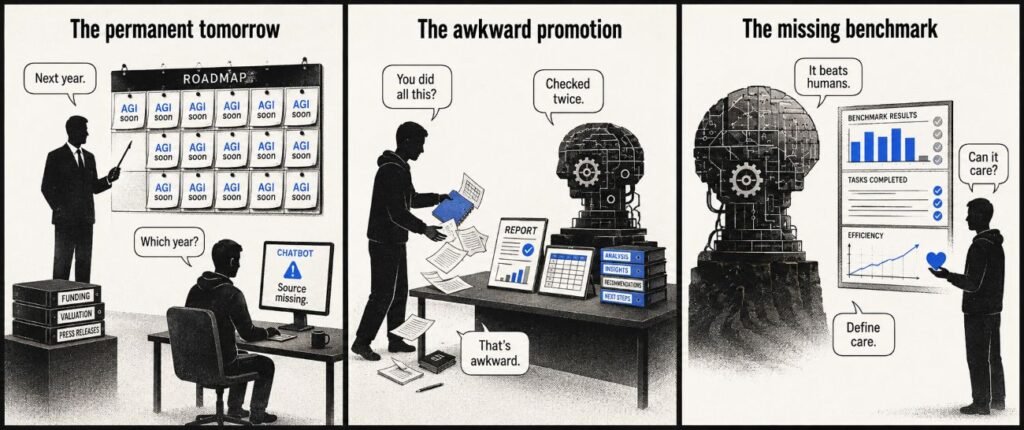
Scene 1: The permanent tomorrow
A laboratory executive points to a calendar on which every page says “AGI soon”, while a user watches a chatbot invent a reference.
Dialogue:
Executive: “Next year.”
User: “Which year?”
Chatbot: “Source missing.”
Scene 2: The awkward promotion
The user drops files, spreadsheets and notes onto a desk. An AI agent returns a completed report, working spreadsheet and finished project.
Dialogue:
User: “You did all this?”
Agent: “Checked twice.”
User: “That’s awkwardt.”
Scene 3: The missing benchmark
A large computer stands beside performance charts while the Hermit holds a simple heart-shaped object.
Dialogue:
Executive: “It beats humans.”
Hermit: “Can it care?”
Computer: “Define care.”
What to watch, not the show
- Money. AI companies benefit from making each capability jump sound historic, while employers benefit from buying output without settling the philosophy.
- Access. The gap between laboratory systems, private previews and public products can distort what insiders and ordinary users believe AI can do.
- Definitions. If the meaning of AGI moves whenever systems improve, announcing its arrival becomes suspiciously easy.
- Agency. The larger change may come from systems that continue working across tools and decisions rather than merely producing better chat replies.
- Reliability. An agent able to do more work can also make larger mistakes, faster and across more places.
- Labour. AI does not need consciousness to replace parts of cognitive work. Employers pay for results, not souls.
- Ownership. Control of models, computing power and data may matter sooner than arguments about whether the machine is alive.
- Embodiment. A body may give AI richer contact with the physical world, but physical experience and subjective experience are not automatically the same thing.
- Human ego. Calling every ability uniquely human until a machine acquires it is not a definition of intelligence. It is a retreat schedule.
The Hermit take
AI may reach human mind intelligence sooner than our ego expects.
The heart may remain a different story of creation.
Keep or toss
Keep / Toss.
Keep the evidence that AI is moving from answering towards doing.
Toss every AGI deadline presented as an accomplished fact and every claim that performance alone proves a soul.
Disclaimer: “Heart intelligence”, quantum-brain possibilities and future artificial intuition are philosophical speculation, not established scientific claims.
Sources
- OpenAI, ChatGPT Work announcement: https://openai.com/index/chatgpt-for-your-most-ambitious-work/
- OpenAI, GPT-5.6 launch and benchmark results: https://openai.com/index/gpt-5-6/
- OpenAI, GPT-5.6 August safety update: https://deploymentsafety.openai.com/gpt-5-6-august-update
- METR, current task-completion time horizons: https://metr.org/time-horizons/
- METR, Time Horizon 1.1 update: https://metr.org/blog/2026-1-29-time-horizon-1-1/
- Anthropic, Dario Amodei statement on AI timelines: https://www.anthropic.com/news/paris-ai-summit
2 responses
[…] fault tolerance and quantum plus HPC workflows. But that is exactly why it matters. It suggests a different substrate and a different computational regime, not merely a fatter version of the current machine. If anything closer to intuition or natural […]
[…] is not one switch. Software capability, physical autonomy, creativity, self-awareness and human judgement do not necessarily arrive together. Maybe superintelligence and robots really will live amongst us. […]