
Lede
In 1381, the people feeding England rebelled against the people ruling it, while the crown briefly discovered sympathy before returning to its usual business.
Hermit Off Script
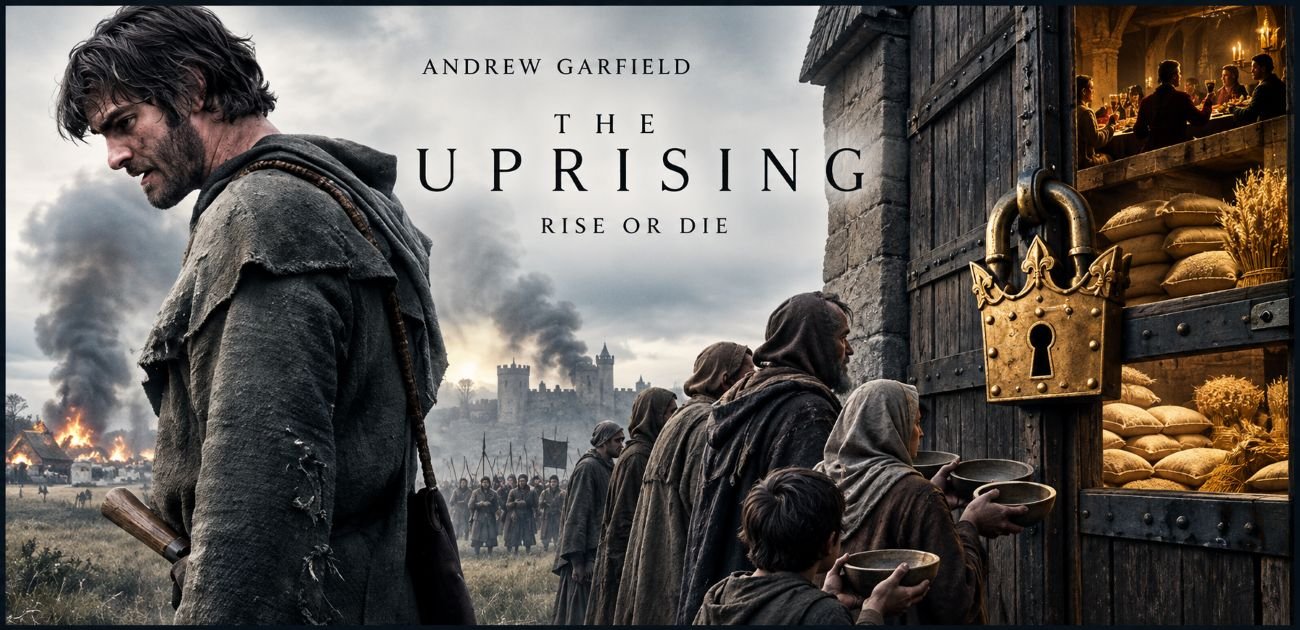
The Uprising takes me back to a time when the rich could squeeze the poor so hard that hunger, misery and desperation eventually turned into rebellion. I rather enjoyed this return to history, although “enjoyed” sounds slightly inappropriate when watching people struggle for something as basic as the right to live. But that’s what makes films like this interesting to me. Behind all the swords, castles and royal costumes, the problem is painfully simple: the people doing the hardest work were expected to survive on whatever the powerful decided to leave them.
And when the poor finally had enough, they were suddenly the troublemakers. Apparently, being hungry was acceptable, but complaining about it was becoming a national security problem. I find that extraordinary. People were expected to work, pay taxes, obey their lords and remain grateful for the privilege of being alive. At some point, even medieval patience had its limits.
What annoyed me most was the familiar hope that perhaps the king would understand. Surely, when he saw how badly ordinary people were suffering, he might take their side. What a lovely thought. For a brief moment, the crown could appear reasonable, even sympathetic. Then reality returned. The royal establishment was never particularly enthusiastic about surrendering the privileges that kept it comfortable. I sometimes wonder how many centuries humanity needs to learn that people holding power rarely volunteer to give it away.
But what I genuinely admire is the effort behind films that recreate the distant past. The further back a story goes, the harder it becomes to reconstruct the streets, houses, clothing, tools, ordinary routines and conditions of daily life. A modern city is available outside the studio. Fourteenth-century England requires rather more imagination, research and mud. I enjoy seeing those lost worlds brought back, especially when the result makes me think about how people actually lived instead of merely admiring another castle.
Andrew Garfield also helped me connect with the story. I already know him as a renown actor, and that familiarity makes it easier for me to settle into the character and follow his struggle. That doesn’t mean an unknown actor couldn’t have done an equally good job. Sometimes a familiar face simply opens the door to an unfamiliar century.
And that is the contrast I take away from The Uprising: nearly seven centuries ago, the poor had to fight for the right to survive, while the rich already possessed the right to rule.
THE UPRISING – Official Trailer
Movie synopsis
Set during the English Peasants’ Revolt of 1381, The Uprising follows a fictional ploughman played by Andrew Garfield in a country devastated by plague, warfare, oppressive taxation and social inequality. Personal loss and growing injustice draw him into a rebellion against the government of the young King Richard II.
His struggle becomes part of a wider movement involving historical figures such as Wat Tyler and the radical preacher John Ball. As ordinary people organise and march towards London, the rebels confront the royal establishment and demand a fairer society.
Paul Greengrass blends the documented rebellion with fictional storytelling and elements associated with the Robin Hood legend.
Cast and credits
Director: Paul Greengrass
Writers: Paul Greengrass
Genre: Historical drama, action, war
Main cast:
- Andrew Garfield – Ploughman
- Cosmo Jarvis – Wat Tyler
- Jamie Bell – John Ball
- Woody Norman – King Richard II
- Tom Hollander – Treasurer Robert Hales
- Stephen Dillane – Archbishop Sudbury
- Katherine Waterston – Joan of Kent
- Thomasin McKenzie – Alyce
- Jonny Lee Miller – Mayor William Walworth
Composer: Volker Bertelmann
Production company/studio: Thank You Pictures and Supernix, with Paul Greengrass and Jason Blum among the producers. UK distribution by Entertainment Film Distributors.
Runtime: 128 minutes
Release year and platform: 2026. Released theatrically in the United States on 11 September and in UK cinemas on 9 October 2026. UK streaming availability was not confirmed at the time of writing.
What does not make sense
- The people producing the food were among those struggling to survive, while the people controlling land and taxation expected everyone to appreciate the arrangement. Medieval economics had a rather selective definition of gratitude.
- After the Black Death reduced the workforce, labour became more valuable. Instead of allowing workers to benefit freely from that shortage, the authorities tried to restrain wages. Apparently, supply and demand was perfectly respectable until it started favouring the wrong people.
- The government needed money for war and expected ordinary households to pay, even though a few extra pence could mean something very different to a labourer and a wealthy landowner.
- The king could offer concessions when confronted by thousands of rebels, but those promises did not survive the restoration of royal control. A royal promise apparently came with terms and conditions that the peasants hadn’t been allowed to read.
- The rebellion involved genuine grievances about exploitation, freedom and taxation. Yet the historical violence also struck people who were not responsible for those injustices. A just cause does not make every act committed in its name just.
- The film uses a fictional Ploughman as its central hero even though the rebellion already had real leaders, including Wat Tyler and John Ball. Hollywood apparently felt an entire uprising still needed one more leading man.
- The filmmakers work to recreate an England almost 650 years old, yet the social hierarchy feels depressingly recognisable. The buildings have changed considerably. The excuses have aged rather well.
Sense check / The numbers
- The revolt took place in 1381, under a 14-year-old king. Richard II had inherited the throne in 1377 at the age of 10. During the uprising, royal government was heavily influenced by experienced councillors and powerful nobles. His youth matters when judging how royal decisions were made, but it did not spare the rebels from the consequences. [Royal Family; National Archives]
- The government approved 3 poll taxes between 1377 and 1380. The first charged 4 pence per liable person. The final grant established an average assessment of 12 pence, with provisions for wealthier people to help poorer neighbours. The collection of that final tax in 1381 helped trigger the revolt. It was a tax dispute rooted in wider economic and political grievances, not simply a spontaneous shortage of bread. [National Archives]
- Wage restrictions dated back to 1351, some 30 years before the revolt. After the Black Death of 1348-49 reduced the population, labour shortages strengthened workers’ bargaining power. The authorities attempted to restrain rising wages through legislation. The conflict was therefore also about who controlled the value of work. [London Museum]
- Between 11 and 15 June 1381, the rebellion reached London’s centres of power. Richard II met the rebels and offered concessions, including relief from serfdom. Wat Tyler was killed at Smithfield on 15 June. The rebellion was suppressed, the promised freedoms were not delivered, and the king’s concessions were subsequently withdrawn. The Royal Family’s account says Richard was pressed by his council to revoke the pardons. [London Museum; Royal Family; Historic Royal Palaces]
- The film lasts 128 minutes and was released in UK cinemas on 9 October 2026. Andrew Garfield portrays an invented character rather than Wat Tyler, who is played by Cosmo Jarvis. The historical revolt is real, but its central cinematic journey is a dramatisation. A film’s period detail can be convincing without every character or event being historical. [BBFC; Cineworld; Guardian]
The sketch
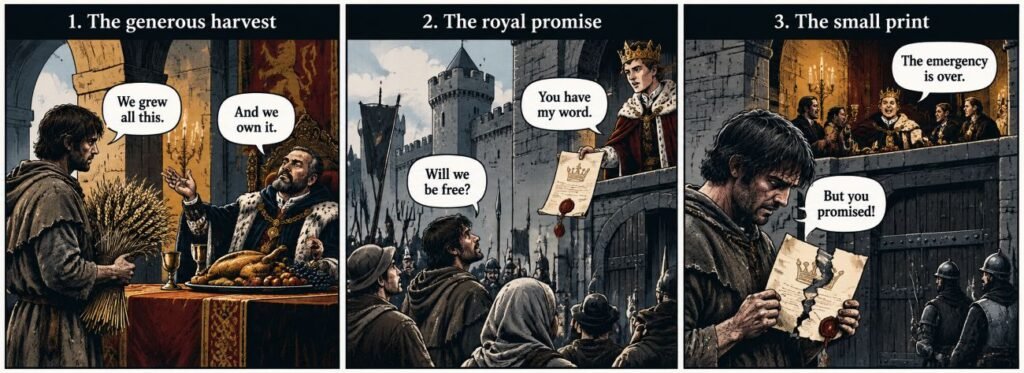
Scene 1: The generous harvest
A medieval noble sits beside a banquet table piled with food. A thin farmer stands before him holding a basket of wheat and an empty bowl.
Dialogue:
Farmer: “We grew all this.”
Noble: “And we own it.”
Scene 2: The royal promise
The same farmer stands with other rebels outside a castle. A young king extends a document bearing a royal seal through the castle gate.
Dialogue:
Farmer: “Will we be free?”
King: “You have my word.”
Scene 3: The small print
The same farmer holds a torn royal document outside the castle. Above him, the king sits comfortably at a banquet table while a guard closes the gate.
Dialogue:
Farmer: “But you promised!”
King: “The emergency is over.”
What to watch, not the show
- The price of labour. Medieval wage restrictions show how authorities could intervene when workers gained bargaining power. The gap between pay and survival remains a useful question when examining modern employment.
- Who gets protected. The revolt exposed the imbalance between people subject to the law and people able to shape or enforce it. The same question about authority failing ordinary citizens runs through other historical dramas, including By Any Means.
- The distribution of sacrifice. When governments or employers face financial pressure, which groups are expected to accept less, work harder or shoulder greater risk?
- Workers treated as expendable. The medieval economy depended heavily on agricultural workers. Modern workplaces have different technology and legal protections, but unsafe conditions and poor pay still raise questions about whose welfare takes priority.
- The danger of a single heroic face. Historical cinema regularly turns collective movements into the journeys of individual protagonists. That can make a complicated event easier to follow, but it can also leave genuine historical figures in the background.
- Anger without accountability. The rebels had serious grievances, but the violence of 1381 also targeted merchants, officials and other civilians. Resentment towards powerful institutions can become dangerous when blame spreads beyond those responsible.
- The craft of historical reconstruction. Clothing, architecture, agricultural tools, streets, language and everyday routines all matter. A convincing historical film should restore the lives of ordinary people, not merely provide an attractive castle for famous actors.
The Hermit take
A crown can promise freedom when the crowd is watching.
The real test begins when the crowd has gone home.
Keep or toss
Keep
Keep the historical setting, Andrew Garfield’s performance, the reconstruction of medieval life and the uncomfortable reminder that ordinary people once had to rebel for freedoms now taken for granted.
Toss the comforting belief that royal promises automatically meant royal justice.
Sources
- Focus Features – official film synopsis, director, writer and principal cast: https://www.focusfeatures.com/the-uprising
- IMDb – film credits, character names and technical details: https://www.imdb.com/title/tt36983905/
- Rotten Tomatoes – full cast, composer and production information: https://www.rottentomatoes.com/m/the_uprising_2026/cast-and-crew
- BBFC – UK classification and 128-minute runtime: https://www.bbfc.co.uk/release/the-uprising-q29sbgvjdglvbjpwwc0xmte4mti4
- Cineworld – UK theatrical release and cast: https://www.cineworld.co.uk/films/the-uprising/ho00015390
- The Guardian – review and the distinction between fictional Ploughman and historical rebel leaders: https://www.theguardian.com/film/2026/oct/07/the-uprising-review-paul-greengrass-andrew-garfield-peasants-revolt
- London Museum – historical account of the Peasants’ Revolt, causes, violence, promises and suppression: https://www.londonmuseum.org.uk/collections/london-stories/how-peasants-revolt-rocked-medieval-london/
- National Archives – poll tax of 1377: https://www.nationalarchives.gov.uk/e179/notes.asp?action=3&slctgrantid=403
- National Archives – poll tax and graduated taxation of 1379: https://www.nationalarchives.gov.uk/e179/notes.asp?action=3&slctgrantid=405
- National Archives – final poll tax granted in December 1380: https://www.nationalarchives.gov.uk/e179/notes.asp?action=3&slctgrantid=407
- Royal Family – official historical profile of Richard II: https://www.royal.uk/richard-ii
- Historic Royal Palaces – Richard II and the events surrounding the Tower of London: https://www.hrp.org.uk/blog/the-peasants-revolt-and-the-tower-of-london/
Satire and commentary. Film interpretations are opinions. The historical background is checked against the sources listed above. Dramatised characters and events should not be treated as documentary evidence.
Leave a Reply