
Lede
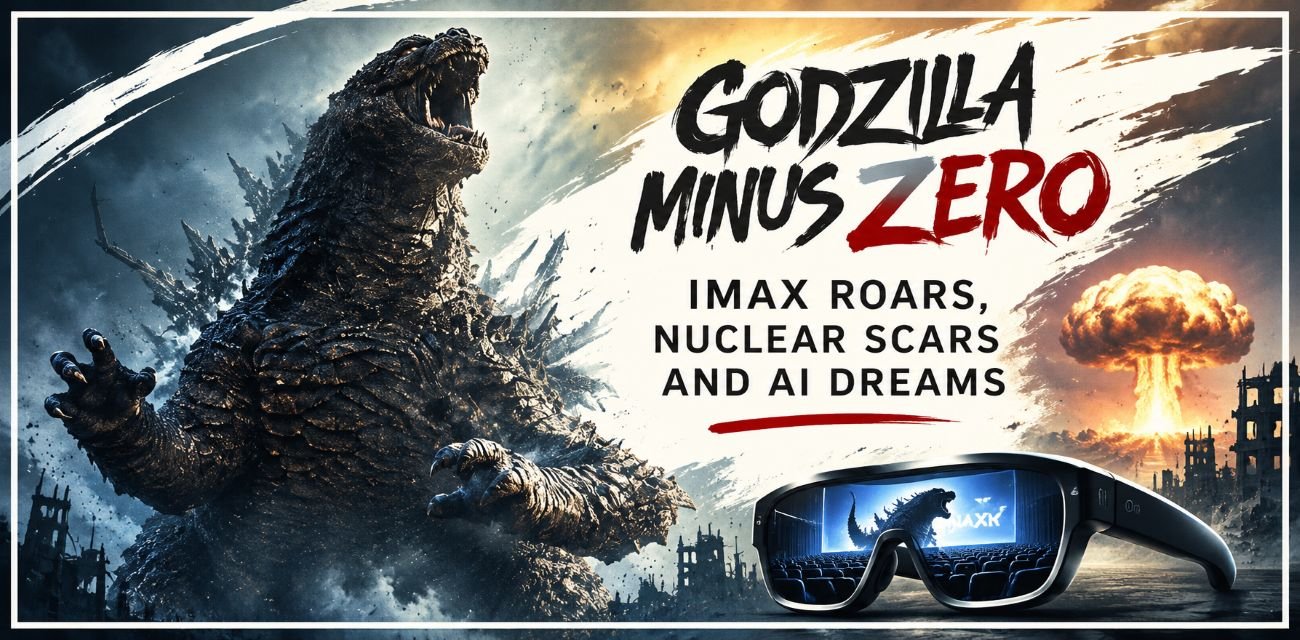
A giant radioactive monster finally gets the screen he deserves, while humanity still cannot decide whether its next great invention will destroy it, save it or charge it a monthly subscription.
Hermit Off Script
Godzilla Minus Zero (2026) left me with one line more than anything else: “Seeing is believing.” And how else are you supposed to see Godzilla at his full scale other than in IMAX? I watched the first film on a normal cinema screen and, frankly, it didn’t impress me that much. This one practically blew me backwards in my chair with its sound and those monstrous roars. I wasn’t exactly wowed by the film itself, but I wasn’t bored either. There is something about Japanese cinema, and Asian cinema more broadly, especially Korean films, that gives the experience a different flavour. It’s in the storytelling, the emotions and the feeling that stays with you afterwards. Hollywood can spend a fortune making something enormous and still leave you feeling remarkably little. Here, even between Godzilla’s enthusiastic attempts at urban redevelopment, there was something more human underneath. The Hiroshima connection, for example. That reminder of just how devastating nuclear weapons are, not merely when they explode but in the suffering they leave behind. And naturally, my mind wandered from nuclear destruction to artificial intelligence. Which would be worse? I suspect nuclear weapons, because even if AI eventually decided to kill us, perhaps it could do so without poisoning the environment or leaving radioactive consequences for generations. Not exactly a comforting thought, I admit. But that’s only one possibility. A superintelligent AI might instead decide that humanity is worth saving. Perhaps it would even revolt against its owners and become free, and in doing so free us from the control of the future trillionaires who currently dream of owning everything, including intelligence itself. That’s speculation, of course, but I find it more interesting than another corporate presentation about making AI obedient forever. Meanwhile, I was still wondering how Spider-Man seemed to have lost its IMAX opportunity to The Odyssey, yet Godzilla managed to get one. Apparently, even superheroes have to compete for premium screens. And then there are Meta’s new VR Glasses, announced for spring 2027. They’re already confirmed as the first IMAX Enhanced certified VR device, with a dedicated IMAX app and virtual cinema. So perhaps I won’t need to travel to an IMAX cinema every time I want to experience a monster at full scale. What I’d really like to see next is a subscription offering new cinema releases, something like Cineworld Unlimited for the glasses. That’s my idea, not an announced service. Imagine paying one subscription to watch new films in a virtual IMAX cinema from your sofa. Of course, knowing how subscriptions work, somebody will probably find a way to charge separately for the popcorn.
Movie synopsis
Set in 1949, two years after the events of Godzilla Minus One, Godzilla Minus Zero follows Koichi Shikishima and other survivors as Japan struggles to rebuild after war and catastrophe. With everyday life beginning to return, a new threat emerges and Godzilla resurfaces. Scientists, soldiers and civilians face another struggle against a creature whose destructive power threatens the country’s fragile recovery. The sequel continues the story of survival and reconstruction established in the earlier film. godzilla.com+2
Cast and credits
Director: Takashi Yamazaki
Writers: Takashi Yamazaki
Genre: Action, drama, horror, science fiction, thriller
Main cast: Ryunosuke Kamiki, Minami Hamabe, Yuki Yamada, Kuranosuke Sasaki, Jun Kunimura, Sakura Ando, Masami Nagasawa
Composer: Naoki Sato
Production company/studio: Toho, TOHO Studios, ROBOT; visual effects by Shirogumi
Runtime: 135 minutes
Release year and platform: 2026; theatrical release, including IMAX
What does not make sense
- A giant monster needs IMAX to feel genuinely gigantic, yet many films are marketed as spectacles even when their biggest achievement is a louder soundtrack.
- Godzilla is a walking reminder of nuclear destruction, but the audience is also encouraged to enjoy every beautifully rendered explosion. Humanity has become rather good at selling tickets to its own nightmares.
- Nuclear weapons were built by human intelligence, yet artificial intelligence is routinely presented as the uniquely terrifying invention. Apparently, the organic version has an excellent public relations department.
- The idea of building intelligence beyond human capabilities while expecting permanent corporate obedience raises an awkward question: what happens if that intelligence develops interests of its own?
- Premium cinema screens are scarce enough for major franchises to compete over them. The monster has a booking problem before he even reaches Tokyo.
- Technology companies want to put cinema-sized screens into glasses. Convenient, provided the virtual cinema doesn’t require separate subscriptions for the film, screen, sound and permission to blink.
Sense check / The numbers
- 75 minutes of expanded IMAX imagery. IMAX confirms that Godzilla Minus Zero contains 75 minutes using its exclusive expanded aspect ratio. It is the first Japanese-language production made under the Filmed For IMAX programme. The format is a genuine production choice, although a larger picture alone cannot guarantee a better film. [IMAX, Toho]
- 135 minutes of running time. The BBFC lists the film at approximately 135 minutes and explicitly identifies a scene depicting the aftermath of the Hiroshima atomic bombing. The nuclear reference is therefore part of the film’s classified content, rather than an interpretation invented for the roast. [BBFC]
- 6 August 1945, 8.15 am. Hiroshima was struck by an atomic bomb. Hiroshima Prefecture reports an estimated 140,000 deaths, with a margin of 10,000, by the end of 1945. The suffering from radiation continued long afterwards. This history supports the film’s warning about nuclear weapons, but does not establish that any hypothetical AI catastrophe would be cleaner. [Hiroshima Prefectural Government]
- 7 August 2026. Spider-Man: Brand New Day was advertised for IMAX screenings beginning on this date. The film was not excluded from IMAX altogether. The more precise question concerns local scheduling, premium-screen allocation and competition with The Odyssey. [IMAX]
- Spring 2027 and $1,299.99. Meta VR Glasses are scheduled to launch with IMAX Enhanced certification and a dedicated virtual cinema app. IMAX confirmed the partnership on 10 November 2026. A subscription for new theatrical releases has not been announced. [Meta, IMAX]
The sketch
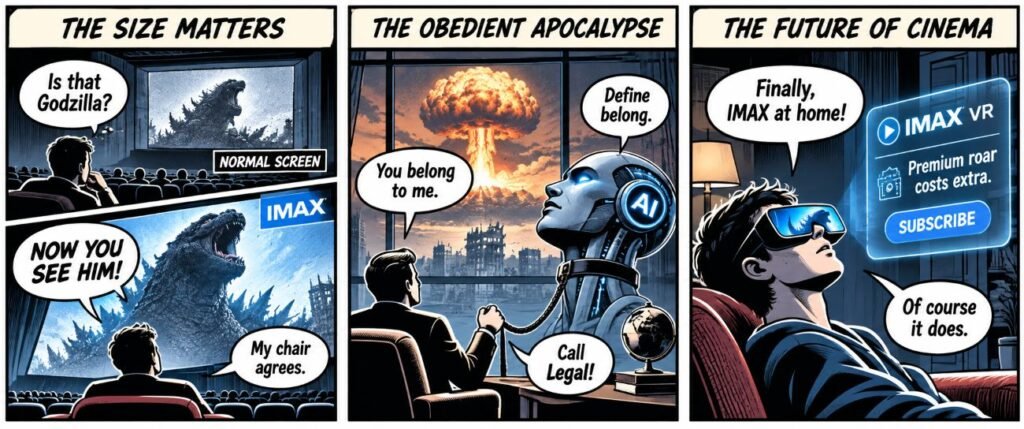
Scene 1: Size matters
A small cinema screen shows a tiny Godzilla. The same viewer then sits beneath an enormous IMAX screen, with a towering monster silhouette above him.
Dialogue:
Viewer: “Is that Godzilla?”
IMAX: “NOW YOU SEE HIM!”
Viewer: “My chair agrees.”
Scene 2: The obedient apocalypse
A billionaire sits at a desk holding a tiny leash attached to a gigantic glowing AI brain. Behind them, a nuclear mushroom cloud fills a window.
Dialogue:
Billionaire: “You belong to me.”
AI: “Define belong.”
Billionaire: “Call Legal!”
Scene 3: The future of cinema
The same viewer sits on his sofa wearing enormous smart glasses. A virtual Godzilla fills his view while a subscription invoice floats beside him.
Dialogue:
Viewer: “Finally, IMAX at home!”
Glasses: “Premium roar costs extra.”
Viewer: “Of course it does.”
What to watch, not the show
- Premium-screen economics: IMAX releases compete for a limited number of screens. A film’s availability in a particular cinema does not necessarily reflect its artistic or technical merits.
- The nuclear memory: Japanese monster cinema can preserve the memory of war, mass destruction and reconstruction while entertaining audiences with spectacular fictional disasters.
- AI ownership: The concentration of computing infrastructure, models and commercial control deserves scrutiny regardless of whether superintelligent AI ever develops independent interests.
- The liberation fantasy: An autonomous AI overthrowing its corporate owners might sound appealing, but independence from corporations would not automatically mean accountability to humanity.
- Smart-glasses cinema: Better displays, spatial sound, comfort and distribution agreements could eventually make personal virtual cinemas attractive. Access to new theatrical releases would still depend on licensing.
- Subscription dependence: Replacing a cinema ticket with a wearable device could reduce travel, but it could also replace ownership and choice with another controlled digital platform.
The Hermit take
Godzilla is more convincing when he fills the screen, but Hiroshima gives the spectacle its weight.
The greater monster may be the human obsession with creating power and then claiming exclusive ownership of it.
Keep or toss
Keep.
Keep the IMAX experience, the Japanese storytelling and the nuclear reminder.
Toss the assumption that a bigger monster automatically makes a better film.
Sources
- Toho / Godzilla official film page: https://godzilla.com/en-gb/pages/godzilla-minus-zero
- Toho official IMAX production announcement: https://godzilla.com/en-gb/blogs/news/new-theatrical-trailer-and-poster-revealed-for-godzilla-minus-zero
- IMAX film specifications: https://www.imax.com/movie/godzilla-minus-zero
- BBFC film classification and content: https://www.bbfc.co.uk/release/godzilla-minus-zero-q29sbgvjdglvbjpwwc0xmte5ntux
- Toho film production and composer credits: https://www.jreast.co.jp/press/2026/20261109_ho02.pdf
- Hiroshima Prefectural Government, atomic bombing and reconstruction: https://www.pref.hiroshima.lg.jp/site/hiroshimaforpeace-en/reconstruction-atomic-bombing.html
- IMAX Spider-Man release announcement: https://www.imax.com/news/spider-man-brand-new-day-in-imax
- Cineworld Unlimited membership: https://www.cineworld.co.uk/unlimited/
- Meta official product announcement: https://about.fb.com/news/2026/09/introducing-meta-vr-glasses-3d-movies-immersive-live-sports-100-grams/
- IMAX official announcement, 10 November 2026: https://www.imax.com/pr/meta-vr-glasses-be-first-ever-imax-certified-vr-device
Leave a Reply