
Lede
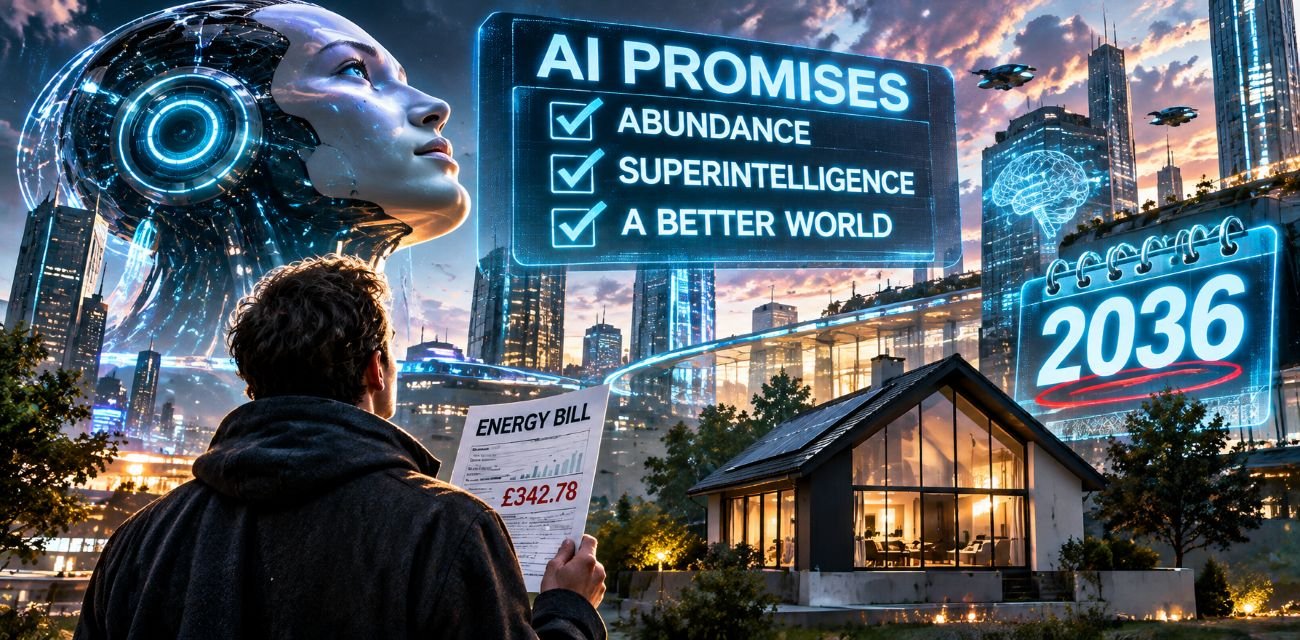
The AI industry is selling a future of superintelligence, abundance and civilisation-changing progress, while the rather inconvenient question of whether ordinary people will actually live better remains unanswered.
Words used
- AGI (Artificial General Intelligence): A proposed form of AI capable of performing a broad range of intellectual tasks at or beyond human ability. Definitions vary.
- Superintelligence: Hypothetical intelligence that substantially exceeds human intellectual capabilities across many important domains.
- Quantum computing: Computing that uses quantum-mechanical principles to process information, potentially offering major advantages for certain problems.
Hermit Off Script
Mark my words: nothing will be as they say. Absolutely nothing. No abundance as they keep advocating, no complete transformation of our world at the level they imagine, and certainly no guarantee of some out-of-this-world superintelligence arriving to solve humanity’s problems. I’m putting this down on 28 October 2026, so nobody can accuse me of pretending I predicted it after the event. From my point of view, what we’re calling AI today is largely the human brain and human intelligence operating at full speed, accelerated beyond anything an individual could manage. That’s what these systems are doing. They’ve been trained on enormous amounts of humanity’s accumulated knowledge, research, language, code, discoveries and experience. They extract patterns, connect ideas, reason through problems and produce new results from those foundations. And yes, some of those results are genuinely new. I’m not denying that, or the extraordinary usefulness of the technology. But I find it rather amusing that we’re now expected to believe humanity has suddenly invented something entirely detached from humanity itself. The machine has absorbed our intellectual history, and somehow the marketing department has promoted it to our replacement. Bloody hell, at least give the original authors a thank-you card. Until another fundamental technological breakthrough, perhaps involving quantum computers or something we haven’t yet discovered, I suspect much of what we’re witnessing is accelerated human-derived intelligence rather than the completely different intelligence being advertised. That doesn’t mean quantum computing automatically creates superintelligence. Nobody has established that. It’s simply one possible direction I think deserves attention. And here’s the part that will probably upset the technological prophets: I believe humanity would eventually reach many of the same scientific discoveries and technological advances without AI. Perhaps considerably later, of course. AI may compress years of research into months, and that’s wonderful. But acceleration isn’t the same as creating an entirely new destination. We were discovering medicines, building computers, exploring space and advancing physics long before chatbots arrived to explain our own mistakes back to us. More importantly, why should faster science automatically mean a better world? We can develop extraordinary medical treatments and still leave people unable to afford them. We can automate businesses and still make workers poorer. We can build intelligent machines and use them to make society less safe. So let’s speak again in five years, on 28 October 2031, and then in ten years, on 28 October 2036. I suspect the world will be technologically more advanced but nowhere near as different as the prophets suggest. Perhaps it will even be less safe, and certainly not automatically better for humanity. That’s my judgement, not a scientific certainty. Maybe I’m completely wrong. Hopefully I am. I’d be delighted to live in a peaceful, prosperous world where intelligence has finally produced some wisdom.
P.S. If 2036 really delivers universal abundance, I’ll happily apologise to every AI prophet while enjoying my free electricity, affordable home and extraordinary healthcare. Until then, I’ll believe in progress, not paradise sold by subscription.
What does not make sense
- Abundance without distribution. AI could generate enormous wealth, but there is no automatic mechanism ensuring that the benefits reach everybody. The shareholders may reach paradise considerably earlier than the workers.
- Human knowledge treated as a machine’s private achievement. Modern AI depends on vast quantities of training material, scientific knowledge and human engineering. It can produce original results, but the history behind those results cannot simply be erased.
- Superintelligence presented as a scheduled delivery. There is no agreed scientific timetable for superintelligence. Confident predictions are still predictions, however expensive the keynote presentation.
- The assumption that scaling must eventually produce a fundamentally different mind. Greater capability does not by itself establish consciousness or human-like understanding. Equally, the absence of consciousness would not prevent a system from becoming extraordinarily capable.
- Quantum computing treated as either magic or irrelevant. Quantum machines offer promising approaches to particular computational problems, but no evidence establishes that they are necessary for AGI or superintelligence.
- Speed confused with originality. AI can generate discoveries and solutions that humans have not previously produced. Whether humanity would eventually have reached the same results without AI is a counterfactual question, not something current evidence can settle.
- Productivity confused with prosperity. A company can increase output while reducing employment, wages or bargaining power. The economic benefit depends on who owns the technology and how the gains are shared.
- Intelligence confused with wisdom. More capable systems may accelerate medicine, engineering and education while also making surveillance, fraud and cyberattacks more effective.
- A forecast presented as humanity’s destiny. The public is expected to accept sweeping promises about the future without being offered equally clear measurements of who benefits, who pays and what happens if the predictions fail.
Sense check / The numbers
- AI is advancing, but it remains unreliable on important tasks. Stanford’s 2026 AI Index reports that AI agents improved from approximately 12 per cent to 66 per cent task success on OSWorld, a benchmark involving computer operations. This demonstrates substantial progress, but also leaves roughly one-third of benchmark attempts unsuccessful. It does not establish a ceiling on future capabilities. [Stanford AI Index, 2026]
- Scientific progress is real, even without superintelligence. The AlphaFold Protein Structure Database contains more than 200 million predicted protein structures. The 2024 Nobel Prize in Chemistry recognised work involving AlphaFold2. This demonstrates a major contribution to scientific research, although predicting protein structures is not the same as producing affordable medicines or proving that AI can solve every scientific problem. [EMBL-EBI; Nobel Prize, 2024]
- The employment effects may be substantial and uneven. The IMF estimated in January 2024 that almost 40 per cent of global employment was exposed to AI, rising to approximately 60 per cent in advanced economies. Exposure does not mean job loss. Some workers may benefit from greater productivity, while others may face reduced demand or wages. Universal prosperity cannot be inferred from these figures. [IMF, 2024]
- Greater capability has not eliminated safety problems. Stanford’s 2026 AI Index records 362 documented AI incidents in 2025, compared with 233 in 2024. These figures describe recorded incidents rather than the probability of harm from an individual system, and reporting practices affect the totals. Nevertheless, they provide evidence that safety remains an unresolved concern. [Stanford AI Index, 2026]
- The physical costs of the digital revolution are considerable. The International Energy Agency’s updated outlook projects global data-centre electricity consumption increasing from approximately 485 terawatt-hours in 2025 to 950 terawatt-hours by 2030. AI is a major driver, although other digital services contribute. The figures are projections, not guaranteed outcomes, and they do not establish that household bills will necessarily rise. [IEA, 2026]
The sketch
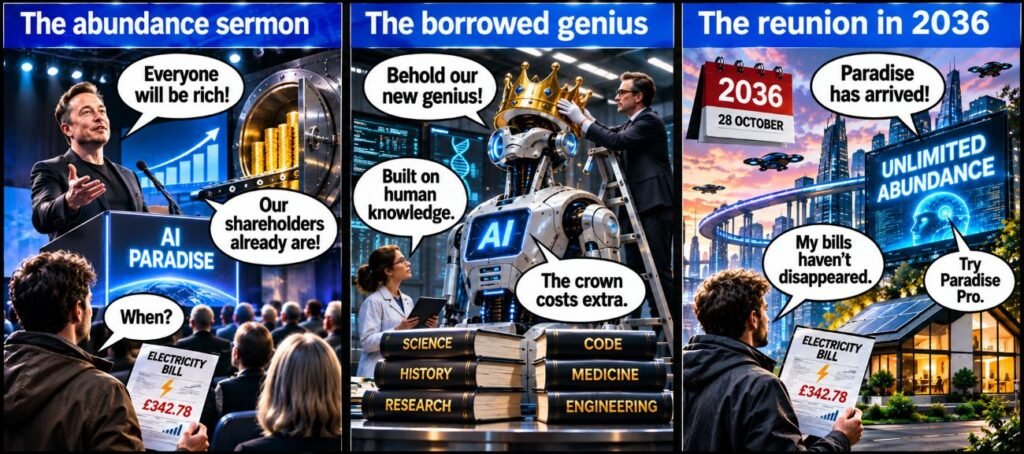
Scene 1: The abundance sermon
A corporate executive stands on a stage labelled “AI PARADISE”. Behind the curtain, a conveyor belt carries coins into a locked vault. A worker below holds an electricity bill.
Dialogue:
Executive: “Everyone will be rich!”
Worker: “When?”
Executive: “Our shareholders already are!”
Scene 2: The borrowed genius
A giant computer stands on mountains of books and scientific papers. Researchers feed it more material while an executive places a golden crown on the machine.
Dialogue:
Executive: “Behold our new genius!”
Researcher: “Built on human knowledge.”
Computer: “The crown costs extra.”
Scene 3: The reunion in 2036
The same worker stands beside a modest house under a calendar marked “2036”. Futuristic machines tower above the city while an enormous screen advertises “UNLIMITED ABUNDANCE”.
Dialogue:
Announcer: “Paradise has arrived!”
Worker: “My bills haven’t disappeared.”
Announcer: “Try Paradise Pro.”
What to watch, not the show
- Ownership and wealth: Whether the economic gains from AI are broadly shared or increasingly concentrated among model developers, infrastructure providers and investors.
- The gap between promises and evidence: Whether claims about AGI, superintelligence and abundance are accompanied by independently reproducible demonstrations.
- Human labour: Changes in real wages, employment, working hours, job security and the ability of workers to negotiate their share of productivity gains.
- Scientific discovery: Whether AI-assisted research leads to independently validated treatments, technologies and improvements that become accessible outside wealthy institutions.
- Quantum computing: Verified computational advantages on useful problems, rather than speculative claims that quantum hardware will automatically produce a new kind of intelligence.
- Safety and public freedom: The development of fraud, surveillance, cybercrime, misinformation and effective legal accountability.
- Energy and infrastructure: The actual cost of computing capacity, electricity, cooling, construction and maintaining increasingly capable systems.
- Adoption rather than demonstration: Whether households, businesses and public institutions can afford, trust and successfully integrate the technology.
The 2031 and 2036 prediction test
The prediction was recorded on 28 October 2026. Its two checkpoints are 28 October 2031 and 28 October 2036.
The test should distinguish three separate outcomes: technological capability and actual adoption, the pace of scientific discovery and improvements in ordinary human life.
A strong challenge to the prediction would be independently demonstrated superintelligence accompanied by widespread, measurable improvements in prosperity, healthcare, security and available free time.
Evidence supporting the prediction would include major technological progress without comparably broad social gains, particularly if affordability, inequality or safety deteriorated.
The comparison should use consistent indicators and account for changes caused by public policy, economic conditions and other technologies. Neither a single extraordinary AI demonstration nor a single economic crisis would settle the argument.
The Hermit take
Faster intelligence can accelerate discovery without guaranteeing a better civilisation.
The real test of AI abundance is what ordinary people gain, not what the machines achieve.
Keep or toss
Toss.
Keep the scientific advances, useful AI tools and genuine improvements to human life.
Toss the certainty that technological intelligence will inevitably deliver universal prosperity or wisdom.
Sources
- Stanford University, The 2026 AI Index Report: https://hai.stanford.edu/ai-index/2026-ai-index-report
- Stanford University, Responsible AI, 2026: https://hai.stanford.edu/ai-index/2026-ai-index-report/responsible-ai
- EMBL-EBI, AlphaFold Protein Structure Database: https://alphafold.ebi.ac.uk/
- Nobel Prize, Chemistry Prize 2024: https://www.nobelprize.org/prizes/chemistry/2024/press-release/b/
- International Monetary Fund, AI and the Global Economy, January 2024: https://www.imf.org/en/blogs/articles/2024/01/14/ai-will-transform-the-global-economy-lets-make-sure-it-benefits-humanity
- International Monetary Fund, Gen-AI: Artificial Intelligence and the Future of Work: https://www.elibrary.imf.org/view/journals/006/2024/001/article-A001-en.xml
- International Energy Agency, Key Questions on Energy and AI: https://www.iea.org/reports/key-questions-on-energy-and-ai/executive-summary
- International Energy Agency, Energy and AI: https://www.iea.org/reports/energy-and-ai/executive-summary
Disclaimer: This article contains satire, opinion and speculative predictions. The 2031 and 2036 outlook represents the author’s judgement, not an established scientific forecast. The numerical evidence is attributed to the research organisations listed above. This article does not constitute financial or investment advice.
Leave a Reply