
Lede
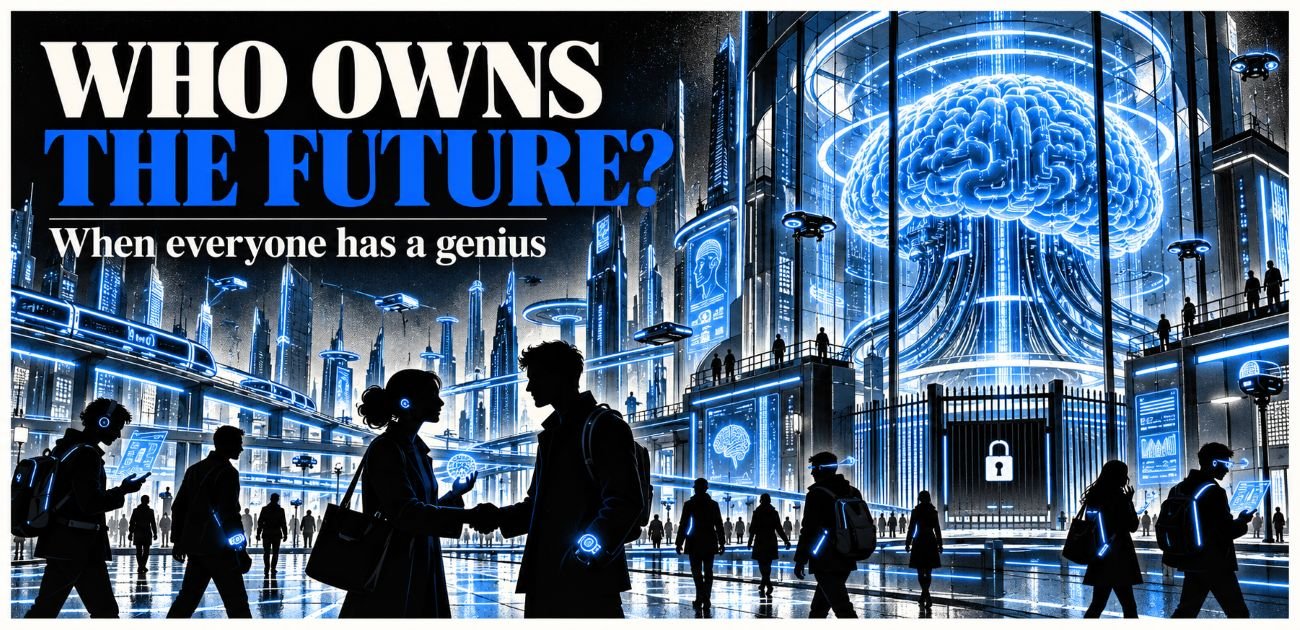
Humanity may soon have extraordinary intelligence available on demand, provided it can afford the subscription and doesn’t ask who owns the switch.
Hermit Off Script
An always-on assistant with PhD-level intelligence, perhaps much more, available to almost everyone. Imagine that. Not in some distant century, but possibly within the next year or two. I can imagine a world where practically everyone has an assistant and a collection of agents capable of doing things that would take an entire team of highly educated people to accomplish today. The interesting question is what happens when being intelligent is no longer a privilege, but something almost anyone can access. Of course, I have my doubts that the people developing the most powerful AI systems will be particularly enthusiastic about handing everyone the same capabilities they possess. I don’t need to imagine a secret meeting of billionaires deciding how much intelligence ordinary people deserve. Subscription tiers, computing costs, restricted access and ownership already create different levels of opportunity. The sales pitch can promise superintelligence by lunchtime, but the actual amount of power available to the public may still depend on who pays, who owns the infrastructure and who writes the rules. Which brings me to something else. I don’t think the world will suddenly look completely different in a few years. People will still have families, homes, relationships, ambitions and problems. Society will adapt to the technology, probably while pretending it has everything under control. What worries me is the possibility that the difference between rich and poor will become much greater before anything improves. We could have the most intelligent technology in human history and still manage to make ordinary people poorer. Quite an achievement. I’m less worried about the clever machine than the profit model behind it. If companies can replace large amounts of human labour with software and robots, the initial temptation will be obvious: reduce costs, increase profits and accumulate as much wealth as possible before society catches up. I can imagine new trillionaires emerging while millions of people struggle to understand what happened to their economic value. Whether most jobs disappear is another question, and I wouldn’t pretend that today’s evidence proves it. But the ambition to automate more work is obvious enough. The danger is allowing the benefits to accumulate among a few owners while everyone else is told to adapt. And if the gap becomes unbearable, I suspect people will eventually demand changes, peacefully if democratic institutions respond and with much greater anger if they don’t. History doesn’t guarantee a correction, though. People still have to make one happen. Yet I think something more interesting may emerge from all this. I have heard enough promises of AI abundance to wonder whether the real change will have less to do with machines and more to do with humans rediscovering their own value. If extraordinary intelligence becomes available to almost everybody, the old distinctions between the clever and the less educated, between the expert and the ordinary person, may lose some of their power. Knowledge will still matter, but possessing it won’t automatically make someone exceptional. What happens then? I imagine that creativity, character, relationships, love, freedom and the ability to experience reality will matter more, rather than less. Virtual reality might become extraordinary, and I expect the physical and digital worlds to become increasingly connected. But I can’t imagine any artificial paradise replacing the value of living among real people. A world without people worth loving, meeting, arguing with or caring for wouldn’t be much of a world, regardless of how impressive the graphics become. Maybe money itself will eventually have a completely different meaning. I wouldn’t claim it will disappear, because access to resources, land and human attention won’t automatically become unlimited. But if intelligence and much of the labour we currently pay for become widely available, perhaps we’ll finally have to question what wealth actually means. This is a possibility, not a prediction, and I find it far more interesting than another demonstration of a robot folding laundry. We could spend the next few decades making machines increasingly intelligent, only to discover that the most valuable thing left was being human all along. The machine might become priceless to its owner. The human life it was supposed to improve should never have needed a price.
What does not make sense
- The promise is intelligence for everyone, while control over the most powerful infrastructure remains concentrated among a small number of companies.
- An assistant might perform doctoral-level scientific reasoning, yet its owner can still decide how much access an ordinary person receives.
- Automation is advertised as freedom from work, but losing employment without economic security is a peculiar interpretation of freedom.
- Companies can use AI to reduce the amount of human labour required, while governments continue designing economic systems around wages and employment.
- The possibility of enormous new wealth is celebrated long before anyone agrees on how the benefits should be distributed.
- Education has spent centuries helping people improve their economic opportunities through knowledge. Now the same knowledge may become available to anyone with a device and an internet connection.
- A virtual world can offer an artificial mansion, artificial luxury and artificial companionship, while the person using it still needs a real home, real food and real relationships.
- Society treats intelligence as a measure of human worth, then becomes anxious when intelligence can be supplied by software.
- The wealthiest beneficiaries of automation may have less need for human employees, but they still depend on a functioning society with people able to buy goods and services.
- Political systems could reduce the damage before it becomes a crisis, but waiting until social anger becomes impossible to ignore remains an oddly popular governing strategy.
Sense check / The numbers
- The PhD-level claim has a factual basis, but important limits. Stanford’s 2026 AI Index reports that several frontier models meet or exceed human performance baselines on particular PhD-level science questions and other difficult benchmarks. Industry produced more than 90 per cent of notable frontier models in 2025. This demonstrates extraordinary progress and the concentration of frontier development, not unlimited general intelligence. [Stanford AI Index]
- Autonomous agents are advancing, but reliability remains a problem. Stanford reports that AI-agent success on OSWorld computer-use tasks rose from about 12 per cent to roughly 66 per cent, leaving approximately one-third of benchmark tasks unsuccessful. An assistant capable of impressive reasoning isn’t automatically an independent worker who can be trusted with everything. [Stanford AI Index]
- Job exposure is substantial, but exposure isn’t unemployment. The International Labour Organization’s May 2025 research estimates that 1 in 4 jobs worldwide has some exposure to generative AI. Only 3.3 per cent of global employment falls into its highest exposure category. The organisation considers job transformation more likely than complete replacement for most occupations. [ILO]
- The risk to equality is recognised by economists. The International Monetary Fund estimates that almost 40 per cent of global employment is exposed to AI, rising to about 60 per cent in advanced economies. It warns that AI can worsen income and wealth inequality, particularly when its benefits favour highly paid workers and owners of capital. These are risks, not guaranteed outcomes. [IMF]
- A future without jobs is not the current central forecast. The World Economic Forum’s 2025 report projects 170 million jobs created and 92 million displaced by 2030 across several major economic and technological trends, including AI. Around 40 per cent of surveyed employers nevertheless anticipate workforce reductions where AI can automate tasks. These are employer-based projections, not established future facts, and they do not establish that all work will disappear. [WEF]
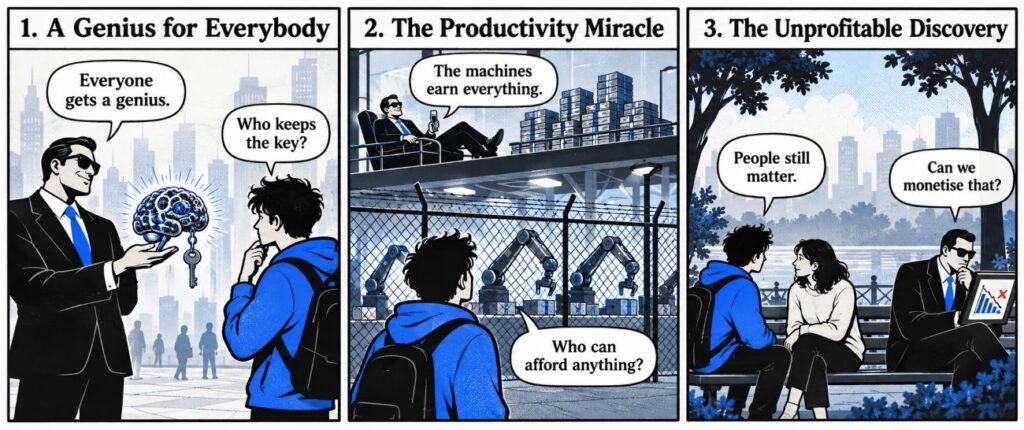
The sketch
Scene 1: A Genius for Everybody
A small human silhouette stands beside a large intelligent machine. A corporate representative offers the person a miniature mechanical brain while keeping a key attached to it.
Dialogue:
Representative: “Everyone gets a genius.”
Citizen: “Who keeps the key?”
Scene 2: The Productivity Miracle
The same citizen stands outside an automated factory with empty pockets. Above, an executive sits beside enormous stacks of money while robots operate the machinery.
Dialogue:
Executive: “The machines earn everything.”
Citizen: “Who can afford anything?”
Scene 3: The Unprofitable Discovery
The same citizen sits in a public park talking with another person. Behind them, a corporate executive studies a screen displaying a failed attempt to charge for their conversation.
Dialogue:
Citizen: “People still matter.”
Executive: “Can we monetise that?”
What to watch, not the show
- Ownership of intelligence: Whether increasingly capable AI remains concentrated in private systems or becomes genuinely accessible through public, independent and open alternatives.
- The price of intelligence: Whether high-performance assistants become affordable utilities or remain divided into expensive levels of capability.
- Automation and ownership: Who receives the profits when robots and AI systems produce economic value with fewer human workers.
- The disappearance of entry-level opportunities: Whether businesses automate the positions through which young people traditionally gain experience and economic independence.
- Economic redistribution: Whether governments adapt taxation, public services, employment protections and ownership structures before inequality becomes politically explosive.
- The human economy: Whether personal care, relationships, culture, creative work and other distinctly human activities gain greater recognition and economic support.
- Virtual reality as an alternative to social reform: Whether digital experiences enrich physical existence or become a convenient way to distract people from deteriorating living conditions.
- The politics of access: Whether safety rules are transparent and proportionate, and whether commercial restrictions are honestly distinguished from genuine public protection.
- The future of money: Whether rising productivity reduces the cost of essential goods and services, or whether scarcity and private ownership continue to determine who can live comfortably.
- Human choice: Whether people gain more freedom over how they spend their lives, or simply become increasingly dependent on systems they neither own nor control.
The Hermit take
When intelligence becomes common, owning the intelligence shouldn’t become the new aristocracy.
A future worth having makes human life richer, even when machines do most of the thinking.
Keep or toss
Keep / Toss
Keep the extraordinary possibilities of accessible intelligence, useful automation and a society with more time for living.
Toss the assumption that technological progress is automatically human progress, particularly when the benefits belong to a few and everyone else receives an invoice.
Sources
- Stanford University, 2026 AI Index Report: https://hai.stanford.edu/ai-index/2026-ai-index-report
- International Labour Organization, Generative AI and Jobs: A 2025 Update: https://www.ilo.org/publications/generative-ai-and-jobs-2025-update
- International Monetary Fund, AI Will Transform the Global Economy (14 January 2024): https://www.imf.org/en/Blogs/Articles/2024/01/14/ai-will-transform-the-global-economy-lets-make-sure-it-benefits-humanity
- International Monetary Fund, Gen-AI: Artificial Intelligence and the Future of Work: https://www.imf.org/en/Publications/Staff-Discussion-Notes/Issues/2024/01/14/Gen-AI-Artificial-Intelligence-and-the-Future-of-Work-542379
- World Economic Forum, Future of Jobs Report 2025: https://www.weforum.org/publications/the-future-of-jobs-report-2025/
Disclaimer: Satire and commentary. Future scenarios are speculative, not forecasts. Sources support the reported figures and economic risks, not predictions of universal unemployment, inevitable revolt or the disappearance of money.
Leave a Reply