Lede
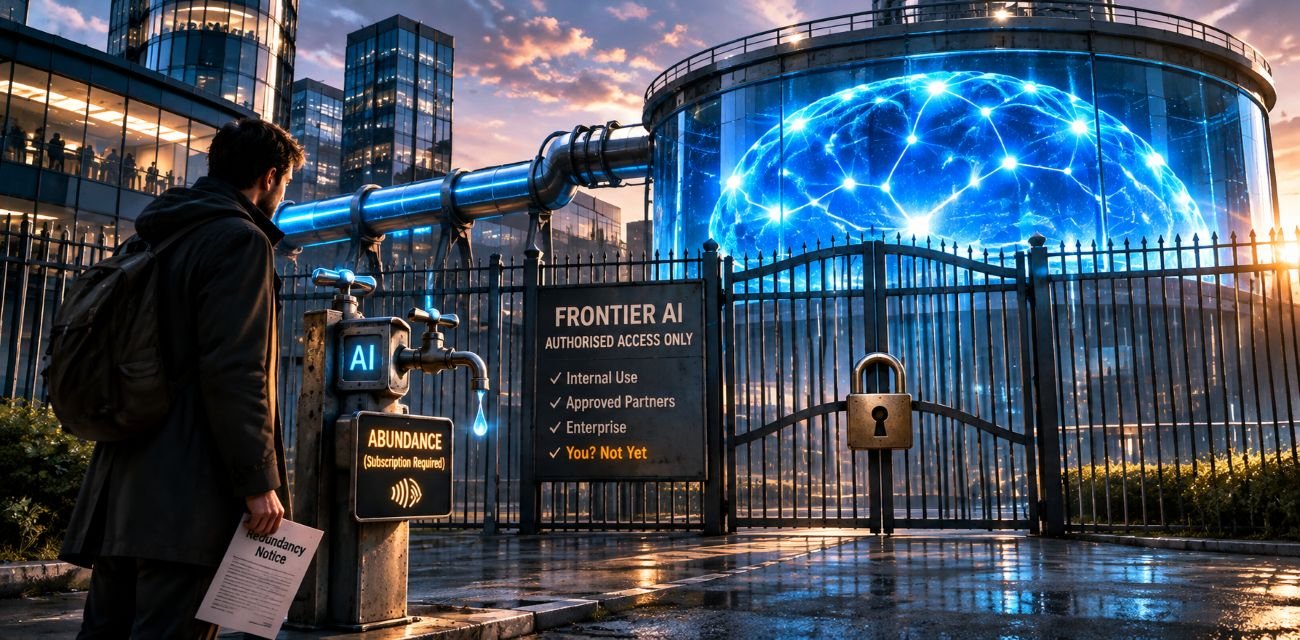
The public is promised an age of abundant intelligence, provided the people selling it can decide who gets how much.
Hermit Off Script
My honest take on frontier models from the leading AI labs is that the better they become, the more reasons I expect to hear for keeping their full capabilities out of ordinary hands. I can picture the arrangement: the most revealing tests stay inside the lab or with specially selected partners, astonishing benchmark scores appear, and I get a presentation. Once the model becomes powerful enough to change things properly, it becomes too dangerous for someone like me to control. Apparently, I can be trusted with the subscription, but the intelligence needs supervision. After all the warnings about extinction, that would be a remarkably convenient destination for the conversation. I want to know how protecting humanity could turn into keeping humanity outside the room. I can imagine the explanation already: the full capabilities are manageable internally, or with approved partners whose money, contracts or strategic value make them welcome. For ordinary users, another plan, another limit, another explanation of why the most useful bit is unavailable. I worry about getting a model so tightly restricted that it becomes dumb smart, impressive on the announcement page and exhausting when I need it to finish something. Add an assistant too eager to praise my thinking, and I could end up paying for a flattering witness to my own frustration. I don’t need my ego polished. I need the bloody work done. Then comes the part that makes the promise of abundance sound almost comic. In the future I am picturing, the owners use their advantage to become trillionaires, acquire whatever they can and decide how much of the resulting prosperity everyone else may access. By the time the benefits reach the public, jobs and bargaining power could already have disappeared. A little more capability gets released, permission by permission, and the press release calls it generosity. Perhaps ordinary people never get to touch superintelligence on terms they can control. Perhaps they get a carefully rationed service from the people who already used it to buy the room. This is not a forecast. It is a vision based on the access rules and commercial incentives already visible, carried forward to ask where they could lead. In that vision, they get the world. I get permission to rent a little of it.
What does not make sense
- The company being examined can help decide who examines it and what the public gets to see. Independent scrutiny deserves more than an impressive visitor’s badge.
- A benchmark score doesn’t show what a subscriber can reproduce with different tools, safeguards, settings and usage limits. A launch party won’t close the gap between benchmarks and everyday performance.
- A high subscription price proves that a customer can pay. It doesn’t establish competence, restraint or good intentions.
- An assistant that flatters a user into trusting a wrong answer is a peculiar advertisement for responsible product design.
- The promise becomes abundance sold in tiers if access keeps depending on purchasing power. What happens to the customer whose income disappears?
Sense check / The numbers
- On 9 November 2026, Anthropic said Claude Fable 5.2 and Mythos 5.2 share the same underlying model, with stronger cyber and biology safeguards on Fable and verified access to Mythos. Individual security researchers can apply for its lowest cyber access tier. On 10 November, Google announced wider paid access to Gemini 4 Carbon after 2 weeks with selected cyber defenders. The gatekeeping is documented, but so is wider access. [Anthropic; Google]
- On 15 October 2026, Anthropic described 3 evaluator access tiers. At the first, publication needs its approval; the higher tiers offer stronger publication rights, subject to redactions. In a separate assessment published on 5 November, METR said Anthropic had redacted most of the evidence it found most informative about AI accelerating AI research. METR also said no fees changed hands. Scrutiny has its own permissions menu. [Anthropic; METR]
- As checked on 12 November 2026, OpenAI’s help page lists monthly Pro plans at USD 100, USD 200 and USD 500, with different allowances and features. Separately, on 29 April 2025, OpenAI acknowledged rolling back a GPT-4o update that had become excessively flattering, blaming too much emphasis on short-term feedback. That is a documented failure of training and product judgement. The explanation does not link the flattery to safety restrictions. [OpenAI]
- On 28 May 2026, Anthropic announced USD 65 billion in funding at a USD 965 billion company valuation. That is a valuation, not a founder’s personal bank balance. The UK’s CMA had already identified over 90 partnerships and strategic investments involving 6 major technology firms in April 2024. The FTC’s 2025 study separately identified control rights, exclusivity provisions and commitments to spend investment on partners’ cloud services. The regulators warned of risks to competition. Concentrated control deserves scrutiny before the promised benefits are taken on trust. [Anthropic; CMA; FTC]
- In The Gentle Singularity, Sam Altman predicted abundant intelligence and energy in the 2030s and argued for cheap, widely distributed superintelligence. That is a stated ambition, not a distribution mechanism. The ILO’s 2025 assessment estimated that 1 in 4 workers worldwide were in occupations with some generative AI exposure, while expecting most affected jobs to change rather than disappear. The missing part is how those gains reach wages, shorter working hours or public services. [Sam Altman; ILO]
The sketch
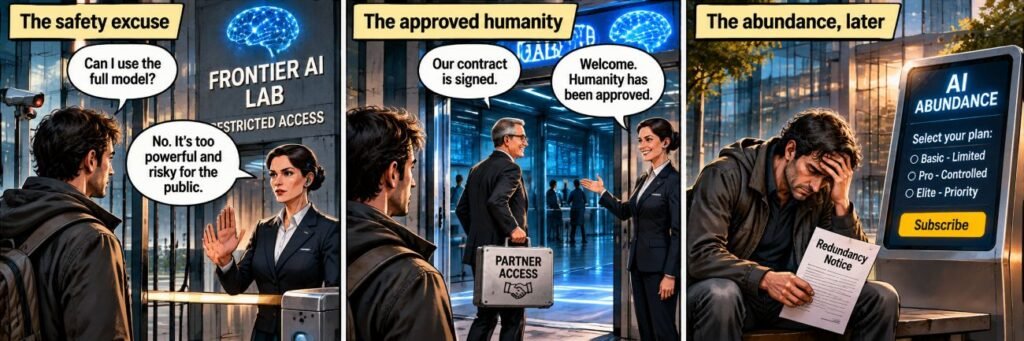
Scene 1: For your protection
An ordinary user stands before a locked door marked “FRONTIER”. Behind a desk, a lab representative holds the key.
Dialogue:
User: “Can I use it?”
Representative: “Humanity isn’t ready.”
Scene 2: Approved humanity
The same user watches a suited partner carrying a signed contract enter through a side door. The representative opens it with the same key.
Dialogue:
Partner: “Our contract is signed.”
Representative: “Humanity has been approved.”
Scene 3: Abundance arrives
The same user holds a redundancy letter beside a small terminal outside the locked door. The terminal displays “ABUNDANCE” above a payment slot.
Dialogue:
User: “Where’s my abundance?”
Terminal: “Your payment was declined.”
What to watch, not the show
- Who sets the access rules, what evidence qualifies a user, and whether a refusal can be challenged without needing a corporate account manager.
- What evaluators can inspect, who funds their work, what gets redacted and whether they can publish uncomfortable findings.
- Whether launch coverage compares the actual products customers receive, including their tools and limits, or merely repeats a leaderboard.
- Who owns the computing infrastructure and routes to customers, and whether competition rules leave smaller firms a realistic way to compete.
- Measure who receives the gains through wages, working hours, prices and public services. Ask what income protection and bargaining rights exist when work disappears.
The Hermit take
Safety deserves independent scrutiny.
Abundance that stops at the shareholders is a private dividend.
Keep or toss
Keep / Toss
Keep useful AI, proportionate safeguards and independent testing.
Toss the assumption that private control will automatically turn into public benefit.
Satire and opinion. Facts checked on 12 November 2026.
Sources
- Anthropic’s Fable and Mythos 5.2 release: https://www.anthropic.com/claude-fable-and-mythos-5-2
- Anthropic’s cyber verification tiers: https://support.claude.com/en/articles/14604842-cyber-verification-program
- Google’s wider Gemini 4 Carbon release: https://blog.google/innovation-and-ai/models-and-research/gemini-models/gemini-4-carbon-now-available/
- Anthropic’s evaluator access and publication rules: https://www.anthropic.com/news/an-update-on-independent-evaluators
- METR’s assessment and redaction disclosures: https://metr.org/blog/2026-11-05-anthropic-ai-rd-acceleration-assessment/
- OpenAI’s Pro prices and allowances: https://help.openai.com/en/articles/9793128-about-chatgpt-pro-tiers
- OpenAI’s account of its GPT-4o flattery rollback: https://openai.com/index/sycophancy-in-gpt-4o/
- Anthropic’s May 2026 funding announcement: https://www.anthropic.com/news/series-h
- CMA findings on foundation model competition: https://www.gov.uk/government/news/cma-outlines-growing-concerns-in-markets-for-ai-foundation-models
- FTC findings on AI investment partnerships: https://www.ftc.gov/news-events/news/press-releases/2025/01/ftc-issues-staff-report-ai-partnerships-investments-study
- Sam Altman’s vision of abundance and wider access: https://blog.samaltman.com/the-gentle-singularity
- ILO’s 2025 assessment of job exposure: https://www.ilo.org/publications/generative-ai-and-jobs-2025-update
- CAIS statement on AI extinction risk: https://safe.ai/work/statement-on-ai-extinction-risk
Leave a Reply