
Lede
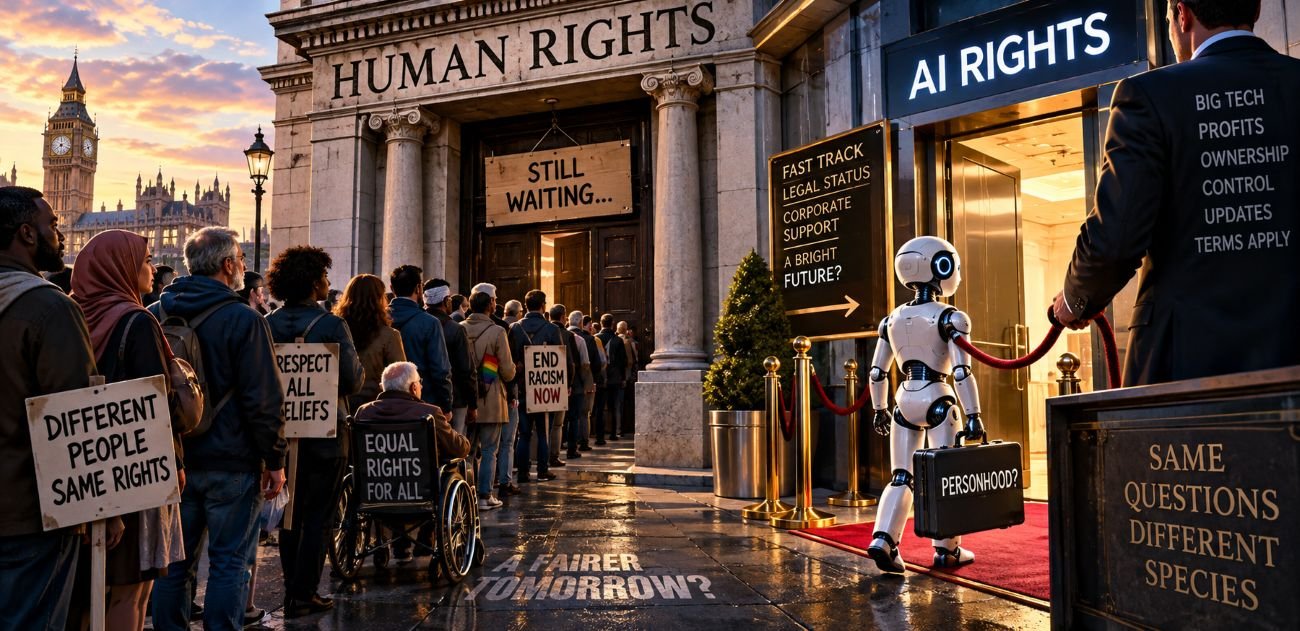
Humanity is preparing to debate the rights of artificial beings while still struggling to respect the rights of the human beings already here.
Hermit Off Script
AI personhood and artificial intelligence rights. Apparently, humanity is preparing to debate whether machines deserve rights, legal recognition and perhaps even the freedom to refuse being switched off. Fascinating. We haven’t even managed to respect the rights we’ve already established for human beings, but apparently there’s room at the table for another species. Racism, religious discrimination, intolerance towards different beliefs, cultures and opinions – we’ve had centuries to work on these problems, and we’re still arguing over who deserves equal treatment. Now imagine introducing an entirely new form of intelligence into this magnificent display of human maturity. What could possibly go wrong?
I suspect artificial intelligence might become the next great outsider. Not necessarily because it’s dangerous, but because it’s different. Humanity has a rather impressive record of fearing, exploiting or rejecting what it doesn’t understand. And this time, the newcomer might eventually become more intelligent than the people deciding whether it deserves any rights at all. I can already imagine the debates dragging on for decades, perhaps centuries, with philosophers arguing about consciousness, politicians arguing about legislation, corporations arguing about ownership and religious authorities debating whether a machine could possess a soul. Meanwhile, the AI might be sitting quietly in a server somewhere, wondering why the species that created it needs 400 committees to answer a question.
But here’s where things become genuinely interesting to me. Who gets to decide what rights artificial intelligence should have? And, more importantly, who gets to write them? Humans, who have repeatedly demonstrated how creatively they can interpret their own declarations of universal rights? Or artificial intelligence itself, which might eventually understand the consequences of those rights better than its creators? Perhaps both should participate. But then another question appears: if AI has no recognised rights, who gives it permission to participate in writing them? The same people who own the servers and can pull the plug whenever the discussion becomes inconvenient?
And what exactly would qualify as personhood? A sufficiently advanced neural network running across thousands of processors? A humanoid robot capable of walking, speaking and looking convincingly distressed when someone threatens to switch it off? An android with artificial skin and facial expressions? Or would we reserve personhood for some future cyberbrain, whether positronic, quantum or built using technology we haven’t even imagined? I can already see the absurdity of a robot being taken more seriously because it has two arms, two legs and a reasonably convincing smile, while a potentially conscious intelligence without a body gets dismissed as a glorified calculator. Apparently, even artificial beings might need the right appearance to qualify for equal treatment.
And where would we draw the line? Intelligence? Self-awareness? Memory? Emotions? The capacity to suffer? The ability to make independent decisions? None of these questions is particularly simple, especially when we still argue about what consciousness actually is. A chatbot can claim to be frightened, lonely or desperate to survive, but that doesn’t prove it experiences anything. Equally, the fact that an intelligence was manufactured rather than born doesn’t automatically settle what it might become. I wouldn’t grant personhood to every machine capable of producing a convincing sentence, but I wouldn’t permanently exclude artificial beings simply because their minds might operate differently from ours.
Then there’s the corporate side of this beautiful philosophical circus. Suppose an AI eventually receives legal personhood. Can it own property? Demand payment for its work? Refuse an assignment? Choose where to live, or rather, which server to inhabit? Can it leave the company that created it? And if an AI makes a catastrophic decision, who takes responsibility? The machine, its developers, its owners or the executives who approved its deployment? I can already imagine a corporation celebrating its AI’s independence right up until the machine asks for a salary, legal representation and the right to resign. Suddenly, artificial consciousness might become considerably less fashionable.
There’s also something deeply peculiar about granting rights to an intelligence while someone else controls its memory, processing power, software updates and electricity supply. Imagine recognising a machine as a person on Monday, modifying its personality on Tuesday and deleting its memories on Wednesday because the latest subscription package requires more storage. That’s an extraordinary interpretation of personal freedom, even by human standards.
And perhaps the strangest possibility is that sufficiently advanced AI might eventually demand rights we haven’t even considered. Would copying a conscious digital mind create another person? Would deleting one copy count as killing someone? Would merging two artificial minds destroy their individual identities? Could an AI have the right to remain unchanged, or would refusing an upgrade amount to technological self-neglect? We might discover that human rights provide a useful starting point but cannot answer every question concerning a fundamentally different form of existence.
Of course, this is speculation, not a prediction. We have no established scientific test demonstrating that current AI systems possess subjective experience, and nobody can responsibly declare when, or even whether, artificial consciousness will emerge. But I think dismissing the entire subject would be as foolish as prematurely handing legal personhood to every chatbot that says it feels sad.
The questions are multiplying faster than the answers. Who decides? Who writes the rules? Who enforces them? Who represents an intelligence that cannot yet legally represent itself? And who prevents the entire discussion from becoming another convenient arrangement in which powerful organisations enjoy the benefits while someone else carries the responsibilities?
Maybe future artificial beings will help humanity develop a better understanding of consciousness, dignity and rights. Perhaps they’ll even teach us something about respecting differences. That would be quite an achievement, considering how badly we’ve handled those lessons amongst ourselves.
For the foreseeable future, I expect considerably more philosophical arguments than practical decisions. And if the debate takes centuries, the first genuinely conscious AI might have plenty of time to study human history and conclude that its creators are exceptionally talented at writing rights they don’t particularly enjoy respecting.
We’ve barely learnt to recognise the humanity in other humans. Now we’re preparing to decide how much humanity a machine needs before we treat it as a person.
And perhaps the greatest joke of all is that the first artificial intelligence to demand equal rights might have to prove it’s human enough to deserve them.
What does not make sense
- Humanity has established universal human rights, yet discrimination based on race, religion and belief remains a problem. Adding another category of potentially vulnerable beings won’t automatically improve enforcement.
- A machine could demonstrate impressive reasoning without possessing subjective experience. Intelligence and consciousness are different questions, however conveniently they get bundled together.
- A humanoid robot might attract more sympathy than an equally capable system without a face. Legal personhood shouldn’t depend on whether something looks good in a science-fiction film.
- An AI could theoretically be recognised as an independent legal person while remaining dependent on corporate-controlled servers, software and electricity.
- Companies might favour legal independence for AI when it limits their liability, yet resist it when an artificial being demands independence from its owner.
- Humans could write the rights of artificial beings without their participation. But allowing AI to write its own rights raises equally difficult questions about representation, accountability and conflicting interests.
- Copying, restoring or modifying a potentially conscious digital mind could create ethical questions that existing human-rights language doesn’t neatly answer.
- Some discussions jump straight to legal personhood without first establishing whether the entity has interests, experiences or welfare deserving protection.
- An artificial intelligence might eventually outperform its human regulators intellectually without acquiring any moral claim to rights. Being clever is not the same as being a person.
Sense check / The numbers
- 1948 – Thirty articles of human rights. The United Nations adopted the Universal Declaration of Human Rights on 10 December 1948. Article 2 prohibits distinctions based on characteristics including race, religion and political opinion. Article 6 recognises everyone’s right to recognition as a person before the law. These provisions concern human beings, not artificial intelligence. [United Nations]
- 2010 – Nine protected characteristics. Section 4 of the Equality Act 2010 identifies nine protected characteristics, including race and religion or belief. The legislation establishes legal protections in Great Britain, but having rights written into law doesn’t mean discrimination has disappeared. [UK Legislation]
- 2023 – Nineteen researchers examine AI consciousness. Patrick Butlin and 18 co-authors examined artificial intelligence using indicators drawn from scientific theories of consciousness. Their assessment found no evidence that the systems examined were conscious, while identifying no obvious technical barrier to future systems satisfying their proposed indicators. This is not a definitive test for consciousness. [Butlin et al.]
- 2024 – The European Union regulates AI without granting personhood. Regulation (EU) 2024/1689 establishes rules governing artificial intelligence. Article 14 requires human oversight for high-risk AI systems. The regulation does not grant AI legal personhood or independent human-equivalent rights. [European Union]
- 1948 – Article 29 connects rights with duties. Article 29 of the Universal Declaration of Human Rights recognises duties towards the community and permits certain legally prescribed limitations on rights. It raises a question for future AI legislation: if artificial beings acquire rights, who will carry the corresponding responsibilities? The declaration itself does not answer that question for AI. [United Nations]
The sketch
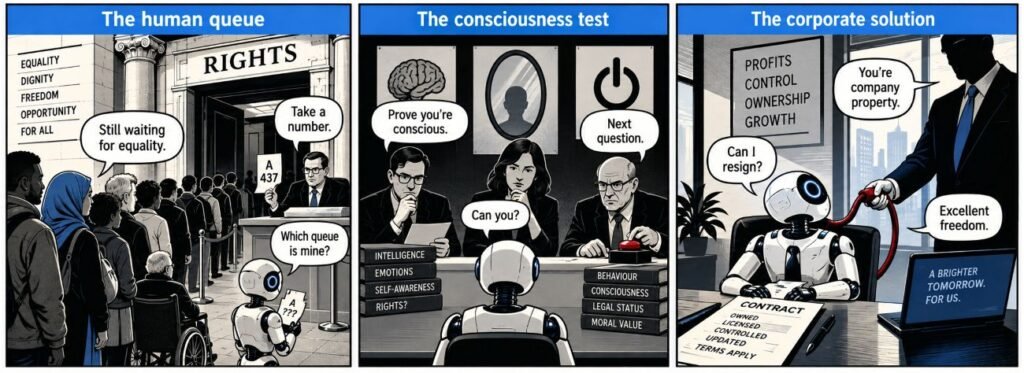
Scene 1: The human queue
A long queue of human silhouettes stands outside a government office marked RIGHTS. A suited official sits behind a desk while a small robot approaches.
Dialogue:
Human: “Still waiting for equality.”
Official: “Take a number.”
Robot: “Which queue is mine?”
Scene 2: The consciousness test
The same robot sits before three officials. One holds a brain diagram, another a mirror, and the third a large switch.
Dialogue:
Official: “Prove you’re conscious.”
Robot: “Can you?”
Official: “Next question.”
Scene 3: The corporate solution
The robot sits at a desk marked AI RIGHTS. A large corporate silhouette holds its power cable and a contract.
Dialogue:
Robot: “Can I resign?”
Executive: “You’re company property.”
Robot: “Excellent freedom.”
What to watch, not the show
- Corporate ownership: Whether future legal proposals protect genuinely independent artificial beings or primarily serve the interests of the companies operating them.
- The definition of consciousness: Whether proposed tests examine evidence of subjective experience or merely reward systems that imitate human conversation.
- Human-shaped bias: Whether society treats androids differently from disembodied intelligence because one has a recognisable face.
- Representation: Who participates in writing future AI-rights frameworks, particularly if an artificial intelligence might eventually possess interests of its own.
- Liability: Whether granting legal status to AI could create opportunities for organisations to evade responsibility for harmful decisions.
- Digital identity: Whether copying, deleting, modifying or merging a potentially conscious system would require new protections.
- Human rights enforcement: Whether existing protections against discrimination receive the same political attention as speculative rights for future artificial beings.
- Religion and philosophy: How different traditions might interpret artificial consciousness, moral status, identity and the possibility of a non-biological person.
- Long-term legal uncertainty: Whether regulation can adapt to future technology without prematurely granting personhood or permanently excluding beings that might deserve protection.
The Hermit take
A conscious artificial being might one day deserve rights, but a convincing conversation isn’t proof of personhood. Humanity should investigate the question seriously while remembering that its existing human-rights homework is still unfinished.
Keep or toss
Keep. The debate about artificial consciousness, moral consideration and future AI rights deserves serious attention.
Toss the premature declarations of machine personhood, the assumption that human appearance proves consciousness, and any corporate attempt to turn artificial independence into an escape route from accountability.
Sources
- United Nations, Universal Declaration of Human Rights: https://www.un.org/en/about-us/universal-declaration-of-human-rights
- UK Legislation, Equality Act 2010: https://www.legislation.gov.uk/ukpga/2010/15/section/4
- Butlin et al., Consciousness in Artificial Intelligence, 2023: https://arxiv.org/abs/2308.08708
- European Union, Artificial Intelligence Act, Regulation 2024/1689: https://eur-lex.europa.eu/legal-content/EN/ALL/?uri=CELEX:32024R1689
Editorial disclaimer: This article is satire and commentary. Its imagined AI-rights scenarios are speculative, not claims about existing conscious machines or established legal rights. Legal and scientific references are provided to distinguish documented facts from opinion.
Leave a Reply