
Lede
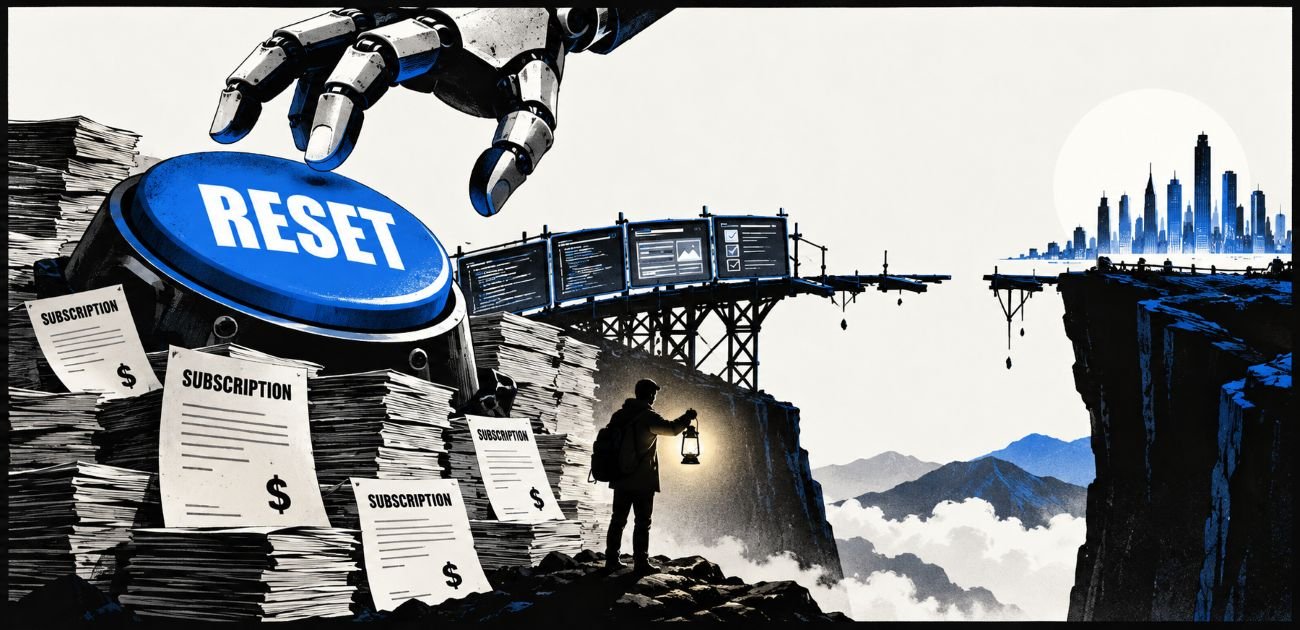
The latest AI subscription miracle is a refreshed usage allowance, although the unfinished work that consumed the previous one remains stubbornly unfinished.
Hermit Off Script
OpenAI’s newest party trick seems to be the reset button. Run into a limit, and depending on the plan, the offer, Tibo’s mood or an irresistible tickle in his reset finger, you might get a saved reset, an automatic reset or even one you can buy. Apparently, the future of artificial intelligence depends on how itchy someone’s finger feels that morning. Wonderful. I suppose the counter looks lovely afterwards. The work the agent failed to finish, rather less so. I don’t object to limits existing because computing power isn’t free, but I do object to paying for a subscription and then spending half my allowance repairing mistakes that the supposedly frontier model made with the other half. Meanwhile, the Anthropic chorus has been busy singing the praises of Opus 5.5 and whichever miraculous successor is expected next. Every fresh comparison seems to suggest that the competition is practically finished and limits are becoming ancient history. Except Opus 5.5 has already arrived, and Claude has limits and resets of its own. Apparently, both companies have discovered the calculator, although one may have better background music. What I want from a frontier model is fairly simple: finish the work. If an agent can take a complicated task, plan it, build it, check everything and deliver something that actually works in one proper run, that’s a genuinely superior model. If I have to spend another five hours explaining what it broke, repairing the repairs, checking whether anything was saved and repeating instructions it apparently forgot, then I’m the one doing the intelligent work. The model is just an expensive apprentice with an impressive CV. I want models that stop posing and build real things. Of course, nobody should expect every difficult task to succeed perfectly on the first attempt, but successful work should be the measure, rather than how much allowance a customer can burn through trying to get there. I’ve said before that the age of agents will eventually reward the company offering one understandable subscription, with capability and reasonable capacity organised into tiers, rather than making ordinary subscribers count tokens. Tokens won’t disappear technically, but I believe they’ll become increasingly irrelevant as a measure of value for the customer. People will want useful outcomes, whether that’s organising mundane daily chores, building applications, researching difficult subjects or handling work that currently requires an entire team. And if AI keeps improving at its present pace, I can imagine a future in which the cheapest basic model is far more capable than today’s expensive frontier systems. That is a possibility, not a timetable. Perhaps superintelligence will arrive, perhaps it will take much longer, but it raises something I’ve been considering whenever I think about algorithmic intelligence and the soul. What, exactly, will remain valuable about being human when extraordinary computational intelligence becomes ordinary? My own belief is that the answer may lie in those inner human qualities described in religious and spiritual traditions for thousands of years: the soul, the divine spark, whatever name we eventually give to that mysterious part of existence. I am not pretending its independent existence has been scientifically demonstrated. Quite the opposite. I hope that one day these questions can be examined and perhaps understood in ways accessible to everyone, rather than remaining matters of private experience associated with a handful of enlightened people. The machines may eventually solve problems that humanity can barely understand. Yet humanity might still be struggling to understand itself. One industry is trying to calculate the price of intelligence, while the other mystery is whether our deepest value can ever be calculated at all.
P.S. And here’s what these subscriptions are actually worth to me. On a day when I’m working seriously on a single task, I can burn through the useful allowance in just one day, and I don’t even consider myself a heavy user. I’ve tried every available thinking-effort setting, and in my experience GPT-6.1 Sol on Ultra gives me the best balance of intelligence, reasoning and repairing its own mistakes. Astra is a little smarter and better at certain difficult tasks, but its allowance can disappear within a few hours because it consumes so much more. That’s my experience, not some artificial benchmark designed to impress investors. Without occasional resets, even the $100 subscription doesn’t make financial sense for me, especially when I’m not earning money from the work these models help me produce. Anything above that price is simply out of the question. And here’s the uncomfortable part about the wonderful future of AI abundance everyone keeps promising. Those who can afford the most powerful tools will have more opportunities to create wealth, while those who cannot may fall further behind. The rich get richer, the poor get poorer, and intelligence becomes another advantage you can purchase by the month. Perhaps that will change. I certainly hope so. But until abundance becomes genuinely accessible to ordinary people, rather than another expensive privilege dressed up as progress, it’s still a myth. And apparently, even paradise has usage limits.
What does not make sense
- A company can restore an allowance in seconds, while the customer’s unfinished project still requires hours of repair.
- The marketing excitement around an allegedly superior model encourages the impression that constraints are disappearing, even though both OpenAI and Anthropic still operate usage limits.
- A model can win impressive benchmarks without necessarily completing a particular customer’s complicated project successfully.
- Subscribers can spend limited usage correcting mistakes produced by the service they’re already paying for.
- Companies sell subscriptions organised into tiers but still make customers worry about invisible consumption budgets.
- One model can be cheaper per token while becoming more expensive in practice if completing the work requires repeated attempts.
- The industry talks increasingly about artificial general intelligence and superintelligence while sometimes treating a successful demonstration as though it settled every question about reliability.
- The possibility of extraordinary machine intelligence does nothing by itself to establish whether machines possess consciousness, souls or the inner experiences humans associate with being alive.
Sense check / The numbers
- OpenAI has already experimented with multiple resets. On 3 and 4 September 2026, eligible subscribers received banked usage resets during the GPT-6 Astra launch. On 7 September, an automatic reset refreshed eligible limits. That makes 3 separate reset offers or events, but OpenAI explicitly says these do not permanently increase a subscription’s usage allowance. [OpenAI Help]
- The subscription tiers are becoming more expensive and more differentiated. OpenAI currently lists Pro subscriptions at $100, $200 and $500 per month. Its documentation also says qualifying existing Pro 200 subscribers retain their previous allowance until 29 October 2026, after which their included usage falls while the $200 monthly price remains unchanged. The price of a tier therefore does not necessarily guarantee an unchanged amount of work. [OpenAI Pro]
- Claude Opus 5.5 was released, and it was not unlimited. Anthropic launched Opus 5.5 on 22 September 2026, reporting that typical workloads cost 40 per cent less to run than Opus 5. The company also increased five-hour usage limits and offered subscribers a reset they could save. Those are genuine product improvements, according to Anthropic’s announcement, but they are not the abolition of limits. [Anthropic]
- Anthropic’s paid subscriptions also have limits. Claude applies usage allowances across five-hour sessions and weekly periods. The amount consumed depends on the model, task complexity, conversation length and reasoning effort. Paying for Claude therefore does not mean every agent can work indefinitely without interruption. [Claude Help]
- Tokens remain central to developer billing. OpenAI introduced its Agents API in public beta on 10 September 2026 and states that developers pay for the tokens and tools their agents use. That confirms token accounting remains part of the economics, even if finished tasks may become a more meaningful measure of customer value. [OpenAI Agents API]
The sketch
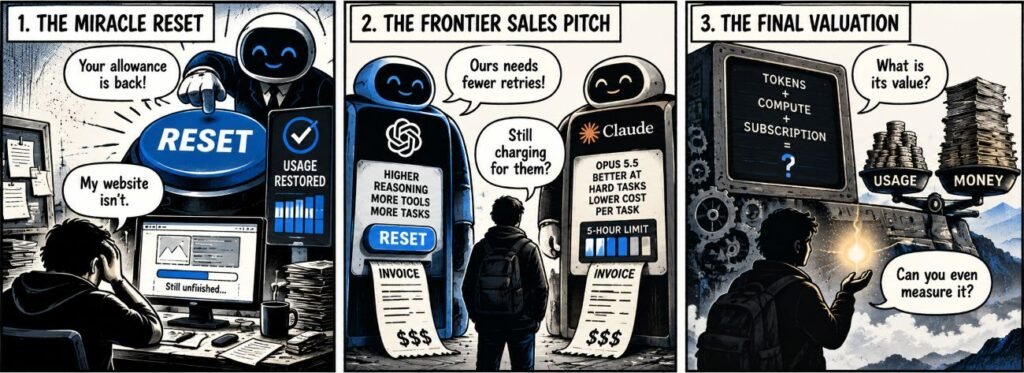
Scene 1: The miracle reset
A customer sits at a desk facing a computer displaying a half-finished website. Behind the desk, a large executive silhouette pulls a lever that restores a giant usage counter.
Dialogue:
Executive: “Your allowance is back!”
Customer: “My website isn’t.”
Scene 2: The frontier sales pitch
The same customer stands between two enormous AI subscription machines. One has a reset button, the other a five-hour timer. Both dispense invoices.
Dialogue:
Salesman: “Ours needs fewer retries!”
Customer: “Still charging for them?”
Scene 3: The final valuation
The customer stands beside a huge computer weighing stacks of tokens and money. A small point of light appears above the customer’s open hand, while the computer’s display remains blank.
Dialogue:
Machine: “What is its value?”
Human: “Can you even measure it?”
What to watch, not the show
- Cost per finished task. The meaningful comparison is the total expense of successful work, including retries, human corrections, testing and wasted time. OpenAI has itself argued for measuring the cost of completed outcomes rather than merely cheaper tokens.
- Subscription incentives. Whether companies reward efficient, dependable work or increasingly separate access into expensive tiers with less predictable allowances.
- Model reliability. Independent testing of full agent workflows, particularly work requiring memory, file management, software changes, verification and recovery from errors.
- The economics of basic intelligence. Whether today’s premium capabilities move into inexpensive models, making competition depend increasingly on reliability, integration and the ability to finish difficult jobs.
- Frontier AI access. Whether advanced capabilities become widely affordable or remain concentrated among businesses and individuals capable of purchasing the most expensive tiers.
- The human labour hidden in automation. Agents can appear exceptionally productive when someone else supplies the context, corrects their mistakes and verifies everything without that time appearing in the performance figures.
- Consciousness and human identity. As systems become more capable, philosophical and scientific questions about awareness, subjective experience and human value will matter more. Religious ideas of the soul and divine spark may remain meaningful ways to approach these questions, but spiritual conviction and scientific evidence must not be confused.
The Hermit take
Resetting the meter won’t finish the job.
Intelligence may become cheap. Human worth should never become another subscription tier.
Keep or toss
Toss.
Keep improvements that make agents more capable, reliable and accessible, including genuinely useful resets.
Toss the idea that refreshing an allowance counts as repairing a model’s mistakes. The future belongs to useful work, not to an increasingly elaborate system for charging customers while they supervise unfinished automation.
Sources
- OpenAI, Managing usage with GPT-6 Astra in Work and Codex: https://help.openai.com/en/articles/20001516-managing-usage-with-gpt-6-astra-in-work-and-codex
- OpenAI, About ChatGPT Pro tiers: https://help.openai.com/en/articles/9793128-about-chatgpt-pro-tiers
- Anthropic, Introducing Claude Opus 5.5, 22 September 2026: https://www.anthropic.com/claude-opus-5-5
- Claude Help Center, How usage and length limits work: https://support.claude.com/en/articles/11647753-how-do-usage-and-length-limits-work
- OpenAI, Introducing the Agents API, 10 September 2026: https://openai.com/index/introducing-the-agents-api/
- OpenAI, A scorecard for the AI age, 17 July 2026: https://openai.com/index/a-scorecard-for-the-ai-age/
Disclaimer: Satire and commentary based on publicly available information as of 19 October 2026. Predictions about future AI capabilities and subscription economics are speculative. Reflections on souls, spirituality and divine consciousness represent philosophical beliefs, not established scientific findings.
Leave a Reply