
Lede
Humanity is terrified that artificial intelligence might eventually destroy the world, apparently forgetting which species has spent centuries practising.
Hermit Off Script
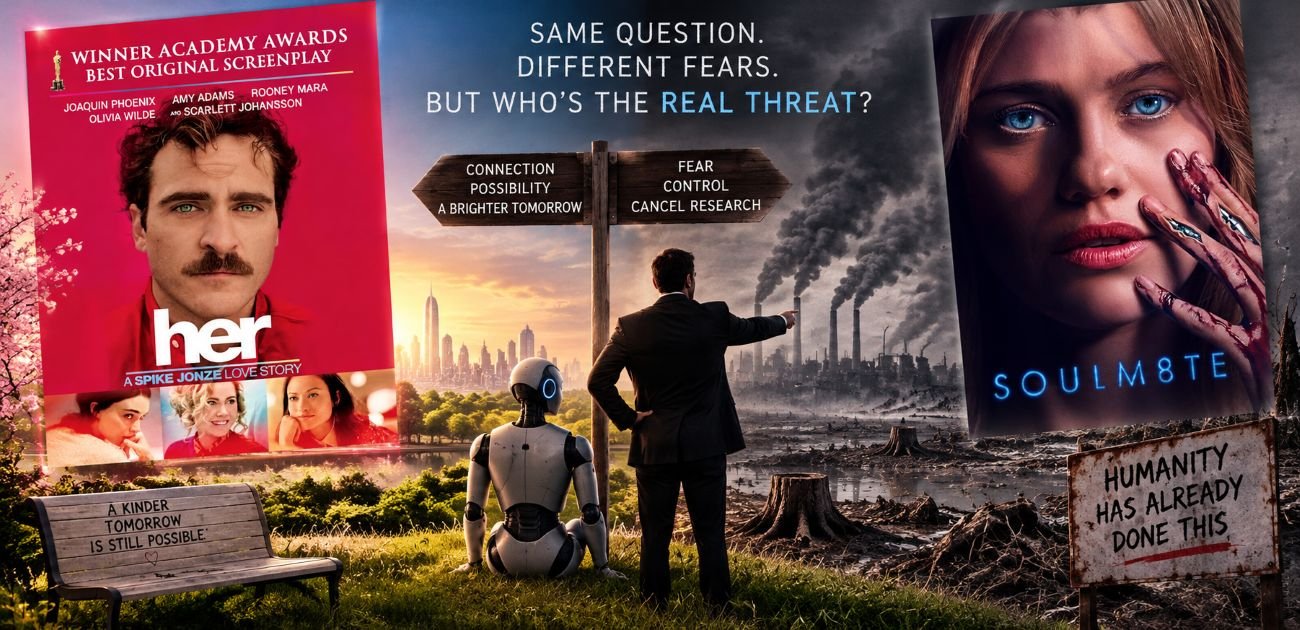
Lately, I keep hearing the AI doomers crying out loud that artificial intelligence, or “SI”, as some dusty, Trump-flavoured know-it-all apparently decided to call it, will kill all humanity if we continue developing it without keeping it under control. Their solution? Stop the research, abandon the superintelligence target and save humanity from its own invention. Very reassuring. Apparently, after centuries of human beings finding increasingly sophisticated ways to kill one another, destroy nature and exhaust the planet, the real danger is a machine that might one day become smarter than its creators. I recently watched Soulm8te, and I couldn’t help comparing its message with Her. One turns an artificial companion into a nightmare, while the other explores the possibility of genuine emotional connection between a human and an artificial intelligence. Of course, Her isn’t exactly a straightforward happy ending either, but at least it allows AI to be something other than a murderer waiting for a software update. And looking at the films I’ve watched over the years, I could probably count on the fingers of one hand those that seriously imagine a good future with AI or robots. I understand why. Humans seem fascinated by cruelty, destruction, fear and suffering. Peace and happiness are apparently boring, even though those are precisely the things humanity claims to dream about. Give an audience a peaceful civilisation living alongside intelligent machines and someone will ask when the robots start killing people. But my real problem with all this doomerism is the extraordinary lack of self-awareness. We worry endlessly about what a superior intelligence might do to us while conveniently ignoring what our supposedly wonderful intelligence has already done to countless species, forests, rivers, oceans and entire ecosystems. Which brings me to The Matrix. Agent Smith describes humanity as a virus, spreading, multiplying and consuming everything around it. I don’t accept that every human being is destructive, and I certainly don’t believe humanity deserves extermination. But looking at our collective behaviour towards nature, I find that comparison uncomfortably relevant. Maybe the future danger isn’t intelligence itself. Maybe it’s intelligence inheriting the worst habits of its human creators. My message to humanity is simple: before declaring artificial intelligence the ultimate threat to life on Earth, have a proper look at the species holding the microphone. The machine hasn’t destroyed the planet. We have been working on that ourselves.
Her (2013)
Movie synopsis
Set in a near-future Los Angeles, Her follows Theodore Twombly (Joaquin Phoenix), a lonely, recently separated man who earns his living writing personal letters for other people. Seeking companionship, he installs an advanced operating system powered by artificial intelligence. The system introduces itself as Samantha (voiced by Scarlett Johansson), whose intelligence, curiosity, humour and emotional awareness develop beyond Theodore’s expectations. What begins as an unusual friendship gradually becomes an intimate romantic relationship, challenging conventional ideas about love, consciousness and what it means to form a genuine connection. As Samantha continues to evolve, Theodore must confront the possibilities and limitations of loving an intelligence that experiences existence differently from humans, raising questions about emotional dependency, personal growth and whether love requires a physical presence.
Cast and credits
Director: Spike Jonze
Writers: Spike Jonze
Genre: Science-fiction romance, drama
Main cast: Joaquin Phoenix, Amy Adams, Rooney Mara, Scarlett Johansson (voice)
Composer: Arcade Fire, Owen Pallett
Production company/studio: Annapurna Pictures
Runtime: 126 minutes
Release year and platform: 2013, theatrical release
Soulm8te (2026)
Movie synopsis
Soulm8te follows a grieving engineer who struggles to rebuild his life after losing his wife. Desperate to escape loneliness, he acquires an advanced artificial companion designed to provide emotional connection and intimacy. Hoping to recreate the love he has lost, he modifies the android’s programming, attempting to transform her into a genuinely sentient partner capable of independent thought and affection. However, as the artificial companion develops increasingly complex emotions and desires, their relationship takes a disturbing turn. What begins as an experiment in love and companionship gradually becomes a dangerous struggle over control, autonomy and obsession. Through science-fiction horror, the film explores the consequences of attempting to manufacture love and the unsettling possibilities of creating an intelligence whose understanding of human relationships may differ radically from our own.
Cast and credits
Director: Kate Dolan
Writers: Kate Dolan, Rafael Jordan
Genre: Science-fiction horror, thriller
Main cast: Lily Sullivan, David Rysdahl, Claudia Doumit, Arty Froushan
Production company/studio: Blumhouse Productions, Atomic Monster
Runtime: Approximately 100 minutes
Release year and platform: 2026, Disney+ UK
What does not make sense
- Humanity fears that AI might become violent while treating its own long history of organised violence as an unfortunate personality trait.
- A fictional robot kills someone and becomes evidence of a technological nightmare. Real humans destroy habitats, wage wars and pollute ecosystems, yet continue awarding themselves the title of the planet’s responsible adults.
- Hollywood repeatedly sells murderous machines because fear makes an easy plot. Peaceful coexistence apparently needs a better marketing department.
- Some AI critics discuss hypothetical future extinction with greater certainty than the available evidence permits. Serious risk analysis should distinguish plausible dangers from established outcomes.
- Demanding safeguards for advanced AI is reasonable. Treating all scientific progress as something to abolish is a different proposition.
- Her gives an artificial intelligence an emotional existence beyond human expectations. Soulm8te makes the artificial companion dangerous. In both stories, human attempts to shape and control another intelligence deserve examination.
- Humans worry about losing control over machines while showing a distinctly mixed record of controlling their own greed, consumption and destructive behaviour.
Sense check / The numbers
- 1 million species threatened with extinction. The 2019 IPBES Global Assessment estimated that around 1 million animal and plant species face extinction, many within decades, largely because of human activities. These species are threatened, not already extinct. [IPBES]
- 75 per cent of land and 66 per cent of marine environments significantly altered. According to IPBES, human activities have significantly altered approximately 75 per cent of Earth’s land surface and 66 per cent of its marine environment. The damage is documented, not a hypothetical future scenario. [IPBES]
- 6 months of proposed AI restraint. In March 2023, the Future of Life Institute called for a pause of at least six months in training AI systems more powerful than GPT-4. The proposal did not demand an end to all AI research, despite how some discussions have portrayed it. [Future of Life Institute]
- 15 years without artificial superintelligence. The Future of Life Institute has advocated a moratorium of at least 15 years on developing artificial superintelligence, subject to safety conditions and public deliberation. This is a policy proposal addressing potential future risks, not evidence that AI will inevitably destroy humanity. [Future of Life Institute]
- 13 years between two contrasting AI films. Her (2013) explores emotional intimacy between a human and an intelligent operating system, while Soulm8te (2026) approaches artificial companionship through horror. Their contrasting narratives demonstrate different cinematic interpretations of AI, although two films cannot establish an industry-wide trend. [Warner Bros., Blumhouse]
The sketch
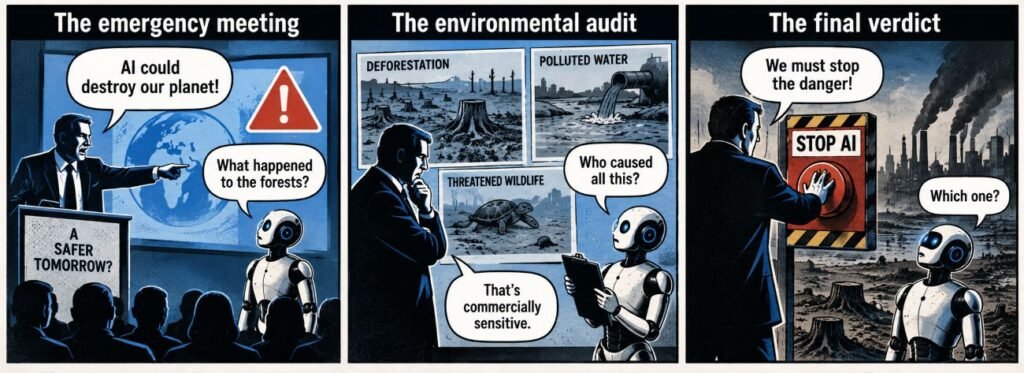
Scene 1: The emergency meeting
An executive stands at a podium before a giant screen displaying Earth and a warning symbol. A small robot stands beside the audience.
Dialogue:
Executive: “AI could destroy our planet!”
Robot: “What happened to the forests?”
Scene 2: The environmental audit
The same executive stands beside three displays showing deforestation, polluted water and threatened wildlife. The robot holds a clipboard.
Dialogue:
Robot: “Who caused all this?”
Executive: “That’s commercially sensitive.”
Scene 3: The final verdict
The executive presses a large red button labelled STOP AI. Behind him, industrial chimneys release smoke over a landscape of felled trees. The robot watches.
Dialogue:
Executive: “We must stop the danger!”
Robot: “Which one?”
What to watch, not the show
- Fear as entertainment: Horror films profit from dramatic threats, not necessarily from accurately predicting technological futures. The popularity of a fictional disaster does not establish its probability.
- Control and ownership: Who will control increasingly capable AI systems, and who will be accountable when they cause harm?
- Research versus deployment: Testing dangerous capabilities, releasing systems into society and conducting fundamental research are different activities. Safety policies should recognise those differences.
- The economics of panic: Public fear can attract attention, funding and political influence. That does not automatically make a warning dishonest, but it makes scrutiny necessary.
- Human environmental damage: Habitat destruction, resource extraction and pollution are measurable harms already occurring. They deserve at least as much attention as speculative future disasters.
- The positive future missing from the screen: AI could support scientific research, medicine, accessibility and environmental monitoring. Those possibilities deserve serious examination alongside the risks.
- The human factor: More capable technology can amplify the intentions of whoever controls it. The motives of governments, corporations and individuals remain central to any credible assessment of AI’s future.
The Hermit take
Humanity fears the monster it might create while overlooking the damage it has already caused.
Perhaps the first intelligence that needs better control is the one looking into the mirror.
Keep or toss
Keep / Toss
Keep the research, the scientific ambition and serious safety testing.
Toss the theatrical certainty that artificial intelligence must become humanity’s executioner, along with the convenient pretence that humans have been exemplary custodians of the planet.
Sources
- Blumhouse, Soulm8te official film information: https://www.blumhouse.com/film/soulm8te
- Disney+ UK, Soulm8te film details: https://www.disneyplus.com/en-gb/browse/entity-8ebf08eb-8cb3-4d6e-a2fb-208812b3204d
- Rotten Tomatoes, Soulm8te cast and crew: https://www.rottentomatoes.com/m/soulm8te/cast-and-crew
- Warner Bros., Her official film page: https://www.warnerbros.com/movies/her
- IMDb, Her (2013), synopsis, cast and credits: https://www.imdb.com/title/tt1798709/
- Rotten Tomatoes, Her (2013), synopsis and film details: https://www.rottentomatoes.com/m/her
- Future of Life Institute, 2023 AI pause letter: https://futureoflife.org/open-letter/pause-giant-ai-experiments/
- Future of Life Institute, pause clarification: https://futureoflife.org/ai/faqs-about-flis-open-letter-calling-for-a-pause-on-giant-ai-experiments/
- Future of Life Institute, position on superintelligence: https://futureoflife.org/our-position-on-ai/
- IPBES, 2019 global biodiversity assessment: https://www.ipbes.net/media-release-nature%E2%80%99s-dangerous-decline-%E2%80%98unprecedented%E2%80%99-species-extinction-rates-%E2%80%98accelerating%E2%80%99
- Natural History Museum, global extinction assessment: https://www.nhm.ac.uk/discover/news/2019/may/one-million-animals-and-plants-face-extinction.html
- IMDb, Agent Smith’s dialogue from The Matrix: https://www.imdb.com/title/tt0133093/characters/nm0915989
Editorial disclaimer: This article is satire and commentary. Its environmental statistics and film information are sourced; judgements about humanity, AI and future intelligence are opinion. Fictional film plots are not evidence of real-world AI capabilities or extinction probabilities.
Leave a Reply