Lede
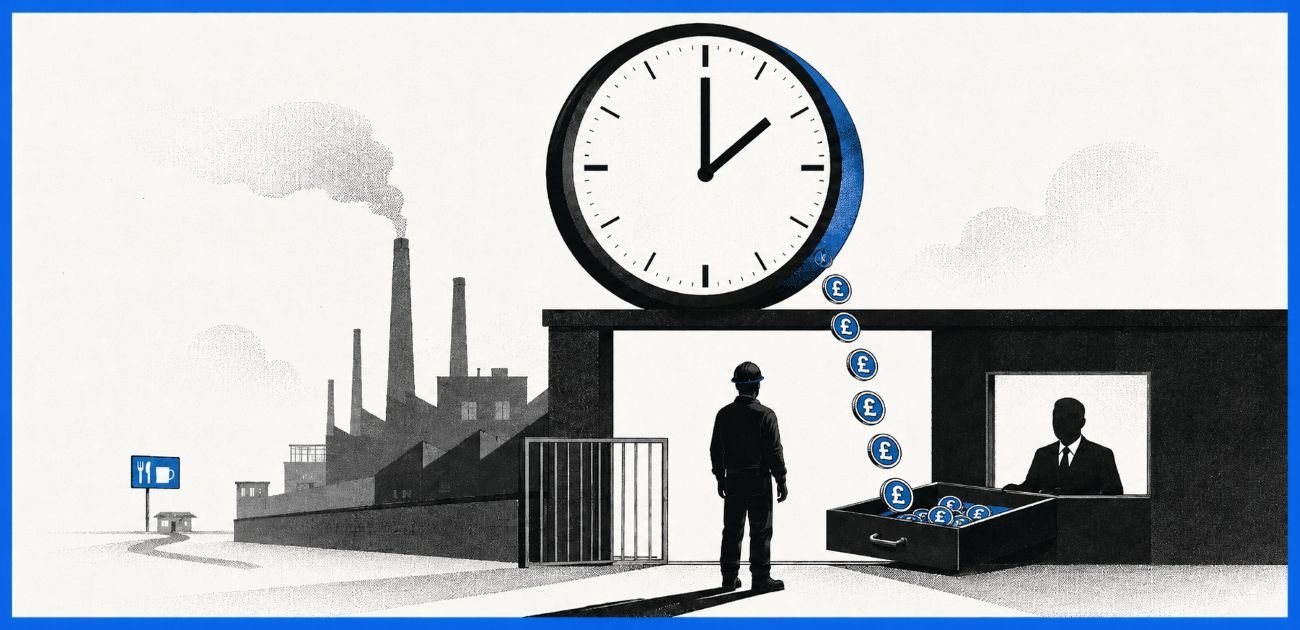
A workplace cannot praise wellbeing while treating the worker’s time like loose change found behind the sofa.
Hermit Off Script
Work is not only about money, but money is where respect first shows its face. A company can talk about wellbeing, family values and comfort, but the real sermon starts at the clocking machine. If we arrive early and stand around before the official start, that time quietly belongs to the company. If we are late by 1 minute, suddenly time becomes sacred, audited, deducted and probably wearing a tie. The same thing happens at the end of the shift. Stay a few minutes longer and it is called team spirit. Leave a few minutes early and your life becomes an admin investigation with shoes. Break time has its own little theatre. If the break is paid, it becomes the Achilles heel of the worker. The company can allow a break that looks fine on paper, but if the walk from the line to the canteen eats half of it, the sandwich is already under management review. You say the break is too short to eat like a human being and suddenly you are difficult. Stay longer than allowed and the clock becomes a courtroom. Comment on the break and you have committed the ancient sin of noticing reality. Overtime is the same magic trick with different lighting. Some companies pay extra hours at normal wage, some pay time and a half, and some pay double. The law leaves too much space for contracts to do the heavy lifting, and contracts are often written as if workers are furniture with a pulse. I understand that a company needs profit. Bills do not get paid with spiritual incense. But if profit comes from short wages, cheap materials, squeezing breaks, stretching shifts and still calling it “customer first”, then the business model is not clever. It is just tired. If a business cannot survive without nibbling at the worker’s unpaid minutes, maybe it is not alive. Maybe it is being kept warm by other people’s time. Then comes the pension, the grand gamble with retirement money. Many workers in hard jobs spend their health before they ever reach the soft chair promised at the end. The safer jobs, the office jobs, the management jobs, often seem designed to leave more body intact for later. The people who lift, stand, sweat, breathe dust, rush lines and carry the place on their knees are told to wait longer. Work until the state says you may rest, and hope your body agrees with the government calendar. And soon the robots will come smiling in polished metal, or more likely without a smile because smiles cost extra. This is not a prediction, more like the moral direction of the argument: if automation takes jobs and society builds no guardrails, then we are not creating progress. We are creating the next class of billionaires and trillionaires while the people who kept the old machines running are asked to be grateful for a 20-minute break they spent walking to the canteen.
What does not make sense
- The company can enjoy your early arrival as “readiness”, but punish your late arrival as a financial event.
- A few unpaid minutes after the shift are treated as loyalty, while a few minutes before leaving are treated as rebellion.
- Break time can exist on paper while the real break is eaten by walking distance, queues and clock pressure.
- Overtime can be essential to production and still treated as optional when the pay rate is discussed.
- A business can claim “customer first” while saving money on workers, materials and time.
- Pension policy assumes a neat average life, while hard jobs spend the body unevenly.
- Automation is sold as progress, but without protection it becomes a transfer of risk from owners to workers.
Sense check / The numbers
- From 1 April 2026, the National Living Wage for workers aged 21 and over is GBP 12.71 an hour. [GOV.UK]
- For minimum wage purposes, time usually counts when a worker is at work and required to be there, or available for work at or near the workplace. [GOV.UK]
- Adult workers are usually entitled to 1 uninterrupted 20-minute rest break if they work more than 6 hours a day, but the break does not have to be paid unless the contract says so. [GOV.UK]
- UK employers do not have to pay an overtime premium by law, but average pay for the total hours worked must not fall below the National Minimum Wage. [GOV.UK]
- The State Pension age is rising from 66 to 67 between 2026 and 2028, while UK healthy life expectancy in 2022 to 2024 was 60.7 years for males and 60.9 years for females. [GOV.UK / ONS]
- The World Economic Forum’s 2025 jobs report projected 170 million new jobs and 92 million displaced jobs globally by 2030. [WEF]
The sketch
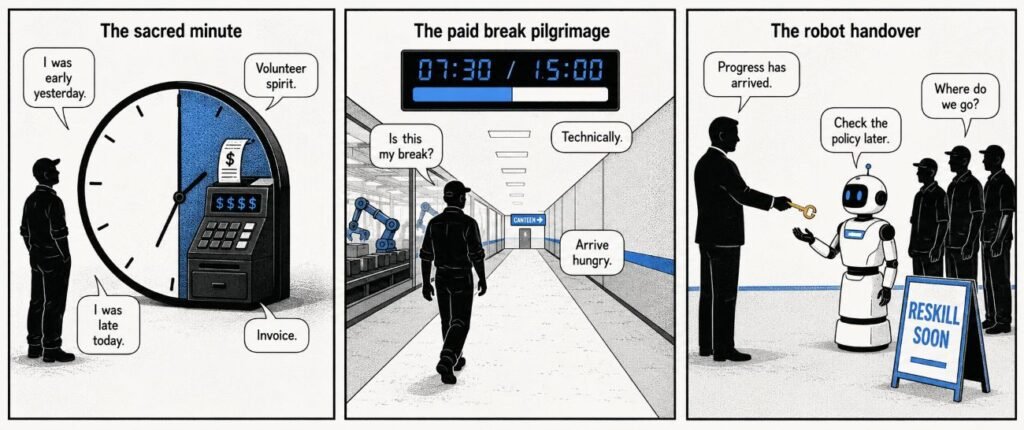
Scene 1: The sacred minute
A worker stands by a giant clock. The early side of the clock is blank. The late side has a cash register attached.
Dialogue:
Worker: “I was early yesterday.”
Clock: “Volunteer spirit.”
Worker: “I was late today.”
Clock: “Invoice.”
Scene 2: The paid break pilgrimage
A worker walks from a factory line through a long corridor towards a tiny canteen sign. A timer above the corridor is already halfway gone.
Dialogue:
Worker: “Is this my break?”
Timer: “Technically.”
Canteen: “Arrive hungry.”
Scene 3: The robot handover
A robot receives a gold key from a manager while workers stand beside a sign reading “Reskill soon”.
Dialogue:
Manager: “Progress has arrived.”
Worker: “Where do we go?”
Robot: “Check the policy later.”
What to watch, not the show
- Unpaid preparation time dressed up as discipline.
- Automatic deductions that hit workers harder than managers admit.
- Break policies that ignore walking time, queues and production pressure.
- Overtime clauses that protect the company before the worker.
- Wage floors being treated as a moral ceiling.
- Pension age rises rubbing against falling healthy life expectancy.
- Automation gains going to owners while workers carry the disruption.
- Weak worker voice when management changes and cost-cutting becomes the culture.
The Hermit take
Pay the minutes, protect the breaks, and stop pretending respect is a poster.
If a company needs unpaid time to survive, the worker is not the problem.
Keep or toss
Keep / Toss.
Keep profit that pays people properly.
Toss the quiet habit of making workers donate minutes and health to the spreadsheet.
Sources
- UK National Minimum Wage and National Living Wage rates: https://www.gov.uk/national-minimum-wage-rates
- GOV.UK minimum wage working hours guidance: https://www.gov.uk/guidance/calculating-the-minimum-wage/working-hours-for-which-the-minimum-wage-must-be-paid
- GOV.UK rest breaks overview: https://www.gov.uk/rest-breaks-work/overview
- GOV.UK overtime rights: https://www.gov.uk/overtime-your-rights
- GOV.UK pay deductions guidance: https://www.gov.uk/understanding-your-pay/deductions-from-your-pay
- GOV.UK State Pension age timetable: https://www.gov.uk/government/publications/state-pension-age-timetable/state-pension-age-timetable
- ONS healthy life expectancy, UK, 2022 to 2024: https://www.ons.gov.uk/peoplepopulationandcommunity/healthandsocialcare/healthandlifeexpectancies/bulletins/healthstatelifeexpectanciesuk/between2011to2013and2022to2024
- World Economic Forum Future of Jobs Report 2025: https://www.weforum.org/publications/the-future-of-jobs-report-2025/in-full/2-jobs-outlook/