
Lede
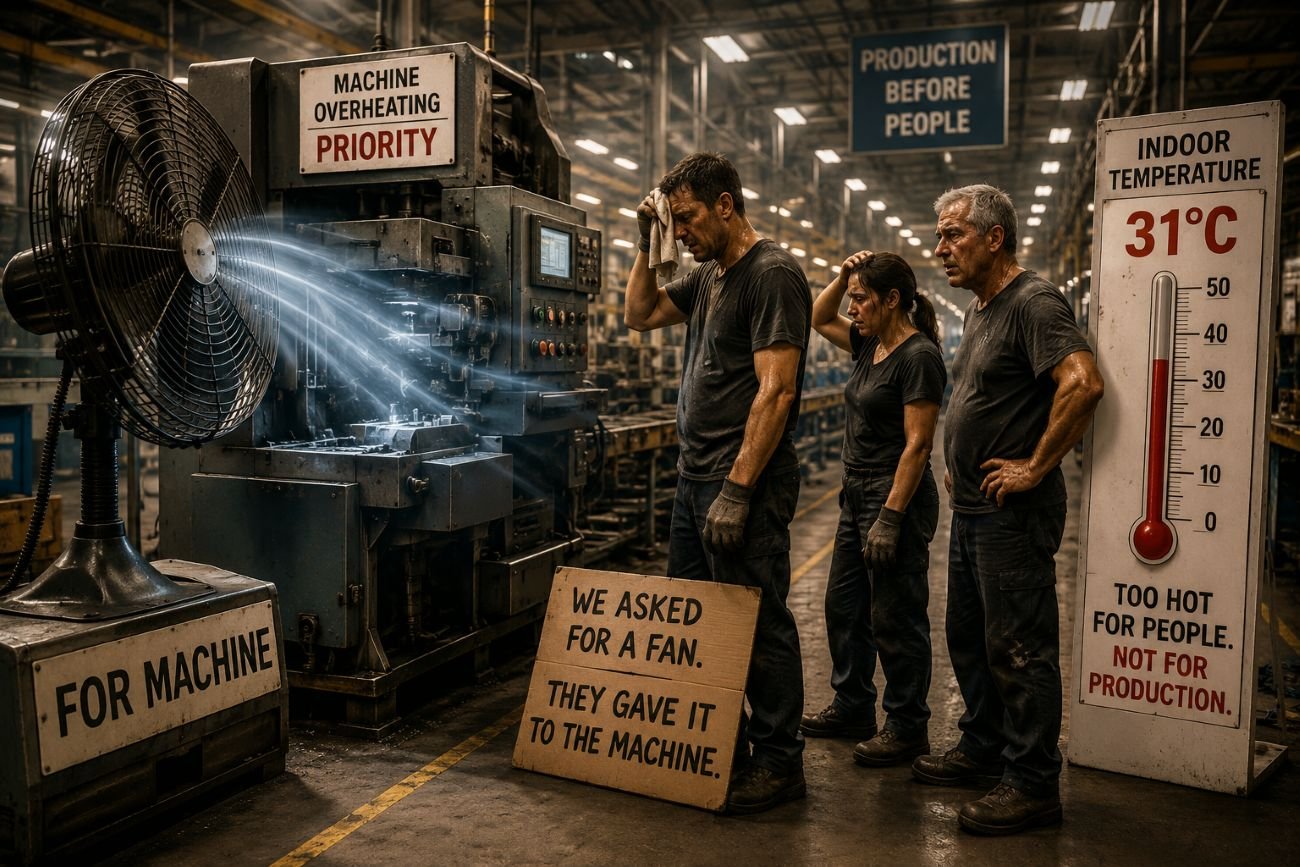
A workplace where the machine gets the fan before the worker has already written its own HR policy.
Hermit Off Script
Best company line ever: people ask for a fan because it is too hot inside, above 31 degrees C, and the answer comes back like a wet invoice to the soul: “The fan is for the machine because it is overheating.” Beautiful. The machine overheats and receives protection. The worker overheats and receives endurance training with a payslip. I honestly don’t know how people keep working in this kind of place, except of course I do know. They need money. Rent does not accept dignity as payment. Bills don’t care if your body is being slowly cooked beside a machine that apparently has better rights because it beeps louder. This is the polite modern version of bondage: not chains, just wages low enough and living costs high enough that “choice” becomes theatre. I know “modern slavery” is a serious legal phrase, so I am using it here as moral commentary, not as a court filing. But the feeling is clear. Freedom on paper, pressure in the lungs. Until government sets real rules that say people should not work under dangerous heat, companies will keep discovering that “reasonable” is a very elastic word when profit is pulling it. And every year this will probably get worse as heatwaves become more common. This is also why some countries and companies dislike the European Union’s worker protections. Protecting people interrupts the worship service of money. A machine gets a fan because it must keep producing. A human gets advice because apparently breathing is still their own responsibility.
P.S. And the cleanest punchline is this: in the end, the worker said, “I must go home then.” Suddenly the cooler found a new purpose in life. The sacred machine fan became a human fan, not because the worker was too hot, but because the line would have stopped. There it is, naked as a factory clock: the person mattered only when production was about to suffer.
P.P.S. This is why workplace conditions cannot be left to company kindness. Make it a legal requirement: if people work there, the space must be safe to work in, no matter what it costs. Machines get maintenance schedules. Workers get motivational posters. That is not management. That is civilisation with a budget cut.
What does not make sense
- The machine overheating is treated as an emergency, while the worker overheating is treated as a mood.
- The company can find cooling when equipment is at risk, but becomes a philosopher when humans ask for the same air.
- The word “reasonable” works nicely until the person defining it is not the one sweating.
- A workplace can measure machine temperature precisely, yet somehow human heat becomes vague and negotiable.
- “Democratic freedom” means very little when the worker’s real choices are heat, debt, or unemployment.
- Climate change is making hot work more dangerous, while too many policies still behave like summer is a surprise guest.
Sense check / The numbers
- In the UK, there is no legal maximum workplace temperature, but HSE says heat is a hazard and employers must assess risks and put controls in place. [HSE]
- GOV.UK says indoor workplace temperatures must be “reasonable”, but also says there is no law for a minimum or maximum working temperature and no guidance for a maximum limit. [GOV.UK]
- HSE guidance suggests indoor workplaces should normally be at least 16 degrees C, or 13 degrees C where work involves rigorous physical effort, yet there is no matching upper number. [HSE]
- The TUC has proposed action above 24 degrees C where workers feel uncomfortable, and a stop-work limit of 30 degrees C, or 27 degrees C for strenuous work. The Commons Library also notes that the Climate Change Committee recommended maximum temperature regulations for work in 2026. [Commons Library]
- EU-OSHA said around 1 in 5 workers across the EU faced extreme heat on the job in the previous 12 months, while Euronews reported ETUI figures of 130 million European workers exposed to workplace heat stress, with 277,000 related injuries and 230 deaths annually. [EU-OSHA] [Euronews]
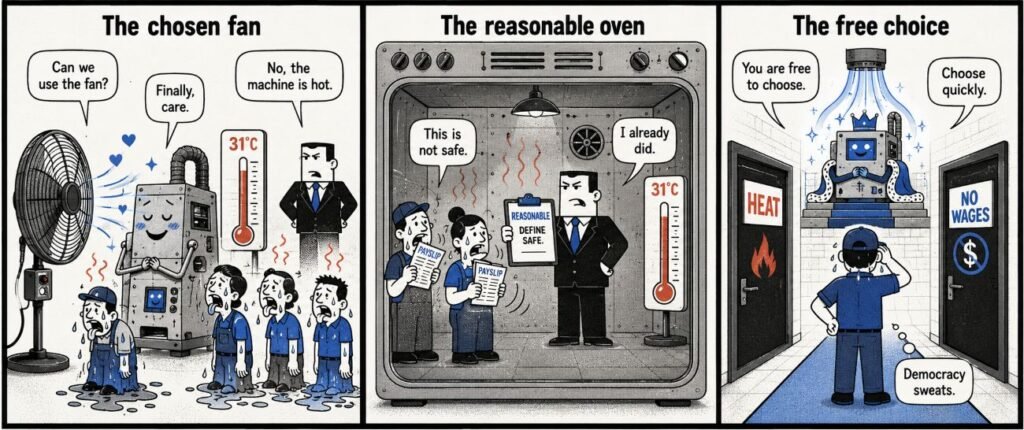
The sketch
Scene 1: The chosen fan
A large fan points lovingly at a sweating machine. Three workers stand behind it, melting into little puddles beside a thermometer reading 31 degrees C.
Dialogue:
Worker: “Can we use the fan?”
Manager: “No, the machine is hot.”
Machine: “Finally, care.”
Scene 2: The reasonable oven
A manager stands in an indoor workspace shaped like an oven, holding a clipboard labelled “reasonable”. Workers fan themselves with payslips.
Dialogue:
Worker: “This is not safe.”
Clipboard: “Define safe.”
Thermometer: “I already did.”
Scene 3: The free choice
A worker stands between two doors. One says “heat”. The other says “no wages”. Behind them, a machine sits under cool air like royalty.
Dialogue:
Company: “You are free to choose.”
Rent: “Choose quickly.”
Worker: “Democracy sweats.”
What to watch, not the show
- Employers who treat equipment downtime as urgent and worker discomfort as personal weakness.
- Health and safety law that depends on “reasonable” without a clear upper limit.
- Old buildings, warehouses and production floors built for yesterday’s weather.
- Heat policies that mention water and breaks, but don’t change targets, shifts or staffing.
- Workers with the least power being asked to carry the highest physical risk.
- Political resistance to binding rules because voluntary kindness is cheaper on paper.
- The coming fight over whether heat is a weather problem or a labour rights problem.
The Hermit take
The machine got the fan because the machine has a price tag.
The worker only has a pulse, and apparently that needs a policy review.
Keep or toss
Verdict: Toss.
Toss any workplace where overheating equipment gets urgency and overheating people get philosophy.
Sources
- HSE, Temperature in the workplace: What the law says: https://www.hse.gov.uk/temperature/employer/the-law.htm
- GOV.UK, Workplace temperatures: https://www.gov.uk/workplace-temperatures
- House of Commons Library, Working in hot weather: What does the law say?: https://commonslibrary.parliament.uk/research-briefings/cbp-10925/
- EU-OSHA, Heat at work: Preventing illness and protecting workers: https://osha.europa.eu/en/highlights/heat-work-preventing-illness-and-protecting-workers
- Euronews, Heat stress threatens 130 million European workers: https://www.euronews.com/my-europe/2026/06/25/heat-stress-threatens-130-million-european-workers-trade-union-body-warns
- Copernicus, European State of the Climate 2025: https://climate.copernicus.eu/esotc/2025
- The Guardian, Unions in Europe press for new worker protections to counter heat stress: https://www.theguardian.com/environment/2026/jul/08/unions-europe-worker-protections-heat-stress-climate-crisis