
Lede
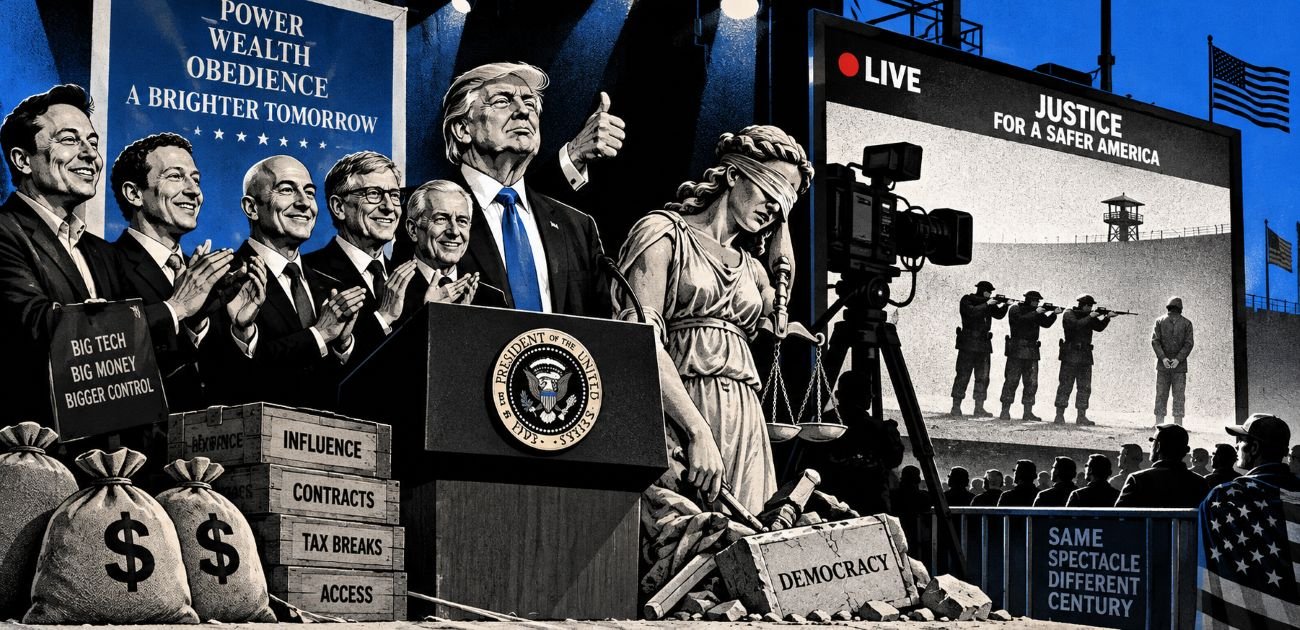
The Trump administration wants to livestream a firing squad execution, apparently having decided that justice in the world’s most powerful democracy now requires an audience.
Hermit Off Script
For some time, I’ve genuinely wanted to forget about Donald Trump. Trump, Dump or Dumb, whichever happens to fit the day’s events. Frankly, keeping up with the appropriate nickname is becoming a full-time occupation, and I’d rather spend my remaining years doing something more useful. But lately, watching this return to the public display of violence and cruelty, I’ve found it increasingly difficult to keep quiet. There are things that bother the mind, and then there are things that bother the soul. This particular development manages both.
I understand that criminals, including those responsible for the worst atrocities our society produces, deserve punishment. And yes, society produces them. We seem remarkably keen to forget that inconvenient detail whenever discussing the monsters who emerge from it. I can understand why people believe certain crimes deserve the harshest possible sentence, even death, although that remains a serious moral question in itself. But turning an execution into a publicly broadcast spectacle? That’s another chapter entirely. That’s where I begin to wonder how far one of the world’s greatest democratic countries intends to travel backwards before somebody notices the direction.
I thought we had already learnt something from centuries of public executions, cheering crowds and governments demonstrating their power over human bodies. Apparently, I was being optimistic. The Trump administration now wants to offer the modern equivalent, complete with cameras, internet distribution and, presumably, somebody checking whether the viewing figures are satisfactory. What exactly are we supposed to learn from watching a human being killed by the state? That murder is wrong, unless the government organises the broadcast?
And I fear what comes next. With elections approaching and American politics becoming increasingly hostile, I worry that the country I once associated with opportunity, freedom and democratic ambition is being dragged further down a dangerous road. The word “regime” used to feel excessive when describing an American government. Under Trump’s second term, I find myself reaching for it more often. That’s my political judgement, not a declaration that American democracy has already disappeared. But when political leaders seem more fascinated by the methods of strongmen than by the patient work of democratic government, I think the warning deserves to be heard.
I look at Iran, North Korea and other authoritarian states, where governments have used fear, punishment and public displays of power to remind people who controls their lives. I’m not claiming America has become North Korea. That would be absurd. I’m asking why an American administration would borrow even the appearance of practices that democratic societies ought to have left behind. Why celebrate the spectacle of state violence instead of defending education, democratic institutions, civic responsibility and respect for others?
And then there is the wealthy entourage. The billionaires, the political financiers, the powerful friends and the family interests. I increasingly see an uncomfortable resemblance to the oligarchic arrangements surrounding authoritarian leaders, where wealth buys proximity to government and political influence helps protect wealth. I don’t believe every wealthy Trump supporter is corrupt, but I certainly don’t believe a democracy becomes healthier when enormous private fortunes gather around political power while ordinary citizens are encouraged to applaud another demonstration of strength.
What troubles me most is the direction. America was never perfect, and pretending otherwise would insult its history. But for generations, it represented something extraordinary to people watching from elsewhere: a country where freedom, possibility and democratic ideals could offer a better future. I don’t want to see that promise reduced to a government-sponsored spectacle of death.
I once looked towards America and saw a dream of freedom. Now I’m being invited to watch a firing squad.
What does not make sense
- A government claims it wants to demonstrate the seriousness of killing by arranging for the public to watch a killing.
- Pete Hegseth presents public visibility as a deterrent, although broadcasting an execution does not establish that it will prevent future murders.
- The United States has spent decades condemning authoritarian displays of punishment. Its own military leadership now proposes putting an execution online.
- An execution already governed by military law becomes an opportunity for political theatre, while legal appeals remain unresolved.
- The administration claims to defend civilisation against barbarism, then proposes reviving the public spectacle that modern justice largely abandoned.
- Trump has condemned public executions in Iran. A proposed American livestream makes that criticism considerably harder to deliver without embarrassment.
- The victims and their families deserve justice and dignity, not to have their suffering turned into an international broadcast event.
Sense check / The numbers
- 13 people were killed and 32 injured when Nidal Hasan opened fire at Fort Hood, Texas, on 5 November 2009. He was convicted and sentenced to death in 2013. The seriousness of his crimes is not in dispute; the proposed public broadcast is a separate question. [BBC, AP]
- 3 December 2026 is the announced date for Hasan’s execution by firing squad. The Pentagon has proposed livestreaming it, but Trump said on 10 October that he would make a final decision, and outstanding legal proceedings could delay or prevent the execution. A public broadcast has not yet occurred. [BBC, Reuters, Washington Post]
- 1961 was the year of the last US military execution. The last American military execution by firing squad occurred in 1945. The proposed event would therefore break with many decades of military practice. [BBC, Reuters]
- 17 public executions were documented by Amnesty International in 2025 across Iran and Afghanistan: 11 in Iran and 6 in Afghanistan. The figures illustrate how unusual public executions have become, although reporting limitations mean they are not necessarily a complete global count. [BBC, AP]
- 13 federal executions took place during the final months of Trump’s first presidential term, after a 17-year federal execution hiatus. His second administration has also explicitly sought to expand use of the federal death penalty. Those policies concern capital punishment; they do not establish a legal or moral justification for livestreaming it. [BBC]
The sketch
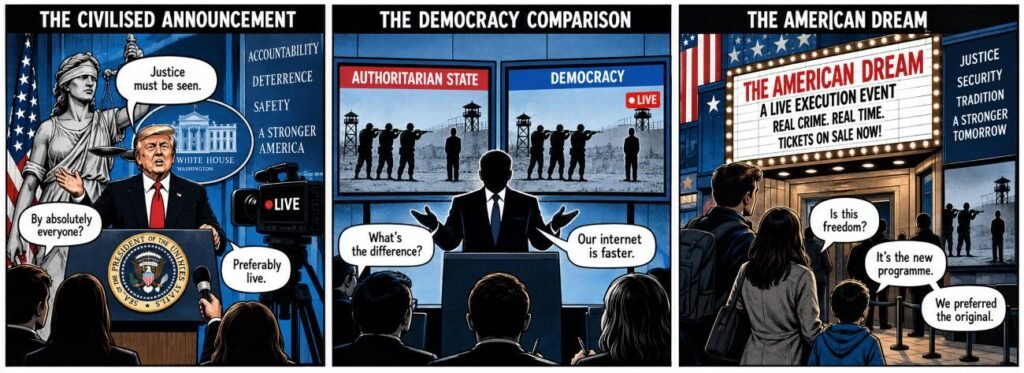
Scene 1: The civilised announcement
A presidential podium stands before a screen displaying the White House. Trump gestures towards reporters while Lady Justice stands behind him to his left. A television camera marked “LIVE” records the announcement.
Dialogue:
Official: “Justice must be seen.”
Reporter: “By absolutely everyone?”
Official: “Preferably live.”
Scene 2: The democracy comparison
Two television screens stand side by side. One is labelled “AUTHORITARIAN STATE” and the other “DEMOCRACY”. Both show a firing squad silhouette. A government spokesperson stands between them.
Dialogue:
Reporter: “What’s the difference?”
Spokesperson: “Our internet is faster.”
Scene 3: The American dream
A family stands outside a cinema advertising “THE AMERICAN DREAM”. Inside, a screen shows a government podium beside a firing squad. A ticket clerk sits beneath an American flag.
Dialogue:
Child: “Is this freedom?”
Clerk: “It’s the new programme.”
Parent: “We preferred the original.”
What to watch, not the show
- The legal boundary. Whether the military execution proceeds, whether further appeals intervene, and whether courts examine the legality of public broadcasting.
- The politics of deterrence. Whether the administration produces credible evidence that televising executions prevents violent crime, rather than merely claiming it does.
- The normalisation of cruelty. Repeated exposure to state violence risks changing public expectations about what governments may legitimately display.
- The media incentive. Platforms and broadcasters must decide whether public interest justifies distributing graphic footage. The existence of a livestream does not oblige anyone to carry it.
- The billionaire connection. Political donations, business interests, government contracts and access to decision-makers deserve scrutiny through evidence, not assumptions that every wealthy supporter belongs to a conspiracy.
- The midterm elections. The November 2026 elections will test whether voters reward theatrical displays of strength or demand stronger institutional accountability. Any claim that the execution announcement was timed for electoral advantage requires evidence.
- The international example. Democracies weaken their criticism of authoritarian punishment when their own governments begin defending similar public spectacles.
- The longer democratic risk. Courts, education, independent journalism, legislative oversight and civil liberties matter more than the personality of any president.
The Hermit take
When a democracy starts borrowing the theatre of tyrants, the costume should worry everyone.
Justice does not become stronger because the execution has a camera crew.
Keep or toss
Toss.
Keep justice, accountability, lawful punishment and dignity for victims.
Toss the proposed livestream, the political theatre and the idea that broadcasting state violence demonstrates democratic strength.
Sources
- BBC News, Fort Hood attacker’s execution by firing squad will be livestreamed, 8 October 2026, subsequently updated: https://www.bbc.co.uk/news/articles/cmy0r96xygx6o
- BBC News, video supplied for this article: https://youtu.be/ebaGPfRIITM
- Reuters, US plan to livestream an execution compared with global practice, 9 October 2026: https://www.reuters.com/business/media-telecom/how-us-plan-to-livestream-an-execution-compares-with-global-practice-2026-10-09/
- Reuters, Republican opposition and Trump’s pending decision, 9 October 2026: https://www.reuters.com/world/us/vance-says-he-does-not-know-if-pentagon-will-proceed-with-livestream-fort-hood-2026-10-09/
- Associated Press, US public execution plans and international comparisons: https://apnews.com/article/8a1858aeaf90ad7fd8c2e5c41d1f4f95
- Washington Post, Trump says he will decide on the proposed livestream, 10 October 2026: https://www.washingtonpost.com/politics/2026/10/10/trump-make-decision-hegseth-plan-live-streamed-public-execution/
Editorial disclaimer: This article contains political opinion and satire based on reported events as of 11 October 2026. The proposed livestream remains subject to further decisions and potential legal proceedings. Political comparisons are commentary, not findings of legal equivalence or criminal wrongdoing. The supplied YouTube video’s transcript could not be independently retrieved, so no additional factual claims are attributed to it.
Leave a Reply