
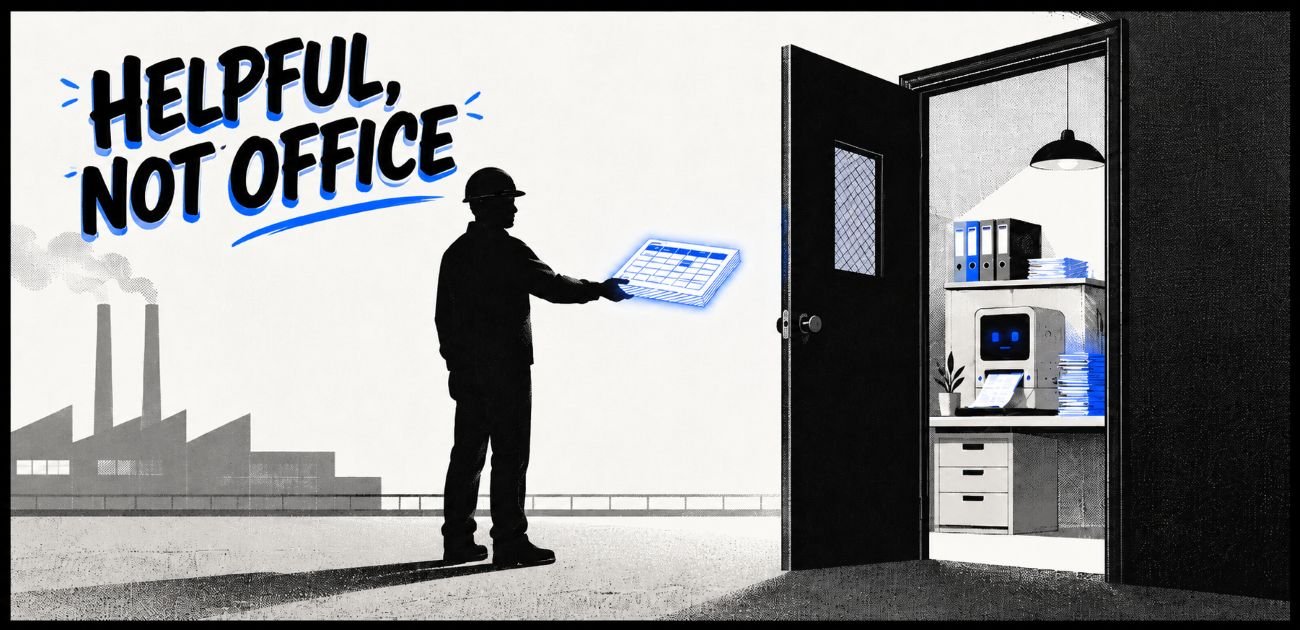
Lede
The office loves free automation until the person who built it starts looking like they deserve a chair at the table.
Words used
- Julian date: a day number used in production and file naming, often to keep records consistent across shifts, batches and forms.
- Shadow automation: useful automation built by staff outside a formal IT or office role, usually because the official system is slow, old or missing.
Hermit Off Script
Sometimes I forget that helping the office does not make me part of the office. It makes me a helper, which is a polite word for someone useful until the boundary has to be remembered. I do my best because I have extra knowledge, extra curiosity and too many hobbies that accidentally become company assets. Forms can be cleaner. Processes can be faster. Boring tasks can be automated. Julian dates can fill themselves in. Folders can create themselves. Files can name, move and organise themselves. Data can travel between workbooks without someone manually dragging it like a tired horse across a muddy field. And yes, the office staff are doing their jobs as best they can. That is not the issue. The issue is that companies often do not provide proper software, advanced training or paid tools, so everyone ends up living inside old Excel forms and Word documents. Nothing wrong with Excel. It is a good tool. But when it becomes the database, the form system, the tracker, the archive, the reporting engine and the office operating system, the cracks start singing. Too much data. Too many forms. Too many mistakes. Too much manual completion. Then someone from production arrives with automation skills and suddenly the impossible becomes very possible. But do not worry. There is no job for that. No money, remember? For a while, after building enough useful things, I can start thinking maybe I am part of the room. Then a rule arrives, calm and sharp, and reminds me I am production, not office. Rules are fine. Roles matter. But when a place takes the help, the ideas and the hours, then reminds you to keep your place, it does not feel professional. It feels small. It wakes you up. Maybe the answer is a better role in another department. Maybe it is another company that knows the difference between using skill and respecting it.
P.S. When the Machine Takes the Paperwork
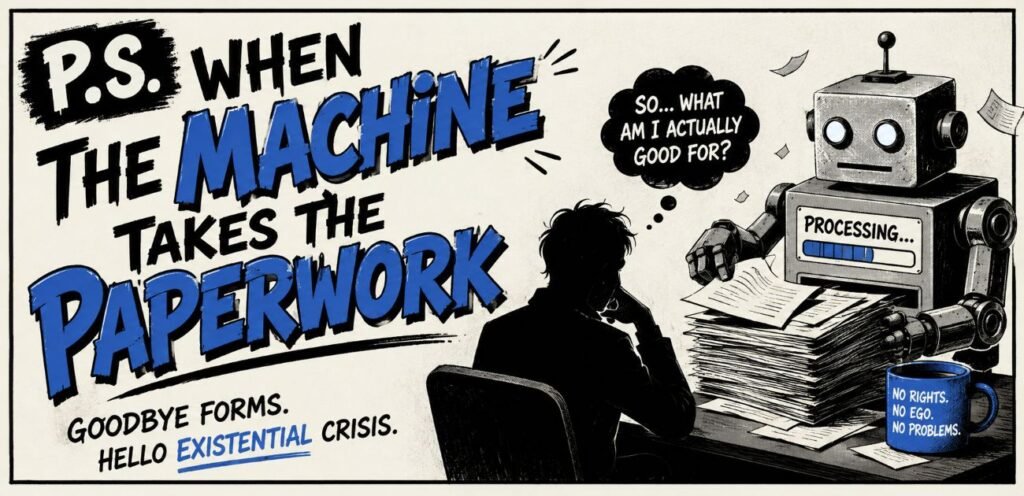
It was not always this cold. I cannot prove every harsh word came from Brexit or from the rise of extremism, but the air in Britain has become harder. People speak more sharply about race, position, skills, immigrants, pride and status. The country learned how to be rude and then called it honesty. One day AI may be better for companies than employees because it will not ask for recognition, promotion or dignity. It will just process the form. Then many people will lose the small battles they fought for relevance and will have to search for a deeper meaning, maybe the spiritual one we buried thousands of years ago. Maybe since Atlantis. As an idea, not a fact: when the machine takes the paperwork, humans may finally notice they have been avoiding their own soul.
What does not make sense
- The company has no money for better software, but somehow has endless time for manual work, repeated errors and broken forms.
- Free automation is welcome until it starts looking like evidence of higher skill.
- A helper can build systems, but the moment recognition appears, the old badge suddenly matters again.
- Excel is treated as a serious workflow system, then blamed when it behaves like a spreadsheet.
- Boundaries are useful, but using them only after taking someone’s extra work is not discipline. It is convenience.
- AI is feared as a job killer, while human skill is often ignored until a machine can sell it back as a subscription.
Sense check / The numbers
- Microsoft says a single Excel worksheet supports 1,048,576 rows and 16,384 columns. That is large, but it is still a spreadsheet, not a proper process system for every office problem. [Microsoft]
- In late December 2025, around 15 per cent of UK businesses told the ONS they planned to adopt some form of AI technology within the next 3 months. Among businesses already using AI, 4 per cent said headcount had decreased because of it. [ONS]
- In November 2025, CIPD reported that 17 per cent of employers expected AI to shrink their workforce over the next year. Of those employers, 62 per cent said clerical, junior managerial, professional or administrative roles were most likely to be lost. [CIPD]
- The ONS reported that racially or religiously aggravated offences recorded by police in July 2016 were 41 per cent higher than in July 2015, in the period around the EU referendum. [ONS]
- The TUC reported in 2022 that 41 per cent of Black and minority ethnic workers surveyed had faced racism at work in the previous 5 years, while only 19 per cent of those who experienced harassment reported the most recent incident to their employer. [TUC]
The sketch
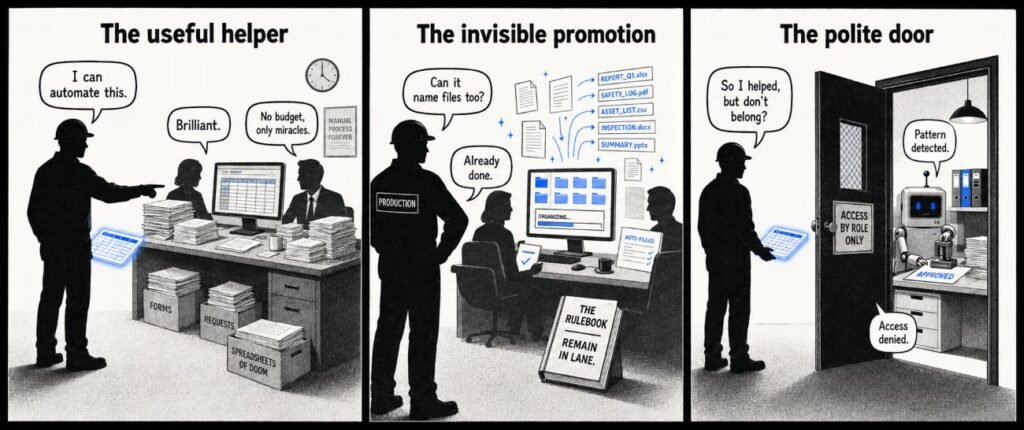
Scene 1: The useful helper
An employee from production stands beside an office desk, holding a laptop with tidy forms on screen. Office workers point at piles of paper and old spreadsheets.
Dialogue:
Helper: “I can automate this.”
Office: “Brilliant.”
Manager: “No budget, only miracles.”
Scene 2: The invisible promotion
Folders create themselves on a screen while files move neatly into place. The helper’s badge still says production.
Dialogue:
Office: “Can it name files too?”
Helper: “Already done.”
Rulebook: “Remain in lane.”
Scene 3: The polite door
The office door closes while a small AI machine stamps forms inside. The helper stands outside holding a finished workbook.
Dialogue:
Helper: “So I helped, but don’t belong?”
AI: “Pattern detected.”
Door: “Access denied.”
What to watch, not the show
- Companies absorbing staff skill as quiet process improvement without creating a proper role, title or pathway.
- Old software kept alive by invisible manual labour.
- Excel sprawl being mistaken for digital maturity.
- AI adoption without training, role redesign or fair promotion routes.
- Office status games hiding behind procedure.
- Immigrant workers being praised for hard work, then reminded of rank when they become too useful.
- Skills that save time but do not change pay, title or respect.
- Management treating automation as value only when bought from a vendor.
The Hermit take
Help is not a promotion.
If the company saves time from your skill, your role should not stay frozen in old cement.
Keep or toss
Keep / Toss.
Keep helping when it builds your future.
Toss extra responsibility with no proper role, title or respect.
Sources
- Microsoft Excel specifications and limits: https://support.microsoft.com/en-us/office/excel-specifications-and-limits-1672b34d-7043-467e-8e27-269d656771c3
- ONS business insights and AI adoption, 8 January 2026: https://www.ons.gov.uk/businessindustryandtrade/business/businessservices/bulletins/businessinsightsandimpactontheukeconomy/8january2026
- CIPD AI and workforce headcount, 10 November 2025: https://www.cipd.org/en/about/press-releases/one-in-six-employers-say-ai-shrink-headcount-autumn-labour-market-outlook/
- ONS crime in England and Wales, year ending September 2016: https://www.ons.gov.uk/peoplepopulationandcommunity/crimeandjustice/bulletins/crimeinenglandandwales/yearendingsept2016
- TUC racism at work report, 31 August 2022: https://www.tuc.org.uk/news/2-5-bme-workers-experience-racism-work-new-tuc-report
- Home Office hate crime, England and Wales, year ending March 2025: https://www.gov.uk/government/statistics/hate-crime-england-and-wales-year-ending-march-2025/hate-crime-england-and-wales-year-ending-march-2025